Written by: Ed Sim
Translated by: Block unicorn
At this time of year, many retrospective articles often emerge. However, a few articles last week stood out for different reasons: they provided a real historical context for where we currently stand in the development curve of artificial intelligence and the direction of future developments.
Three articles that particularly caught my attention are: Ivan Zhao (Notion - Steam, Steel, and Infinite Thinking), Aaron Levie (Box - Jevons' Paradox of Knowledge Work), and Jaya Gupta (Foundation Capital - The Trillion-Dollar Opportunity in Artificial Intelligence: A Background Map). Despite starting from completely different perspectives, they converge on the same core point: we are not merely layering AI on existing software; we are fundamentally reconstructing how work, decision-making, and enterprise systems operate.
Some common themes are gradually emerging:
1/ This transformation is structural, not incremental.
Enterprise software is being re-architected around AI-native systems, rather than upgrading SaaS.
2/ Context is more important than raw data.
The future is not just about storing files or tickets, but about understanding the reasons behind decisions.
3/ Agents can only perform powerfully within rich contexts.
Workflows, intentions, histories, permissions, and outcomes are key to shifting agents from demonstrations to systems.
4/ We have seen this movie before.
Every major platform migration looks primitive before the right abstraction layer appears. Once the right abstraction layer emerges, value creation accelerates.
5/ This is not a one-year hype cycle.
This is a multi-year reconstruction project aimed at re-examining how work is done, who does the work, and the meaning of enterprise software.
This brings to mind a theme I have been deeply contemplating over the past year: context. When we talk about context, we are not referring to metadata or more refined prompts, but to the understanding during decision-making. Context is the combination of inputs, intentions, constraints, histories, permissions, exceptions, and outcomes surrounding every actual business decision. It distinguishes between "knowing what happened" and "knowing why it happened."
Most enterprise systems were originally built to store records; they were never designed to capture the evolution of decision logic. Today, this flaw is becoming a bottleneck for the widespread application of artificial intelligence.

This idea is not entirely new. We can find some early signs in the field of software development. Specification-driven development has become one of the fastest-growing directions in the field of artificial intelligence, with a simple core idea: agents need clear constraints to function properly.
In that world, specifications become living documents. They encode intentions, boundaries, and expected behaviors, evolving continuously with the actions and learning of the subjects.
What is different now is the scope.
Decision intelligence extends this concept from the code level into every workflow within the enterprise, where agents can interpret ambiguous human intentions, make trade-offs, and take action in the real world. The result is a broader and more powerful abstract concept: the execution intelligence layer.
The execution intelligence layer sits between intention and infrastructure. It is responsible for assessing context, making decisions, coordinating actions, and recording outcomes. It transforms understanding into action.
I elaborated on this in "What's Hot#464":
Specifications are a practical application of the strategy layer. They apply not only to code but also to all workflows that require agents to interpret ambiguous human intentions and act accordingly. Once established, specifications become dynamic documents that translate text into agent behavior.
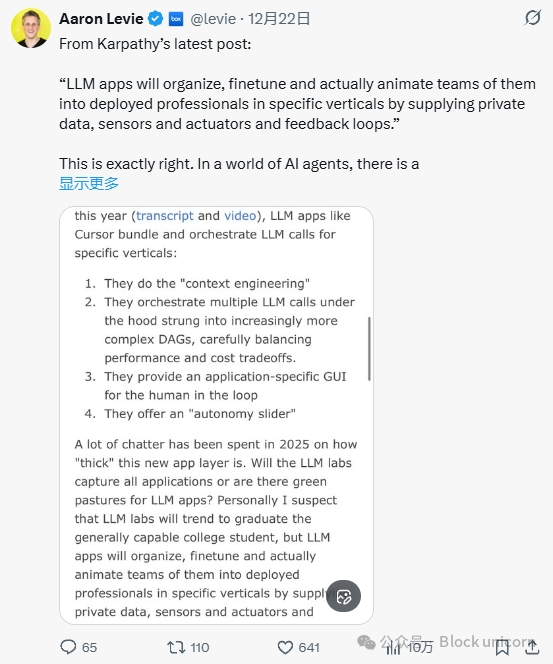
Aaron articulated the future opportunities and explained why context is larger than we imagine.
Jaya Gupta went further, pointing out the name of this missing artifact.
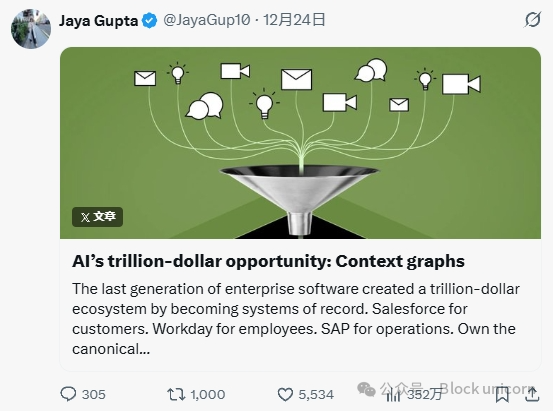
Agents need more than just rules. They also need access to decision traces that show how rules were applied in the past, how exceptions were approved, how conflicts were resolved, who approved what, and which precedents actually govern reality.
This is where the structural advantage of agent system startups lies. They are positioned in the execution path, able to see the complete context during decision-making: what inputs were collected across systems, which strategies were evaluated, which exception handling paths were invoked, who approved them, and what states were written. If this tracking information is persisted, it can provide something that most enterprises currently lack: a queryable record of the decision-making process.
And this is the key—why startups can win.
Agent system startups have a structural advantage: they are on the coordination path.
When agents prioritize upgrade events, respond to emergencies, or decide on discounts, they extract contextual information from multiple systems, evaluate rules, resolve conflicts, and take action. The orchestration layer can see the big picture: what input information was collected, what strategies were applied, what exceptions were approved, and why. Since it is responsible for executing workflows, it can capture this contextual information immediately during decision-making—not retrospectively through ETL processing, but as a first-class record in real-time.
These ideas collectively point to the same conclusion: the model itself does not create leverage; the execution intelligence layer does.
I have seen this in many of my portfolio companies. As Aaron Levie said, there is a layer above LLM (Faraday mechanism) that is much thicker than initially imagined.
The moat is not the interaction between query and response. When workflows are automated, human participation in decision-making, exceptions are properly handled, and systems learn from these outcomes to form better behavior patterns over time, the moat becomes more robust.
The "last mile" of enterprise operations is always the longest. And this is precisely where the opportunity lies in 2026. As agent systems evolve into decision-making, execution, and learning engines, the value released within enterprises will be immense. Of course, to achieve this, we still need to build and refine many aspects.
As always, thank you for reading, and see you in the next article!
免责声明:本文章仅代表作者个人观点,不代表本平台的立场和观点。本文章仅供信息分享,不构成对任何人的任何投资建议。用户与作者之间的任何争议,与本平台无关。如网页中刊载的文章或图片涉及侵权,请提供相关的权利证明和身份证明发送邮件到support@aicoin.com,本平台相关工作人员将会进行核查。


