On December 26, a brief and intense price fluctuation occurred on Binance with the newly listed trading pair BTC/USD1, where the BTC price was significantly "crashed" in a very short time before quickly recovering.
Binance founder CZ (Changpeng Zhao) immediately clarified that the incident was due to insufficient liquidity in the new trading pair, where a large market order triggered an instantaneous price fluctuation, and it was not a platform issue, nor did it trigger a chain liquidation. This "flash crash," which lasted only a few minutes, acted like a precise stress test, exposing the liquidity risk issues hidden in the cryptocurrency market, especially in emerging trading pairs, to the spotlight.
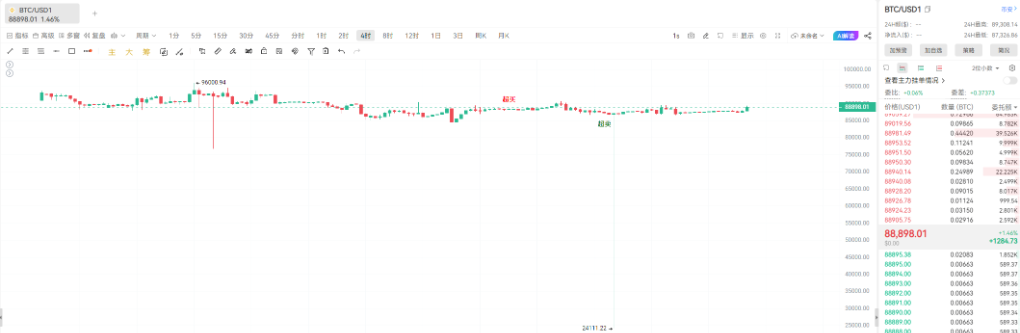
1. Event Retrospective: A Chain Reaction Triggered by "Promotion"
To understand this flash crash, we need to trace its complete transmission chain.
- Source: High-Interest Promotions and Arbitrage Demand
● The starting point of the event was a deposit promotion launched by Binance in collaboration with the stablecoin project USD1. This promotion offered a fixed annual yield of up to 20%, which was highly attractive to users seeking stable returns.
● This directly led to a large number of users exchanging their mainstream stablecoin USDT for USD1 to participate in the promotion. The strong buying demand caused USD1 to temporarily trade at a premium of about 0.39%, meaning the price was slightly above its theoretical peg of 1 dollar.
- Transmission: Leverage Lending and Selling Pressure Formation
● Keen market participants quickly identified the arbitrage opportunity. Some funds did not remain in simple deposit arbitrage but instead borrowed USD1 through the lending market of the decentralized finance (DeFi) platform Lista DAO, using Bitcoin-related assets like SolvBTC or SolvBTC-BTCB as collateral.
● Their strategy was: After borrowing USD1, they sold it in the spot market for USDT or other assets to lock in the premium profit. This behavior created persistent selling pressure on USD1 in the spot market.
- Outbreak: A Thin "Moat" of Liquidity
● The key issue was the channel for selling USD1. Some traders chose to operate directly through the relatively novel and insufficiently deep trading pair BTC/USD1. To complete the transaction quickly, they used market sell orders. However, the buy side (i.e., liquidity) of the BTC/USD1 trading pair was extremely thin.
● A relatively large market sell order was like a boulder thrown into a shallow pond, instantly "sweeping away" the limited buy orders, causing the BTC price on that trading pair to plummet sharply, resulting in a flash crash.
- Correction: Instantaneous Correction by Arbitrage Bots
● The efficiency of the cryptocurrency market was demonstrated at this moment. When the price deviated significantly from mainstream market prices, it immediately triggered the programs of countless arbitrage bots. These bots detected that the price on the BTC/USD1 trading pair was significantly lower than that on other major trading pairs (like BTC/USDT) and automatically executed buy low BTC while selling on other markets.
● A large number of arbitrage buy orders quickly flooded in, pulling the depressed price back to normal levels, and the entire abnormal fluctuation process lasted only a short time.
2. CZ's Clarification Core: Market Behavior and Risk Isolation
In response to community questions and market concerns, CZ's clarification conveyed three core messages:
Platform Neutrality: "This actually indicates that the trading platform did not participate in the relevant transactions." This statement aimed to clear the exchange of any suspicion of "market making" or price manipulation, characterizing the event as a result of purely individual actions by market participants.
Liquidity as the Fundamental Cause: "Due to the low liquidity of the newly listed trading pair, a large market order can lead to an instantaneous price surge (or crash)." This explanation directly pointed out the crux of the problem—structural liquidity deficiency. In emerging trading pairs, due to fewer participants and insufficient market maker depth, their ability to withstand large order shocks is extremely weak.
Effective Risk Control: "Since this trading pair was not included in any index, it did not trigger liquidation." This is a crucial point. Although the price experienced instantaneous severe fluctuations, since this trading pair was not a pricing source for mainstream indices (such as those used for derivatives liquidation), it did not trigger a broader, chain reaction of forced liquidations. This effectively contained the volatility within an "isolation chamber," avoiding systemic risk.
3. In-Depth Analysis: Industry Concerns Behind the Flash Crash
Although this incident did not cause significant actual losses, it served as a mirror reflecting several hidden dangers worth pondering in the cryptocurrency trading ecosystem.
- "Liquidity Illusion" and Investor Protection
● In centralized exchanges, the list of trading pairs users see is often uniform. However, the market depth behind each trading pair can vary greatly. Novice or less diligent investors can easily fall into the illusion that "all listed trading pairs have sufficient liquidity."
● Using market orders in low liquidity trading pairs is akin to exposing oneself to significant slippage risk, potentially executing trades at prices far below expectations, leading to unexpected losses. Should exchanges be responsible for providing more prominent risk warnings for low liquidity trading pairs?
- Disconnection Between Product Innovation and Infrastructure
● Exchanges continuously launch new assets and trading pairs to enrich their product lines and compete for market share. However, are the accompanying market maker incentives and liquidity cultivation mechanisms keeping pace? If they merely "launch and leave," allowing trading pairs to "live or die" in a state of low liquidity, similar small-scale flash crash events may become the norm, continuously eroding user trust in platform stability.
- Interconnected Risks Between DeFi and CeFi
● This incident clearly demonstrated the interconnected effects between decentralized finance (DeFi) protocols and centralized exchanges (CeFi). Arbitrage strategies can be executed seamlessly across platforms, with funds creating demand in CeFi and completing leveraged operations in DeFi, ultimately impacting the CeFi spot market.
● This interconnectedness enhances market efficiency but also creates more complex and hidden risk transmission paths. Any weak link (such as a low liquidity trading pair) could become the breaking point of the entire chain.
- Warnings from "Harmless Fluctuations"
● This incident was "harmless" because it was not included in any index. However, this raises a serious question: How should exchanges prudently decide which trading pairs to include in index calculations? If a low liquidity trading pair is inadvertently included in a key index in the future, could similar instantaneous fluctuations lead to a large-scale liquidation crisis that could have been avoided? This requires exchanges to possess extremely high foresight and rigor in index design.
4. Shift in Thinking from "Listing Coins" to "Nurturing Coins"
The BTC/USD1 flash crash event has sounded an alarm for exchanges, project teams, and ordinary investors alike.
- For Exchanges: Responsibility First, Transparent Management
a. Liquidity Grading and Risk Warnings: A transparent liquidity assessment system should be established to grade trading pairs (e.g., "high liquidity," "medium liquidity," "low liquidity/emerging") and provide enhanced slippage risk warnings when users place market orders.
b. Market Maker Ecosystem Development: For newly listed assets, market makers should be introduced and incentivized in a planned, phased manner to provide necessary liquidity support, rather than merely pursuing the quantity of listed coins.
c. Prudent Selection of Index Components: Trading pairs must be strictly evaluated for liquidity, resistance to manipulation, and market representation before being included in key indices, eliminating the possibility of systemic risk arising from small-cap fluctuations at the source.
- For Project Teams: Co-creating a Healthy Market
Project teams, especially those issuing new assets or stablecoins, should not be satisfied with merely being listed on top exchanges. They need to actively collaborate with exchanges and market makers to provide the necessary liquidity foundation in the early stages, ensuring a stable trading environment, which is also a key part of maintaining project reputation and investor confidence.
- For Investors: Respect the Market, Operate Cautiously
a. Beware of Liquidity Traps: Before trading, always check the order book depth and recent trading volume of the trading pair to avoid making large trades on "zombie" or extremely low-depth trading pairs.
b. Make Good Use of Limit Orders: In high-uncertainty environments, prioritize using limit orders over market orders to control execution prices and avoid unexpected slippage.
c. Understand Associated Risks: Be aware that arbitrage activities across platforms and domains (CeFi/DeFi) may have unexpected market impacts, broadening the boundaries of risk awareness.
The "harmless" flash crash of the Binance BTC/USD1 trading pair serves as a vivid market education. It once again proves that in the highly digitalized, programmatic, and 24/7 operating cryptocurrency market, liquidity is a more fundamental element than price. The instantaneous distortion and correction of prices demonstrate the duality of market efficiency: it can fluctuate due to structural defects but can also quickly self-correct through arbitrage mechanisms.
For the industry, its significance goes far beyond a one-off technical fluctuation. It calls for the entire ecosystem to shift from the "coin listing competition" focused on scale expansion to an emphasis on health and stability through "deep cultivation." Only when exchanges, project teams, and investors collectively recognize and actively manage liquidity risks can the cryptocurrency trading market build a more solid foundation and move towards a more mature and robust development stage. After all, a market that can withstand the impact of a single order is the only truly trustworthy market.
Join our community to discuss and grow stronger together!
Official Telegram community: https://t.me/aicoincn
AiCoin Chinese Twitter: https://x.com/AiCoinzh
OKX benefits group: https://aicoin.com/link/chat?cid=l61eM4owQ
Binance benefits group: https://aicoin.com/link/chat?cid=ynr7d1P6Z
免责声明:本文章仅代表作者个人观点,不代表本平台的立场和观点。本文章仅供信息分享,不构成对任何人的任何投资建议。用户与作者之间的任何争议,与本平台无关。如网页中刊载的文章或图片涉及侵权,请提供相关的权利证明和身份证明发送邮件到support@aicoin.com,本平台相关工作人员将会进行核查。


