Author: Frank, PANews
As the narrative dividends of the crypto market gradually fade, funds are seeking the next certain outlet. Recently, prediction markets have emerged as a standout, not only for their independent performance during turbulent market conditions but also due to a series of high-return "smart money" strategies that have surfaced behind them, making them widely regarded as one of the most explosive potential sectors for 2026.
However, for most onlookers, prediction markets still resemble a black box wrapped in blockchain. Although they are built on smart contracts, oracles, and stablecoins, their core mechanisms differ significantly from the traditional "speculating on coins" logic. Here, we do not look at candlestick charts, but rather at probabilities; we do not tell stories, but rather present facts.
For newcomers, questions arise one after another: How does this market operate efficiently? What are the essential differences between it and traditional crypto play? What unknown arbitrage models does the legendary "smart money" hold? And does this seemingly fervent market truly have the capacity to accommodate trillions in funds?
With these questions in mind, PANews conducted a panoramic survey of the current prediction market. We will peel back the "gambling" facade, delve into the underlying mechanisms and on-chain data, deconstruct this mathematical war of cognitive monetization, and restore those risks and opportunities that may have been overlooked.
Data Truth: The Eve of the Prediction Market Explosion
From the actual development situation, prediction markets are indeed one of the few "bull market" sectors for 2025 (similar to stablecoins). In the past few months, while the entire crypto market has been sluggish, prediction markets led by Polymarket and Kalshi have continued to grow rapidly.
This trend is clearly visible in trading volumes. In September of this year, Polymarket's average daily trading volume remained in the range of $20 million to $30 million, with Kalshi being similar. However, as the entire crypto market began to decline after mid-October, the daily trading volumes of these two leading prediction markets started to surge significantly. On October 11, Polymarket's daily trading volume reached $94 million, while Kalshi exceeded $200 million. The increase was approximately 3 to 7 times, and it has remained at a high level and continues to rise.
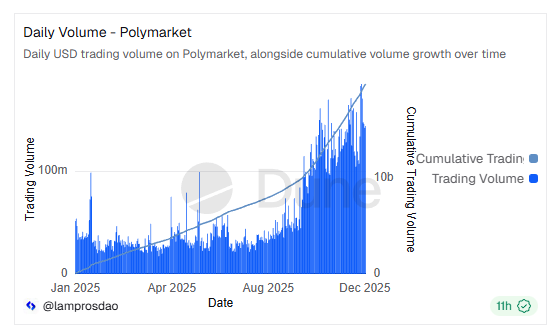
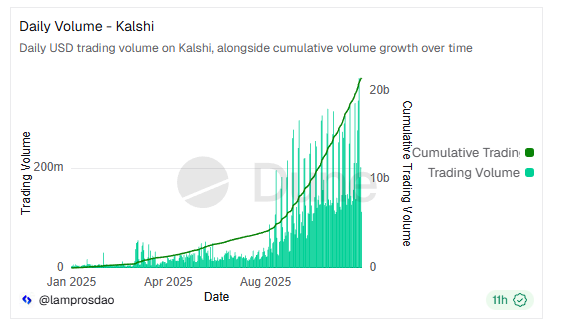
However, in terms of scale, prediction markets are still at an early stage. The cumulative trading volume of Polymarket and Kalshi combined is only about $38.5 billion. This total trading volume is less than the daily trading volume of Binance, and the average daily trading volume of $200 million ranks only around 50th among all exchanges.
However, with the 2026 FIFA World Cup approaching, the market generally expects the scale of prediction markets to further increase. Citizens Financial Group predicts that by 2030, the overall scale of prediction markets could reach the trillion-dollar level. Eilers & Krejcik (E&K) reports predict that by the end of this decade (around 2030), annual trading volumes could reach $1 trillion. Based on this scale, the market still has dozens of times the growth potential, and several institutional reports have mentioned that the 2026 World Cup will serve as a catalyst and stress test event for this market's growth.
Deconstructing Smart Money: Analysis of Eleven Arbitrage Strategies
In this context, the greatest attraction of prediction markets recently has been those timeless "wealth stories." After seeing these wealth stories, many people's first thought is to replicate or follow them. However, exploring the core principles and conditions for implementing these strategies, as well as the risks behind them, may be a more reliable choice. PANews has summarized ten popular strategies currently discussed in the prediction market.
1. Pure Mathematical Arbitrage
Logic: Utilize the mathematical imbalance where Yes + No is less than 1. For example, when the YES probability of an event on Polymarket is 55%, and the NO probability on Kalshi is 40%, the total probability is 95%. In this case, placing orders for YES and NO on both sides results in a total cost of 0.95, and regardless of the final outcome, a profit of 1 is guaranteed, creating a 5% arbitrage opportunity.
Conditions: This requires participants to have strong technical means to quickly identify such arbitrage opportunities, as not everyone can pick up the slack.
Risks: Many platforms have different criteria for determining the same event, and overlooking these criteria may lead to a double loss. As pointed out by @linwanwan823, during the 2024 U.S. government shutdown event, arbitrageurs found that Polymarket determined "shutdown occurred" (YES), while Kalshi determined "shutdown did not occur" (NO). The reason is that Polymarket's settlement standard is "OPM issues a shutdown announcement," while Kalshi requires "actual shutdown for more than 24 hours."
2. Cross-Platform/Cross-Chain Hedging Arbitrage
Logic: Utilize pricing discrepancies for the same event across different platforms (information silos). For instance, the odds for "Trump winning" on Polymarket and Kalshi may not be synchronized. For example, one side may be 40%, while the other is 55%, allowing for different directional purchases. Ultimately, a hedged result is constructed.
Conditions: Similar to the first type, requires extremely strong technical conditions to scan and discover.
Risks: Also needs to be cautious of different platforms' criteria for the same event.
3. High Probability "Bond" Strategy
Logic: Treat high-certainty events as "short-term bonds." When the outcome of an event is already clear (e.g., just before a Federal Reserve interest rate decision, with market consensus at 99%), but the prediction market price remains at 0.95 or 0.96 due to capital occupation costs, this is akin to picking up "interest on time."
Conditions: Large capital volume is required, as the single yield is low and necessitates larger funds to achieve meaningful profits.
Risks: Black swan events; if a low-probability reversal occurs, significant losses may ensue.
4. Initial Liquidity Sniping
Logic: Utilize the "central limit order book vacuum period" when a new market is just created. When there are no sell orders in the new market, the first person to place an order has absolute pricing power. Scripts are written to monitor on-chain events. At the moment of opening, a large number of extremely low-priced buy orders (0.01-0.05) are placed. Once liquidity normalizes, these are usually sold at 0.5 or even higher.
Conditions: Due to numerous competitors, servers need to be hosted very close to nodes to reduce latency.
Risks: Similar to MEME's opening sniping; if the speed advantage is not present, it may turn into a situation of being left holding the bag.
5. AI Probability Modeling Trading
Logic: Utilize AI large models to conduct in-depth market research and discover conclusions that differ from the market. Then, buy when there is arbitrage space; for example, if AI analysis shows that the true probability of "Real Madrid winning the match" today is 70%, but the market price is only 0.5, then a purchase can be made.
Conditions: Complex data analysis tools and machine learning models; AI computing costs are relatively high.
Risks: AI prediction errors or unexpected events may lead to loss of principal.
6. AI Information Asymmetry Model
Logic: Utilize the time difference where "machine reading speed > human reading speed." Obtain information faster than other ordinary users and buy in advance before market changes.
Conditions: Expensive information sources, possibly requiring paid access to institutional-level APIs and precise AI recognition algorithms.
Risks: Fake news attacks or AI hallucinations.
7. Correlated Market Arbitrage
Logic: Utilize the lag in the causal chain transmission between events. The price change of the main event often occurs instantly, but the reaction of secondary correlated events may lag. For example, "Trump winning the election" and "Republicans winning the Senate."
Conditions: Must deeply understand the deep logical connections between political or economic events while being able to monitor price linkages across hundreds of markets.
Risks: Event correlation failure, such as a lack of positive correlation between Messi's absence from a match and the team's loss.
8. Automated Market Making and Market Making Rewards
Logic: Be the one who "sells shovels." Do not bet on direction, just provide liquidity, earning the bid-ask spread and platform rewards.
Conditions: Professional market-making strategies and substantial capital.
Risks: Transaction fees and black swan events.
9. On-Chain Copy Trading and Whale Tracking
Logic: Believe that "smart money" possesses insider information. Monitor high-win-rate addresses, and once a whale makes a large position, the bot immediately follows.
Conditions: On-chain analysis tools are needed, requiring data cleaning to filter out whales' "test orders" or "hedge orders." Quick response capability is essential.
Risks: Reverse harvesting and hedging intentions of whales.
10. Exclusive Research-Based "Information Arbitrage"
Logic: Master "private information" unknown to the market. For example, during the 2024 U.S. election, French trader Théo discovered "invisible voter" tendencies through the "neighbor effect" and heavily invested against the odds when they appeared pessimistic.
Conditions: Exclusive research plans and relatively high costs.
Risks: Research method errors may lead to obtaining incorrect "insider information," resulting in heavy investments in the wrong direction.
11. Manipulating Oracles
Logic: Regarding who the referee is. Due to the complexity of many events in prediction markets, the determination of these complex events cannot simply rely on algorithms for direct judgment. Therefore, external oracles need to be introduced. Currently, Polymarket uses UMA's Optimistic Oracle. After each event concludes, a human must submit a judgment result in the UMA protocol. If the voting rate exceeds 98% within 2 hours, this result is considered true. Disputed results require further community research and voting to resolve.
However, this mechanism clearly has vulnerabilities and manipulation potential. In July 2025, regarding "Did Ukrainian President Zelensky wear a suit before July?" although multiple media reported that Zelensky had worn a suit, in UMA's voting, four large holders used over 40% of the tokens to ultimately determine the result as "NO," leading to a loss of about $2 million for users who invested against the market. Additionally, events such as "Did Ukraine sign a rare earth mineral agreement with the U.S.?" and "Will the Trump administration declassify UFO documents in 2025?" also showed varying degrees of manipulation. Many users believe that relying on a token with a market cap of less than $100 million like UMA to referee a market like Polymarket is not reliable.
Conditions: A large holding of UMA or controversial judgment criteria.
Risks: Oracles will gradually close similar vulnerabilities after upgrades. In August 2025, MOOV2 (Managed Optimistic Oracle V2) was introduced, limiting proposals to a whitelist to reduce spam/malicious proposals.
Overall, these strategies can be divided into technical players, capital players, and professional players. Regardless of the type, they all establish profit models through exclusive asymmetrical advantages. However, these strategies may only be effective during the short-term immature phase of this market (similar to early arbitrage plays in the crypto market). As secrets are revealed and the market matures, most arbitrage opportunities will become increasingly scarce.
Why Prediction Markets Can Be the "Antidote of the Information Age"
Behind the market growth and institutional optimism, what kind of magic do prediction markets possess? The mainstream view in the market believes that prediction markets solve a core pain point: in an era of information explosion and rampant fake news, the cost of truth is becoming increasingly high.
There may be three main reasons behind this starting point.
"Real money" voting is more reliable than surveys. Traditional market research or expert predictions often have no actual cost associated with their accuracy, and the power to make these predictions is held by certain authoritative individuals and institutions. This leads to many predictions lacking credibility, while the structure of prediction markets is the result of multiple investors' monetary games. This not only realizes the collective wisdom formed by multiple information sources but also adds weight to these predictions through monetary voting. From this perspective, prediction markets as a product address the societal "truth problem," which itself holds value.
The ability to convert individual expertise or information advantages into money. This is well reflected in the top smart money addresses in prediction markets. Although the strategies of these addresses vary widely, analyzing the reasons for their success boils down to their possession of some professional or informational advantage in a certain area. For example, some individuals may have extensive knowledge of a particular sporting event, giving them a significant professional edge in predicting various aspects of that event. Alternatively, some users may be able to verify the outcome of an event faster than others through technical means, allowing them to exploit arbitrage opportunities in the final stages of the prediction market. This represents a significant departure from traditional finance and the crypto market, where capital is no longer the greatest advantage (and can even be a disadvantage in prediction markets); rather, technology and capability are. This has attracted a large number of talented individuals to focus their attention on prediction markets. Subsequently, these benchmark cases have garnered more followers.
The simple logic of binary options has a lower threshold than speculating on coins. Essentially, the nature of prediction markets is binary options, where people bet on either "YES" or "NO." The trading threshold is lower, requiring less consideration of price direction, trends, technical indicators, and other complex trading systems. Additionally, the trading subjects are usually very simple and easy to understand. Which of these two teams will win? Rather than what the technical principles of this zero-knowledge proof project are? This also means that the user base of prediction markets is likely to be much larger than that of the crypto market.
Of course, prediction markets also have their drawbacks, such as typically short cycles for individual markets, insufficient liquidity for niche markets, risks of insider trading and manipulation, compliance issues, and so on. The most important reason, however, is that at the current juncture, prediction markets seem to be filling the boring "narrative vacuum" of the crypto market.
The essence of prediction markets is a pricing revolution about the "future." It pieces together countless individual cognitive fragments into the closest puzzle to the truth through monetary games.
For onlookers, this is the "truth machine" of the information age. For participants, it is a smoke-free mathematical war. As 2026 approaches, the canvas of this trillion-dollar sector has just begun to unfold. But regardless of how algorithms evolve or strategies iterate, the most fundamental truth of prediction markets has never changed: there is no free lunch here, only the ultimate reward for cognitive monetization.
免责声明:本文章仅代表作者个人观点,不代表本平台的立场和观点。本文章仅供信息分享,不构成对任何人的任何投资建议。用户与作者之间的任何争议,与本平台无关。如网页中刊载的文章或图片涉及侵权,请提供相关的权利证明和身份证明发送邮件到support@aicoin.com,本平台相关工作人员将会进行核查。


