2025 is destined to leave a significant mark in global financial history, being referred to as the "Year of Sovereign Fusion" in the cryptocurrency asset industry. If 2024 is characterized by the "Wall Street moment" brought by Bitcoin ETFs, then 2025 marks the official leap of digital assets from mere financial speculation tools to strategic chips in geopolitical affairs and national reserve assets. The core driving force behind this transformation stems from a dramatic shift in the U.S. administration—after the Trump administration took office, the establishment of the "Bitcoin Strategic Reserve," a historic initiative, fundamentally rewrote the underlying logic of global monetary competition.
This year saw frequent watershed events in regulatory aspects: the signing of the GENIUS Act granted stablecoins a legitimate dollar status; the World Liberty Financial (WLFI) project, directly involving the Trump family, broke the boundaries between politics and DeFi; and the pardons of Ross Ulbricht and CZ marked the conclusion of the grievances of the cryptocurrency "wild west era" and the beginning of a new order.
This article will review what I personally consider to be ten milestone events in the cryptocurrency industry in 2025.
These events constitute the "irreversible points" in the industry's development in 2025—those decisive moments that fundamentally changed market structure, regulatory environment, or technological paradigms.
1. Geopolitical Shift: Establishment of the U.S. Bitcoin Strategic Reserve
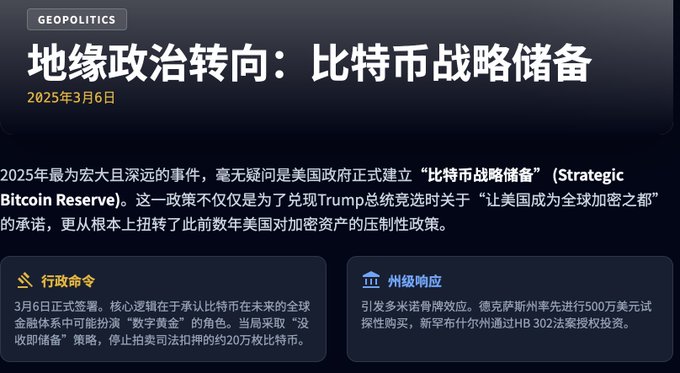
The most grand and far-reaching event of 2025 is undoubtedly the U.S. government's formal establishment of the "Bitcoin Strategic Reserve." This policy is not only aimed at fulfilling President Trump's campaign promise to "make America the global crypto capital," but it fundamentally reverses the suppressive policies the U.S. had towards cryptocurrency assets in previous years, elevating them to the status of national strategic resources on par with gold and oil.
1.1 Policy Origins and Implementation Mechanism
President Trump signed an executive order upon taking office and officially signed the directive to establish the reserve on March 6. The core logic of this directive is to acknowledge Bitcoin's potential role as "digital gold" in the future global financial system.
On the implementation level, authorities adopted a "seize and reserve" strategy—stopping the auction of approximately 200,000 Bitcoins previously judicially seized (such as in the "Silk Road" case and the Bitfinex case) and transferring them to the newly established "Digital Asset Reserve" for permanent holding. Additionally, the executive order instructed the Treasury and Commerce Departments to formulate a "budget-neutral" accumulation strategy, meaning the U.S. government effectively transformed from the largest potential seller to a long-term holder of this asset class.
1.2 The "Lummis Plan" and Legislative Games
Senator Cynthia Lummis reintroduced the "Bitcoin Strategic Reserve Act," proposing to use Federal Reserve surplus funds to purchase 1 million Bitcoins (about 5% of the total supply) over five years and hold them for at least 20 years. Although somewhat fanciful and sparking intense debate in Congress, the prior implementation of the executive order at least set a positive precedent.
1.3 State-Level Domino Effect
The federal government's shift in attitude triggered a "digital arms race" among states. By December 2025, 16 states had put related legislation on their agendas or entered discussion stages.
- Texas: Took the lead with a $5 million "test" purchase through the state auditor's office.
- New Hampshire: Passed HB 302, authorizing the state treasury to invest reserve funds in digital assets, marking a significant breakthrough in state government financial management concepts.
2. The Endgame of Regulation: The GENIUS Act and the "Dollarization" of Stablecoins, Arrival of MiCA
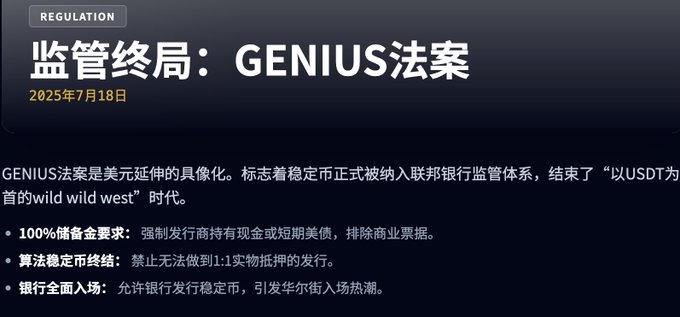
The GENIUS Act, signed into effect on July 18, 2025, is a tangible manifestation of the dollar's extension. This act marks the formal inclusion of stablecoins into the federal banking regulatory system, ending the "wild wild west" era led by USDT.
2.1 Ending the Regulatory Vacuum
The GENIUS Act essentially established a unified regulatory framework at the federal level:
100% reserve requirement: Mandating issuers to hold 100% of "high-quality liquid assets" (cash, short-term U.S. Treasury bonds) as reserves, directly excluding commercial paper and enhancing credit quality.
End of algorithmic stablecoins: Effectively prohibiting the issuance of algorithmic stablecoins that cannot achieve 1:1 physical collateralization.
2.2 Full Entry of the Banking System
The act allows banks and their subsidiaries to issue stablecoins, sparking a wave of interest from Wall Street.
Visa's strategic move: Visa quickly announced the launch of USDC settlement services based on the Solana chain in the U.S., leveraging the legal certainty provided by the act to integrate stablecoin settlements on a large scale.
JPMorgan's on-chain fund: Launched a tokenized money market fund (MONY) based on Ethereum, serving as a rehearsal for banks exploring compliant stablecoin issuance.
2.3 MiCA Finally Arrives in Europe
The EU's Markets in Crypto-Assets Regulation (MiCA) was fully implemented in early 2025, becoming the world's first comprehensive regulatory framework covering 27 countries with unified standards. It eliminated regulatory fragmentation within the region through a "passport" system, forcing non-compliant stablecoins out of the European market and establishing a new benchmark for global compliant operations.
3. The President's Token: The Rise of TRUMP and World Liberty Financial (WLFI)
On January 17, just three days before Trump was sworn in as President of the United States, he launched his own memecoin $TRUMP. Regardless of how much profit the Trump family made from it, this action not only plunged the already shaky Solana meme liquidity into crisis but also directly ignited the "celebrity coin" effect. A private dinner in April further pushed this farce to its peak.
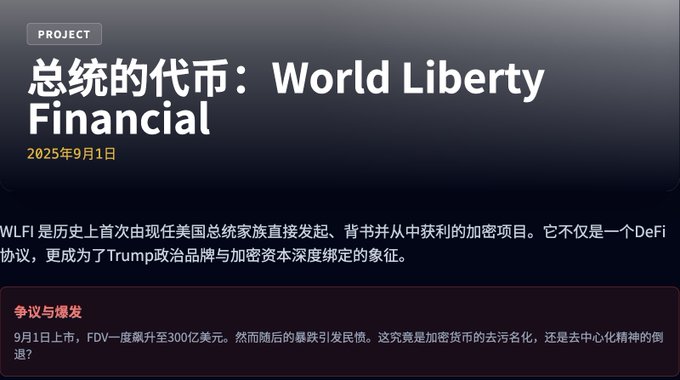
But it didn't stop there; World Liberty Financial (WLFI) became another major weapon for the Trump family. With the "presidential aura," it is not only a DeFi protocol but also a symbol of the deep binding of Trump's political brand with crypto capital.
Led by the Trump family, WLFI aims to "democratize finance." After multiple rounds of financing, it even set up a corresponding DAT before its listing. On September 1, 2025, WLFI officially went public.
At the opening, its FDV soared to over $30 billion but then significantly retraced. Besides the public outrage caused by the price crash, the project sparked huge controversy, particularly regarding suspicions that foreign capital (such as Justin Sun and Aqua 1) might use token purchases for disguised political donations. Some believe that WLFI's emergence marks the complete destigmatization of cryptocurrency and introduces millions of MAGA supporters to DeFi wallets for the first time; others argue that this approach makes the supposedly decentralized crypto industry even more "centralized," causing the entire market to regress.
4. Institutional Explosion: Approval of Solana and XRP ETFs, Popularity of Altcoin DATs

2025 was a year where altcoins performed "notably," but it was also the year when altcoin ETFs flourished. With the SEC adopting a more pragmatic "general listing standard," Solana and Ripple finally crossed the regulatory chasm. The U.S. Securities and Exchange Commission (SEC) approved new standard listing rules, shortening the approval window for crypto ETFs from the previous 240-270 days to just 75 days. This institutional reform directly opened the "altcoin ETF era," with spot ETFs for assets like Solana, XRP, and Litecoin quickly approved, marking a systematic leap from a single asset to a diversified investment portfolio.
4.1 Solana ETF: Establishing the "Third Pole"
The application for the Solana ETF saw a glimmer of hope in the second half of 2025, with market expectations for its approval probability being extremely high. This became the core driving force for SOL's strong performance in 2025, as institutional investors began to view it as the only "investment-grade" public chain asset aside from BTC and ETH.
4.2 Ripple ETF: From "Security" to "Commodity"
With the conclusion of the lawsuit between Ripple and the SEC, the listing of the XRP ETF became the biggest turnaround of 2025. The REX-Osprey XRP ETF (XRPR) was listed on September 18. This symbolized a "pardon" from regulators regarding historical issues, pushing XRP's price above $2 and signaling to the market that compliant rectification could lead to entry into the mainstream system.
4.3 The Carnival of Altcoin DATs
The strategy in the first half of the year showcased another possibility to the market, leading to a flood of imitators, from well-known altcoins like ETH, HYPE, BNB, and AVAX to smaller market cap altcoins, all eager to catch this wave. However, everyone's goals varied; some aimed for greater capital inflows, while others merely sought market publicity. In today's NAV 1, it remains uncertain whether this will lead to their own liquidation. Nevertheless, this undoubtedly entered the radar of traditional capital and unprecedentedly opened the normalization of "coin-stock linkage" operations.
This has created more possibilities for tokens and their extensions in DeFi, NFTs, ve, staking, and buybacks.
5. Rapid Evolution of Infrastructure: Upgrades of Firedancer, Pectra, and Fusaka

5.1 Solana Firedancer
In December 2025, the Firedancer validation client developed by Jump Crypto went live on the Solana mainnet. This is the first validation node software rewritten in C++ by a third party, with a test environment TPS exceeding 1 million. It brought crucial client diversity to Solana, eliminating single points of failure and laying the groundwork for the entry of giants like Visa.
5.2 Ethereum Pectra and Fusaka Upgrades
The Pectra upgrade executed in May 2025 significantly enhanced Ethereum's usability.
- Staking threshold optimization: The maximum effective staking balance for validators has been raised to 2048 ETH, reducing operational costs for large institutions.
- Account abstraction: The introduction of "programmable wallet" functionality allows regular accounts to possess smart contract capabilities, significantly lowering the user entry barrier.
The Fusaka upgrade executed in December 2025 primarily aims to "repair" the value capture chain between L1 and L2, essentially meaning that L2 must pay tribute to L1. EIP-7918 introduced a "floor price" mechanism—price increase. It stipulates that the base fee for Blobs can no longer fall indefinitely to 1 wei. Instead, the minimum price for Blobs will be linked to the Gas price of the L1 execution layer. If implemented as planned, this could bring substantial revenue to ETH.
6. Maturity of Corporate Equity: Circle, Kraken, and HashKey IPOs
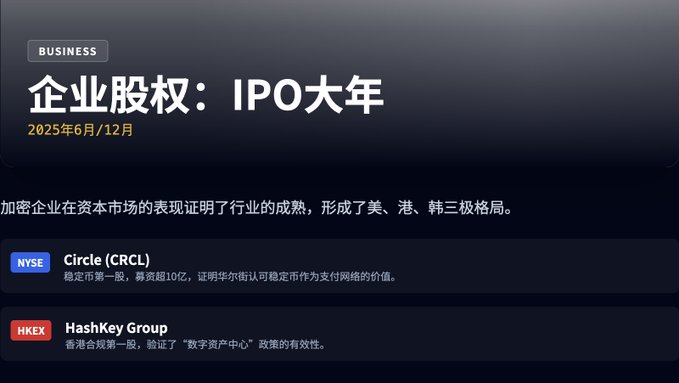
In 2025, the performance of crypto companies in the capital markets demonstrated the industry's maturity, forming a tri-polar listing pattern in the U.S., Hong Kong, and South Korea.
6.1 Circle IPO: The First Stablecoin Stock
USDC issuer Circle successfully went public on the NYSE on June 5, 2025, under the ticker CRCL. It raised over $1 billion, with a valuation of approximately $8 billion. Its success proved Wall Street's recognition of the long-term value of "stablecoins as payment networks," marking the most significant industry IPO since Coinbase. (This article skips Bullish.)
6.2 Kraken: Valuation Repair and Transformation
Although Kraken did not complete its IPO in 2025, it secured $800 million in Pre-IPO financing, reaching a valuation of $20 billion. After reaching a settlement with the SEC, Kraken successfully transformed into a full-service institutional brokerage, planning to go public in 2026 to challenge Coinbase's position.
6.3 HashKey Group IPO: The First Compliant Stock in Hong Kong
In the East, HashKey Group officially listed on the main board of the Hong Kong Stock Exchange (HKEX) on December 17, 2025. This IPO raised approximately HKD 1.67 billion (about USD 215 million), with a market capitalization of around USD 2.5 billion.
Milestone significance: This is the first licensed crypto asset exchange group to go public in Hong Kong and even Asia. HashKey's successful listing validates the effectiveness of Hong Kong's "Digital Asset Hub" policy, paving the way for Asian crypto companies to raise funds in local capital markets.
6.4 Bithumb Seeks U.S. IPO; Upbit Fully Acquired by Naver
The South Korean crypto market also experienced its capital exit moment, with the top two exchanges announcing their listing plans this year.
7. Revolution in Settlement Layer: Visa, USDC, and the Explosion of RWA
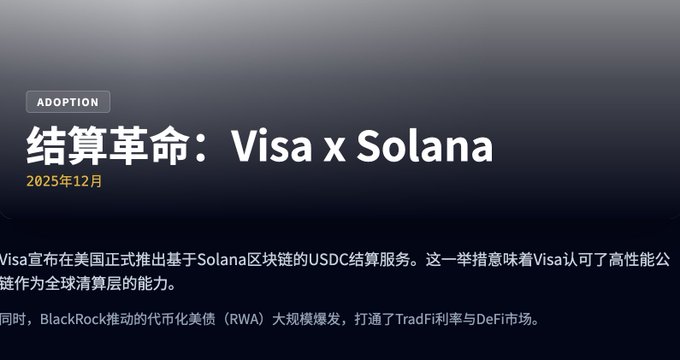
In 2025, the tokenization of RWAs and the on-chain payment settlement entered a large-scale implementation phase.
7.1 Visa Chooses Solana
In December 2025, Visa announced the official launch of USDC settlement services based on the Solana blockchain in the U.S. This move signifies Visa's recognition of high-performance public chains as capable of serving as a global settlement layer, integrating blockchain into the core global payment network.
7.2 Scaling Tokenized U.S. Treasuries
Tokenized U.S. Treasuries (such as the BUIDL fund) driven by giants like BlackRock exploded in 2025, gradually becoming collateral for DeFi protocols. This bridged the gap between TradFi interest rates and the DeFi market, significantly enhancing capital efficiency.
8. A Wake-Up Call for Security: Bybit's $1.5 Billion Hacking Incident

On February 21, 2025, Bybit exchange suffered the largest hacking attack in history, with losses amounting to $1.5 billion in ETH.
The Lazarus Group infiltrated the computer of a developer at the multi-signature service provider Safe, implanting malicious code that altered the front-end UI. The Bybit team unknowingly signed transactions that transferred funds to the hackers.
This incident shocked the entire industry, prompting a shift from single multi-signature to MPC and hardware-level strategy engines, and became a significant catalyst for the anti-money laundering provisions in the U.S. GENIUS Act.
This hacking incident also revealed the invisible hand among exchanges' "alliances," where the competitive relationships on the surface were merely a misunderstanding.
9. Extreme Market Cycle: The "10.11 Incident" and Leverage Liquidation
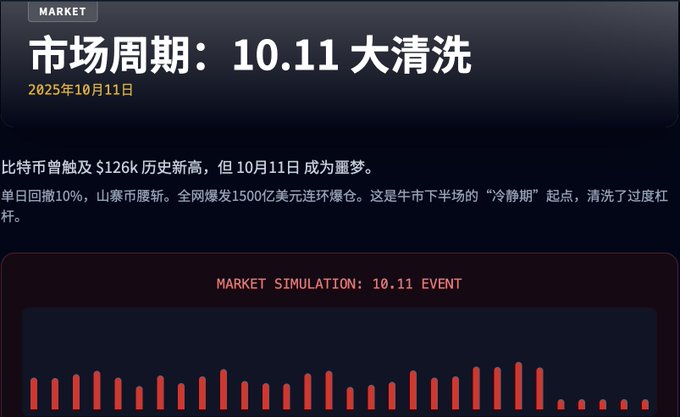
The market in 2025 experienced a rollercoaster ride from extreme euphoria to brutal liquidation, with the "10.11 Incident" becoming a watershed moment for the annual market.
Driven by the effects of Trump's election victory and the establishment of the strategic reserve, Bitcoin reached an all-time high of approximately $126,000 on October 6. However, the market then experienced a sharp reversal.
October 11 became the most terrifying day in the secondary market of 2025. On this day, BTC and ETH retraced by 10%, with some altcoins nearly dropping to zero, leading to a sea of red in the overall market, which faced a massive bloodbath, prompting Binance to conduct the largest compensation in history.
As "smart money" was buried, news of market makers "blowing up" spread, and the order book had only a few buy orders, panic quickly spread. In the following days, a total of approximately $150 billion in liquidations occurred across the network, with Bitcoin's price rapidly retracing to the $85,000 range. The "10.11 Incident" is seen as the starting point of the "cooling period" in the second half of the 2025 bull market, cleansing the overly leveraged speculative capital, resulting in a dire situation.
10. A Great Pardon: The Return of Ross Ulbricht and CZ

In 2025, the crypto industry witnessed a turning point for two iconic figures, symbolizing a certain "reconciliation" between the U.S. government and crypto fundamentalism as well as the early exchange era.
10.1 Ross Ulbricht's Pardon
On January 21, 2025, President Trump signed a pardon order the day after his inauguration, announcing the unconditional release of Ross Ulbricht, the founder of Silk Road. Ross Ulbricht was sentenced to two life sentences for creating the dark web marketplace Silk Road and had served 12 years. In the eyes of the crypto community, he is viewed as a martyr of libertarianism.
This pardon fulfilled Trump's campaign promise and was seen as a significant victory by libertarians and early Bitcoin adopters, symbolizing that the government no longer views code writers as "drug lords," but rather acknowledges the historical limitations and contributions of early internet explorers.
10.2 CZ's Liberation
In October 2025, CZ also welcomed his moment of pardon. CZ's return (though he may no longer serve as CEO) and Ross's freedom marked the complete turning point of the crypto industry's "wild west era."
These two pardons not only changed individual destinies but also hinted that under the new geopolitical and capital landscape, former "outlaws" could be re-accepted by "mainstream" society through capital, public opinion, and political maneuvering.
Conclusion: From Speculation to Cornerstone
Looking back at 2025, from Bitcoin becoming a (preparatory) national reserve to the listings of HashKey and Circle, and the pardons of Ross and CZ, all events point in the same direction: the comprehensive institutionalization of crypto assets.
Once-rebellious figures have been reconciled, and once-marginal assets have become national wealth. 2025 is not the end of a cycle but the beginning of "crypto realism." In this new era, code remains law, but the law has finally learned how to coexist with and even leverage code.
Postscript
If there is anything that excites people, it is probably the establishment of the trend of "Bitcoinization" of global corporate balance sheets.
By the end of 2025, over 200 publicly listed companies and funds held approximately 5.1% of the total Bitcoin supply. Besides MicroStrategy (holding over 670,000 coins), several fintech companies, collectively known as "Digital Asset Finance (DAT)" companies, attracted a total of $92 billion in inflows. Bitcoin has evolved from a gamble by individual companies to a standardized allocation method for enterprises to hedge against inflation and optimize capital structure.
免责声明:本文章仅代表作者个人观点,不代表本平台的立场和观点。本文章仅供信息分享,不构成对任何人的任何投资建议。用户与作者之间的任何争议,与本平台无关。如网页中刊载的文章或图片涉及侵权,请提供相关的权利证明和身份证明发送邮件到support@aicoin.com,本平台相关工作人员将会进行核查。


