Original Title: "Ethereum Staking Key Reversal: Incoming Capital is Twice the Outgoing"
Original Author: KarenZ, Foresight News
At the end of 2025, the Ethereum network has reached a critical turning point: the number of validators entering the "entry queue" has reversed and surpassed those in the "exit queue."
This means that after months of market cleansing, the amount of capital attempting to stake Ethereum to become validators has far exceeded the amount wanting to unstake and exit.
This change is not just a numerical shift; it is a barometer of market sentiment and network fundamentals, marking a gradual alleviation of the selling pressure that has persisted for several months. It also indicates that, driven by the return of confidence from some institutions, the Pectra upgrade optimization, and the clearing of DeFi leverage, the Ethereum network is entering a new cycle of enhanced security and capital accumulation.
Reversal of the Ethereum Validator Queue
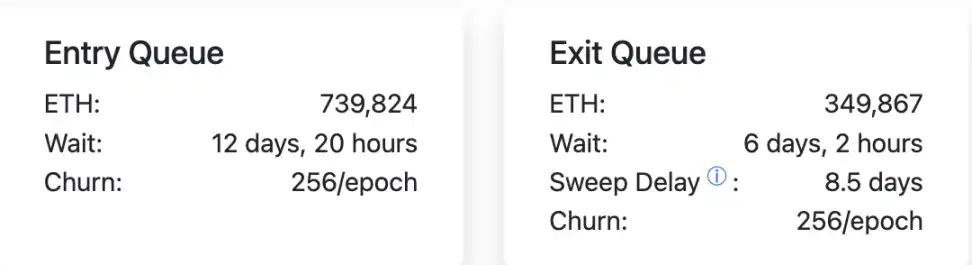
According to the latest data from the Ethereum Validator Queue, approximately 739,824 ETH are currently queued to enter the network, with an expected waiting time of 12 days and 20 hours; the exit queue has only 349,867 ETH, which will take about 6 days to clear.
Additionally, the total amount of staked Ethereum is approximately 35.5 million ETH, accounting for 29.27% of the total supply, with the number of active validators reaching 983,600.
What is the Validator Queue? Why is it Important?
Under Ethereum's Proof of Stake (PoS) mechanism, to ensure the stability of consensus, the protocol stipulates that nodes cannot enter and exit freely but are regulated through a "Churn Limit" mechanism.
Currently, the maximum number of validators that can join (activate) or exit each epoch (approximately 6 minutes and 24 seconds) is capped at 256 ETH, equivalent to a processing capacity of about 57,600 ETH per day.
Entry Queue: The queue for staking 32 ETH to apply to become a validator. An increase in this queue indicates strong staking demand and optimism about long-term returns.
Exit Queue: The queue for applying to withdraw funds. An increase in this queue typically signals selling pressure, liquidity demand, or deleveraging behavior.
Therefore, the validator queue is not only an indicator of network health but also a barometer of market sentiment.
How Will the Validator Queue Change in 2025?
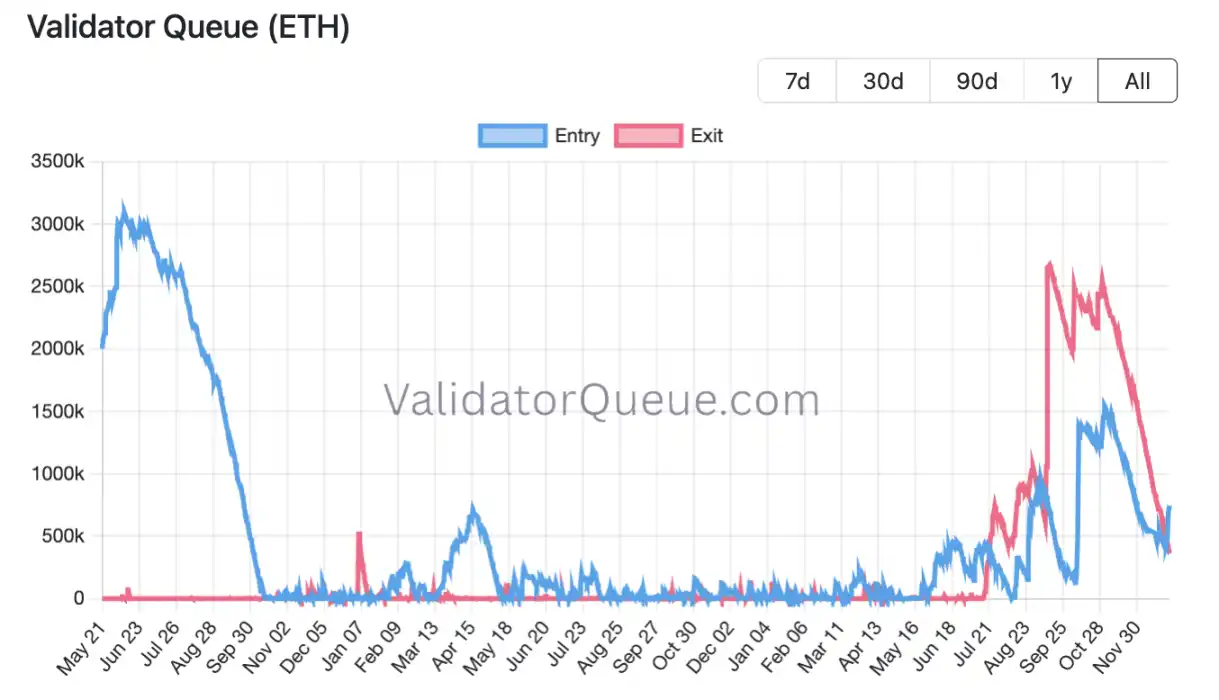
Throughout 2025, the Ethereum validator queue experienced significant fluctuations:
From the first half of the year to autumn: The exit queue reached record highs multiple times, primarily due to institutional rotation, profit-taking, DeFi deleveraging (such as the surge in Aave lending rates leading to the liquidation of stETH circular lending), and individual security incidents (such as Kiln exiting all Ethereum validator nodes in September).
In mid-September, the exit queue peaked at 2.67 million ETH, with a waiting time of up to 46 days.
From September to October: The "entry queue" briefly surpassed the "exit queue," but was soon dominated by the "exit queue" again.
In November: The "entry queue" grew back to over 1.5 million ETH, but the "exit queue" once reached over 2.5 million ETH.
By the end of December: The "entry queue" reversed, with approximately 739,824 ETH currently queued to enter the network, while only 349,867 ETH are in the exit queue.
Four Core Driving Forces Behind the December Reversal
This reversal is not coincidental but rather the result of the interplay of capital, technology, and the macro environment:
Large Staking by Treasury Companies like BitMine
Just two days before the reversal (December 25-27), BitMine staked a total of 342,560 ETH (approximately $1 billion), directly driving the queue reversal.
Moreover, BitMine has previously stated its plan to launch a dedicated staking infrastructure—Manufactured Validator Network (MAVAN) in the first quarter of 2026, demonstrating its long-term commitment to the Ethereum staking ecosystem.
At the same time, another leading treasury company, SharpLink, has completed staking nearly 100% of its ETH, further contributing to the inflow momentum.
Despite the current severe challenges facing the crypto treasury sector, with some institutions slowing down their ETH accumulation pace and even cases like ETHZilla liquidating, the substantial investments from leading players like BitMine and SharpLink have largely stabilized the foundational ecosystem of Ethereum staking.
Pectra Upgrade Optimizes Staking Experience
The Pectra upgrade implemented in May 2025 introduced key improvements through EIP-7251: increasing the maximum effective validator balance from 32 ETH to 2048 ETH and enabling reward compounding and validator consolidation. This has reduced the operational costs for institutions managing thousands of validator nodes, providing technical convenience for large capital inflows.
Kiln's Reopening for Re-staking
Kiln underwent a large-scale exit from validators after a security incident in September 2025. While it is unclear when Kiln will restart staking, data from Beaconcha.in shows that Kiln currently holds a 1.68% share in the Ethereum staking ecosystem.
DeFi Deleveraging Nearing Conclusion
In June and July, rising Aave lending rates forced the liquidation of stETH circular leverage strategies, triggering temporary selling pressure. Recently, as the deleveraging process gradually clears, the related exit demand has diminished, with market inflow demand taking the lead.
Some Institutions Positioning for Lower Prices
The market has adjusted for several days, and some institutions are optimistic about ETH's long-term value. Trend Research is preparing to continue accumulating ETH with $1 billion. On December 25, Ai Yi confirmed with Jack Yi that Trend Research's actual cost for the ETH accumulated since November is approximately around $3,150, meaning the 645,000 ETH held currently has an unrealized loss of about $143 million. After the subsequent $1 billion investment, the average cost of ETH is expected to be controlled at around $3,050.
Summary
The reversal of Ethereum validators' "entry queue" surpassing the "exit queue" marks the initial formation of a net inflow dominance in staking for the first time since July. This change is not merely a numerical crossing but a key signal of market confidence rebuilding. Of course, whether this leading trend can continue to solidify remains to be seen over time.
Although there has not yet been significant net inflow into Ethereum spot ETFs, the improvement in on-chain fundamentals is evident. As Joseph Chalom, co-CEO of SharpLink Gaming, stated this month, the surge in stablecoins, tokenized RWA, and the growing interest from sovereign wealth funds may drive Ethereum's TVL to grow tenfold by 2026.
As we stand at the end of 2025, is Ethereum ready to build momentum for 2026? The answer will be revealed in time.
免责声明:本文章仅代表作者个人观点,不代表本平台的立场和观点。本文章仅供信息分享,不构成对任何人的任何投资建议。用户与作者之间的任何争议,与本平台无关。如网页中刊载的文章或图片涉及侵权,请提供相关的权利证明和身份证明发送邮件到support@aicoin.com,本平台相关工作人员将会进行核查。


