Author: DaiDai, Maitong MSX Maidian
There is nothing new under the cannon fire. If "Tang Luoism" can truly "violently reset" Venezuela, which military, energy, and other sectors will reap excess dividends?
Core Overview
In the early hours of January 3, 2026, the U.S. military's "Operation Southern Spear" shattered the anti-American stronghold in Caracas that had lasted for over twenty years with a thunderous force that left global markets gasping; this was not merely a military decapitation of the Maduro regime, but a violent reset of the energy landscape in the Western Hemisphere, marking the formal takeover of this "bankrupt giant" with 303 billion barrels of oil reserves by the "American Union," centered around Wall Street capital, Texas oil, and Pentagon defense technology.
I. The Geopolitical Tipping Point—From "Monroe Doctrine" to "Tang Luoism"
1. The Deep Logic of Escalating Conflict: A Hegemony Cornered
The military action on January 3, 2026, was not a sudden black swan event, but an inevitable gray rhino following the failure of geopolitical pressure tests since mid-2025. Although the official narrative defined it as a law enforcement action against "narco-terrorism," deep intelligence analysis reveals that its underlying logic is the absolute reaffirmation of U.S. strategic control over the Western Hemisphere, namely the physical implementation of "Monroe Doctrine 2.0."
Looking back at the second half of 2025, the deterioration of U.S.-Venezuela relations showed a clear spiral trajectory. In August 2025, the U.S. Southern Command (USSOUTHCOM) initiated a naval buildup in the northern waters of Caracas under the pretext of combating transnational criminal organizations. This action initially appeared to be a response to Venezuela's long-term sheltering of criminal groups like "Tren de Aragua," but its scale quickly exceeded the realm of law enforcement.
The real turning point occurred in September 2025, when U.S. forces sank a Venezuelan vessel during an interception operation, resulting in 11 deaths. This "kinetic" event broke the long-standing tacit understanding between the two sides, pushing the Cold War-style confrontation to the brink of hot war. In the following months, Washington chose not to de-escalate; instead, Defense Secretary Pete Hegseth officially unveiled "Operation Southern Spear" in November and unprecedentedly deployed the U.S. Navy's most advanced aircraft carrier strike group, USS Gerald R. Ford, to the Caribbean.
2. The Essequibo Crisis: An Ignored Trigger
In analyzing the legitimacy of this invasion, the territorial dispute over the Essequibo region in Guyana is a key piece of the puzzle. Since 2023, Venezuela's territorial claims over this oil-rich area have become increasingly aggressive, even designating it as a state within its own territory through legislation. A series of rulings by the International Court of Justice (ICJ) between 2024 and 2025 failed to effectively curb Caracas's ambitions, instead intensifying nationalist sentiments within the Maduro government, leading to military troop buildups at the border.
For the U.S., Essequibo not only involves ExxonMobil's massive investments in the region but also concerns the energy security corridor of the Caribbean. Venezuela's freezing of natural gas projects with Trinidad and Tobago at the end of 2025 further severed the possibility of regional energy cooperation. Therefore, using military means to permanently eliminate Venezuela's threat to its neighbors became a necessary choice to safeguard U.S. energy companies' interests and regional stability.
3. The "Oil-for-Reconstruction" Theory: A Reconstructed Economic Agenda
Unlike previous interventions that emphasized "democracy promotion," this action has a distinctly commercial flavor. President Trump openly stated after the operation's success that U.S. oil companies would enter Venezuela to "reimburse" the military investment and reconstruction costs through oil extraction and sales. This "oil-for-reconstruction" strategy not only provides policy backing for subsequent capital involvement but also directly defines Venezuela's economic model for the next decade: a resource-based economy dominated by U.S. capital, centered on debt repayment and exports.
II. The Dividends of the War Machine—A Real-World Roadshow of the Defense Industrial Base
"Operation Southern Spear" is a concentrated display of the results of the U.S. military's Third Offset Strategy. For the secondary market, observing the equipment and technology used in this operation can clearly outline the sources of alpha returns in the defense sector.
1. Absolute Control of Sea Power: Aircraft Carriers and Shipbuilding Industry
The combat debut of USS Gerald R. Ford (CVN-78) is the core highlight of this operation. As the lead ship of the Ford-class carriers, its deployment in the Caribbean is not just a deterrent but also a pressure test for the Electromagnetic Aircraft Launch System (EMALS) and Advanced Arresting Gear (AAG) under high-intensity operational cycles.
Huntington Ingalls Industries (NYSE: HII): As the only manufacturer of nuclear-powered aircraft carriers in the U.S., HII is the sole supplier of this strategic asset. The performance of the Ford during the operation directly validates the combat effectiveness of this class of carriers, providing solid political support for continued funding for the upcoming Kennedy (CVN-79) and Enterprise (CVN-80) carriers. For investors, HII is not just a shipbuilder but also the cornerstone of U.S. global maritime hegemony, with long-cycle order visibility significantly enhanced due to escalating geopolitical conflicts.
General Dynamics (NYSE: GD): In addition to its Bath Iron Works' involvement in building the destroyer escort network, General Dynamics' land systems division will also play a key role in subsequent ground peacekeeping and special operations support. With the U.S. military announcing it will "temporarily manage" Venezuela, the demand for ground armored vehicles and logistical support vehicles will enter a multi-year maintenance and upgrade cycle.
2. Digital Kill Chain: The Victory of Software-Defined Warfare
If aircraft carriers are the shell of war, then software is its soul. In this operation, the U.S. military's strikes against Venezuela's complex air defense systems and asymmetric drug networks heavily relied on data fusion and AI decision-making.
Palantir Technologies (NYSE: PLTR): In "Operation Southern Spear," Palantir's Gotham platform likely played a central role in intelligence operations. By integrating satellite imagery, drone reconnaissance data, and communication interception information, the U.S. military was able to accurately locate high-value targets (HVT) in complex urban and jungle environments.
Deep Insight: Notably, Palantir recently signed a $448 million contract with the U.S. Navy to accelerate supply chain management in the shipbuilding industry through its "Warp Speed" operating system. This full-link coverage from the battlefield front (target identification) to the rear factory (production acceleration) positions PLTR as a core target for the digital transformation of the defense industry. Its collaboration with L3Harris to introduce AI into factory workshops to solve supply chain bottlenecks further proves the critical role of software companies in modern warfare logistics.
Anduril Industries (Private / Potential Unicorn): Although Anduril is not yet publicly traded, its technology's application in this conflict is worth close attention. Its "Lattice" operating system is used by the Space Force to upgrade space surveillance networks, and this mesh network technology is crucial for monitoring illegal activities along Venezuela's vast borders and maritime areas. Anduril represents a new military-industrial model of "low-cost, autonomy, and scalability," and its success on the battlefield will exert valuation pressure on traditional military giants while guiding future investment directions in the primary market.
3. Electronic Warfare and Unmanned Systems: Invisible Gunpowder Smoke
Venezuela possesses Russian-made S-300 air defense systems, and establishing air superiority in such an environment requires electronic warfare (EW) as a prerequisite.
L3Harris Technologies (NYSE: LHX): As a leader in electronic warfare, L3Harris provides critical airborne jamming and signals intelligence (SIGINT) capabilities. Additionally, its layout in the unmanned surface vessel (USV) sector perfectly aligns with Southern Command's needs to combat drug submarines and fast boats in the Caribbean. L3Harris's technology enables the U.S. military to incapacitate enemy command and communication networks in a non-contact manner, making it a core supplier of "soft kill" capabilities in modern warfare.
Kratos Defense (NASDAQ: KTOS): In the face of potential portable air defense missile threats from Venezuela, using high-performance unmanned target drones or "Valkyrie" drones produced by Kratos for decoying and frontline reconnaissance is the best strategy to reduce pilot risk. The operational application of these attritable drones will accelerate the U.S. military's transition from expensive manned aircraft to drone swarm tactics.
AeroVironment (NASDAQ: AVAV): In urban warfare and precise strikes against drug lord hideouts, AVAV's "Switchblade" loitering munition offers unparalleled collateral damage control capabilities. As U.S. special forces deepen their activities within Venezuela, the demand for such portable precision strike weapons will grow exponentially.
4. Logistics and Base Construction: The Continuation of War
KBR, Inc. (NYSE: KBR): This may be one of the most certain beneficiaries of this operation. KBR holds the U.S. Army's LOGCAP V (Logistics Civil Augmentation Program) contract, responsible for providing a full suite of logistics services, including base construction, catering, and maintenance for U.S. military operations worldwide.
Business Logic: With Trump announcing that U.S. forces will "take over" and "operate" the country, this means tens of thousands of U.S. military and related personnel will be stationed long-term. From repairing bombed airport runways to establishing secure military camps and maintaining a vast supply chain, KBR is the only contractor capable of such large-scale rapid response. Historical data shows that during the Iraq and Afghanistan wars, such contracts generated hundreds of billions of dollars in revenue for KBR.
III. The Awakening of Black Gold—The "Great Reboot" of the Energy Industry
Venezuela's oil reserves are the "elephant in the room" of the global energy market. With the fall of the Maduro regime, this country, with 303 billion barrels of proven reserves, will undergo a "privatization" frenzy led by U.S. capital. This is not only a restoration of production but also a structural reversal of global crude oil trade flows.
1. Monetizing Reserves: From "Underground Assets" to "Balance Sheets"
Venezuela's oil is primarily concentrated in the Orinoco Belt, which harbors vast reserves of extra-heavy crude oil. However, the extraction and processing of this oil heavily rely on technology and capital. Over the past decade, production has plummeted to about 1 million barrels per day (mainly directed to China) due to a lack of diluents and maintenance of upgrading facilities.
The U.S. government's plan is very clear: to bring in American oil giants, repair infrastructure, restore production, and use oil revenues to repay debts and reconstruction costs.
2. Winner's List: Who Will Share the Cake
Chevron (NYSE: CVX):
- Core Logic: As the only American oil giant allowed to maintain limited operations in Venezuela during sanctions, Chevron has an unparalleled first-mover advantage. Its joint ventures (like Petropiar) have relatively intact infrastructure, and technicians are still on site. In the chaotic early stages after the takeover, Chevron is the only company that can immediately respond and ramp up production.
- Market Expectations: The market expects Chevron to receive the first batch of "super concessions" issued by the new government, allowing it not only to control upstream extraction but also to directly manage export sales, significantly enhancing its profit margins from Venezuelan assets.
ExxonMobil (NYSE: XOM) and ConocoPhillips (NYSE: COP):
- Revenge and Returns: These two companies had substantial assets seized during the nationalization wave in 2007. ConocoPhillips holds a right to $8.7 billion in compensation from an international arbitration court.
- Debt-for-Equity Opportunities: Given Venezuela's cash-strapped situation, the new government is likely to invite these giants back to the Orinoco Belt through a "debt-for-equity" arrangement. Conoco and Exxon can leverage their arbitration rulings as bargaining chips to acquire the world's highest-quality heavy oil assets at extremely low historical costs. This not only repairs their balance sheets but also secures the reserve life for the next twenty years.
Oil Service Duopoly: Schlumberger (SLB) and Halliburton (HAL):
- Rigid Demand: Venezuela's oil wells require complex workovers and production enhancement measures after long shutdowns. Heavy oil extraction heavily depends on thermal recovery technologies (like SAGD) and electric submersible pumps (ESP). Schlumberger and Halliburton monopolize these high-end technologies.
- Infrastructure Repair: Besides wellheads, KBR and Fluor's historical experience in refining and petrochemical engineering will make them the preferred contractors for repairing the heavy oil upgrading plants in the Jose industrial area. Without these upgrading plants, Orinoco's heavy oil cannot be exported at internationally acceptable prices.
Arbitrage at the Refining End: Valero (NYSE: VLO):
- The refining system along the U.S. Gulf Coast (PADD 3) was originally designed to process Venezuelan heavy sour crude. Since the sanctions, these refineries have been forced to pay a premium to purchase heavy oil from Canada or the Middle East or adjust processes to handle light oil, leading to decreased efficiency.
- Arbitrage Logic: With Venezuelan crude returning to the U.S. market, the short transportation distance (only a few days from Venezuela to the Gulf, compared to weeks from the Persian Gulf) and the significant discount of heavy oil relative to Brent crude will significantly lower the raw material costs for complex refiners like Valero. This will directly expand the crack spread and enhance refining margins.
3. Market Impact: Bidirectional Fluctuations in Oil Prices
In the short term, war panic may drive up oil prices, but in the medium to long term, Venezuela's return represents a massive supply-side shock. If production recovers to 3 million barrels per day within a few years, it will pose a significant challenge to OPEC+'s production cuts, potentially putting long-term pressure on oil prices. However, this is a major boon for downstream companies focused on refining and chemicals, as well as the airline industry (e.g., Delta Air Lines DAL, United Airlines UAL).
IV. Business on the Ruins—Infrastructure and Environmental Restoration
Beyond oil, Venezuela's reconstruction is a massive project encompassing electricity, transportation, and the environment. Years of socialist experiments and subsequent economic collapse have left the country's infrastructure at a "pre-industrial" level.
1. Concrete and Steel: The Cornerstone of Reconstruction
Cemex (NYSE: CX): This Mexican building materials giant has a deep foundation in Latin America. Cemex once had a large business in Venezuela, which was later nationalized and compensated.
Investment Logic: The demand for cement in post-war reconstruction is rigid. Whether repairing bombed airports, ports, or renovating long-neglected roads and housing, thousands of tons of concrete will be needed. With its production network and logistics advantages in the Caribbean, Cemex is expected to become a major supplier of building materials. Additionally, as a former "victim," Cemex's return to the market under the new regime has political and legal legitimacy.
2. Environmental Restoration: The Overlooked Trillion-Dollar Market
Venezuela's oil industry completely ignored environmental standards in its later stages, leading to severe oil spills and ecological disasters, particularly in areas like Morrocoy National Park.
Tetra Tech (NASDAQ: TTEK): As a global leader in high-end consulting and engineering, Tetra Tech possesses top-tier expertise in water treatment and environmental restoration.
Contract-Driven: Tetra Tech has just secured a $94 million contract from the U.S. Environmental Protection Agency (EPA) specifically for addressing oil spills and hazardous substance releases. As the U.S. government leads the reconstruction of Venezuela, environmental compliance will be a prerequisite for American oil companies' entry. TTEK is likely to secure substantial environmental assessment and cleanup contracts funded by the U.S. Agency for International Development (USAID) or oil giants.
3. Power Grid Reconstruction: From Darkness to Light
Venezuela's electricity crisis is notorious, with frequent blackouts paralyzing industries and destroying the once-thriving Bitcoin mining sector. Rebuilding the power grid is a prerequisite for restoring oil production (which requires substantial electricity to drive pumping stations) and maintaining social order. This will benefit power equipment suppliers like General Electric (GE Vernova, NYSE: GEV) and Siemens Energy.
V. The Deep Waters of Financial Markets—Debt, Currency, and Crypto Assets
Beyond the real economy, the regime change in Venezuela has triggered more intense and complex fluctuations in financial markets.
1. Sovereign Debt: A Century-Long Feast of Non-Performing Assets
The total amount of defaulted debt owed by the Venezuelan government and PDVSA exceeds $60 billion, with interest potentially reaching $150 billion. These bonds were prohibited from trading due to U.S. sanctions, and their prices once fell to single digits of face value.
Trading Logic: With the new government recognized by the U.S. taking office, the lifting of sanctions is a matter of time. This will allow U.S. institutional investors to re-enter the market.
Restructuring Expectations:
- Distressed debt funds like Canaima Global Opportunities Fund and IlliquidX have been positioning themselves for years.
- The CIO of Altana Wealth has referred to it as "the most attractive asymmetric sovereign debt opportunity in the world."
- If bond prices recover from 5 cents to 30-40 cents (based on restructuring expectations supported by oil revenues), it will yield several times the return.
- Retail Tools: For ordinary investors, the barrier to directly purchasing defaulted bonds is very high, but focusing on ETFs like VanEck Emerging Markets High Yield Bond ETF (HYEM), which holds high-yield bonds from emerging markets, is an indirect way to capture this trend. Although HYEM may have limited direct exposure to Venezuela (due to sanctions), re-inclusion after index adjustments will bring passive buying.
2. Cryptocurrency: From "Sanction Evasion" to "Dollarization Vehicle"
Venezuela is a "sanctuary" for global cryptocurrency applications, but the driving force behind this is undergoing a fundamental reversal.
Bearish on USDT (Tether): In the past, PDVSA used USDT as a tool to bypass the SWIFT system for oil sales (i.e., the "shadow fleet" payment chain). With the U.S. cutting off this illegal trade chain and restoring regular dollar settlements, the demand for USDT in Venezuela as a "money laundering tool" will plummet. Additionally, Tether's actions to freeze wallets in compliance with U.S. sanctions have diminished its appeal in gray areas.
Bullish on USDC and RSR:
- Circle (USDC): Circle has collaborated with the U.S. government to distribute aid funds to Venezuelan healthcare workers through Airtm, bypassing Maduro's control. In the reconstruction phase, USDC, as a compliant and regulated "digital dollar," is highly likely to be chosen as the official aid distribution tool, potentially becoming a de facto parallel currency.
- Reserve Rights (RSR): The Reserve Protocol has about 500,000 active users in Venezuela, and its app allows users to exchange bolivars for dollar-pegged stablecoins to combat inflation. Unlike the failed official cryptocurrency "Petro," RSR is a grassroots choice from the bottom up. As the economy opens up, Reserve's value as a payment gateway will further highlight, especially while the traditional banking system is still being rebuilt.
- Bitcoin (BTC): In the short term, geopolitical conflicts have stimulated Bitcoin's safe-haven attributes. However, for the local mining industry in Venezuela, the reconstruction and normalization of the power grid may signal the end of the era of cheap stolen electricity, leading to increased compliance costs, but in the long run, it will benefit the scaling and greening of the industry.
VI. Conclusion and Risk Panorama
1. Summary
The U.S. military takeover of Venezuela is essentially a forced liquidation and restructuring of a severely undervalued and mismanaged core asset by global capital. This is not just a victory in geopolitics but also a capital frenzy. From fighter jets on aircraft carrier decks to oil wells in Orinoco, from trading desks on Wall Street to street payments in Caracas, a clear chain of interests has emerged: defense and military industry pave the way, energy giants take over, infrastructure and environmental cleanup follow, and financial capital arbitrages.
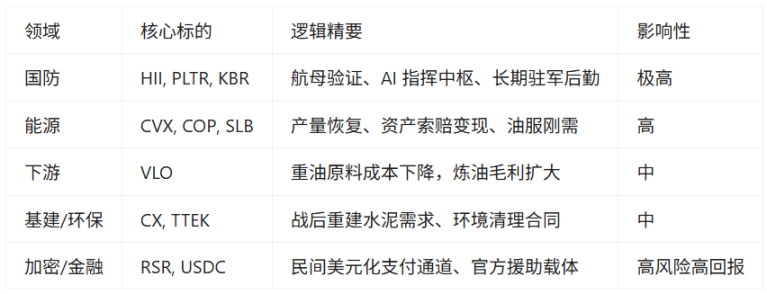
2. Key Investment Target List
Risk Warning
- Security War Quagmire: If residual forces launch a long-term guerrilla war, sabotaging oil pipelines and power grids, it will lead to cost overruns for companies like KBR, and oil production recovery may fall short of expectations.
- Great Power Game: Russia and China, as Venezuela's main creditors, may trigger new diplomatic and legal disputes over asset disposal, affecting the restructuring process.
- Oil Price Backlash: If Venezuela's production capacity is released too quickly, combined with a global economic slowdown, it may lead to a collapse in oil prices, thereby harming the interests of the U.S. shale oil industry and forcing a policy shift.
Disclaimer: This report is for reference only and does not constitute any form of investment advice.
免责声明:本文章仅代表作者个人观点,不代表本平台的立场和观点。本文章仅供信息分享,不构成对任何人的任何投资建议。用户与作者之间的任何争议,与本平台无关。如网页中刊载的文章或图片涉及侵权,请提供相关的权利证明和身份证明发送邮件到support@aicoin.com,本平台相关工作人员将会进行核查。


