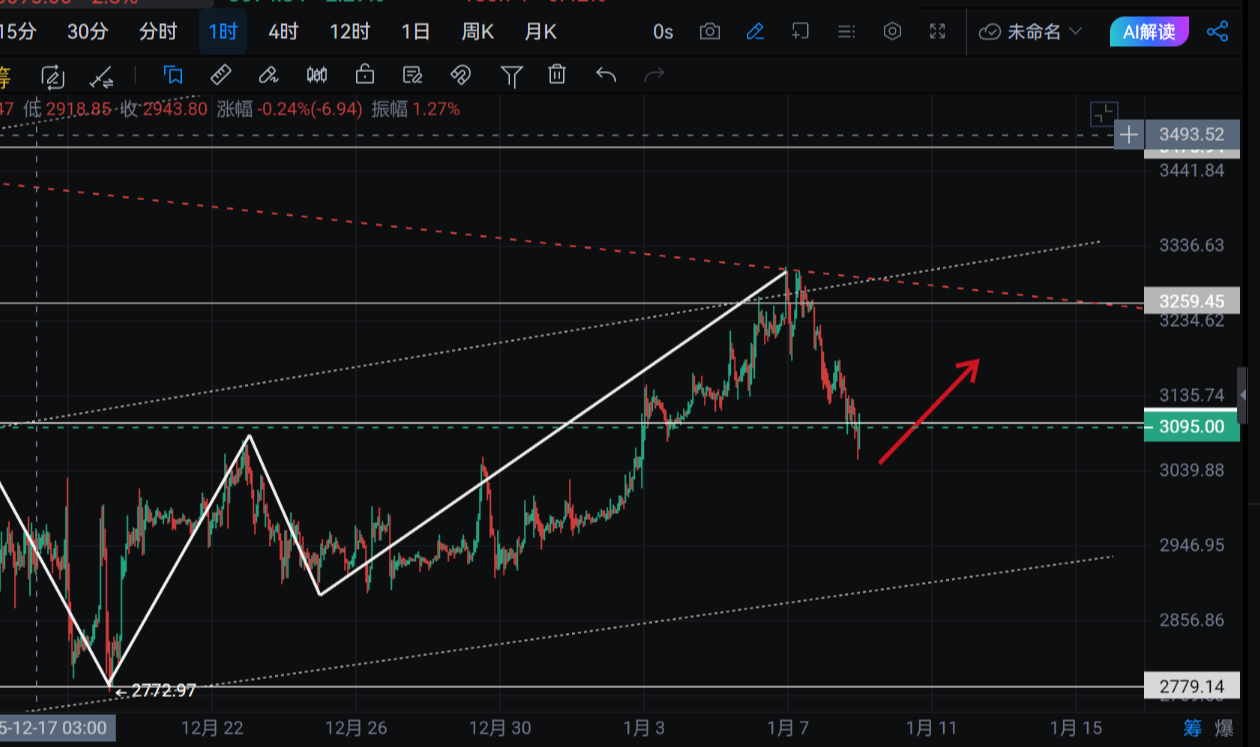
On January 6, 2026, as the total market capitalization of the cryptocurrency market rebounded by 4.82% within a week, both BTC and ETH rose, reigniting market interest at the start of the new year. The core feature of this market movement is not a single leading asset driving the rise, but rather a rapid return of funds, spreading from large-cap to mid and small-cap assets, with clear structural rotation signals. While prices are gradually recovering, mainstream sentiment indicators remain in the "extreme fear" zone, creating a strong contrast between price and sentiment. This article will analyze the intensity and sustainability of this rebound from the perspectives of capital flow and sector rotation.
Breadth and Level Diffusion of Total Market Capitalization Recovery
● The overall rebound shows that, from a market capitalization perspective, this round of rebound has a certain "thickness." According to Gate Ventures weekly report, in the past week, the total market capitalization of the cryptocurrency market increased by 4.82%, recovering part of the previous decline, presenting a broad-based rise from leading assets to long-tail assets.
● Leading assets continue to be the dual core driving sentiment and Beta recovery. Among them, BTC rose by 4.13% and ETH rose by 6.61%. As the two assets with the largest market capitalization and strongest liquidity, their simultaneous rise not only improved the overall market capitalization performance but also provided a fundamental support for the warming of risk appetite, driving the Beta recovery of related derivative sectors.
● Excluding BTC and ETH, a broader asset pool can be seen participating in this round of rebound. Data shows that, excluding these two major assets, the overall market capitalization of other cryptocurrency assets increased by 5.47% within a week, which is higher than both the overall and leading assets, indicating that funds are not limited to "holding leading assets," but are spreading from top to bottom.
● From a time perspective, this round of rebound has concentrated in the recent week, with clear weekly scale increases. However, existing data lacks more precise starting points and intraday or hourly level rhythms, making it impossible to refine the structure to daily or hourly levels, and can only assess the strength and sustainability of the rebound at the weekly level.
Small-Cap and High Beta Assets' Dual Breakthrough
● More aggressive signals come from the performance outside of leading assets. According to A/B source data, excluding the top ten assets, the remaining assets' market capitalization increased by 7.7% within a week, which is significantly higher than the total market capitalization increase of 4.82%, and also outperformed BTC and ETH, reflecting a typical "small-cap surge" characteristic.
● In terms of sector structure, the Memecoin sector has become the leading direction. This phenomenon usually indicates a rise in risk appetite and a resurgence of speculative funds in the market. Memecoins lack traditional fundamental constraints but have generated relative returns during the rebound phase, reflecting the amplification effect of price expectations, liquidity, and sentiment in this sector.
● Alongside the speculative Memecoins, funds are also actively embracing the data and infrastructure track. Research briefs indicate that recent funds have concentrated on related tracks, with one end being small-cap high Beta assets providing short-term elasticity, and the other end being relatively certain data and infrastructure projects favored for medium to long-term allocation, forming a dual-line main attack pattern of "high-risk speculation + track certainty."
● Structurally, this round of market movement is closer to a bottom-up structural rebound. Prices are not simply driven by a single-line rise of Bitcoin, but rather, based on the bottoming and recovery of leading assets, funds continue to spread to next-high and tail assets, showing a diffusion path from leading to mid-tier to long-tail. This pattern often triggers discussions about a "new small-cap cycle," but sustainability still depends on whether funds can continue to flow in.
ETF Net Inflows and Primary Market Institutional Return Signals
● In terms of off-market funds, ETF data provides clearer institutional signals. Gate Ventures weekly report shows that in the past week, BTC ETF net inflows were approximately $459 million, and ETH ETF net inflows were approximately $161 million, totaling over $600 million flowing into spot or related positions through compliant channels, providing a solid capital support for the recovery of spot prices and sentiment.
● Continuous ETF net inflows indirectly indicate that funds primarily from institutions and medium to long-term allocators are gradually returning and increasing positions at relatively low levels during price corrections and periods of low sentiment. Unlike short-term funds, these funds often focus on risk-return balance over multiple quarters or even years, rather than single weekly fluctuations.
● In stark contrast, mainstream sentiment indicators still point to "extreme fear," indicating that retail investors and short-cycle funds have limited trust in this round of rebound. The capital market shows a dislocation between "continuous ETF net inflows" and "extreme fear sentiment indicators," with prices driven by rational funds while sentiment has yet to follow suit.
● In the primary market, there were four financing events in the cryptocurrency sector in the past week, totaling approximately $17 million. Although the amount is not exaggerated, the continuous funding support for projects amid adjustments and macro uncertainties indicates that VCs and strategic investors are still making selective bets. Together with the ETF inflows in the secondary market, this forms a closed loop of institutional capital return from top to bottom and bottom to top.
Multiple Resonances of Macro and New Narratives
From a higher macro perspective, this round of rebound is not an isolated event but the result of multiple factors resonating. Firstly, the strengthening of expectations for Federal Reserve interest rate cuts provides a valuation repair window for high-risk assets, including cryptocurrency assets. Once interest rate expectations shift from "maintaining high levels" to "potential future cuts," the pressure of time value discount diminishes, and the valuation elasticity of long-duration assets and growth narrative assets naturally increases, benefiting cryptocurrency assets. Secondly, the new year often accompanies funds reallocating and rebalancing for the year, and even though the relevant institutional lists and quantitative data still need further verification, the market's expectation of "new year allocation" itself is enough to drive some funds to position early. Meanwhile, the rise in geopolitical uncertainties has led some funds to seek diversified allocation tools beyond traditional assets, with cryptocurrency assets being included in the "hedging" and "multi-asset portfolio" framework, rather than merely speculative targets.
On the technical and fundamental levels, Ethereum-related narratives have become an important supplement to this round of rebound. Channels like Gate Ventures point out that the advancement of Ethereum's scaling roadmap and the large-scale landing of tokenized financial products are seen as important fundamental catalysts supporting ETH and its ecological track. Although these views mainly come from a single source, they at least provide a reasonable explanation for ETH's relative outperformance over BTC in terms of market expectations, and reinforce the position of data, infrastructure, and tokenization tracks in this round of structural rebound. The intertwining of macro easing expectations, new year allocation logic, geopolitical hedging demand, and the technical narrative of Ethereum and tokenization together constitute the multiple driving forces behind this rebound.
Retail Investors' Dislocation in Extreme Fear
In sharp contrast to the strong price rebound, mainstream sentiment indicators remain in the "extreme fear" zone, indicating that most retail investors and short-term traders still lack confidence in this round of rebound. The previous steep decline has left a deep impression on the market, and external opinions regarding "the demand momentum for Bitcoin has cooled" (such as some views from CryptoQuant) have circulated on social media, further exacerbating ordinary investors' concerns, even though these views still require more data validation. In such an environment, institutions and medium to long-term funds are slowly increasing positions through ETFs and the primary market, while retail investors tend to remain on the sidelines, in a state of "seeing the rebound but not daring to heavily invest." The capital market presents a typical pattern of "institutions buying, retail investors fearing," with prices being pushed up by patient funds while sentiment lags behind price recovery.
This dislocation leaves considerable elasticity for subsequent market movements. Once prices stabilize or even rise further, sentiment indicators may recover from extreme fear to neutral or even greedy zones, and retail investors and passive funds may likely flood back in through "chasing the rise to make up for losses," bringing a second wave of capital push to the market. Meanwhile, this disconnection between sentiment and price itself also means that if macro expectations or capital flows reverse, the downward selling pressure in the market may be relatively limited before retail investors fully return, with more risks concentrated on the positions of institutions and high-leverage funds that have already entered the market. From this perspective, the rebound amid fear contains opportunities but also amplifies sensitivity to subsequent capital behaviors.
Is the Rebound a Strong Heartbeat or a Flash in the Pan?
From a short-term perspective, this round of rebound has certain capital and fundamental support. On one hand, the hundreds of millions of dollars in net inflows at the ETF level show that institutions and allocative funds are actively replenishing positions at low prices. On the other hand, small-cap assets and high Beta sectors are leading the rise, with Memecoins and data and infrastructure tracks flying together, indicating that market funds are not passively raising prices but are actively seeking offensive directions. Under the combined effects of macro interest rate cut expectations and narratives around Ethereum scaling and tokenization, this "strong heartbeat" has significantly repaired the market's panic pricing of downside risks at this stage. However, to determine whether this round of rebound can evolve into a mid-term trend, we need to return to the two main lines of macro and fundamentals. Firstly, the path and rhythm of the Federal Reserve's interest rate cuts are key variables; if expectations fall short or are significantly delayed, the current valuation repair momentum of high-risk assets may face discounting. Secondly, the progress of Ethereum's scaling and the actual landing speed of tokenized financial products will determine whether the profit expectations of related tracks can be realized, thereby supporting longer-term capital allocation logic.
In terms of sentiment and structure, the repair and return of retail investor sentiment will likely lag behind the price rebound itself. This "price leading, sentiment following" pattern suggests that there is still potential space for secondary capital pushes, but it also amplifies price sensitivity to negative variables. For investors, while seizing opportunities brought by institutional returns and structural rotations, it is also necessary to be cautious of the potential for sharp pullbacks in the context of disconnection between sentiment and price. On one hand, continuously tracking ETF net inflows, primary market financing dynamics, and sector rotations can help assess marginal changes in capital; on the other hand, closely monitoring macro policy expectations and adjustments in interest rate paths can help identify early signals of the rebound evolving from a "strong heartbeat" to a "flash in the pan." In the current environment of coexisting fear and rebound, higher-dimensional risk management and rhythm control may be more critical than the direction itself.
Join our community to discuss and become stronger together!
Official Telegram community: https://t.me/aicoincn
AiCoin Chinese Twitter: https://x.com/AiCoinzh
OKX Benefits Group: https://aicoin.com/link/chat?cid=l61eM4owQ
Binance Benefits Group: https://aicoin.com/link/chat?cid=ynr7d1P6Z
免责声明:本文章仅代表作者个人观点,不代表本平台的立场和观点。本文章仅供信息分享,不构成对任何人的任何投资建议。用户与作者之间的任何争议,与本平台无关。如网页中刊载的文章或图片涉及侵权,请提供相关的权利证明和身份证明发送邮件到support@aicoin.com,本平台相关工作人员将会进行核查。