Source: Uweb Live Sharing Class
Content Organized by: Peter_Techub News
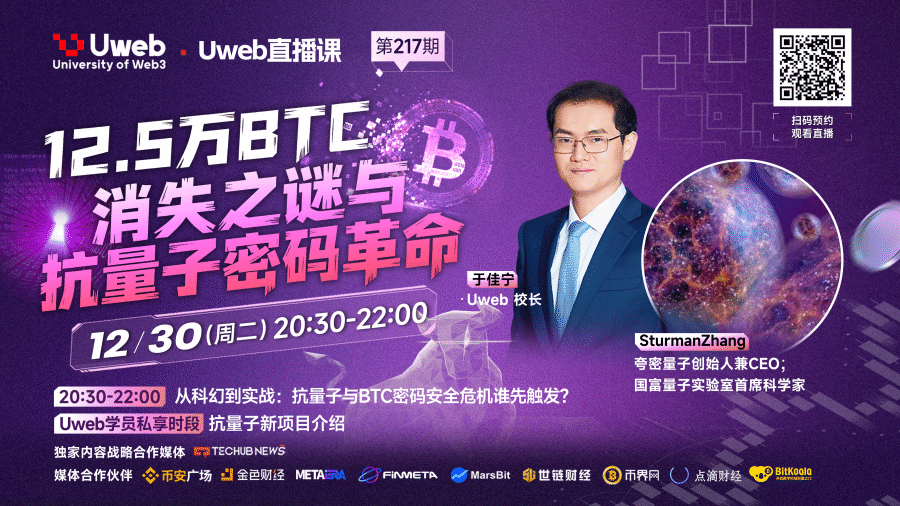
On the evening of December 30, 2025, the 217th session of the Uweb live sharing class was broadcast as scheduled. This session focused on the theme "The Mystery of 125,000 BTC Disappearance and the Quantum Resistance Cryptography Revolution," hosted by Dr. Yu Jianing, President of Uweb in Hong Kong, with special guest Sturman Zhang, Founder and CEO of Quam Quantum and Chief Scientist at Guofu Quantum Laboratory. The live broadcast attracted nearly 600 viewers, with the public sharing segment delving into the potential threats of quantum computing to cryptographic security, while the private session for Uweb students introduced new projects and technological layouts related to quantum resistance.
Public Session Theme: From Science Fiction to Practice - Who Triggers the Quantum Resistance and BTC Cryptographic Security Crisis First?
Sturman Zhang began by discussing the current state of quantum computing, pointing out that a million-qubit universal quantum computer is still far off, with the current world record being just over 100 qubits (held by Google and China's "Zuchongzhi 3"). The growth is linear rather than exponential as per Moore's Law. However, he emphasized that even if a specialized quantum computer without error correction reaches thousands of qubits, it could still lead to the development of special algorithms that accelerate the cracking of existing asymmetric cryptography, making cryptographic upgrades urgent.
The existing mainstream asymmetric cryptographic systems (RSA for the internet, ECC for blockchain) are extremely vulnerable to quantum computers using Shor's algorithm: classical computers require exponential time to crack, while quantum computers can reduce this to polynomial time, theoretically achieving "instant cracking." Sturman Zhang illustrated the superposition property of qubits using the Bloch sphere, which gives them natural parallel computing capabilities, the fundamental reason for quantum acceleration.
The upgrade paths for quantum-resistant cryptography mainly include two:
High-cost Quantum Key Distribution (QKD), such as the Micius satellite and ground fiber optic networks, providing "true random" symmetric keys based on physical principles, theoretically resistant to any algorithm (including future super-quantum algorithms).
Low-cost Post-Quantum Cryptography (PQC), which extends the time required for quantum computers to crack cryptography to decades or even centuries through software upgrades, currently being vigorously promoted by the global financial system and cryptographic authorities.
Sturman Zhang specifically pointed out that in hardware wallet applications, the signature length of PQC can exceed 8000 bytes, leading to signature times of over 20 seconds, requiring higher computing power CPUs; on PCs and servers, it can be completed in a few seconds, suitable for rapid deployment.
Among the three major fields of quantum technology, quantum sensing and precision measurement are relatively mature and mostly used in military applications; quantum communication (mainly QKD) has a certain commercial foundation; while quantum computing remains in the "dream level," similar to controllable nuclear fusion, once breakthroughs occur, it will bring infinite computing power.
The most concerning case is the 125,000 BTC controlled by the U.S. Department of Justice from the Cambodian Prince Group's Luobin mining pool. Sturman Zhang analyzed that this was not due to quantum computing but rather the exploitation of a pseudo-random number vulnerability: the mining pool used an old pseudo-random number generator (Mersenne Twister algorithm) with only a 32-bit seed, which high-performance classical computers could exhaustively search for the private key in minutes to hours. In contrast, true random numbers (especially quantum random numbers) can achieve security levels of 2^256, equivalent to the age of the universe in terms of possibilities, completely eliminating exhaustive search.
Sturman Zhang likened this type of attack to "cheating": quantum computers may "solve problems according to rules" to reverse-engineer public keys in the future, while pseudo-random number vulnerabilities directly "steal answers." The latter has already caused real losses and is more imminent.
Private Session (Uweb Student Exclusive): Introduction to New Quantum Resistance Projects
In the private session, Sturman Zhang shared in-depth about his team's current layout:
Quantum Hardware Wallet: The software and hardware development has been completed, and it is ready for mass production, comparable to the Ledger Nano X, priced slightly higher but with lower costs. Its core advantage lies in the built-in quantum random number chip (sourced from Samsung's mass-produced chips and domestic solutions from Guoshield Quantum), completely replacing all pseudo-random number scenarios, ensuring that both private keys and encryption random numbers are true random. It supports mainstream elliptic curve algorithms and has integrated PQC algorithms (such as Sphincs+ in the NIST standard), becoming the world's first hardware wallet with both quantum random numbers and PQC.
Financial Quantum Technology Infrastructure: The team is forming a "national team," planning to establish a headquarters in Beijing (in collaboration with institutions under the central bank) and layout in multiple locations including Shanghai, Hong Kong, Shenzhen, Hangzhou, and Hainan. The goal is to make quantum random number chips standard in U-shields/hardware wallets, integrating PQC into the bank's CFCA certificate system, while providing quantum security upgrades for digital RMB and international trade settlements. They have deeply collaborated with Guoshield Quantum, with B-end devices provided by Guoshield and C-end managed by the team.
Decentralized Consensus Technology: The team proposed the "PoR (Proof of Randomness)" Macau algorithm, utilizing quantum random numbers to achieve fast and fair consensus, significantly improving public chain performance while maintaining decentralization, which has been stably running on a small-scale test network for a year.
In terms of financing, the team has completed an angel round (led by Dr. Qi Lu of Miracle Ventures) and a Pre-A round, and is advancing a new round of financing (valued at 250-300 million RMB), aiming to rapidly expand to nearly 100 people and accelerate national project applications and standard formulation.
Summary
This session of the sharing class presented the originally complex knowledge of quantum cryptography to the audience through relatable cases (such as the 125,000 BTC incident) and a clear framework. Sturman Zhang emphasized that while the ultimate threat of quantum computing still requires time, the pseudo-random number vulnerability has already posed a real crisis, necessitating hardware upgrades to true random numbers (especially quantum random numbers). At the same time, post-quantum cryptography (PQC) and quantum key distribution form a dual defense system that will jointly build the security foundation for future finance and blockchain.
President Yu Jianing repeatedly reminded students: even if the content is profound, they should grasp key terms (such as PQC, true random numbers, Shor's algorithm) and further study with AI, as this is the "golden key" to opening the door to cutting-edge technology. In 2026, the narrative of quantum technology is expected to further ferment, making it worthwhile to continue monitoring related targets and security upgrade opportunities.
Uweb will continue to deepen the delivery of technology-related content, helping students seize opportunities in the new era of technological revolution and investment. Viewers who missed the live broadcast can watch the replay, and those interested can follow upcoming courses and events.
Introduction to the Digital Asset Analyst (HKCDAA) Qualification Examination
The Digital Asset Analyst (HKCDAA) qualification examination launched by the Hong Kong Registered Digital Asset Analysts Association aims to provide authoritative certification for professionals in the digital asset field. The exam covers areas such as basic theories of digital assets, blockchain technology, investment analysis, trading tools, risk management, regulatory laws and regulations, and professional ethics, cultivating and certifying professionals with a global perspective in digital assets.
The exam has now been officially incorporated into the professional/vocational examination system recognized by the Hong Kong Examinations and Assessment Authority (listed on the Authority's official website) and is administered by the Hong Kong Examinations and Assessment Authority, alongside international authoritative exams such as HKDSE, CFA, and FRM, under a unified management system. This marks the official authoritative recognition of the exam by the Hong Kong Examination Authority, establishing its irreplaceable authoritative position in the digital asset industry, laying the foundation for the standardization and professionalization of talent in the digital asset field, and injecting more reliable professional strength into the Web3.0 industry.
The career development path after obtaining the certification is broad, including directions such as financial institutions and investment companies, digital asset exchanges and Web3.0 enterprises, regulatory agencies and compliance departments, digital asset investment and wealth management, education and research institutions, etc. The applicable audience includes practitioners in financial institutions, digital asset practitioners, digital asset investors, regulatory agencies and compliance personnel, as well as students and beginners.
Scan to learn more about the Digital Asset Analyst
免责声明:本文章仅代表作者个人观点,不代表本平台的立场和观点。本文章仅供信息分享,不构成对任何人的任何投资建议。用户与作者之间的任何争议,与本平台无关。如网页中刊载的文章或图片涉及侵权,请提供相关的权利证明和身份证明发送邮件到support@aicoin.com,本平台相关工作人员将会进行核查。


