The market holds its breath as it awaits the release of the U.S. December ADP employment data at 9:15 PM tonight. This figure is not just a number; it is a key code to glimpse the Federal Reserve's policy shift.
The U.S. will release the ADP National Employment Report for December 2025. This data, known as the "little non-farm," is compiled from payroll data of approximately 400,000 private companies across the country and is regarded as an important leading indicator for the official non-farm employment report.
The market generally predicts that private sector jobs will increase by 47,000 in December, a stark contrast to the sharp decline of 32,000 in November.

1. Data Aftershocks
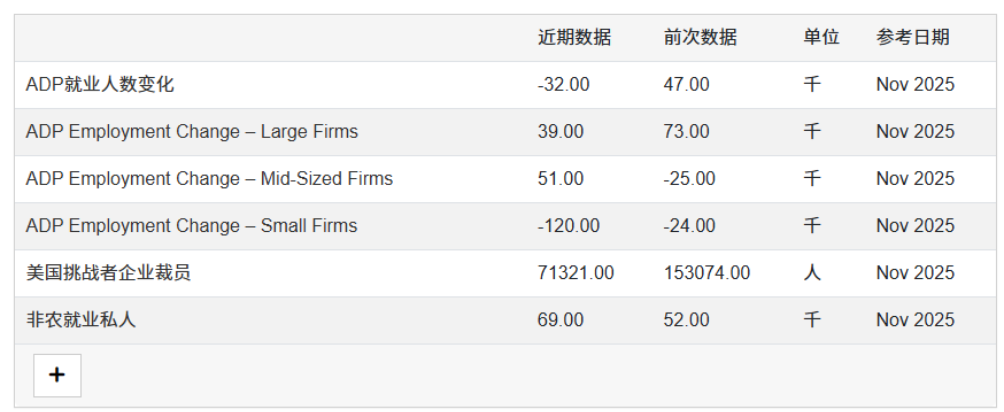
● The ADP report for November 2025 brought an unexpected shock to the market. The data showed that the number of jobs in U.S. private enterprises decreased by 32,000 that month, marking the largest single-month drop since March 2023. This result was far from the economists' expectation of an increase of 10,000 jobs, highlighting the severe challenges facing the labor market.
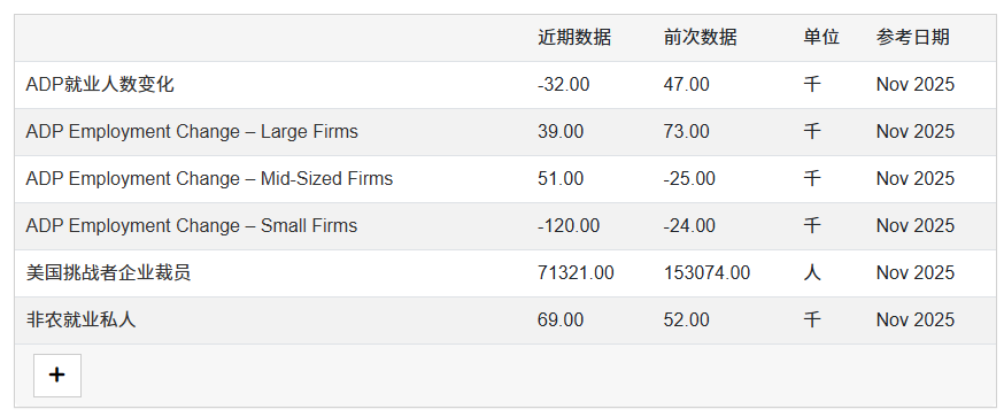
● Layoff pressures were primarily concentrated in small businesses. The data indicated that small businesses with fewer than 50 employees cut as many as 120,000 jobs in November, the largest single-month decline since May 2020.
Analyzing by business size, companies with 20 to 49 employees reduced 74,000 jobs, becoming the main drag.
2. Industry Growing Pains
● The weakness in the job market is widespread. From an industry perspective, professional and business services lost 26,000 jobs, information services lost 20,000, and manufacturing lost 18,000.
● Construction and finance also each lost about 9,000 employees. This synchronized decline across industries indicates that the pressure of economic slowdown is spreading.
● ADP Chief Economist Nela Richardson pointed out: “With consumers being more cautious and the overall environment uncertain, hiring by businesses has recently shown significant volatility.” In the second half of this year, U.S. private enterprises have experienced four months of negative job growth, indicating that overall hiring momentum is gradually weakening.
3. Expectation Reversal
● In light of the weak data from November, the market holds a more optimistic expectation for December's performance. According to data from the ADP Research Institute for the four weeks ending December 6, 2025, private enterprises added an average of 11,500 jobs per week. This marks the third consecutive period of job growth, indicating that hiring activity remains in a positive range.
● Samuel Thomas, Chief U.S. Economist at Pantheon Macroeconomics, analyzed that if this growth rate remains stable throughout December, the monthly job increase could reach around 45,000.
● This forecast aligns closely with the market consensus of 47,000 new jobs, suggesting that the job market may rebound by the end of the year.
4. Key Divides
As two key indicators of U.S. employment conditions, ADP and non-farm data have essential differences in composition and methodology, which often leads to divergences in their trends.
● In terms of composition, ADP only includes private sector employment, while non-farm employment data includes both private and government sector employment. When employment trends in these two sectors diverge, the data will show discrepancies.
● Methodologically, ADP counts the number of employees who actually received wages during the survey period, while non-farm counts the number of employees on payrolls. This means that even if an employee did not actually receive wages in a given month, they will still be counted in the non-farm data as long as they are on the payroll.
● The sampling frequency also differs: ADP data is collected weekly and reported monthly, while non-farm only collects payroll data for the week of the 12th of each month. This makes ADP more sensitive to part-time and temporary employment.
5. Policy Chessboard
The reason tonight's ADP data is receiving so much attention is that it will provide policymakers with crucial real-time information about the labor market ahead of the Federal Reserve's interest rate decision meeting on January 27-28.
● Federal Reserve officials have clearly stated that, in the context of government shutdowns leading to some data distortions, the unemployment rate is a reliable barometer for measuring labor market conditions.
● The market generally predicts that the U.S. unemployment rate will slightly decline from 4.6% in November to 4.5% in December. If the job market indeed begins to warm up, the Federal Reserve is very likely to choose to keep interest rates unchanged at the January meeting.
● Currently, the Federal Reserve itself expects to cut rates only once in 2026 and again in 2027. According to the CME FedWatch Tool, the market expects at least two rate cuts this year, with the policy rate potentially dropping to the range of 3% to 3.25% by early December.
6. Deep Pulses
● In addition to overall employment data, the market will also closely monitor wage growth. In the November ADP report, the annual salary increase for retained employees was 4.4%, slightly down from October. The annual salary increase for job changers was 6.3%, the lowest level since February 2021. Slowing wage growth may alleviate inflationary pressures, providing more room for the Federal Reserve's policy shift.
● KPMG Chief Economist Diane Swonk predicts that average hourly earnings in December are expected to grow by 0.3% month-on-month and 3.6% year-on-year, slightly higher than November's 3.5%.
● Weekly working hours are expected to remain at 34.3 hours. These detailed data points will provide a more comprehensive perspective for assessing the tightness of the labor market.
7. Global Perspective
● ADP data not only affects the U.S. market but also has spillover effects on global capital flows. Historical experience shows that when ADP data is stronger than expected, the U.S. dollar tends to strengthen; conversely, the dollar may come under pressure. Given the dollar's central role in the global financial system, such fluctuations will impact trade conditions and capital flows in various countries through exchange rate channels.
● For Chinese enterprises engaged in global expansion, trends in the U.S. labor market are also of significant importance. ADP, based on payroll and labor data covering 140 countries and regions, indicates that skills, governance, and technology are becoming the three key forces influencing global enterprises.
● Changes in wages and employment patterns in the U.S. job market may provide references for multinational companies' human resource strategies.

As night falls, the terminal screens of the financial markets are all locked onto the same countdown. At 9:15 PM, the number that is about to emerge will be like a stone thrown into a lake.
Whether the result is a strong rebound confirming economic resilience or renewed weakness reinforcing recession fears, the ripples will quickly spread: from interest rate futures at the Chicago Mercantile Exchange to trading floors at Wall Street banks, and into the policy discussion rooms within the Federal Reserve's marble building.
The market is ready to embrace a new round of interpretation, gamesmanship, and adjustments.
Join our community to discuss and grow stronger together!
Official Telegram community: https://t.me/aicoincn
AiCoin Chinese Twitter: https://x.com/AiCoinzh
OKX benefits group: https://aicoin.com/link/chat?cid=l61eM4owQ
Binance benefits group: https://aicoin.com/link/chat?cid=ynr7d1P6Z
免责声明:本文章仅代表作者个人观点,不代表本平台的立场和观点。本文章仅供信息分享,不构成对任何人的任何投资建议。用户与作者之间的任何争议,与本平台无关。如网页中刊载的文章或图片涉及侵权,请提供相关的权利证明和身份证明发送邮件到support@aicoin.com,本平台相关工作人员将会进行核查。


