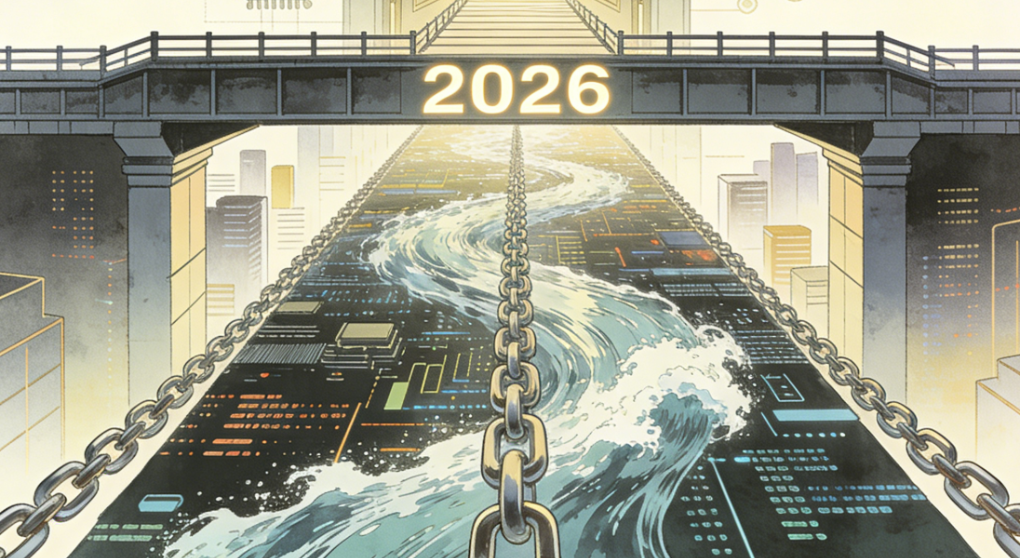
Goodbye to the long "road construction" era, the crypto world is on the brink of a profound transformation. Over the past four years, the industry's focus has been on the expansion and stabilization of blockchain underlying technology, akin to laying the foundation for an information superhighway. As we enter 2026, the core issue has shifted: the road has been paved, and the key will be how quickly and intelligently the "assets" on it can create value. This new paradigm is defined as "Kinetic Finance," marked by a complete shift in the industry's focus from the supply of network capacity to the release of asset efficiency.
This transformation will be driven by three core engines: the form of the assets themselves, the participants in the market, and the governing rules of the market, all of which are undergoing fundamental restructuring simultaneously.

1. Asset Transformation: From Digital Mapping to Global Settlement Layer
The narrative of asset on-chain is experiencing a qualitative leap. Early attempts focused on "mapping," which simply issued digital certificates for real-world assets (such as bonds and stocks). Currently, blockchain is evolving into a global, 24/7 uninterrupted real-time settlement center. This is not just a technological improvement but a paradigm revolution in financial efficiency—compressing traditional financial T+2 or even longer settlement cycles into T+0 moments on-chain. This transformation is driven by two main forces:
Deep Financialization and Layered Structure of RWA: The on-chain process of Real World Assets (RWA) has entered "Stage 2.0." Its core is no longer a single asset mapping but rather constructing a layered financial system based on asset liquidity characteristics:
a. Top Layer - Standardized Assets: Represented by tokenized U.S. Treasury bonds and U.S. stocks. The former has surpassed $7.3 billion, becoming the benchmark for risk-free interest rates on-chain; the latter, with a scale of about $500 million, is breaking through trading time and regional restrictions, jointly building a complete on-chain investment portfolio foundation with on-chain U.S. Treasuries.
b. Bottom Layer - Non-Standardized Assets: Covering private credit, real estate, intellectual property, etc. Despite the potential scale being enormous (e.g., the stock of private credit is about $80 billion), its on-chain process is a key breakthrough due to pricing and liquidity challenges. By 2030, the global RWA market size is expected to reach $16 trillion, with the on-chain non-stablecoin RWA scale likely to exceed $10 billion by 2026, marking its transition from niche experiments to mainstream.
Stablecoins: A Formed Global Settlement Network: Stablecoins have long surpassed their role as trading pairs, evolving into an efficient cross-border payment and settlement infrastructure. Their annual on-chain settlement total has exceeded $12 trillion, officially surpassing payment giant Visa. Over 40% of transactions occur during traditional bank off-hours, filling the "liquidity vacuum" in global finance. More importantly, the combination of RWA assets and DeFi Lego has created a chemical reaction: about 30% of tokenized government bonds (approximately $2.2 billion) are being used as collateral for lending protocols, thereby increasing capital utilization by 2-3 times.
2. Participant Transformation: From Human Dominance to AI Agency Economy
The protagonists on the trading stage are switching. Human investors are gradually transferring execution and even decision-making power to more efficient, tireless AI agents. This is not just an upgrade of automation tools but a fundamental shift in economic entities.
AI Agents as New Traders: AI is learning to understand and execute complex financial strategies. Future DeFi protocols will resemble "financial APIs" called by AI, where the funds themselves will possess "intelligence," actively seeking optimal returns globally. The trading paradigm is accelerating its shift from "human-machine interaction" to "machine-to-machine interaction."
Rise of M2M Payment Networks: Collaboration between agents requires frequent, nuanced value transfers. Blockchain-based micropayment protocols provide an ideal track for this. Giants like Google, OpenAI (via Stripe), and Visa have all laid out agent payment infrastructure. Predictions indicate that by 2027, daily on-chain trading volume driven by AI agents could reach $5 billion. The pay-per-use micropayment model can reduce service call costs by up to 60% compared to traditional API subscriptions.
Verifiable Data and Trustworthy Reasoning as Cornerstones: The next generation of AI "world models" relies on high-quality, verifiable physical world data to avoid "model collapse." Blockchain builds a trustworthy bridge connecting the physical and digital worlds by providing immutable proof for sensor data. Meanwhile, as AI reasoning migrates to edge devices like smartphones and computers, zero-knowledge machine learning (zkML) technology becomes crucial. It can verify the correctness of reasoning processes on-chain without disclosing original data, ensuring the reliability of decentralized computing networks.
3. Rule Transformation: Compliance and Privacy from Conflict to Integration
As traditional financial institutions enter the arena with massive capital, the tension between transparency and privacy, innovation and regulation becomes prominent. A new rule system is being redefined at the code level.
Privacy Becomes a Necessity for Institutions, Not Optional: In a fully transparent on-chain environment, the massive trading intentions and strategies of institutions are laid bare, leading to significant front-running risks. Therefore, "programmable privacy" technologies (such as zero-knowledge proofs) are shifting from marginal needs to foundational infrastructure for institutional entry. Its new connotation is: while protecting trade secrets and strategic security, it can still prove compliance to regulators. The concept of "compliance dark pools" has emerged.
Smart Compliance: From "Post-Event Accountability" to "Code-Level Interruption": In the face of potentially massive on-chain transactions initiated by AI agents in the future, traditional manual compliance review systems will become completely ineffective. Compliance logic must be embedded within smart contracts to achieve millisecond-level automated risk control. The new generation of compliance protocols can analyze transaction graphs in real-time through AI, automatically identify risks, and allow other agents to instantaneously query counterpart compliance scores before transactions, thus achieving preemptive code-based interruption.
Complexity and Structuring of Institutional Products: Crypto assets have completed their transformation into "global macro hedging tools" in the eyes of institutions. Their product demands are becoming increasingly complex, including:
a. Basis Trading: Utilizing the price difference between spot ETFs and futures for arbitrage has become a mainstream strategy.
b. Structured Notes: Packaging combinations like "BTC spot + ETH staking yield" to provide value-added and returns similar to traditional finance.
c. Diversified Allocation: Investment portfolios are expanding from a single BTC to a structure of "BTC + ETH/SOL + DeFi blue chips," where staking yields from POS chains are viewed as the "risk-free rate" of the on-chain economy.
4. Frontier Outlook: The Intelligent Evolution of DeFi and the Rise of Prediction Markets
Under the wash of the three major transformations, specific application layers are nurturing new forms.
DeFi 3.0: Proactive Intelligent Services: DeFi is transitioning from passive, rule-based smart contracts (1.0) to proactive services based on user "intent" (3.0). Users only need to express goals like "I want to buy asset X at the best price" without specifying complex paths, with the backend being completed by a professional "solver" network competing. The core metrics are shifting from total locked value (TVL) to total value turnover rate (TVV), emphasizing capital flow and creation efficiency.
Prediction Markets: High-Resolution "Truth Oracles": In an era of information overload, prediction markets based on real-money betting are evolving into a high-timeliness global information infrastructure. Its value lies not only in speculation but also in generating market-based "truth signals" that are difficult to manipulate. Competition revolves around three dimensions: capital efficiency (releasing margin through innovative mechanisms), traffic acquisition (low-cost customer acquisition through embedded modules), and compliance pathways (navigating the legal characterization between "goods" and "gambling").
Conclusion: The Era of Efficiency is King
In 2026, the main theme of the crypto industry will be "stripping away speculative bubbles and returning to value creation." The advent of the Kinetic Finance era signifies a core shift in evaluation standards: from "how fast the network is" to "how smart the capital is and how efficient the flow is." This is a macro shift from "assets on-chain" to "economy on-chain," where the financial boundaries of the real world will dissolve and reshape within code.
Projects that can reduce trust costs with algorithms, enhance capital flow with smart contracts, and find a compliance balance between transparency and privacy will become the cornerstones defining the new era. The future is here, and its rhythm will be determined by the speed of asset flow and the boundaries of intelligence.
Join our community to discuss and grow stronger together!
Official Telegram community: https://t.me/aicoincn
AiCoin Chinese Twitter: https://x.com/AiCoinzh
OKX benefits group: https://aicoin.com/link/chat?cid=l61eM4owQ
Binance benefits group: https://aicoin.com/link/chat?cid=ynr7d1P6Z
免责声明:本文章仅代表作者个人观点,不代表本平台的立场和观点。本文章仅供信息分享,不构成对任何人的任何投资建议。用户与作者之间的任何争议,与本平台无关。如网页中刊载的文章或图片涉及侵权,请提供相关的权利证明和身份证明发送邮件到support@aicoin.com,本平台相关工作人员将会进行核查。


