Written by: MaiTong MSX Researcher
The narrative direction is fulfilled, certainty welcomes new variables. In 2026, structural opportunities in the US stock market / tokenization / Web3 may be emerging.
Understanding the past cannot be changed, but the future can still be pursued.
2025 has passed in the blink of an eye. This year, global financial markets underwent one round after another of "extreme stress tests": repeated geopolitical tensions, fluctuating macro expectations, the retreat of narratives, and the intertwining of liquidity differentiation. Meanwhile, tokenization quietly accelerated under the push of compliance and infrastructure.
It can be said that from TradFi to Web3, two originally parallel forces are converging at an unprecedented speed, aiming at the on-chain and programmable nature of various financial assets.
To restore the market's "sentiment" into a reference "sample," we used MaiTong MSX as an observation sample and posed nine questions to internal researchers: from annual keywords, personal gains and losses, and core positions, to the overflow paths of funds, judgments on pricing power, and key structural variables that may trigger the TradFi × tokenization "ChatGPT moment." This has been organized into a document for readers.
As a collective review from frontline builders, we hope this provides a glimpse into this year's gains and losses of the US stock market / tokenization / Web3 from the users' perspective. Perhaps it can also serve as a reference to discover the hidden sparks behind and yield a survival guide for 2026.
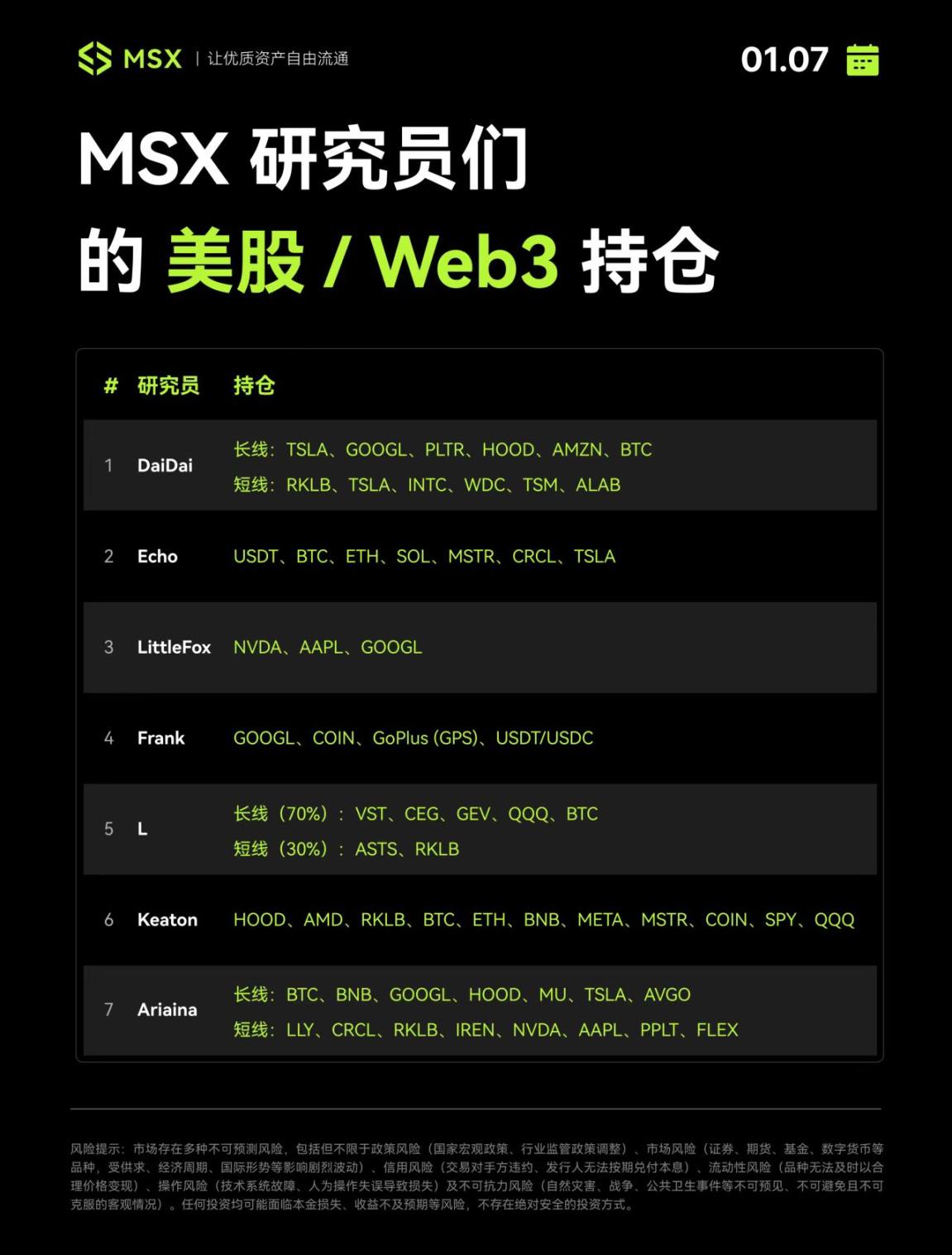
Note: Researcher holdings disclosure (for sample illustration and research discussion only, not constituting any investment advice)
I. Flashback to 2025: Gains and Regrets in the US Stock Market / Web3
1. Looking back at 2025, what do you see as the biggest change in the US stock market or tokenization? If you had to summarize it with one keyword, what would it be?
DaiDai: I believe 2025 was a turning point for the US stock market, shifting from "narrative-driven" to "substantial implementation." The keyword to summarize it would be "value return."
Especially regarding AI's "capital expenditure" (CapEx) realization, it can be said that the entire year was under performance scrutiny. The market clearly no longer buys into a simple "AI story," but is extremely focused on whether the capital expenditures of tech giants can translate into actual revenue.
LittleFox: My keyword is "regulatory-driven technology application."
The biggest change in 2025 was the trend of integration between traditional finance and Web3, which is intuitively reflected in the increase in the number of stablecoins and daily applications. It was very evident that in 2025, trading funds in the crypto market experienced outflows, and the overall market showed a downward trend, failing to maintain a bull market. However, crypto technology has begun to become part of the infrastructure in traditional finance. The market logic is rapidly changing, but from a normal distribution trend, traditional finance, especially the US stock market, will receive more technological support from the crypto market, thus gaining more user growth globally.
Echo: If I had to give a keyword, I think it would be "playability."
From my perspective and that of my friends who are crypto veterans and newcomers to the US stock market, everyone's excitement has shifted from "lowering the investment threshold for US stocks" to "how to play with tokenized US stocks on-chain." This is because this track has enough playability, allowing people to move beyond mere narratives.
Value no longer solely depends on how exciting the future of the story is, but also on how fun the tool is, how it can be played, and whether it can combine the advantages of both to create a higher ceiling. Dual players in stocks and crypto should find it enjoyable; something reliable like Apple stock has turned into "financial Lego" on-chain: it can be held, staked, earn interest, and even serve as a leverage base, switching instantly between various states, with states being stackable.
Frank: If I had to summarize the US stock market tokenization track in 2025 with one keyword, I would choose "acceleration."
This "acceleration" does not come from a single event but is reflected in the synchronized advancement of a whole set of infrastructure and institutional levels, including the forward movement of compliance discussions and a clear shift in attitudes towards the topic of "on-chain." Whether it is Nasdaq moving from being a bystander to actively participating, or the proposal of the 5×23 hour trading experiment, it marks that these Wall Street players are no longer just dipping their toes in the water but are starting to dismantle the fences of the old world (see further reading: "Nasdaq Hits the Gas: From 'Dipping Toes' to 'Feasting,' Is US Stock Tokenization Entering a Decisive Stage?" and "US Stocks Sprinting Towards 'Never Closing': Why Did Nasdaq Launch the '5×23 Hour' Trading Experiment?").
In contrast, my overall impression of the US stock market in 2025 is "turbulent." After all, this year was not peaceful, with events like the deep squat in April and the impacts of tariffs/geopolitical turmoil. However, what is astonishing is its strong resilience and sector rotation efficiency. From AI, chips to electricity, copper, storage, nuclear energy, and infrastructure, almost every stage had a new narrative taking over.
It can be said that 2025 further widened the cognitive gap between the US stock market and Crypto. In my view, the US stock market resembles a deep sea, while Crypto remains a series of fragmented small ponds. More importantly, the US stock market has real profits and cash flow backing it, which allows the valuation logic to be repeatedly verified—something that almost 99% of Altcoins cannot compare to.
Keaton: The keyword I choose is "second half."
From my perspective, blockchain has finally entered the second half, moving towards compliance and maturity. Blockchain is returning to its intended use, competing with the previous generation of black-box settlement systems in traditional finance through superior clearing and settlement efficiency.
User scale and product experience have finally reached the eve of a singularity, capable of supporting some mass adoption-level use cases.
L: Looking back at 2025, if I had to summarize the biggest change in the US stock and tokenized asset fields with one keyword, I would choose "implementation."
In simple terms, "tokenized trading has truly been established" in 2025, because from STO to tokenization, the past few years have mostly remained at the conceptual level, while 2025 began to focus on liquidity, trading depth, and real use cases.
Users are no longer just concerned about "whether assets are on-chain," but rather "whether they are easy to trade and worth long-term participation."
Ariaina: Looking back at 2025, I believe the emergence of US stock tokenization is an important signal that on-chain assets are beginning to undergo structural changes.
The concept is not new; in earlier cycles, the market attempted to put various types of real assets like US Treasury bonds and real estate on-chain. These explorations had their rationale at each stage, but overall, they were more of a supplement to the types of on-chain assets and did not truly enter the mainstream view or change the core structure of on-chain assets.
Against the backdrop of a pressured global economy and tightening liquidity, the Web3 market itself has become increasingly difficult to rely solely on crypto-native assets for new growth. However, as the most mature, liquid, and easily understood asset globally, the tokenization of US stocks not only opens up an asset space far larger than its own scale for Web3 but also establishes a more direct connection between traditional finance and Web3.
From the perspective of ordinary users, this is a more natural path—users do not need to first understand complex crypto concepts but can start from familiar assets and gradually enter the on-chain system.
Therefore, if I had to summarize this change with one word, I would choose "open"—not opening a specific product or entry point, but opening the ceiling of on-chain assets and breaking the long-standing isolation between Web3 and mainstream finance.
2. What was your most comfortable investment operation in 2025, and what was your biggest regret in missing out or losing? (Not limited to US stocks / crypto)
DaiDai: This year, I indeed hit most of the popular stocks, such as OKLO, RKLB, IREN, NBIS, ASTS, SNDK, MU, OPEN, etc. Yes! I love to follow trends, especially popular stocks.
At the same time, in precious metals, I also benefited from gold and silver, and I cleared ETH at over 4000 (looking back, it was another form of "successfully escaping the top"). My biggest regret is not buying back MU and SNDK during the pullback in October-November.
LittleFox: In my personal trading, I adhere to the principle of "going with the flow to avoid disaster, while going against it leads to success," focusing on left-side high-frequency trading. However, I often combine macro data, company data, and other fundamental information with rhythm to find entry opportunities.
The most comfortable trade this year was in November when the market experienced a broad decline due to fundamental pressures. I predicted that after Nvidia's earnings report, it would undoubtedly lift the market, as Nvidia's sales situation had essentially completed all sales tasks by the beginning of the year. I couldn't think of any reason for an unexpected earnings report, so I increased leverage to buy at a relatively good price (voiceover: looking back, increasing leverage at that time had a gambling element, as an unexpected earnings report from Nvidia would have led to significant losses; I do not encourage such behavior). This operation was an opportunity for cognitive realization; besides earning some profits, the greater achievement was the sense of accomplishment from realizing my own understanding, making it memorable.
As for the regret of missing out, it is that I basically did not touch the precious metals market until it reached what I considered an absurd price. I only began to conduct in-depth analysis of precious metals at that point, but by then, there were no suitable entry points in my trading system, and I could only watch from afar. This is regrettable because when precious metals show unusual movements, one should pay attention to conduct in-depth analysis.
Echo: The most comfortable was the dollar-cost averaging and profit-taking on BTC, SOL, and BNB.
The biggest regret was the emotional chasing of TRUMP and CFX, allowing losses to accumulate. I didn't participate in any other meme projects later in the year, feeling completely devoid of intuition in emotional investing; in the US stock market, I threw some New Year's money into MSTR at the beginning of the year, but did not see particularly large gains.
Taking profits is the greatest respect for trading; let's encourage each other.
Frank: To be honest, I did not make many active investments in the crypto field in 2025.
On the contrary, due to work influences, a few operations in the US stock market turned out to be unexpected joys this year, including phase allocations to Google (GOOGL) and Xpeng Motors (XPEV), both of which yielded relatively good returns and made me vaguely aware that this might be a turning point in my personal investment path.
In the past period, I was more accustomed to seeking opportunities on-chain, between different protocols, and between on-chain and CEX/platforms, mainly focusing on stablecoin arbitrage. Therefore, I have long held USDT/USDC, which has provided relatively stable "snack-level" returns. However, since deeply engaging in US stock investment research in the second half of 2025, I have realized one issue, which I just discussed with a friend:
My background as a Web3 Native (self-proclaimed) makes my current investment logic somewhat "amorphous"—not fully based on a mature value investment framework in the US stock market, yet gradually becoming less suited to the highly emotional, purely speculative nature of the Crypto world.
This is precisely why I remain cautious about some high-explosive meme or purely narrative projects, and increasingly agree with a personal conclusion: individuals with a background in US stock investments find it much easier to transition to Crypto than pure Crypto players do when entering the US stock market.
As for regrets, I have none. Although GPS (GoPlus) has been deeply trapped and I keep adding to my position, it is based on trust in the project team and observations of C-end security logic, so it doesn't count as stepping on a landmine. If the market is willing to take the risk, I am willing to endure.
L: If I had to choose, the most comfortable operation for me in 2025 has a common point: I did not deliberately try to be "smarter," but chose to stand on the side of certainty.
In the US stock market, I participated more in the AI infrastructure and energy sectors, such as VST and CEG. They are not the most popular names every day, but the logic is very clear—AI ultimately needs to land, relying on electricity and infrastructure. I don't chase highs or operate frequently; I dare to hold during pullbacks, and the holding process feels very solid.
In Crypto, I continued with a spot, long-term style. Compared to chasing new narratives, I prefer to hold BTC and a small amount of assets with clear infrastructure attributes for the long term. These positions do not require constant monitoring but allow me to stay at the table and move forward with the overall industry trend.
The most regrettable aspect is also quite consistent. Whether in commercial aerospace (ASTS, RKLB) in the US stock market or the periodically explosive AI + Crypto and Restaking directions in Crypto, I understood the logic but chose a more conservative pace in execution, missing out on the steepest part.
Looking back, I don't fully regret it. One thing that 2025 has made me more certain of is that some market movements are meant to "prove the market's resilience," while some positions are meant to accompany you for the long haul. I prefer to focus my energy on the latter.
Ariaina: If I were to say what my most "comfortable" investment operation in 2025 was, it was actually quite boring—continuing to hold BTC for the long term. As an old BTC dollar-cost averaging player, this year was basically a mechanical increase in my position: buying when it went up, buying when it went down, primarily focusing on "I don't know what the market wants to do, but I don't want to guess." Not smart, but I slept well.
In addition to BTC, I also allocated a small position in BNB this year. Platform tokens have had a bad reputation over the years, and everyone says they have no long-term value. My mindset when I bought was quite subtle: on one hand, I didn't really believe it, but on the other hand, I couldn't help but want to try. As a result, BSC was brought to life this year by Alpha Meme, giving me a bit of comfort in the logic for someone like me who was half-convinced.
If I had to mention the most regrettable operation, it would definitely be TRX. In my youth and ignorance, after not using Tron, I almost gave away the remaining TRX in my hands as "electronic waste" to friends. Who would have thought that Sun would really manage to get TRON onto Nasdaq? The biggest lesson for me was not missing out on money, but realizing that you can look down on a project, but never underestimate a founder who can keep tinkering and survive over the long term.
Additionally, 2025 was also the year I returned to trading contracts after two years. The strategy was quite straightforward: "medium to long-term, only play in a bull market." From the perspective of order win rates, the results weren't bad, but the problem lay with me—despite it being a strategy trade, I ultimately let emotions take over my account. During the drop in September, rationality went offline, and panic took over, preventing me from dodging in time. The system didn't break; I just collapsed first.
Looking back at this year, whether I made money or not is no longer the most important thing. The more genuine feeling is that the market changes every year, but I still have to retake the exam in emotional management every year. To add a note about US stock investments, as a complete novice, this year I accidentally boarded the AI express train by following "MaiMai's Selection." Honestly, I used to look down on traditional financial markets, thinking they were slow and lacked imagination. But when the market moved, I could only exclaim: wow, this is really good! I'm still in the learning phase, focusing on survival first, then discussing style and returns.
Finally, if 2025 taught me anything in the US stock market, it might not be specific techniques, but rather a change in mindset: from "looking down on it," to "acknowledging the gap," and then to "willing to learn slowly." I hope that by 2026, I can not only shout "this is great" in US stock investments but truly start to sense the flavor.
3. As of December 31, 2025, what are your core positions, and can you share your reasons for being optimistic about them? (Not limited to US stocks / crypto)
DaiDai: My long-term positions include TSLA, GOOGL, PLTR, HOOD, and AMZN, while my short-term positions include RKLB, TSLA, ONDS, ALAB, INTC, WDC, and TSM.
The logic for short-term and long-term positions is quite different.
For short-term positions like RKLB, ONDS, and TSLA, I roll them over to compound my gains. After playing familiar stocks for a long time, you develop a so-called "market feel," making it easier to grasp the rhythm; INTC, WDC, ALAB, and TSM are companies and sectors I am optimistic about, but since I haven't clearly established long-term positions yet and the costs aren't particularly low, they remain short-term for now, though I don't rule out turning them into long-term positions.
In my long-term positions, besides being optimistic about the company's prospects for TSLA and PLTR, the main reason is still the low cost. Talking about it without considering cost is just playing tricks; GOOGL is a company I am optimistic about, and I added to my position when it dipped. There was a saying this year: "Hiding in GOOGL during the bear market." I have always believed AMZN is an undervalued stock, with AWS having actual performance support. Let's see if its value will be realized; HOOD's product is really well done, and it caught a wave of crypto enthusiasm from the end of 2024 to 2025. In 2026, I will mainly look at whether HOOD's new Social section will bring an explosion.
LittleFox: Since I do day trading, I will talk about the targets I usually work with. First is AAPL, which is an extremely high-quality target, undoubtedly worth holding long-term. In my understanding, after Apple abandoned its automotive business, its strategic development positioning became clearer. However, I do day trading, so I do not hold AAPL stock (previously sold my shares following Buffett). Additionally, based on local information and market changes, I sometimes short AAPL. For example, during last year's iPhone 17 launch event, I shorted it and made a comfortable profit. Similarly, ONDS and TSLA are also targets I frequently trade in waves; their market movements are very interesting. Although I mainly do day trading, I rely heavily on the fundamental environment, and grasping the rhythm of fundamentals gives me confidence in my trades.
As for the crypto industry, besides the BTC I bought a long time ago, I am only very much looking forward to MSX.
Echo: Starting in the second half of 2025, I began trading US stocks and gradually built up my positions in the "seven sisters," which serve as my base, moving with the market. My large position is in TSLA; I'm not betting on the cars but on the cards Musk holds—energy, AI, and robotics. Additionally, I have a bit of MSTR and CRCL, which serve as my "anchor" for crypto sentiment in the traditional market, left untouched.
In Crypto, I still have my old three: BTC, ETH, and SOL. These have been my old friends that I bring home for the New Year; companionship is the longest confession of love.
Frank: In terms of US stocks, my core positions are very concentrated: Google (GOOGL) and Coinbase (COIN).
GOOGL is a position I gradually built after systematically studying US stocks and understanding the logic of tokenization and AI infrastructure over the past three months, with an average cost around $250. Among the "seven sisters" of US stocks, whether in the early internet era or the upcoming AI potential, I have always preferred companies like Google that combine technical depth with commercialization capability. COIN was a target I bought when I first opened my Interactive Brokers account. Despite experiencing deep losses and gains in between, I have not sold it; its symbolic significance outweighs its actual significance.
With my recent continued study in US stock investment research, I have also started to pay attention to RKLB and some storage/infrastructure-related sectors, but overall, I am still in the observation and small position trial phase.
In terms of crypto, my core positions remain very restrained. GPS (GoPlus) is more based on long-term observations in the security sector; USDT/USDC still occupies a considerable proportion, mainly serving stablecoin arbitrage and liquidity mobility needs.
Ariaina: In crypto, I firmly choose to invest in BTC for the long term. There is no special reason; for me, choosing BTC does not require a complex logic. Bitcoin is the only consensus asset in the crypto world that has stood the test of time, and it is the minimum prerequisite for me to stay in this field. At this stage, I prefer to use BTC to represent my long-term judgment on crypto rather than expend energy in the high volatility and constantly changing narratives.
In the US stock market, I am still a novice who is learning. The overall investment is not large, but within my limited positions, I have heavily invested in GOOGL. From a business perspective, Google's core advantages are very clear: search and browser form a long-term stable traffic entry point, and the Google ecosystem has a very high penetration rate in work and collaboration scenarios, becoming one of the infrastructures of daily life and work. In terms of AI, I value the long-term potential behind Gemini. Compared to pure model capabilities, Google has real and continuously generated data, a mature product system, and the ability to quickly implement AI in high-frequency scenarios. At this stage, GOOGL serves more as my core target for building cognition and observing long-term changes in the US stock market, rather than a short-term speculative object.
To add a small observation, looking back at the performance of the seven sisters in the US stock market in 2025, Google's maximum drawdown was about 24%, with a rise of about 76%. It may not be the fastest-growing or the hottest story, but it certainly took the least beating when the market turned. In a sense, GOOGL is more like a "not-so-exciting but reassuring" core position, which aligns well with my current risk preference.
2026 will likely be a year full of excitement, with events like FIFA and the US midterm elections… these short-term hot events will create some short-term trading opportunities. I will participate in related sectors for short-term trading a few times, with the main goal of not crashing, and secondly, making money—if I can leave gracefully before the excitement fades, that would already be an improvement.
II. The Intersection of US Stocks and Crypto: Where Does the Money Come From, and Where Does It Overflow?
4. If the Federal Reserve enters the mid to late stage of interest rate cuts, do you think global liquidity will first overflow into the US stock market or push up BTC and Alt assets? Will the correlation between US stocks and Crypto rise or fall in 2026?
DaiDai: First, liquidity is a "overflow" logic, not a binary choice. By the mid to late stage of interest rate cuts, US stock valuations are usually already pushed up, and large funds find them too expensive to invest in. At this point, the extra hot money will naturally overflow into BTC and altcoins. In simple terms, the US stock market eats first, and the remaining soup and meat will flow into the crypto space.
Secondly, the correlation will definitely decrease. In the past, the crypto market was a "follower" of the US stock market, with everyone watching macroeconomic indicators, moving up and down together. By 2026, it is likely that the US stock market will be busy focusing on company performance and returns, while the crypto market develops its own independent trends, potentially leading to a situation where the US stock market is in a sideways consolidation while the crypto market is thriving on its own.
If we consider the tokenization of US stocks, that presents a different scenario.
LittleFox: I believe there is a very strange state of global liquidity currently. Specifically, there is a lot of uncertainty in the global settlement system, so under Japan's interest rate hikes, liquidity has not decreased, and precious metals have surged under low inflation.
In this context, I think that as the Federal Reserve enters the mid to late stage of interest rate cuts, which means a rhythm of one rate cut per year over the next two years, the overall market liquidity will undergo structural deviations. First, it will flow towards assets with good cash flow that can sustain themselves. In the US stock market, companies with good cash flow will receive more liquidity, while in the crypto market, assets that can generate cash returns will also be favored. The uncertainty in the global settlement system will lead most investment assets to focus not on how to appreciate but on how to preserve value.
Echo: Water may first fill the largest lake (the US stock market) and then overflow into the most solid backup reservoir (BTC), ultimately only irrigating those new ponds (selected Altcoins) that have self-water retention capabilities (cash flow) or are in critical waterways (infrastructure), rather than flooding the entire plain.
In 2026, the correlation between the US stock market and crypto will "structurally decrease." Sometimes they may rise and fall together due to the same major news in the short term, but in the long run, the fundamental reasons for their price increases are diverging: the core pricing of the US stock market will return to "corporate earnings," driven more by "fundamentals"; the core pricing of crypto will shift towards "on-chain utility" and "protocol cash flow," driven more by "utility."
This separation is actually a good thing for investors, as it means that real diversification opportunities are emerging.
Frank: If the Federal Reserve's interest rate cut cycle enters the mid to late stage in 2026, I tend to believe that global liquidity will first overflow into the US stock market, especially into growth stocks supported by both performance and narrative, rather than directly pushing up Alt assets.
BTC may still be an important emotional amplifier, but the widespread diffusion of Altcoins requires not just liquidity easing but also new narrative carriers and structural demand.
In this context, I judge that the correlation between the US stock market and crypto will likely decrease in 2026. This is not because the two are completely decoupling, but because the US stock market is moving towards a more institutionalized and predictable pricing system, while the internal differentiation within crypto will further intensify.
Ariaina: If the Federal Reserve enters the mid to late stage of interest rate cuts, liquidity will likely first go to work in the US stock market before overflowing into BTC and Altcoins, rather than the other way around.
For retail investors, it is very realistic: wherever the market is stable, with small drawdowns and high return ratios, money will go there first—2025 has already demonstrated this in advance. For institutions, the stock market is the main battlefield for accumulating positions, leveraging, and controlling risks, while crypto assets are often the next stop after risk appetite has been fully ignited. When faced with moments of conflict or trade friction, the first reaction of funds is still gold and oil, rather than betting on BTC as a safe-haven narrative.
Therefore, by 2026, it is more likely that the US stock market and crypto will first be lifted by liquidity together, then each will follow its own cycle, rather than always holding hands.
5. Besides the chip ecosystem represented by Nvidia, which US stock sectors also possess high volatility, high growth, and strong narratives? What indicators or signals do you typically use to identify potential structural bull markets?
DaiDai: Personally, I see two options.
One is the space sector, which has an extremely high beta value. Whenever SpaceX makes a big announcement, the small stocks in the sector (like RKLB, ASTS, etc.) can surge by 20% in a day. I usually look at deliveries, such as launch situations and milestone achievements; or I watch for large orders: for example, after RKLB secured a NASA contract, it took off, and I monitor the premium relative to SpaceX and news about SpaceX—such as the potential explosion of the space sector expected from SpaceX's IPO.
The other is nuclear energy and power infrastructure, where the narrative logic is also very straightforward. AI data centers require a lot of electricity; at the very least, chips need to be plugged in, and the current power grid simply cannot handle it. Under this logic, uranium mines and SMRs (small modular reactors) are necessities; their attributes represent a typical double hit of cyclical and growth. Once a tech giant (like Microsoft or Amazon) announces the purchase of a nuclear power plant, this sector will skyrocket.
Additionally, from a technical perspective, one can pay attention to large orders in dark pools, as well as sudden orders and expiring options (unusual whales), which may impact stock prices.
LittleFox: First, the timing of entry must be based on the emotional consensus provided by the fundamental environment to judge the basis for bullish or bearish positions. The timing of entry will focus more on the K-line patterns of the market, such as the "W" bottom and "M" top in larger cycles. If the opportunity in the larger cycle is missed, then consider the patterns in smaller cycles. From the perspective of fractal theory, similar patterns across different cycles still have replicability, and as long as historical market movements have been validated as effective, operations can be executed.
Echo: It’s really about finding the next "must-buy" big story. From my experience (which may not be reliable), the best opportunities are hidden in places where "the story is incredibly reasonable, but most people haven't yet calculated how much money it can make."
Leading companies in mainstream sectors like biotechnology, defense aerospace, and energy, their large orders may serve as the most tangible indicators.
Frank: Besides the chip ecosystem represented by Nvidia, I personally pay more attention to those with high volatility (indicating that capital is willing to participate repeatedly), where the narrative and reality can form a closed loop (constantly validated by earnings reports or events). However, I am still building my specific methodology, so I won't embarrass myself by sharing it just yet.
6. With the increase in trading volume of tokenized US stocks, do you think the pricing power of tokenized assets is more likely to be held by Nasdaq or shift to on-chain DEX platforms?
DaiDai: The main pricing power is definitely still with Nasdaq, but DEX will take away the "around-the-clock" premium power. Nasdaq's biggest weakness is that it has to close (on weekends, holidays, and after hours), at which point DEX becomes the only casino. Of course, future 5×23h or 7×24h trading may bring different situations, but we will need time to see.
LittleFox: It must be with Nasdaq; DEX merely adds channels for stock circulation but cannot determine the liquidity of the stock market itself. Currently, the total volume of stablecoins in the global market is still a drop in the bucket compared to traditional funds. If such a capital volume were to influence the pricing power of stock assets, it would be wishful thinking. However, for some small-cap targets, there may be some new plays, which the market is very much looking forward to.
Echo: Nasdaq, as a regulated "birthplace," will maintain its nominal pricing position in the long term, and people will still look to its prices as a benchmark. However, it will gradually become a place that primarily provides around-the-clock reference prices.
The real pricing actions will shift to on-chain DEX. This is where prices are discovered, volatility is created, and various arbitrage opportunities arise first. Because it is faster, more global, and allows for unlimited combinations of trading strategies, the smartest money and the latest plays will flock here, naturally gaining actual pricing power over time.
Frank: If Nasdaq officially implements tokenized US stocks, the pricing power will initially still reside with Nasdaq. After all, the foundations of rules, compliance, and liquidity depth are in TradFi, but on-chain DEX platforms will hold off-exchange pricing power (such as 7×24 hour price games), and this force will ultimately compel Nasdaq to change its trading mechanisms.
L: I lean towards a result of "layered pricing": in the short term, the core pricing power still lies with Nasdaq and other major exchanges, as the deepest liquidity, information disclosure, and clearing systems are still concentrated there; but as tokenized trading grows, on-chain DEX will gradually gain marginal pricing power, mainly reflected in non-trading hours, long-tail targets, and derivative and leveraged trading scenarios.
Ultimately, it is not a replacement relationship but a division of labor relationship, where traditional exchanges are responsible for main anchor pricing, and on-chain markets are responsible for supplementary price discovery and global 24/7 liquidity.
Ariaina: In my view, the pricing power is more likely to be held by the party that "pays the highest price for price errors," rather than the one that appears more authoritative or is formally more decentralized.
In the Nasdaq system, market makers, brokers, clearing institutions, and regulators form a tightly bound system of interests and responsibilities: price errors, liquidity distortions, and abnormal volatility will directly translate into real financial losses, compliance risks, and even legal liabilities. This high cost of error environment naturally forces prices to be continuously corrected to the closest position of true supply and demand.
In contrast, DEX relies more on liquidity depth and the spontaneous corrections of arbitrageurs. Once liquidity is insufficient or market makers go down, the price deviation punishes not the wrongdoer but the entire market, and this cost is undoubtedly huge (refer to the October 11 incident). Therefore, as long as tokenized US stocks are still anchored to real-world assets and have not formed sufficiently deep on-chain institutional liquidity, traditional markets like Nasdaq are clearly the ones with the greatest responsibility and highest costs.
Of course, if in the future there are enough top-tier market makers on-chain, along with executable responsibilities and penalty mechanisms, then pricing power may truly shift; otherwise, on-chain will be more of a trading location rather than a price arbiter.
III. Looking Ahead to 2026: The Investment K-Line of "Crypto People in the US Stock Market"
7. In 2026, what core US stock sectors do you see as most promising and are willing to hold long-term? Why?
DaiDai: Primarily two sectors—energy and power grid infrastructure, storage, and space.
First, energy and power grids. I even feel that buying power grids is more solid than buying chips. In 2025, everyone was scrambling for computing power, but by 2026, the bottleneck will be in electricity. Even if we have the best H100/H200, if the power grid can't handle it, it's useless. The shortage of transformers in the US and the aging power grid are debts that must be repaid in infrastructure. So, the bet is on the "selling shovels" logic: whether it's nuclear energy (SMR) or the renovation of old power grids, this is where tech giants must invest money to make AI run. This is a necessity among necessities, with almost no uncertainty.
Secondly, storage, because after AI scales up, data storage becomes a necessity. The usage is growing rapidly, and the demand is also expanding quickly. Computing power (GPU) is responsible for production, while storage (NAND/HDD) is responsible for storage. The current situation is that high-end HBM is hard to come by, and the production capacity of large-capacity enterprise hard drives cannot keep up. This is not just a simple price increase; it has transformed from a cyclical product into a necessary infrastructure.
As for space, SpaceX is expected to go public in 2026—what more can I say?
LittleFox: In 2026, if I could only choose one core US stock sector to hold long-term, I would be most optimistic about: AI infrastructure, including the entire chain of computing power + data centers, because there is certainty in spending growth, supply constraints, and the characteristic of layered layout in the industry chain, and it is highly likely that 2026 will still be in the mid-cycle of capital expenditure growth.
Echo: Energy, the "shovel seller" of the AI era. It's not sexy, but the demand is solid, and the business is long-term. Instead of getting tangled up in which AI model company to invest in, it's better to bet directly on the energy that all AI companies rely on.
Frank: In terms of US stock investment, I am still learning, but currently, I am most optimistic about commercialized AI applications and computing power infrastructure. This is not a hype concept, but because real cash flow is shifting in this area.
Ariaina: As a novice in US stocks, I don't yet have a deep knowledge advantage in any particular sector. Rather than forcing a logic, I personally would start with assets like the Seven Sisters that have been repeatedly validated by the market, as my "beginner's safe zone." For me, this is not about betting on which sector will definitely outperform, but about establishing foundational knowledge first, so I prefer to prioritize "longevity and clarity" over "accuracy in selection."
8. If there were to be a true "ChatGPT moment" in 2026 with TradFi × tokenized US stocks, which variable do you think is most likely to trigger it? (For example, the normalization of 24/7 US stock trading, the formal inclusion of stablecoin legislation, or the marginalization of traditional clearinghouses, etc.)
DaiDai: I have actually thought about this question. A true "ChatGPT moment" should be the moment when the public suddenly realizes that "there's no going back," which could be triggered by "Asset as Currency" seamless payments.
For example, when paying for coffee at Starbucks or making a deposit on the Tesla website, you wouldn't need to sell stocks to convert to USDT or dollars; instead, you would directly swipe your tokenized shares of TSLA in your account.
When you can spend your TSLA like cash, that will be the "ChatGPT moment" of TradFi × tokenization. Before that, all the 24/7 trading is just a different place to trade stocks.
LittleFox: I believe that to see the most important "ChatGPT moment," the key is for compliant stablecoins to be clearly integrated into the financial system, to be scaled up by banks and large financial institutions, and to achieve atomic-level settlement with tokenized securities, thereby upgrading the on-chain issuance channel to become the on-chain clearing layer. Nothing else is more important than this.
Echo: DTCC "officially enters the game," allowing financial institutions to directly trade and settle US stock tokens on public chains for users.
Frank: If there is indeed going to be a "ChatGPT moment," I believe the most likely triggering variable is not price, but the system, especially the full normalization of 24/7 US stock trading. This would completely activate global liquidity, and various possibilities surrounding downstream trading would enter a free kingdom. I think we might see a resurgence of the trading and product innovation wave similar to the DeFi Summer of 2020.
Keaton: There need to be 1-2 on-chain brokerage products that can achieve a user experience and security guarantee at the level of WeChat and Alipay.
Ariaina: I believe the real "ChatGPT moment" is not about where you can trade or how long you can trade, but rather that funds finally dare to go all-in. Just like DeFi doesn't lack protocols, but lacks answers about who is responsible when things go wrong. Efficiency determines usability, and regulation determines whether one dares to use it; the real turning point will definitely occur at the moment of "daring to use."
9. Give a self-defense advice to "crypto people in the US stock market": facing the increasingly converging volatility of the two types of assets, what is your hedging strategy? How much cash percentage will you reserve to cope with potential black swans?
DaiDai: Diversify by allocating to US stocks (large-cap stocks with large positions, small-cap stocks with small positions), crypto (currently only trusting BTC and ETH), and precious metals. Keep 20% cash to hedge against risks. At the same time, establish your own logic for taking profits and cutting losses, continuously optimizing this logic to improve your trading win rate.
LittleFox: When I trade, I only use 1/10 of my funds. Even if I fully leverage to 10 times, it is still just a full position of the total funds. If I need to have overnight positions, this strategy will focus on long positions. During the previous "1011 incident," my long positions executed at night, but there was no liquidation due to the huge volatility, and it was even imperceptible because there was no forced liquidation price; I eventually left with profits.
Here, I want to refute the premise of this question: the crypto market, due to a lack of liquidity, can no longer fully align with the US stock market. If you want to do well in investing, it is best to place most of your funds in the US stock market.
Echo: Use the quality of US stocks to hedge against the intensity of the crypto market. More positions will be allocated to US stock assets that can generate stable cash flow and have a valuation floor, likely including the Seven Sisters; at the same time, strictly limit the leverage and proportion of crypto positions, using the profits from the excess volatility to periodically supplement US stock positions.
Frank: Personally, in 2026, I would place about 80% of my movable investment funds within the US stock system.
This is not because I am pessimistic about crypto, but because I think everyone can easily live in their own path dependency. Those who experienced the DeFi Summer often have an irrational expectation of a renewed prosperity on-chain.
For me, it is more important to maintain sufficient cash/stablecoins and control trading frequency, rather than chasing every opportunity. Ultimately, it is about accepting that you do not need to win in every market simultaneously.
Keaton: Don't short large-cap stocks, maintain healthy leverage.
Ariaina: True hedging is not about skill, but about low-leverage small positions, ample cash flow, and discipline that prevents emotions from making trades for you. The market is uncontrollable, but emotions are controllable. Once emotions are leveraged, what explodes is never the position, but the cognition.
免责声明:本文章仅代表作者个人观点,不代表本平台的立场和观点。本文章仅供信息分享,不构成对任何人的任何投资建议。用户与作者之间的任何争议,与本平台无关。如网页中刊载的文章或图片涉及侵权,请提供相关的权利证明和身份证明发送邮件到support@aicoin.com,本平台相关工作人员将会进行核查。


