
Author: Lawyer Shao Shiwei
In the second half of 2025, Lawyer Shao's team received multiple criminal judgments from various courts in Hunan, Hubei, and Northeast regions regarding Web3 cryptocurrency exchanges being convicted of operating illegal gambling establishments. Meanwhile, some criminal litigation processes related to exchanges will continue to advance in 2026.
Through frequent communication and confrontations with judicial authorities across different regions, we gradually realized that such cases differ significantly from traditional criminal cases—these cases are never purely about the application of law, but rather a complex amalgamation of law, policy, social effects, and judicial guidance.
This article systematically organizes the common characteristics and defense points presented in the judicial practice of such new cases based on our practical experience in handling multiple criminal cases involving virtual currency exchanges. It also provides cautious reminders about the potential criminal risks that Web3 practitioners may face, combined with specific case handling insights. An excerpt of over 10,000 words of defense opinions is attached at the end for reference and exchange among legal practitioners.
1. Complexity of Handling Criminal Cases Involving Exchanges
The trial of criminal cases involving virtual currency exchanges differs significantly from traditional criminal cases.
When judges handle such cases, they must weigh far more than just the legal provisions themselves and the individual issues of guilt or innocence; they must also consider the potential industry impact of their judgments, the educational and warning significance for society, and the balance within the current context of financial regulation and technological innovation. This weighing stems from the practical positions of the case handlers.
For them, this is not an isolated, purely legal judgment. Embedded in a complex judicial system, they must carefully assess the systemic professional risks associated with each decision: will a seemingly "correct" not guilty verdict be overturned in a second trial due to touching upon current clear regulatory red lines? Will a groundbreaking ruling be "corrected" later due to misalignment with higher-level judicial policy orientations?
For this reason, representing such cases is also a deep test of the professional wisdom and strategic weighing of defense lawyers.
2. Core Defense Strategy in Web3 Gambling Cases: Achieving Leniency through a Not Guilty Defense
Therefore, in light of this judicial reality and based on practical experiences from multiple successful cases, our team has distilled an effective core defense strategy: using the ultimate standard and rigorous system of a not guilty defense as a realistic path to achieve the best outcomes for clients, such as reduced sentences, probation, or even non-prosecution.
The essence of this strategy lies in the fact that it does not unrealistically pursue a paper declaration of not guilty, but rather constructs an irrefutable logic of innocence and evidence offense and defense, maximizing the revelation of significant controversies in case qualification and inherent flaws in the evidence chain, thereby laying a solid foundation for clients to seek the broadest possible handling space.
We advocate for a not guilty defense and systematically raise points of contention, with the fundamental aim of conveying the following core viewpoints to the court:
The nature of the case is questionable: this is by no means a traditional gambling case. Directly equating complex financial derivatives trading, such as "perpetual contracts," with "gambling" presents significant and fundamental disagreements both legally and in judicial practice.
Insufficient subjective awareness of the parties involved: for the vast majority of employees engaged in technical, operational, customer service, and other routine positions, they objectively lack the foresight to anticipate that their daily work could be classified by judicial authorities as complicity in "operating a gambling establishment."
It is precisely based on the above "fundamental controversy in qualification" and "natural gap in subjective awareness" that even if the court ultimately finds guilt based on various considerations, it should and must impose a lighter or reduced penalty on the parties involved, and fully apply non-prosecution, probation, or conviction without punishment to achieve a true alignment of responsibility and penalty.
In summary, we aim to seek all possible paths for lenient defense for clients under the domestic judicial environment, within the constraints of law and policy, through the ultimate professionalism of the "not guilty defense" and a rigorous logical system.
3. "Combination Punch" Defense Strategy for New Types of Gambling Cases
Thus, in recent years of practice, we have not only formed a clear defense approach but also refined a complete, replicable "combination punch" strategy:
Combining in-court and out-of-court defense: While engaging in intense confrontations in court, we also guide case handlers to focus on the core disputes of the case through reasonable out-of-court defense strategies.
Focusing on detailed evidence examination of key evidence: Especially regarding judicial appraisal opinions, audit reports, etc., we conduct in-depth examinations from perspectives of scientific validity, relevance, methodology, and procedural legality to dismantle the evidentiary system of the accusations.
Reverse engineering evidence gaps from the charges: Starting from the statutory elements of the "operating a gambling establishment" charge, we conduct reverse verification of the evidentiary system, accurately pointing out the breaks in the gambling logic and insufficient proof.
Tightly adhering to procedural and substantive details: We do not overlook any procedural flaws or contradictions in evidence, systematically arguing that "the facts of the case are unclear, and the evidence has not reached the legal standard of certainty and sufficiency."
At the same time, we understand that in the face of such highly specialized and controversial new types of cases, how to enable case handlers to accurately understand the business logic of Web3 is also key to the effectiveness of the defense. Therefore, our communication strategy is not to engage in absolute confrontation with case handlers, but to establish a professional, rational, and ongoing dialogue channel. Because even the sharpest defense points, if not effectively communicated and understood, are unlikely to resonate with the judges. Thus, we will always maintain positive, sufficient, and constructive communication with case handlers. Our core goal is not to require case handlers to master all financial technical details, but to guide them to clearly recognize the following three fundamental issues:
Are there unavoidable flaws in the case handling procedures?
Is there significant controversy in the legal and factual qualification of the case?
Is the evidence in the case sufficient to rigorously support the charge of "operating a gambling establishment"?
Once case handlers can fully perceive the above three points, their judgments will naturally lean towards a more cautious and lenient direction, resulting in significantly lighter penalties compared to traditional gambling cases. This is precisely the specific embodiment of our defense strategy of seeking leniency through the "not guilty defense" in terms of communication.
In conclusion, the defense path for such cases is to adhere to the core concept of a not guilty defense while achieving the most favorable practical results for clients, such as reduced sentencing and probation, through meticulous defense and strategic professional communication.
4. Criminal Risks Faced by All Web3 Positions
Stepping beyond individual cases, based on our representation of multiple criminal cases involving exchanges, we also need to issue a risk warning to all Web3 practitioners working remotely in the country—regardless of whether your position involves technical development, operations, product, design, marketing, business development, customer service, or even finance and human resources (HR), once the platform you serve is investigated, personnel in related positions may be drawn into criminal investigations. This is not alarmism or spreading anxiety; it is a concrete fact we have seen in the case files of criminal cases.
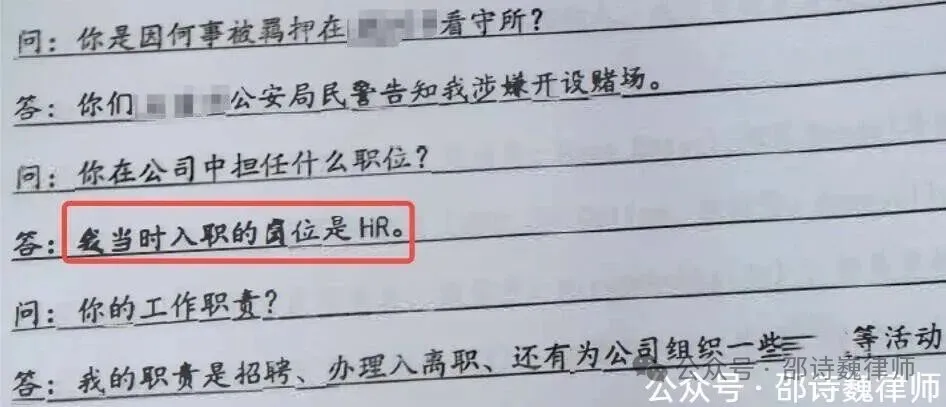
Therefore, for Web3 job seekers in the country, before deciding whether to accept an offer from an exchange or project party, it is advisable to carefully assess the potential legal risks after joining, in conjunction with the specific business model and the objective situation of domestic judicial practice, after consulting with a professional lawyer.
5. Returning to the Essence of Law: Is "Perpetual Contracts" Really Gambling?
In most litigated cases, cryptocurrency exchanges are classified as "operating a gambling establishment," and their contract trading modules are often viewed by law enforcement as key evidence of gambling nature.
However, is "perpetual contracts" really gambling? This remains a highly controversial issue.
Through handling multiple "contract-type" gambling cases and deeply analyzing the business logic of different platforms, we find that whether the contract module of a virtual currency exchange constitutes operating a gambling establishment is not a simple question that can be answered with a blanket yes or no (this is fundamentally similar to the previous discussion by Lawyer Shao on whether virtual currency should be classified as "data" or "property" The Qualitative Dilemma of Illegal Acquisition of Virtual Currency: Judicial Divergence between Property Attributes and Data Attributes (Part 3)), but rather requires specific analysis based on actual scenarios, taking into account the specific business logic, risk control measures, clearing mechanisms, and profit models of different exchanges' contract modules.
Therefore, any abstract or general discussion about "whether perpetual contracts are gambling"—such discussions detached from specific case facts and evidence, Lawyer Shao believes, are essentially meaningless.
Furthermore, even if the contract module exhibits certain characteristics that could be viewed as "gambling-related," the core of the case immediately transforms into a purely legal technical issue:
Has the burden of proof been fulfilled by the judicial authorities? Is the evidence they present indeed sufficient and conclusive enough to indisputably prove that the business meets all statutory elements of the "operating a gambling establishment" charge in the Criminal Law? This is precisely where professional criminal defense needs to focus on overcoming challenges and may uncover weak links in the accusatory system.
6. In Conclusion
Of course, we are well aware that there are still differing opinions and ongoing discussions in both theory and practice regarding the qualification issues surrounding such cases, and no absolute consensus has been reached; their complexity warrants in-depth consideration by legal colleagues. We attach some defense points we formed during the case handling process (content has been anonymized) for the reference and critique of fellow practitioners in professional exchanges.
Appendix: Defense Speech for Cryptocurrency Exchange Suspected of Operating a Gambling Establishment


Special Statement: This article is an original work by Lawyer Shao Shiwei and represents the author's personal views, not constituting legal consultation or legal opinions on specific matters.
Recommended Reading
免责声明:本文章仅代表作者个人观点,不代表本平台的立场和观点。本文章仅供信息分享,不构成对任何人的任何投资建议。用户与作者之间的任何争议,与本平台无关。如网页中刊载的文章或图片涉及侵权,请提供相关的权利证明和身份证明发送邮件到support@aicoin.com,本平台相关工作人员将会进行核查。


