Written by: Glendon, Techub News
As the cryptocurrency market continues to seek direction amidst market fluctuations, Fireblocks has outlined a clear strategic layout in the crypto infrastructure sector through a significant acquisition.
Yesterday, Fireblocks announced the successful acquisition of the cryptocurrency accounting platform TRES Finance for a combined cash and equity deal worth $130 million. Notably, just three months ago, in October 2025, Fireblocks completed the acquisition of the crypto wallet technology startup Dynamic Labs for $90 million. Within a short span of 90 days, Fireblocks has executed two major acquisitions, rapidly building a comprehensive ecosystem that encompasses asset custody, transaction settlement, and compliance accounting.
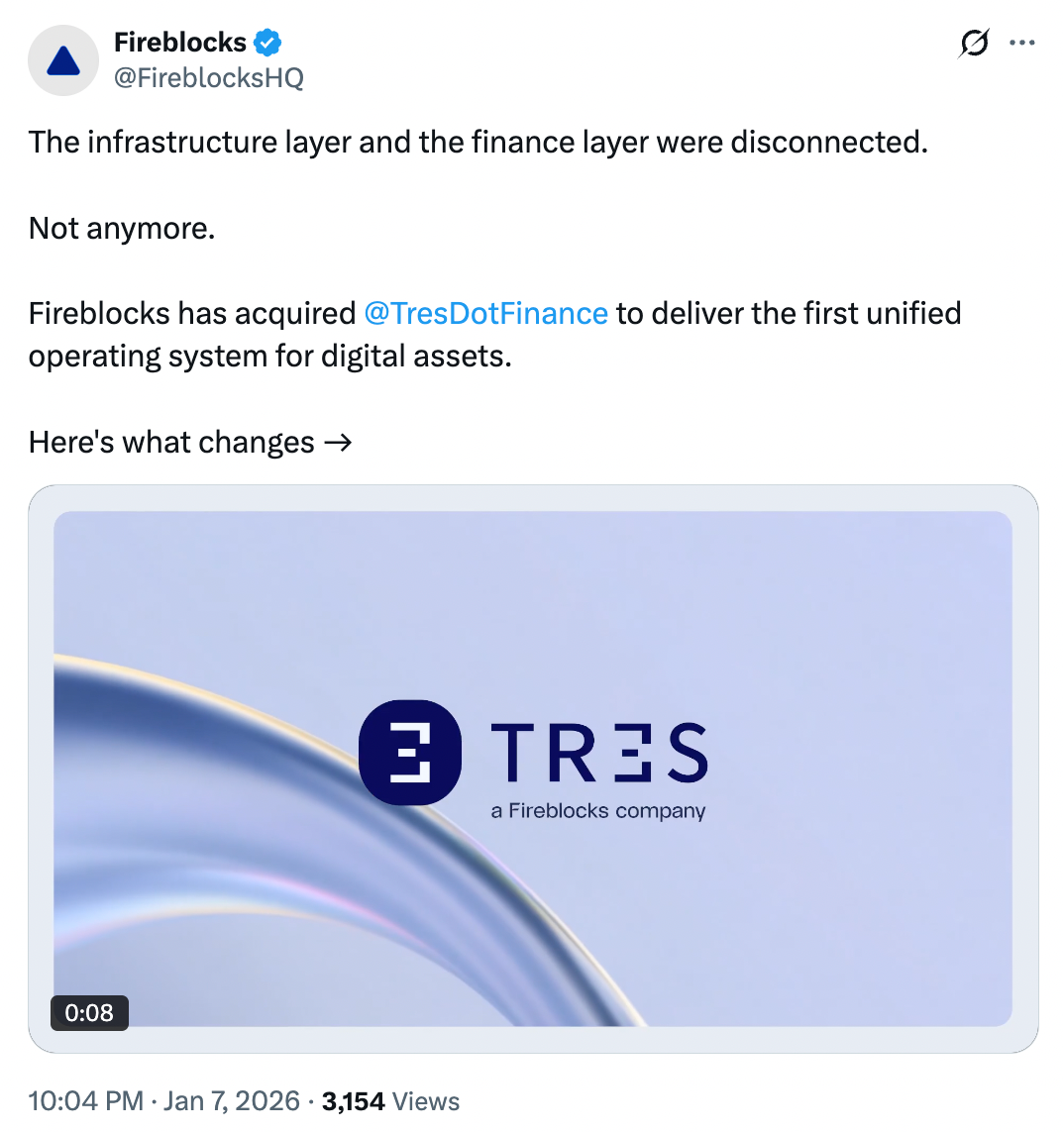
These two transactions also reflect the inevitable trend of the crypto industry moving towards "compliance maturity." With the arrival of the "institutional era," traditional financial institutions are accelerating their entry into the market. The challenges they face are not only ensuring the security of crypto assets but also effectively integrating these assets into the existing financial system. Fireblocks' acquisition of TRES Finance aims to fill this critical gap.
Fireblocks: A Veteran Crypto Infrastructure Platform
From its inception, Fireblocks has positioned itself as an institutional-grade blockchain infrastructure provider, focusing on offering multi-chain asset custody, transfer, and other solutions. In 2018, founders Michael Shaulov, Idan Ofrat, and Pavel Berengoltz established the company in Tel Aviv, Israel.
At that time, the blockchain industry was still a "digital asset wilderness" filled with opportunities and challenges, with the most pressing issue being how to securely transfer assets. This seemingly basic need has become a "stumbling block" preventing institutions from entering the market on a large scale. Therefore, Fireblocks' initial goal was to address the security pain points of institutional clients in digital asset transfers, eliminating risks of private key theft and human error through technological means.
With its core technology product Fireblocks Networks and MPC-based wallet infrastructure, Fireblocks quickly gained prominence and attracted widespread attention from institutions and investors. In January 2022, led by D1 Capital Partners and Spark Capital, Fireblocks completed a $550 million Series E funding round, with its valuation skyrocketing from $2.5 billion to $8 billion, and total funding exceeding $1 billion.
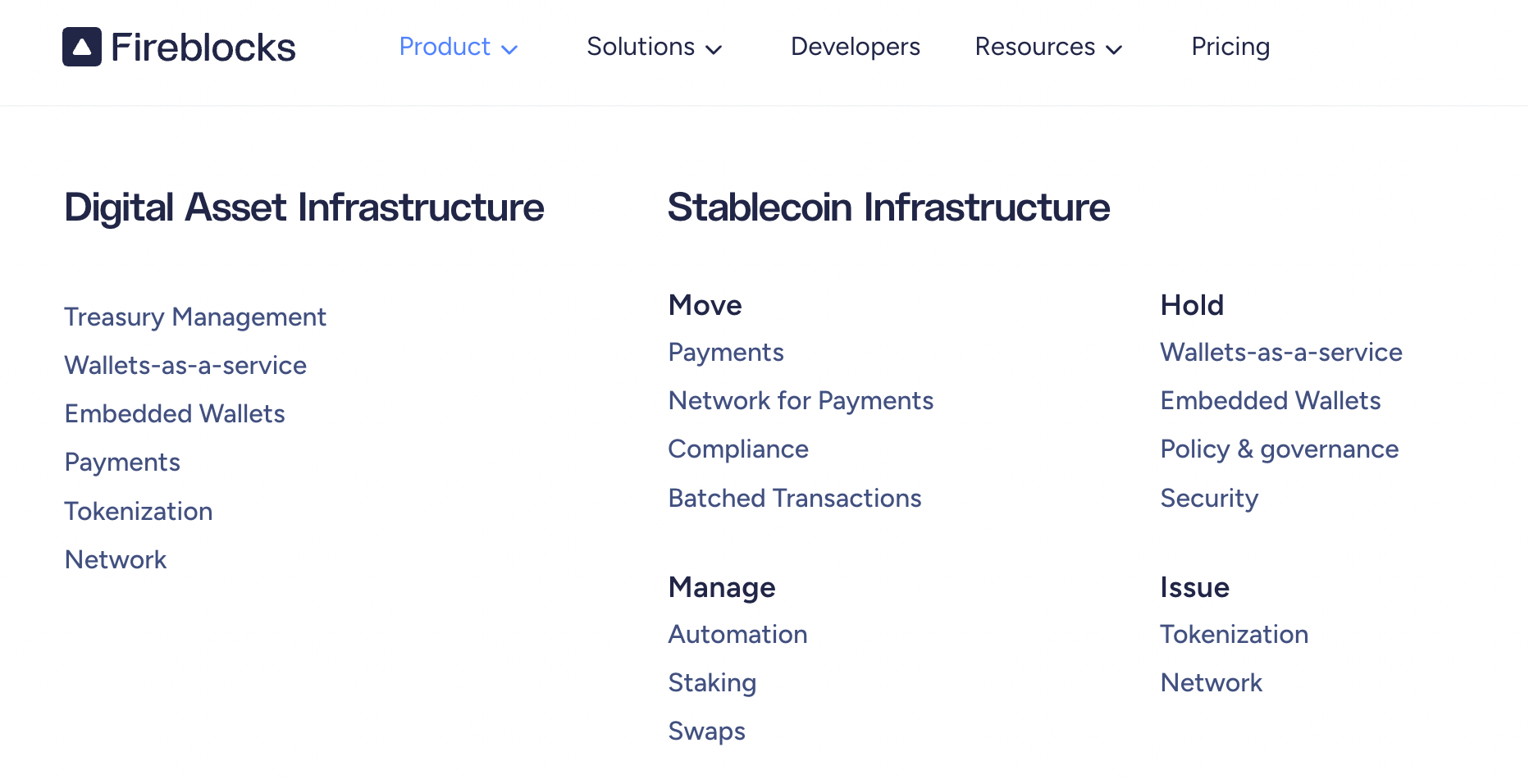
To date, the Fireblocks platform has secured $10 trillion in transactions, serving over 2,400 institutions, including traditional financial giants like BNY Mellon, Credit Suisse, and BNP Paribas, as well as crypto-native companies like Revolut, BlockFi, and Galaxy Digital. The company's business is primarily divided into two major segments: digital asset infrastructure and stablecoin infrastructure. The former includes core products such as financial management, wallet-as-a-service, embedded wallets, payments, and Fireblocks Networks; the latter encompasses payment networks, batch trading, staking, and more products and services.
Today, the development of the crypto industry exhibits distinct phase characteristics. In the early stages, the market focused on scalable digital asset trading capabilities. However, as the financial ecosystem migrates on-chain and the stablecoin sector rises, the industry has now entered a new phase that promotes global payments and asset tokenization. Meanwhile, the continuous growth of business opportunities has generated new operational demands, with compliance audit requirements becoming a key factor constraining industry development.
Plans to Create the First "Operating System" in the Crypto Field
Against the backdrop of gradually implemented global regulatory policies (such as the EU's "Crypto Asset Regulation" and the US's "GENIUS Act"), both crypto-native enterprises and traditional financial institutions now face a common challenge: how to convert on-chain activities into financial records that meet audit requirements and tax regulations.
For crypto-native enterprises, their long-term reliance on blockchain technology to pursue efficiency and innovation has led to a disconnect between on-chain operational data and the structured financial reports required for audits. Companies need to translate decentralized on-chain transaction data (such as DeFi yields and cross-chain transfers) into traditional accounting language. This not only results in significant manpower being spent on evidence collection for audit preparation but also raises concerns about data integrity, directly impacting critical processes such as IPOs, mergers and acquisitions, and institutional financing. Moreover, companies lacking compliant financial data face regulatory penalties and risk losing the trust of institutional investors due to their inability to demonstrate operational compliance, falling into a "compliance black hole."
Traditional financial institutions also face numerous challenges, particularly the contradictions of business transformation and data integration. Although banks and payment institutions embrace the efficiency advantages of blockchain through tokenized deposits and stablecoin transactions, the operational records generated by on-chain activities cannot automatically interface with enterprise resource planning (ERP) systems, necessitating the construction of customized data pipelines. This leads to a disconnect between "on-chain innovation" and "traditional compliance."
Additionally, the multi-chain nature of digital asset trading (such as cross Layer 2 transfers) is incompatible with the centralized financial systems of financial institutions, requiring repeated development of data interfaces for each new business, wasting resources and increasing operational risks.
In short, crypto-native enterprises lack standardized tools to convert on-chain data into compliant reports, while traditional financial institutions face a data gap between on-chain operations and core systems. Fireblocks pointed out in its announcement that the root of these issues lies in the significant disconnect between digital asset infrastructure and the existing financial system. Its acquisition of TRES Finance aims to target this structural gap, planning to create the first complete digital asset operating system that achieves native integration of on-chain activities with traditional financial systems.
Thus, Fireblocks' strategic direction has reached a new turning point. So, what exactly does TRES Finance do?
Founded in 2022 and raising $11 million in 2023, TRES Finance is a significant player in the digital asset accounting field. Its core business is to leverage AI-driven workflows to automate accounting, auditing, and reporting, transforming operational records into complete, structured financial information, enhancing accuracy, simplifying reconciliation processes, and always complying with regulatory requirements. Currently, the platform serves over 230 clients, including CoinFund, Nansen, Finoa, Alchemy, Dune, Wintermute, M2, and Bank Frick.
The most direct impact of acquiring TRES Finance is that Fireblocks will build an ecosystem that combines "secure custody + compliant accounting," generating synergies between the two. Fireblocks provides the secure infrastructure needed for institutions to build, scale, and manage digital asset operations, while TRES offers financial intelligence, converting activities into records consistent with existing ERP, ledgers, and reporting workflows.
This synergy creates a unique value proposition: for crypto-native enterprises, Fireblocks offers a one-stop solution from asset security to compliance auditing; for traditional financial institutions, it helps achieve seamless integration of digital asset activities with traditional financial systems.
This also reveals Fireblocks' clear strategic evolution path. From acquiring Dynamic Labs' institutional-grade wallet to TRES's compliance accounting, the company is integrating decentralized crypto service modules into a standardized solution.
It is worth noting that Fireblocks' layout extends beyond acquisitions. In September last year, Fireblocks launched the stablecoin payment network "Fireblocks Network for Payments," supporting crypto and financial institutions in easily transferring various stablecoins, with participants including Bridge, Zerohash, and Yellow Card. In the same month, Fireblocks reached a strategic partnership with Circle to provide cross-border fund management and tokenized asset settlement services. In December last year, Fireblocks became the stablecoin settlement platform for MoneyGram.
Yesterday, Fireblocks co-founder and CEO Michael Shaulov stated in an interview with Fortune magazine that many crypto companies are seeking to go public or need to operate in a manner that meets fintech or traditional financial standards. Although Fireblocks currently lacks data products to help companies monitor and analyze their cryptocurrency holdings in detail, he firmly believes that the company can create a more comprehensive fund management solution to meet the increasingly diverse needs of the market.
Just as the internet era gave rise to enterprise software giants like Oracle and SAP, Fireblocks' ambition may also be to become the "operating system" of the crypto field, a comprehensive platform that meets the compliance needs of banks, hedge funds, and other financial institutions while providing a secure foundation for crypto-native enterprises. As the "institutional era" of the crypto industry arrives, the deeply cultivated Fireblocks will also add a significant contribution to the increasingly完善的基础设施领域.
免责声明:本文章仅代表作者个人观点,不代表本平台的立场和观点。本文章仅供信息分享,不构成对任何人的任何投资建议。用户与作者之间的任何争议,与本平台无关。如网页中刊载的文章或图片涉及侵权,请提供相关的权利证明和身份证明发送邮件到support@aicoin.com,本平台相关工作人员将会进行核查。


