On the morning of January 9, 2026, East 8 Time, on-chain monitoring showed that Metalpha associated addresses withdrew 6,000 ETH each in three transactions from Kraken, totaling 18,000 ETH, worth approximately $56.01 million at the time, with each transaction amounting to about $18.67 million. This action, combined with over 25,000 ETH withdrawn from Kraken in the past week and the net outflow of approximately $159 million in ETH from exchanges on January 8, 2026, has raised market awareness of the continued contraction of available tokens on exchanges. There is a clear division in the market regarding this institutional-level transfer: one side believes it is a typical "transfer to cold wallets for hoarding," indicating a bullish outlook in the medium to long term; the other side worries it may be for over-the-counter staking or a reorganization of tokens before future selling pressure. This article will analyze the true implications of this large transfer from multiple dimensions, including capital flow, exchange supply, ETFs and macro environment, as well as derivatives leverage.
Large Withdrawals from Kraken and Institutional Capital Flow Patterns
● On-chain data indicates that this transfer was initiated from Kraken to the same Metalpha-associated self-custody address, split into three transactions of 6,000 ETH each, with the timing highly concentrated on the morning of January 9, 2026, UTC. Structurally, the three transactions are close in amount and tightly timed, suggesting a planned batch withdrawal and internal capital allocation rather than a temporary concentration of retail withdrawals.
● Based on the market price at the time, the total value of 18,000 ETH is approximately $56.01 million, corresponding to a single transaction size of about $18.67 million, which significantly exceeds the typical range for high-net-worth individual operations and aligns more with the characteristics of asset management institutions or professional trading firms. The market attributes this to Metalpha's past on-chain activities, but currently, this is primarily based on labels mapped from a single data provider.
● Research briefs show that over 25,000 ETH were withdrawn from Kraken in the past week (according to a single source). If we consider the 18,000 ETH in this context, a relatively clear pattern emerges: institutions complete liquidity acquisition and matching through Kraken and then transfer tokens en masse to self-custody addresses or other over-the-counter structures in a short time to reduce exchange risk exposure and achieve more refined internal management.
● It is important to emphasize that the current judgments regarding "25,000 ETH withdrawn from Kraken in the past week" and "18,000 ETH belonging to Metalpha-associated addresses" rely on limited on-chain markers and a single intelligence source, lacking broader multi-source cross-validation. In particular, the complete path of earlier withdrawals and subsequent deposits to other platforms, as well as whether there is any double counting, still requires further verification through specific transaction hashes. Therefore, interpretations of institutional identity and the entire capital flow route have boundaries and cannot be simply generalized into a fully determined historical operation chain.
Continuous Outflow of ETH from Exchanges and Price Dynamics
● According to brief data, the net outflow of ETH from exchanges on January 8, 2026, was approximately $159 million, which, along with the over 25,000 ETH reduction from Kraken in the past week, points to the same phenomenon: the supply of ETH available for immediate sale on the order book is continuously shrinking. For the short-term market, this means that if buying pressure remains unchanged, the marginal available tokens are decreasing, and passive selling pressure on the spot market may temporarily ease.
● On-chain analysts point out that concentrated withdrawals of thousands of ETH like this one will indeed reduce the immediate available supply on the exchange in the short term, theoretically helping to suppress panic selling and the depth of sell-offs, but this does not mean that prices will necessarily rise quickly as a result. The direction of prices still depends on multiple factors such as new buying pressure, over-the-counter liquidity, and macro risk appetite, so the simple association of "large withdrawals = price must rise" lacks stable statistical support.
● Observing from the order book and liquidity structure, when tokens of the scale of 18,000 ETH are concentrated and moved out of exchanges:
● On one hand, the depth of the order book passively shrinks, making it more difficult to directly hedge against equivalent scale selling demands in the short term, which may objectively reduce the convenience of "immediate sell-off," thus being interpreted as a bullish signal.
● On the other hand, when overall depth thins, if a large market order suddenly appears later (whether buying or selling), the capacity for quoting parties to absorb it decreases, slippage and instantaneous volatility will be amplified, making prices more prone to "flash surges" or "flash crashes," which is a double-edged sword for high-leverage positions and momentum trading.
Metalpha's Cold Storage Statement and Uncertainty of Motives
Metalpha's response to market concerns is that this large ETH withdrawal is part of "routine asset management operations," primarily for transfer to cold storage, with no intention to sell. From the perspective of institutional asset management practices, such statements typically imply that, under considerations of safety and compliance, large long-term held assets are moved from the exchange's hot wallet to a more secure multi-signature or hardware wallet system to reduce trust risks associated with a single centralized platform and provide clearer asset stratification for subsequent account audits and internal risk control. If viewed as standard compliance institutional operational logic, this statement aligns with the on-chain pattern of "concentrated transfer to a single self-custody address." However, the market has not reached a consensus on this. Some viewpoints suggest that such concentrated tokens could also be used for over-the-counter staking, collateral for structured products, or even preparing for future selling or hedging strategies, thus the possibility of "potential selling pressure preparation" cannot be simply ruled out based on official statements. More aggressive bears attempt to interpret any large withdrawal from Kraken as a "signal of escape," but this linear inference overlooks the complexity of institutions dynamically allocating assets across multiple platforms and tools.
Within a broader institutional practice framework, this withdrawal may also correspond to centralized custody management, over-the-counter derivatives hedging, structured product margin management, and cross-regional compliance isolation, among other reasonable uses, many of which do not directly correspond to spot trading behavior. It is precisely because institutions have diversified asset usage methods that the binary narrative of "withdrawal is bullish" or "withdrawal is bearish" increasingly fails to explain the reality of capital flows. For investors, a more prudent approach is to view such large transfers as variables that need to be monitored, rather than automatically attributing them to a bullish or bearish stance as a "certainty signal."
ETF Capital Flow and ETH Reallocation under Macro Rates
Another important clue regarding ETH capital flows comes from the ETF channel. Briefs indicate that Ethereum spot ETFs have recently shown an overall net outflow, with BlackRock experiencing a single-day net outflow of approximately $108 million, contrasting sharply with the net outflow of $159 million in ETH from exchanges on January 8: on one side, compliant ETF products are being redeemed, while on the other, on-chain self-custody addresses are absorbing spot. This indicates that institutional capital is undergoing a rebalancing process between different vehicles, rather than merely flowing in or out of crypto assets in one direction. Meanwhile, at the macro level, the Bank of Japan is widely expected to maintain interest rates, and in a globally relatively low-interest-rate environment, risk assets represented by ETH still hold appeal for some institutions. For overseas allocators, in the context of limited yields in traditional capital markets, dynamically adjusting positions through both ETFs and direct on-chain holdings allows them to leverage the compliance framework and regulatory transparency of ETFs while also utilizing the flexibility of on-chain participation in staking, DeFi, or over-the-counter derivatives trading. Metalpha's concentrated withdrawal is likely situated within this structural reallocation backdrop under a low-interest-rate environment.
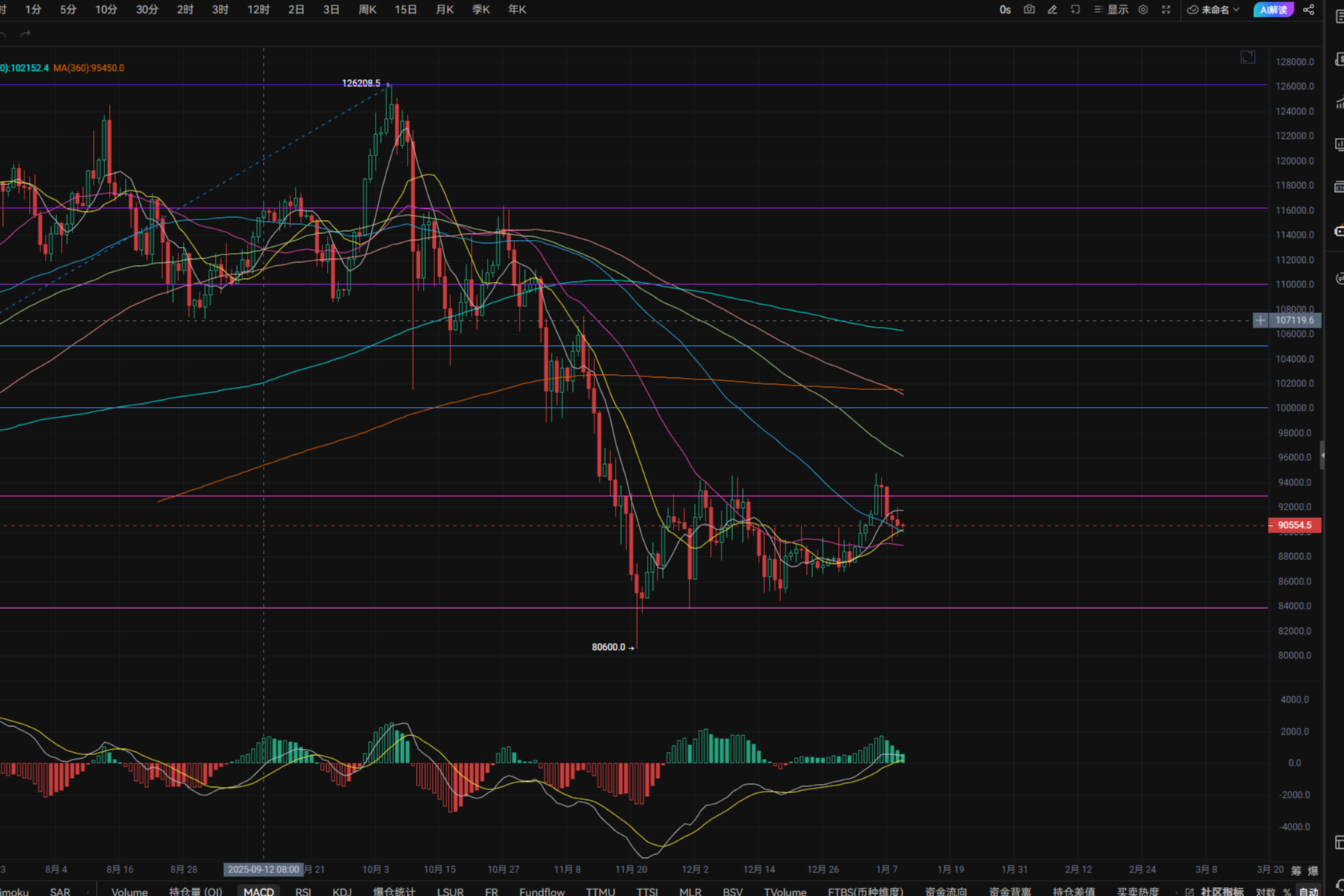
It is important to note that Bitcoin's current range of approximately $89,000 to $93,000 is viewed by the market as a key leverage liquidation price zone, which not only determines the concentration risk points for BTC long and short positions but also influences the entire crypto market through sentiment and capital transmission. If BTC experiences large-scale liquidations or missed opportunities within this range, the resulting risk appetite contraction or FOMO sentiment could transmit to ETH's capital flows:
On one hand, if a significant BTC pullback leads to leverage liquidations, institutions and traders may be forced to reduce their ETH holdings to replenish margins, weakening ETH's independent capital flow advantage; on the other hand, if BTC breaks through and triggers a new wave of enthusiasm, some capital may shift from ETF redemptions to on-chain channels with greater leverage and yield potential, including derivatives or staking products based on ETH. Metalpha's transfer from Kraken to self-custody addresses, whether for participation in more complex structured trades or simply to enhance asset safety margins, needs to be interpreted within this macro and cross-asset context rather than viewed in isolation as a "single wallet action."
On-chain Whale Signals and Responses from Different Investors
Looking back at past market cycles, institutional-level large on-chain transfers often occur near key turning points, but statistical experience clearly shows that correlation does not imply causation. Many cases of "whale transfers followed by significant price increases/decreases" reveal upon review that the fundamental drivers stem from macro liquidity, changes in policy expectations, or derivative leverage squeezes, while the transfers themselves are more a passive reflection or pre-arrangement of institutions within their risk management frameworks. Therefore, relying solely on a single event of 18,000 ETH concentrated withdrawal is insufficient to construct a stable and replicable "following strategy."
The current leverage levels, funding rates, and futures spot price differentials in the ETH derivatives market will also intertwine with this on-chain signal, affecting short-term trading strategies. If funding rates are high and futures premiums are significant, it indicates crowded long leverage; in this context, a large withdrawal may be interpreted by some traders as "tokens shifting from liquid accounts to illiquid cold wallets," thereby intensifying pressure expectations on shorts; conversely, if funding rates are low or even negative, and futures are trading at a discount, it indicates a more defensive overall market, making large transfers more likely to be interpreted as institutions preparing for hedging or structural protection. For quantitative and high-frequency funds, these signals will manifest in adjustments to leverage multiples, hedging position structures, and order book strategies, rather than simply "following the whale to buy or sell."
For different types of investors, a more realistic approach is to be data-driven and set response frameworks based on their own risk tolerance: medium to long-term allocators can focus on changes in total ETH balances on exchanges, ongoing ETF subscription and redemption directions, and macro interest rate paths, moderately increasing allocations during overall supply contractions and risk appetite recoveries, while maintaining phased entry and sufficient cash buffers; short to medium-term traders should view such large withdrawals as potential preludes to amplified volatility, managing slippage and tail risks arising from order book depth declines by reducing leverage multiples, controlling single-position sizes, and setting stricter stop-loss ranges, rather than blindly following any single "whale" action.
From Single Whale Actions Back to the Complete ETH Capital Landscape
Overall, the event of Metalpha withdrawing a total of 18,000 ETH from Kraken in three transactions has, on one hand, directly exacerbated the contraction of ETH supply on the exchange side, resonating with the $159 million net outflow across the network on January 8, amplifying the market's perception of tightness in spot tokens; on the other hand, the event itself is easily magnified as an emotional catalyst, triggering opposing narratives of "institutional hoarding is bullish" and "preparing for selling is bearish." Considering the current significant information gaps regarding institutional identity binding, the complete historical operation records, and the internal asset composition of cold storage addresses, any single conclusion about this transfer must be approached with caution, clearly defining the boundaries of judgment.
More importantly, the motivation for this withdrawal cannot and should not be assumed to have a single purpose. Whether it is Metalpha's official statement of "routine asset management with no intention to sell" or market speculation about over-the-counter staking, structured products, or preparations for future selling pressure, these can only serve as hypotheses and should not be treated as established facts. When interpreting such large on-chain transfers, it is necessary to combine ETF capital flows (e.g., BlackRock's single-day net outflow of $108 million), macro interest rates and the global liquidity environment, and the leverage risks corresponding to Bitcoin's liquidation range of $89,000 to $93,000, to construct a more complete picture of ETH's capital landscape, rather than being led by a single whale action.
Looking ahead, key indicators worth continuously tracking include: first, whether the Metalpha-associated addresses continue to accumulate or split and transfer out, and whether there are any associated operations with other large addresses or DeFi protocols; second, whether there is a turning point in the net inflow/outflow of ETH across exchanges, especially when price volatility amplifies, whether tokens are clearly flowing back to exchanges in preparation for liquidation; third, changes in the redemption rhythm of Ethereum spot ETFs, observing whether the current net outflow is a phase adjustment or a trend of capital withdrawal. Only under the premise that these dynamic data continuously update and mutually verify can the market make a more reliable judgment on the significance of the 18,000 ETH withdrawal event in a larger cycle.
Join our community to discuss and become stronger together!
Official Telegram community: https://t.me/aicoincn
AiCoin Chinese Twitter: https://x.com/AiCoinzh
OKX Benefits Group: https://aicoin.com/link/chat?cid=l61eM4owQ
Binance Benefits Group: https://aicoin.com/link/chat?cid=ynr7d1P6Z
免责声明:本文章仅代表作者个人观点,不代表本平台的立场和观点。本文章仅供信息分享,不构成对任何人的任何投资建议。用户与作者之间的任何争议,与本平台无关。如网页中刊载的文章或图片涉及侵权,请提供相关的权利证明和身份证明发送邮件到support@aicoin.com,本平台相关工作人员将会进行核查。