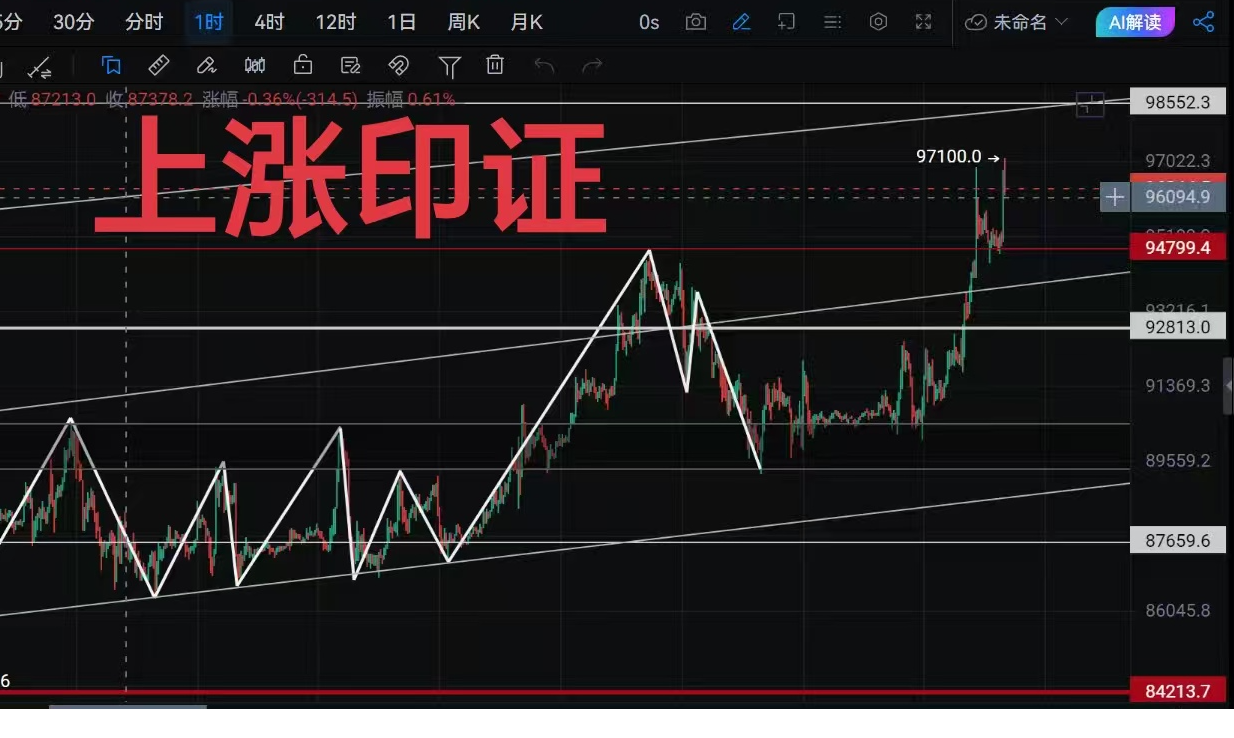
In the Eastern Eight Time Zone, Bitcoin briefly surged past the $95,000 mark this week, with significant intraday volatility and a flurry of liquidation and high-leverage liquidation news. Beneath the vertical price climb, the horizontal asset choices began to sharpen: some funds frequently switched between Bitcoin and the stock MicroStrategy (MSTR), while others revisited the safe-haven function of gold and other precious metals. Amid this multi-faceted tug-of-war, a new suspense emerged: when spot prices seemed robust and volatility indicators temporarily retreated, was Bitcoin's true volatility underestimated by the market, or was it cleverly shifted to other vehicles? And who was quietly bearing the risks behind this intense market movement?
Above Ninety-Five Thousand: The High-Pressure Zone of Long and Short Battles
After Bitcoin touched above $95,000, the market quickly entered a tug-of-war at high levels, with the fate of extreme leveraged positions becoming apparent first. Data from a single source indicated that there was a 20x leveraged short position with a nominal size of about $73.9 million, which was ruthlessly liquidated during the sharp upward movement, becoming a typical victim under the pressure of the bulls. The concentrated explosion of similar high-leverage positions further amplified the price volatility in a short time, intertwining high-level chasing and panic liquidations, with intraday fluctuations far exceeding normal phases. The subsequent short-term pullback and cooling of sentiment led to the question of "Is this a bubble?" spreading simultaneously on the market and social media. Some investors began to worry about the sustainability of high-level buying, while others viewed it as normal noise in a healthy adjustment. In this debate, QCP Asia's assertion that "Bitcoin is relatively undervalued compared to precious metals" formed a stark tension: prices were at historical high ranges, yet valuations were seen as relatively cheap by some institutions. This seemingly contradictory signal laid a clear foreshadowing for the subsequent rotation of funds between different assets and the transfer of volatility to other vehicles.
Volatility Outsourcing: How MSTR Takes Over…
To understand who is "taking on the volatility" in this market cycle, one cannot overlook the role of MicroStrategy. This company has continuously increased its Bitcoin holdings over the past few years, allocating a significant amount of assets to a single crypto asset, with its stock price highly correlated to Bitcoin's movements, but often with more extreme volatility. When Bitcoin rises or adjusts, MSTR's stock price often reacts in an amplified manner, becoming a "leveraged Bitcoin exposure." A prevailing sentiment in the market suggests that "MSTR bears 75% of the drawdown, buffering Bitcoin's volatility," a claim that comes from a single source and is merely a conceptual estimate, lacking specific time frames and calculation methods. However, it reflects a fact: many institutions and funds are beginning to expose themselves to the price risk of this asset indirectly by holding MSTR rather than directly holding spot Bitcoin. In this model, the volatility that should be directly reflected on-chain and in the spot market has been partially transferred to this crypto concept stock in the U.S. stock market, making the spot curve appear "more stable," while the real risk has not disappeared but has taken the stage elsewhere. The result of this volatility outsourcing is a reconstruction of the chain reaction between the spot and derivatives markets: the spot price's reaction to short-term bearishness may be dampened, but systemic risk forms a new transmission channel between the stock market and crypto assets. Once macro or regulatory factors resonate, the market faces not just a single asset's correction but a cross-market, multi-vehicle linked shock.
Decline in Options Heat: Risk Appetite…
In contrast to the high spot prices, the Bitcoin options market has shown a clear cooling. Data from a single source indicates that the open interest in Bitcoin options has shrunk from a high of about $52 billion to about $28 billion, nearly halving in a relatively short period. The significant decrease in open interest means that participants willing to "bet on volatility" have noticeably reduced, with some speculative positions choosing to close out, while others have narrowed their positions, concentrating hedging and speculation more in core ranges. For volatility, this retreat often brings two effects: on one hand, the reduction in passive buying and selling leads to a slight decline in implied volatility; on the other hand, the genuine hedging funds willing to pay for extreme market conditions have decreased, making the market potentially more lacking in buffer during extreme situations. The spot remains oscillating near high levels, while the derivatives exposure shrinks, creating a subtle mismatch—prices still appear strong, but risk appetite has shifted from "full offensive" to "cautious contraction." In this environment, it is hard to say that volatility has truly disappeared; a more reasonable explanation is that some volatility has withdrawn from options and high-leverage contract positions, beginning to transfer to more concealed vehicles, whether through crypto stocks, ETFs, or through weight adjustments within asset portfolios. The market is managing the same uncertainty in more complex ways.
Precious Metals and Crypto Stocks: Risk Aversion…
When QCP Asia proposed the view that "Bitcoin is undervalued relative to precious metals," the bargaining for traditional safe-haven assets like gold became active again. On one hand, funds that have long relied on gold to hedge macro risks will reassess which asset offers better value in the current environment when observing the relative movements of Bitcoin and gold prices; on the other hand, those who have deeply engaged in crypto assets will view precious metals as potential tools to hedge portfolio volatility. Meanwhile, crypto-related stocks are also amplifying the risk appetite of funds sensitive to coin prices. Information from a single source shows that the stock price of Japan's crypto treasury company Metaplanet rose 14.58% in a single trading day, indicating that besides MSTR, there is a group of assets in the global market that are highly sensitive to Bitcoin prices, actively absorbing some high-volatility funds. An invisible rotation is unfolding among Bitcoin itself, stocks like MSTR, other crypto stocks, and precious metals: when spot Bitcoin is seen as a "value anchor," stocks like MSTR and Metaplanet amplify sensitivity to its price, absorbing more aggressive risks; gold and other precious metals are embraced again during panic periods, taking on the risk aversion sentiment towards systemic events. Thus, fund behavior is no longer simply about "whether to enter or exit Bitcoin," but about rearranging risk exposure among various asset vehicles, laying out both offense and defense along the same logical chain.
Regulatory Expectations and Whale Reallocation: Under Currents…
Beneath the surface of price and volatility, structural actions by policies and large funds are quietly shaping this market cycle. Data from a single source indicates that the probability of a certain cryptocurrency bill being passed is estimated at 54%, a number that is not extreme but sensitive enough to become an important variable for medium to long-term fund adjustments. For institutions that need to consider the compliance environment, the uncertainty of regulatory prospects means that they must be more meticulous in currency selection, holding paths, and tool usage. Correspondingly, there are cross-asset reallocation actions at the whale level: according to a single source, a large holder recently exchanged about $26.33 million worth of Bitcoin for Ethereum. This action should not be interpreted as a simple bearish stance on Bitcoin, but rather as a restructuring of weights within the same asset class to adapt to potential policy changes and the evolution of technological narratives. Through these fragments, it can be seen that at high levels, the large funds truly dominating market direction are no longer focused on the short-term rise and fall of a single currency, but on the robustness and elasticity of the entire portfolio structure. When regulatory expectations waver, whales reallocate across chains, and institutions switch between MSTR, crypto stocks, and spot, the underlying logic of this game has long transcended the superficial debate of "Is Bitcoin expensive?" and shifted towards re-pricing the entire crypto asset landscape—from which assets bear growth expectations to which assets are responsible for absorbing systemic risks, each reallocation redraws the future risk map.
After Volatility Migration: The Next Step's Victory…
In summary, Bitcoin's current position is both a highly concentrated area of controversy and an experimental ground for re-layering and partially outsourcing volatility. On one hand, spot prices still hover at high levels, and the debate over whether valuations are overstretched continues; on the other hand, some volatility has already been transferred to crypto stocks like MSTR and Metaplanet, as well as broader equity market vehicles, while the heat of options and high-leverage contracts has clearly cooled. In this pattern, the rotation of funds resembles a continuous "risk redistribution" rather than a simple escape or all-in bet. The relative pricing battle between Bitcoin and precious metals will repeatedly fluctuate with macro conditions and regulatory progress; who serves as the long-term safe haven anchor and who is the high Beta growth asset will not have a unified answer in the short term. Looking ahead, several key variables will jointly shape the direction of the next market cycle: the speed and specific content of relevant bills will directly affect the boundaries for compliant funds entering crypto assets and their derivative vehicles (such as MSTR and various crypto stocks); the way institutions allocate Bitcoin risk exposure among various vehicles will determine whether volatility is concentrated on-chain or sliced into traditional financial markets; and whether the options market heats up again will also impact the liquidity buffer capacity and volatility structure under extreme conditions. In this process, every participant needs to be wary of excessive fantasies about so-called "safe exits"—whether turning to precious metals or indirectly holding Bitcoin through stocks and funds, these are merely changes in risk forms and presentation paths, not true disappearances. The more critical question is one's specific position in this volatility migration: what kind of vehicle is being held, what kind of volatility is being endured, and whether one is clear about the potential consequences of these choices in extreme situations.
Join our community to discuss and grow stronger together!
Official Telegram community: https://t.me/aicoincn
AiCoin Chinese Twitter: https://x.com/AiCoinzh
OKX Benefits Group: https://aicoin.com/link/chat?cid=l61eM4owQ
Binance Benefits Group: https://aicoin.com/link/chat?cid=ynr7d1P6Z
免责声明:本文章仅代表作者个人观点,不代表本平台的立场和观点。本文章仅供信息分享,不构成对任何人的任何投资建议。用户与作者之间的任何争议,与本平台无关。如网页中刊载的文章或图片涉及侵权,请提供相关的权利证明和身份证明发送邮件到support@aicoin.com,本平台相关工作人员将会进行核查。