What do you think of Sentient's economic model? Will you participate in the public sale?
The general impression is that it is a top-tier project, especially with the $85 million funding led by Founders and Pantera completed in 2024.
Currently, the overall token economy of $SENT is among the "most community-oriented" in AI+Crypto projects, and it can even be said to be quite aggressive.
It looks really good, but for projects like this,
people are very afraid that such "top-tier" will become "top-tier" again.
The good aspects of the token economy are visible to everyone, but I mainly want to point out the issues I see and the future FDV estimates:
Let’s take a quick look:
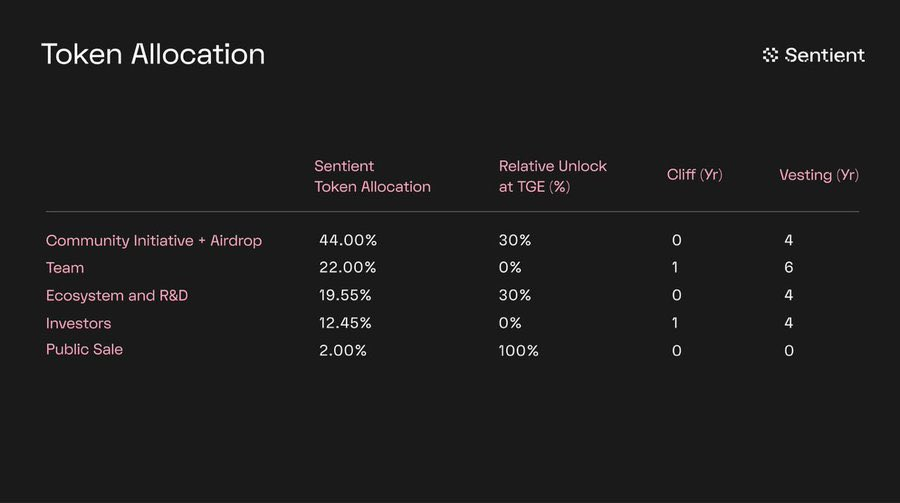
Total community allocation: 65.55% (that's really high)
1) 44% for community incentives and airdrops;
2) 19.55% for ecosystem and R&D pool;
3) Public Sale: 2.00% (very low proportion for public sale)
The team (22%) and investors (12.45%) together account for 34.45%.
Airdrop section:
It is said that a large portion will be unlocked at TGE (Token Generation Event) (it was mentioned that about 30% of this bucket will be released at TGE, accounting for about 13% of the total);
Ecosystem & R&D:
30% at TGE + 70% over 4 years linearly, which is relatively reasonable and standard.
Team: 1-year cliff + 6 years linear (locked quite tightly) → so the early circulation of the team will not be particularly explosive, but the community will have relatively more tokens.
I mainly want to point out a few issues I see:
1️⃣ The early circulation may be larger than expected;
If airdrop + public sale + ecosystem 30% are all released around TGE, the initial selling pressure will not be small (especially since many airdrop recipients will sell immediately).
2️⃣ The real value capture is still in the early stages;
$SENT is positioned as a "coordination layer" for paying for computing power, staking models, governance, and rewarding contributions.
However, the actual usage, willingness to pay, and monetization ability of the entire Sentient GRID ecosystem are still in very early stages.
→ The value of the token largely depends on whether "the community can really co-build a competitive AGI-level model," which is a very high-difficulty long-term bet.
Without a clear consumption and value recovery mechanism, this model will heavily rely on execution quality, and any slight misstep could lead to the old path of "community selling pressure + narrative-driven."
3️⃣ FDV predictions and public sale;
Let me say something blunt: projects with this "top-tier narrative + high community allocation" are most likely to take one of two paths—
Either it truly becomes "the coordination layer for open-source AGI," or it turns into "a liquidity container for open-source stories."
I will not use "storytelling valuation" for FDV; I will only use two metrics: circulation + real consumption.
A) First, calculate the "real pressure of early circulation"
It has been broken down clearly:
Airdrop (a large portion released at TGE)
Ecosystem & R&D also has 30% at TGE
Although the public sale proportion is low, if the pricing is aggressive, it will still create anchor selling pressure.
So I will view it as "early circulation is relatively large, and price volatility is extreme": it’s not that it can’t rise, but "once it rises, it can easily be brought down."
B) Next, see "whether the token actually supports the business"
Sentient talks about the coordination layer: payment for computing power, model staking, governance, and rewarding contributions.
The problem is: these demands are only "supposed to exist" until GRID demonstrates real payment/call volume.
If in the future there is no:
Clear token sink / burn / fee capture
Or the income scale of models/agents can cover incentive distribution
Then SENT will become: maintaining the ecosystem with incentives, supporting valuation with narratives—this path is very familiar, and the outcome is also very familiar.
C) Therefore, I will give FDV a "range," rather than a "divine prediction."
Optimistic scenario: GRID generates sustainable income + SENT becomes a necessary consumable → FDV can be outrageous (because it becomes "the fee layer for AI production materials")
Neutral scenario: the ecosystem is active, but value capture is weak, mainly driven by incentives → FDV won’t rise, more of an emotional wave market.
Pessimistic scenario: usage doesn’t pick up + continuous selling pressure from airdrops → FDV will be brought back to reality by circulation.
I personally lean towards: trading based on the neutral scenario, and adjusting the narrative weight once business data comes out.
Will I participate in the public sale?
If it were me: "I will watch, but I won’t get overly excited," more like participating for a ticket, rather than betting on faith.
I will set three hard conditions:
The public sale price should not be outrageous (don’t give me a ceiling right from the start)
TGE circulation should be controllable (don’t pile airdrop + ecosystem releases together)
There should be a clear roadmap for value recovery mechanisms (when to start charging, how to flow back to the token)
As long as one of these three conditions is not met:
I would rather wait for the market to vote with its feet after TGE, to get a more certain price and buy a more certain trend.
免责声明:本文章仅代表作者个人观点,不代表本平台的立场和观点。本文章仅供信息分享,不构成对任何人的任何投资建议。用户与作者之间的任何争议,与本平台无关。如网页中刊载的文章或图片涉及侵权,请提供相关的权利证明和身份证明发送邮件到support@aicoin.com,本平台相关工作人员将会进行核查。


