Bitcoin’s midweek momentum stalled Friday as the premier digital asset extended its Jan. 15 reversal. After an aggressive push that saw the cryptocurrency flirt with the $98,000 resistance level, it succumbed to profit-taking, plunging to a session low of $94,251. While it managed a modest recovery to stabilize near the $95,000 handle, technical exhaustion was palpable.
This retracement was largely mirrored by a noticeable deceleration in spot exchange-traded fund flows. Following a high-octane 48-hour window of massive institutional inflows, the appetite for fresh exposure appeared to reach a temporary saturation point. Without the fuel of record-breaking ETF buy-side pressure, bitcoin lacked the catalyst required to reclaim $97,000.
Read more: Bitcoin Nears $100,000 as Tariff Limbo and Fed-Trump Clash Ignite ‘Perfect Storm’
The narrative at the week’s open was dominated by a “perfect storm” of geopolitical anxiety and macro speculation. However, by Friday, a dearth of market-shifting headlines left the asset class drifting. As a result, bitcoin’s total market capitalization, which appeared on course to breach the $2 trillion mark on Jan. 14, had ebbed just below the $1.9 trillion mark at the time of writing, 2:20 p.m. EST.
This retreat dampened sentiment across the altcoin landscape, dragging the aggregate crypto economy’s valuation down to just above $3.3 trillion. While bitcoin was eyeing double-digit percentage gains after the first days of the week, the cryptocurrency seemed to be on track to close with a more conservative 4.5% seven-day increase.
Meanwhile, the wavering performance was not localized to crypto. Traditional equities spent the session “grinding sideways” as the early-week euphoria surrounding the 2026 earnings cycle began to fade. The S&P 500 remains tantalizingly close to the 7,000-point psychological milestone, though it is limping toward a modest 0.1% weekly gain. The tech-heavy Nasdaq Composite, meanwhile, struggled to maintain its footing and was on course for a negative weekly close.
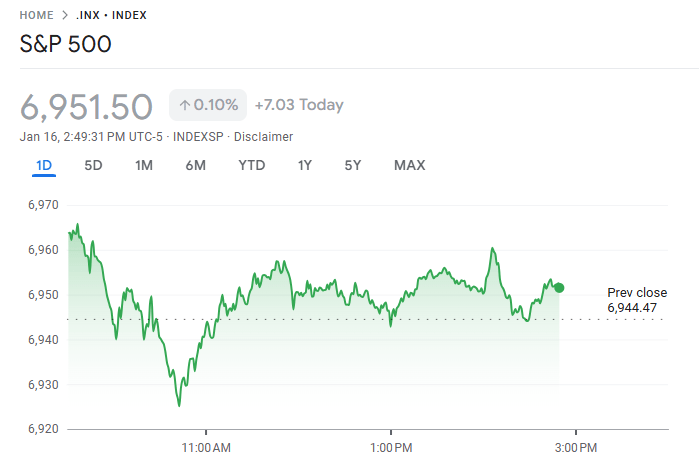
Analysts attributed the flat performance across global markets to the “Iran premium,” which deflated after President Donald Trump indicated that Tehran had heeded his warning against executing protesters. With the immediate threat of military intervention subsiding, the “fear trade” lost its luster. Gold ($4,604) and silver ($91.60), which both notched new milestones on Wednesday, spent the day trading in a tight, sideways range as investors rotated back into riskier assets.
Bitcoin’s technical profile on Jan. 16 reflected a market caught between a successful breakout and immediate resistance exhaustion. After failing to breach the $98,000 handle midweek, the asset is now testing the strength of its newly established support zones.
The 21-day moving average, currently sitting at $91,200, remains the primary line of defense for the short-term bullish trend. Analysts note that as long as the price holds above this level, the path of least resistance remains upward. However, the 365-day moving average at $101,448 acts as the definitive macro bear-market barrier that bulls have yet to reclaim.
The 14-day relative strength index ( RSI) is currently hovering around 64. This indicates strong buying momentum without yet entering overbought territory, suggesting there is still technical room for a move toward $100,000 if buyers return.
- Why did bitcoin stall near $98K? Profit‑taking and technical exhaustion capped momentum after testing resistance.
- How did ETF flows impact the pullback? Institutional inflows slowed, removing a key catalyst for upside.
- What happened to bitcoin’s market cap? It slipped below $1.9 trillion after failing to sustain early‑week strength.
- Are technicals still supportive? Yes, as long as price holds above the $91,200 21‑day moving average.
免责声明:本文章仅代表作者个人观点,不代表本平台的立场和观点。本文章仅供信息分享,不构成对任何人的任何投资建议。用户与作者之间的任何争议,与本平台无关。如网页中刊载的文章或图片涉及侵权,请提供相关的权利证明和身份证明发送邮件到support@aicoin.com,本平台相关工作人员将会进行核查。


