CZ Hong Kong Speech: DEX Will Surpass CEX in Ten Years, AI and Web3 Integration Will Ignite the Next Round of Crypto Growth
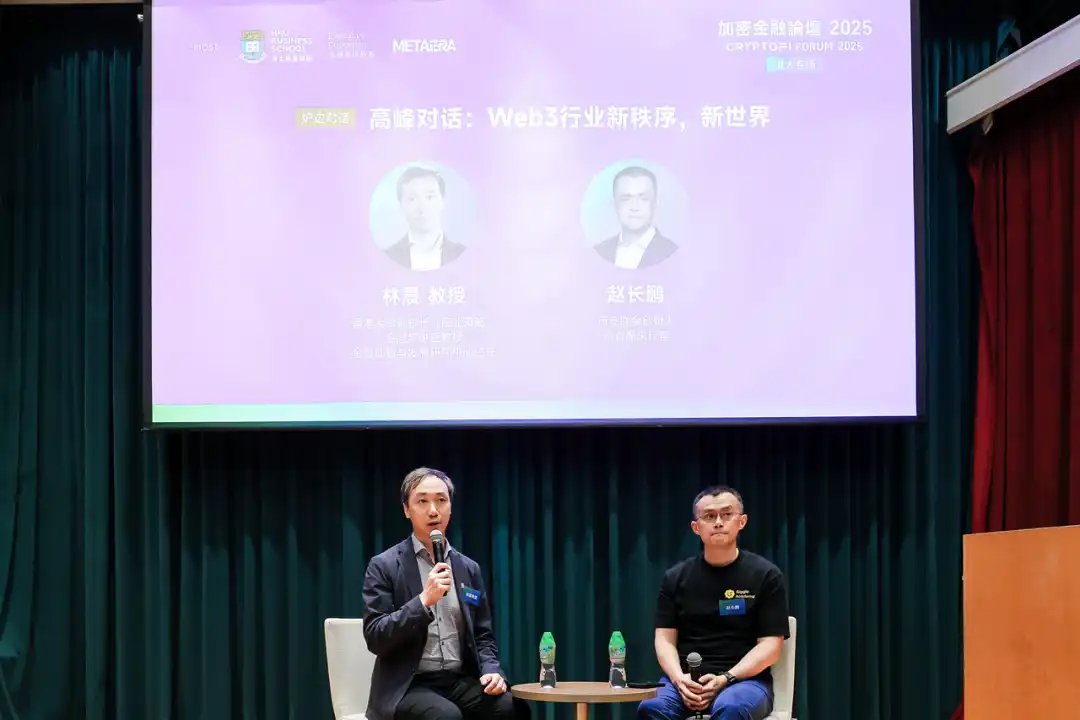
At the "Hong Kong Crypto Finance Forum" held on August 27, Binance founder Zhao Changpeng (CZ) delivered a keynote speech, systematically outlining his views on the future of crypto finance over the next decade. His speech revolved around five major themes: stablecoins, tokenization of real-world assets (RWA), decentralized exchanges (DEX), digital asset treasury (DAT), and the integration of AI and Web3, providing the market with a rare strategic perspective.
Stablecoins are Reshaping the Global Power of the Dollar
CZ believes that stablecoins are one of the core pillars of the crypto financial system, and their importance far exceeds the market's short-term perception.
He reviewed the entire process from the birth of USDT in 2014, the introduction of USDT by Binance in 2017, to the rise of BUSD, pointing out that stablecoins are not only a hedging tool but also an "invisible engine" driving the globalization of the dollar.
"Today, about $100 billion of USDT is used to purchase U.S. Treasury bonds, which means stablecoins directly strengthen the extended influence of the dollar," CZ stated.
He also noted that interest in local stablecoins is rapidly increasing in various countries, with some viewing stablecoins as a new path for the internationalization of their currencies. In contrast, central bank digital currencies (CBDCs) are facing widespread indifference due to regulatory and liquidity constraints.
"The biggest natural application of blockchain is finance, and stablecoins are the starting point for the financialization of blockchain," he said.
RWA Tokenization: Huge Potential, Difficult Reality
CZ pointed out that the much-discussed RWA track (tokenization of real-world assets) has disruptive potential, but its implementation is far more challenging than imagined.
He summarized the core obstacles into three points:
Insufficient Liquidity: Most RWA assets have low volatility and limited trading depth, making it difficult to form a healthy market;
Complex Regulations: Regulatory fragmentation across different jurisdictions creates high barriers to licensing;
Immature Mechanisms: Current securities tokenization products do not effectively anchor the price to the underlying assets, leading to systemic flaws.
However, the success of stablecoins has proven that the path to tokenizing assets with financial attributes is feasible.
CZ believes that if the U.S. can promote the tokenization of traditional assets like stocks, it will further strengthen its financial dominance, while Asian markets, including Hong Kong, are in a critical strategic window.
"From an economic logic perspective, this is a transformation that cannot be missed. The digitalization trend in financial markets will not wait for laggards," he said.
DEX Will Surpass CEX in 10 to 20 Years
Regarding the future landscape of exchanges, CZ has a clear judgment: "In the long run, the volume of decentralized exchanges will surpass centralized platforms."
He explained that all assets that can be tokenized are essentially tokens at the technical level, whether they are cryptocurrencies or RWAs, and their trading logic is fundamentally no different.
Future exchanges will break down barriers between asset classes, enabling the free flow of global assets.
At the same time, he suggested that Hong Kong's crypto regulatory model should avoid overly localized compliance requirements, which may stifle market vitality. "True user protection is not built on isolation but on deep liquidity."
He believes that a platform with global matching capabilities can actually minimize trading risks and price impacts.
Although DEXs currently still have gaps in terms of usage thresholds, fees, and user experience, CZ is confident that advancements in technology and user education will drive a breakout in the next 5 to 10 years.
DAT Model: The "Bridge" for Traditional Capital to Enter Crypto
On the topic of Digital Asset Treasury (DAT), CZ believes this is a key mechanism connecting traditional investors with crypto assets.
By structuring digital assets in a stock-like form, enterprises, funds, and even state-owned enterprises can indirectly gain exposure to digital currencies.
CZ explained that there are four mainstream models for DAT companies—from passive single-coin holdings to ecosystem investment institutions, with Binance leaning towards supporting a "single-coin long-term holding" structure to reduce legal risks and operational costs.
"We hope these companies become capital participants in the ecosystem rather than speculators," he added.
In his view, the rise of DAT signifies that traditional financial capital is beginning to systematically enter the crypto asset market, which will have a long-term impact on the industry landscape.
AI + Web3: The Payment Revolution of the Machine Economy
When discussing the integration of AI and Web3, CZ summarized it in one sentence: "The currency used by AI in the future will not be the dollar, but digital currency."
He predicts that when AI agents become the main entities of production and services, decentralization, automation, and micro-instant payments will become mainstream, with every interaction potentially being an on-chain transaction. This will lead to exponential growth in transaction volume and create a new paradigm of the "machine economy."
However, the enormous computational demands and capital consumption of the AI industry are forcing it to seek new financing mechanisms.
CZ believes that the tokenization model of Web3 can bring a more flexible and equitable capital flow model to AI infrastructure. "AI should be a public good, with decentralized governance and profit distribution."
Hong Kong's Window of Opportunity
Summarizing his views, CZ stated that Hong Kong is at a historical juncture in the development of crypto finance.
In terms of stablecoin regulation, asset tokenization, and AI innovation policies, Hong Kong is acting swiftly and with an open attitude, likely to become a new hub for digital finance in Asia.
"The future competition is a competition of openness and liquidity. If Hong Kong seizes this opportunity, it can occupy a key position in the new round of global financial restructuring," CZ said.
CZ's speech marks a shift in the crypto industry from cyclical discussions to structural transformation. From stablecoins to decentralized trading, from RWA to the AI economy, he envisions a future where decentralized finance is fully integrated into the real economy.
免责声明:本文章仅代表作者个人观点,不代表本平台的立场和观点。本文章仅供信息分享,不构成对任何人的任何投资建议。用户与作者之间的任何争议,与本平台无关。如网页中刊载的文章或图片涉及侵权,请提供相关的权利证明和身份证明发送邮件到support@aicoin.com,本平台相关工作人员将会进行核查。


