Original Title: "Noble Leads the Exodus, Is 'Cosmos Dead' Yet Again Confirmed?"
Original Author: Sanqing, Foresight News
On January 20, Noble, a Cosmos application chain focused on stablecoins, announced its migration from the Cosmos ecosystem to an independent EVM L1 network. The Noble EVM is set to launch on March 18, and the team will continue to support Cosmos-based blockchains in the short term. After the migration, Noble's own USDN stablecoin will become a core feature of the EVM L1, and the NOBLE token will serve as a governance asset, closely linking protocol decisions and value to the stablecoin usage across the entire network.
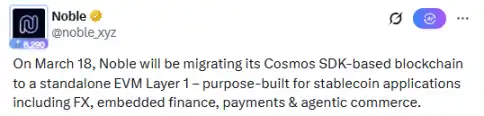
Image Source: Noble Tweet
Subsequently, the founder of Cosmos responded, stating that Noble's transformation does not signify a departure from the vision of Cosmos, but rather embodies the core concept of "sovereignty and interoperability." The migration of Noble does not mean a disconnection from Cosmos Hub. On the contrary, through the IBC v2 protocol, the migrated Noble EVM will become a key bridge connecting the EVM ecosystem with the Cosmos economy. He stated, "We are entering an era where boundaries are no longer defined by chains, but by liquidity."
Why Did Cosmos's Stablecoin Champion Choose to Leave?
Noble is one of the most successful stablecoin infrastructure projects in the Cosmos ecosystem. It is the native chain that brings Circle's USDC to the Cosmos ecosystem, distributing USDC securely and frictionlessly to over 50 chains through IBC, with a cumulative transaction volume exceeding $22 billion.
Noble's existence has given the Cosmos ecosystem a competitive edge with a "native stablecoin," avoiding the trust risks associated with relying on external bridges.
But why is Noble migrating? The official reason given by Noble is quite pragmatic:
The EVM ecosystem holds absolute dominance. Over 75% of the stablecoin market is on EVM chains. Developers, tools, wallets, and dApps are concentrated in the EVM, and Noble wants to be a "stablecoin infrastructure L1," naturally following the money and people.
The EVM tech stack is more developer-friendly. EVM has mature tools like Solidity, Remix, and Hardhat, making it easier to integrate with protocols like Uniswap and Aave. While the Cosmos SDK is powerful, it has a steep learning curve, and the ecosystem tools are relatively lagging.
EVM offers better performance and real-world use cases. Noble EVM aims for sub-second latency, targeting scenarios like payments, embedded finance, agentic commerce, and FX. Although Cosmos's Tendermint consensus is reliable, the EVM stack can better align with mainstream payment chains.
Noble has its own strategic ambitions. Noble does not want to be just a "tool" within Cosmos; it aims to become an independent high-performance stablecoin Layer 1, directly competing with other stablecoin public chain projects.
Thus, Noble voted with its feet. Cosmos provided the soil for its growth, but EVM offers a scalable future.
Noble's Departure Takes Away Half of Cosmos's Vitality
Noble is the only "super giant" in Cosmos. Noble's 30-day IBC transaction volume reached $93.84 million, which is 1.8 times that of the second-ranked Osmosis ($50.06 million). Among the 110 Zones linked by Cosmos IBC, Noble contributed a tier-level liquidity.
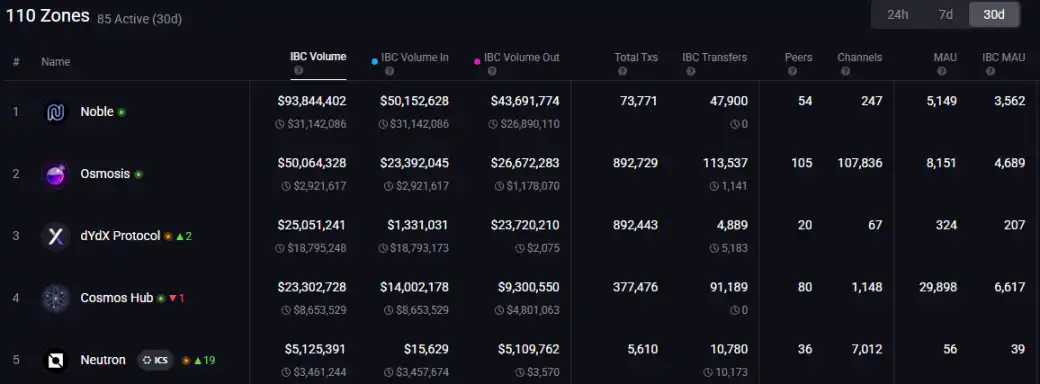
Image Source: MAP OF ZONES
Noble is a "faucet" for institutional funds. Osmosis has nearly 900,000 transactions, while Noble has only 73,000. This means that the average transaction value of Noble is much higher than that of other chains, carrying not small retail exchanges but institutional-level stablecoin settlements and large distributions.
Although IBC connects 110 Zones, only 85 remain active. This means that 23% of the chains are already in a state of death. Liquidity is highly concentrated in the top four chains, while projects ranked outside the top ten have seen their monthly transaction volumes shrink to the million-dollar level, severely depleting the retail vitality of the ecosystem.
Cosmos Hub has about 30,000 monthly active users, which is six times that of Noble (about 5,000). However, the money is clearly flowing to Noble. Most Cosmos users are either staking on the Hub or observing, while the stablecoin activities that generate real value exchange are almost entirely tied to Noble.
The Soul of the Cosmos Ecosystem: How Does IBC Keep the "Internet of Blockchains" Running?
The core narrative of Cosmos is the "Internet of Blockchains," and the realization of this vision is through IBC (Inter-Blockchain Communication Protocol).
IBC is Cosmos's most unique and successful invention. It allows independent sovereign chains to communicate and transfer assets securely and without the need for a trusted third party, much like the TCP/IP of the internet. Its core features include:
Minimized Trust: Verifying the state of the other chain through light clients without the need to custody assets or use multi-signature bridges.
Permissionless Interconnection: Anyone can establish a channel, supporting token transfers, Interchain Accounts, Interchain Queries, and more.
Universality: Not limited by consensus mechanisms, it has connected over 110 chains (according to Map of Zones data), even extending to non-Cosmos chains like Ethereum and Optimism.
IBC has high security, never having been exploited on a large scale, with cumulative transfers amounting to hundreds of billions of dollars. Even if other parts of Cosmos are controversial, IBC itself remains the industry's top interoperability solution.
However, Noble's migration also exposes the awkwardness of IBC: it connects the world but fails to retain projects—everyone interconnected ultimately wants to dominate the EVM single chain.
The Exodus Confirmed: Which Cosmos Projects Will Die or Migrate by 2025-2026?
From 2025 to early 2026, the Cosmos ecosystem experienced a severe "project exodus/shutdown wave."
First, let's talk about those projects that have completely shut down or ceased operations. Most of them had already died by 2025, leaving only community regrets and sporadic maintenance attempts.
The privacy chain Penumbra has completely shut down, with the team exiting; although the chain has a community that barely maintains it, it is essentially ignored, becoming the most typical "dead" case. Pryzm has also completely shut down, and Comdex and Kujira have subsequently fallen, with the latter even taking down sub-projects like Fusion and Levana, resulting in a complete break in the DeFi ecosystem chain.
Stride has officially sunset and ceased operations; Quasar and Tower have died one after another, and Picasso/Composable, after collapsing, trapped SOL assets that were bridged in, leaving users with nothing. Drop abandoned its TGE and sunset, Milkyway shut down, Demex failed to recover after a hacking incident, and Evmos is essentially dead.
These projects cover multiple sectors such as DEX, lending, privacy, and NFTs, with reasons mostly related to lack of growth, insufficient revenue, team attrition, and the long-term aftershocks following the Terra collapse.
Meanwhile, some projects have chosen to migrate to non-Cosmos stacks, or have become the biggest betrayal of the Cosmos narrative. Besides Noble, Sei previously decided to abandon its dual-stack architecture in the SIP-3 upgrade, planning to retain only the EVM chain by mid-2026.
Akash is migrating to Solana, while projects like Elys, pStake, Jackal, and Omniflix are moving to Base. Stargaze is an independent chain planning to migrate to Cosmos Hub, and Shade Protocol (renamed Feather) first migrated to Sei and may further EVM-ize in the future.
The core motivation for these migrations is almost uniform: the developer tools, liquidity, and market scale of the EVM ecosystem far exceed those of Cosmos, leading project teams to vote with their feet, choosing to follow the money and opportunities.
There are also a number of projects that, while not dead, have entered maintenance mode or resource reallocation, with slow project progress.
Osmosis has entered maintenance mode; although it is still maintaining token economics and other updates, team resources have clearly shifted out, and activity has significantly declined. Astroport is similar, essentially stagnant; the Axelar team, after being acquired by Circle, has seen the original project's influence sharply diminish. These projects were once pillars of Cosmos DeFi but have now become a reflection of the ecosystem's shrinkage.
Mantra has undergone restructuring (layoffs in January 2026, cost optimization) and the collapse of the OM token (down nearly 99%), but the project is still progressing. The ERC-20 OM migration is ongoing, with RWA vaults, launchpad, and other functions under development, and it will continue to operate as an IBC-compatible RWA EVM L1.
Additionally, many DEXs such as Wynd, Hopers, Junoswap, Loop, and TerraSwap closed down between 2024 and 2025. Retail DeFi is essentially dead, leaving only institutions and RWA holding on.
The MAP OF ZONES shows that IBC connects 110 chains, but IBC traffic is highly concentrated in the top few (Noble, Osmosis, Cosmos Hub). Once Noble's liquidity migrates away, the overall activity of the ecosystem will be further exacerbated.
Although the Cosmos 2026 roadmap attempts to reverse the decline through EVM compatibility and high-performance upgrades, Noble's "departure" undoubtedly reveals a harsh reality: in the face of liquidity, technical narratives often appear powerless.
免责声明:本文章仅代表作者个人观点,不代表本平台的立场和观点。本文章仅供信息分享,不构成对任何人的任何投资建议。用户与作者之间的任何争议,与本平台无关。如网页中刊载的文章或图片涉及侵权,请提供相关的权利证明和身份证明发送邮件到support@aicoin.com,本平台相关工作人员将会进行核查。


