Original author: Julie Chen (@0xJuliechen)
a16z raised $1.5 billion, what exactly is the new media they are betting on?
On X, everyone is a KOL, with millions of views each month, and traffic is no longer valuable. What is valuable is attention, the power of "belief," and the scarce right.
An article clarifying a16z new media, agency, and how Twitter can generate meaningful traffic, leading to ICM.
🌟🌟
@a16z raised 1.5 billion dollars in New Year financing, making headlines across major platforms. They raised so much money to tell a story of "all in America, believing in AI + crypto and technology."
Two months ago, they specifically established a new media team to help a16z and their portfolio companies with "new media."
Recently, AI/web3 companies in Silicon Valley have also been hiring, offering high rewards to find a "storyteller," someone who can write threads, shitpost, and tell stories.
The partner of a16z new media directly stated: marketing expertise has replaced computer science as the "hot commodity."
What a16z has truly valued in recent years is not the content itself, but the way power is being restructured.
New media is just a facade.
The real change is: who has the right to make people act (agency).
1️⃣ Why has "new media" been elevated so high in the past two years?
Because the path of attention economy has basically run out of tricks.
- Content is extremely oversaturated
- Distribution costs are nearly zero
- Being seen no longer constitutes an advantage
What is truly scarce now is not exposure.
But two things:
- Whether your judgment is worth believing
- Whether you can turn "belief" into "action"
This is also why you can clearly feel a change:
In the past, media was more about telling stories and setting narratives;
Now, media has begun to directly influence decisions and trigger actions.
When content is no longer scarce,
What is truly valuable is no longer "what you said,"
But — what will happen next.
This is the core meaning of a16z repeatedly discussing new media.
It is not about the format of threads, podcasts, or short videos,
But rather the distribution structure has changed, and the power structure has changed along with it.
A simple comparison:
Old Media
- Distribution is scarce (TV, newspapers, platforms)
- Value is concentrated in institutions
- Creators are essentially employees
New Media
- Distribution is decentralized (X / YouTube / Substack / podcasts)
- Individuals themselves become nodes
- Creators directly accumulate influence and bargaining power
The real change can be summed up in one sentence:
Media has transformed from institutional assets to personal capital.
And once media becomes personal capital,
It is no longer just an "exposure tool,"
But begins to transform into a power tool.
When media belongs to institutions, it is your exposure tool;
When media belongs to individuals, it becomes your ability to influence others' decisions.
And influencing decisions is power.
2️⃣ Agency
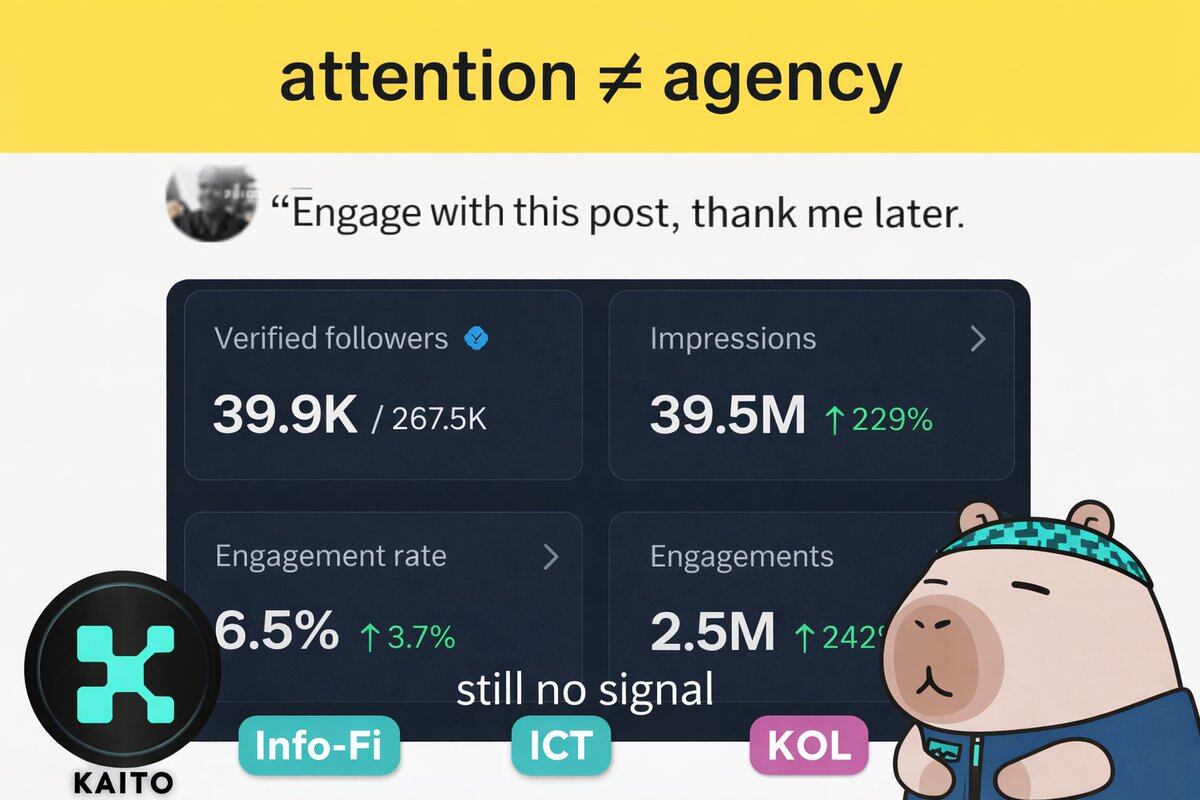
The endpoint of new media is not views,
But agency.
Agency means others are willing to act with you, believe in your judgment, and pay for your concepts.
Packy mentioned in "The Power Brokers":
The goal of the fund is to earn carry with as few people as possible in the shortest time.
The goal of the firm is to scale and continuously accumulate long-term advantages.
This distinction explains one thing:
Why media capability has always been "the icing on the cake" in traditional VC;
While in a16z, this has been directly made into infrastructure.
For a long time, our default order was:
Money → Company → Market
Money is at the forefront, determining everything.
But in a world where media is extremely saturated, this order has flipped:
Agency → Community → Market → Capital
Why is it that "there's a lot of money, but it's hard to get things done" now?
Because funding no longer automatically translates into action.
- Distribution is not scarce
- Attention is extremely noisy
- Trust cannot be bought with a budget
We have seen this many times in the crypto space (not naming examples to avoid offending anyone):
There is a lot of money, but projects still fail to launch successfully.
Valuations are high, but no one is really willing to participate.
Narratives are complete, but no one follows through with execution.
It's not because there isn't enough money.
But because there is no agency.
The truly scarce resource now is not capital.
But rather:
- Can you get a group of people to believe in the same thing simultaneously
- Can you get them to act at the same time
Whoever can do this,
Holds the true leverage.
So I am not praising, but using a16z to explain a structural change that is happening.
3️⃣ What does new media solve? What is still lacking?
If media can form consensus, and consensus can drive action, then the market is the settlement layer of consensus.
Why ICM (Internet Capital Markets) must emerge after new media:
Because new media has a natural structural flaw:
- Influence ≠ Ownership
- Traffic can be monetized, but cannot be combined or held long-term
- Creators still rely on platform revenue sharing, brand collaborations, and advertising cycles
The concept of ICM was first proposed by @solana, and it fills this gap:
- Transforming narratives / consensus / culture
- Into a tradable, holdable, and collaborative capital structure
ICM addresses the next step problem of new media:
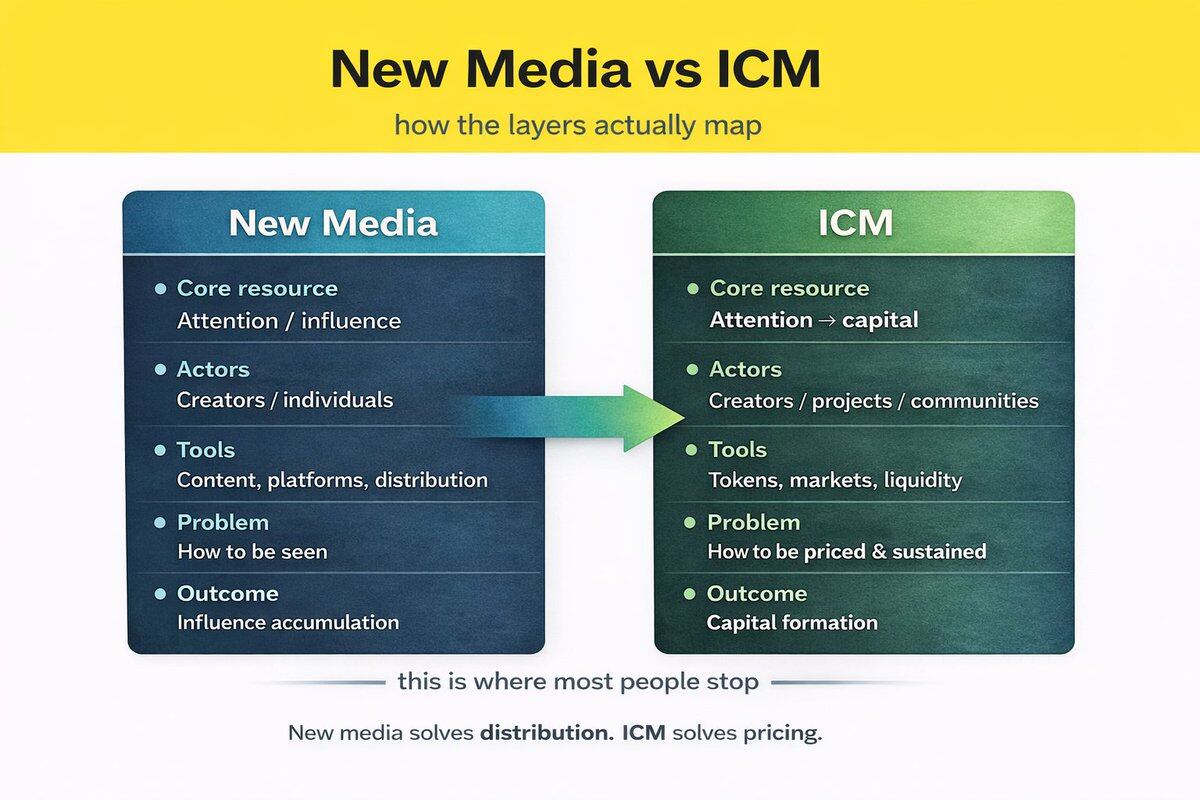
How is influence priced, traded, and sustained?
If we distinguish it in one sentence:
- New media: → Who can gain attention
- ICM: → How attention becomes a capital structure
Conclusion:
New media solves "the right to disseminate," ICM solves "the right to price."
The essence of ICM:
- Transforming attention → agency → pricing → capital formation
- Not a speculative tool, but coordination infrastructure
Closing
Finally, I would like to quote a favorite saying of Naval to echo this point and conclude the article.
Naval said: Code and media are the levers behind the new wealthy class.
Indeed, in the past 10 years, the new elites of Silicon Valley and major companies (internet/software/AI) have essentially relied on "code leverage" to create wealth.
As Cursor and Claude become more popular, everyone can vibe coding, and the ability to write code is gradually becoming less scarce; there are even predictions that all entry-level programming jobs will be replaced by AI in the next decade.
The truly scarce leverage in the next cycle is new media:
That is scalable dissemination of narrative × judgment × taste. Good leverage can continuously generate compound interest while you sleep, continuously influence others in your absence, and help you build "trust + reputation + opportunity access."
code is law
New media is the law.
免责声明:本文章仅代表作者个人观点,不代表本平台的立场和观点。本文章仅供信息分享,不构成对任何人的任何投资建议。用户与作者之间的任何争议,与本平台无关。如网页中刊载的文章或图片涉及侵权,请提供相关的权利证明和身份证明发送邮件到support@aicoin.com,本平台相关工作人员将会进行核查。


