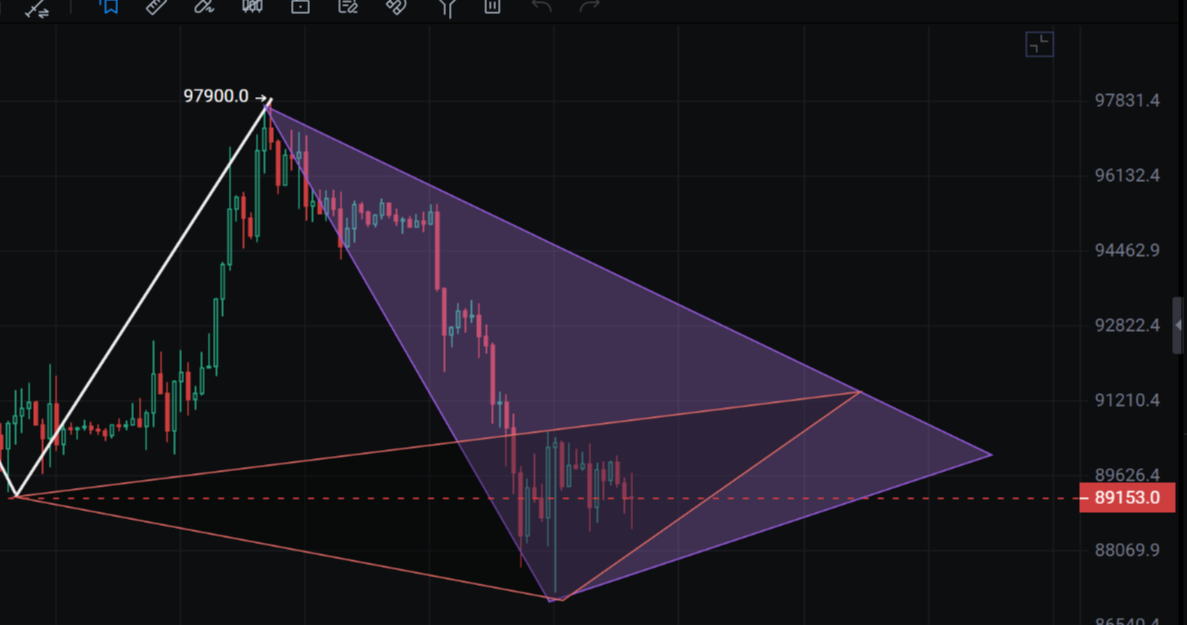
This week, the news that GameStop's suspected associated wallet transferred a large amount of Bitcoin to Coinbase Prime rapidly spread across social media and media outlets, with terms like "all transferred" and "liquidation sale" dominating the conversation. According to CryptoQuant data, GameStop previously accumulated approximately 4,710 BTC, with a total investment of about $504 million, at an average purchase price of around $107,900 per coin. Based on the current price of approximately $90,800 per coin, this results in an estimated unrealized loss of about 15%, corresponding to a paper loss of about $76 million. However, there are significant contradictions between on-chain tracking and media reports regarding the details of "whether all was transferred" and "the specific transfer time": there is currently a lack of official verification and a complete on-chain closed loop regarding whether the wallet is 100% owned by GameStop and whether the transfer ratio reached 100%, leaving suspense for the subsequent discussion on emotional amplification and narrative shift.
On-Chain Timeline Discrepancy: Transfers and News Not Synchronized
● Time Version Split: In public on-chain tracking and some second-hand information, claims such as "suspected transfers in batches on January 17 and January 20" have emerged, but these specific time points are unverified information, with conflicts between different sources. The research brief itself labels the event timing as "conflicting," meaning that it is currently impossible to reconstruct a universally accepted precise timeline; it can only be confirmed that a significant amount of BTC has flowed from suspected GameStop-associated addresses to Coinbase Prime, rather than being able to seriously conclude that "the entire transfer was completed on certain days."
● Evidence Boundary Blurred: From the existing public data, there is no precise official disclosure or complete on-chain evidence that can correspond to each transaction of the 4,710 BTC. What the market can confirm is that a considerable amount of BTC has entered Coinbase's institutional platform, but whether this equates to a 100% position migration still lacks dual confirmation on-chain and at the company level. Since the brief clearly indicates that only about half of the position is clearly marked on-chain, most more aggressive claims remain at the level of inference, which also determines that the current more cautious expression should be "suspected large-scale transfer," rather than directly claiming "all has been completely transferred."
● Post-Hoc Narrative Realization: The timeline discrepancy has amplified market emotions—early on-chain abnormal flows did not trigger much discussion outside professional communities until the media focused on a specific time window to amplify reporting, suddenly forming a collective realization in the public perspective that "GameStop is suddenly trying to run." The timing of news dissemination has been subjectively equated by many with the on-chain transfer time, blurring the gradual changes in the process and narrating what could be a phased capital migration as an overnight "complete liquidation," greatly reinforcing panic and conspiracy speculation.
$504 Million Heavy Position Turns into Unrealized Loss: Choices Under Pressure for Public Companies
● Background of High-Stakes Betting: In May 2025, GameStop heavily invested in Bitcoin with approximately $504 million, buying about 4,710 BTC at an average price of $107,900 per coin, effectively betting directly on this new asset near historical highs. At that time, Bitcoin had just experienced volatility after reaching new highs, and traditional companies holding coins directly were seen as a radical attempt to "embrace a new narrative," as well as a strategic move to seek valuation premiums and topicality through crypto assets amid pressure on their main business, which meant they were destined to face more severe net value fluctuations from the start.
● Unrealized Loss Conflicts with Shareholder Expectations: Based on the estimated price of $90,800 per coin provided in the research brief, this position currently has an unrealized loss of about 15%, with a paper loss of about $76 million. For crypto natives, such fluctuations are within the normal range, but for a public company that needs to disclose quarterly reports and explain capital allocation effectiveness to shareholders, tens of millions of dollars in unrealized losses can quickly translate into dual pressures from finance and public opinion. Some shareholders optimistic about the "GameStop + Bitcoin" combination expect it to become a new profit pivot, rather than a source of volatility dragging down the overall financial statements during market corrections.
● Accounting and Impairment Pressure: Under traditional accounting frameworks, Bitcoin is typically treated as an intangible asset or similar investment asset, and the impairment and provisions resulting from price declines may need to be reflected in the financial statements in a timely manner, while subsequent gains from price increases may not necessarily be proportionally reversed. This accounting treatment makes public companies more inclined to "actively stop losses" or adjust their holding structures when facing price pullbacks, to control the volatility exposure on the financial statement. Compared to long-term-oriented institutions or individuals, a company constrained by financial reporting cycles and regulatory requirements often finds it difficult to maintain an extreme "hold on" stance in the face of public losses.
Destination on Coinbase Prime: Liquidation, Custody, or Structured Position
● Experience Judgment of Exchange Inflows: CryptoQuant's analysis points out that "large BTC inflows to exchanges usually indicate potential selling or providing liquidity to the market." The underlying logic of statistical experience is that holders will only concentrate large assets to exchanges or institutional platforms when there is a need for trading, financing, or structured arrangements. However, this judgment is a probabilistic conclusion based on historical data and does not have legal evidential power for every specific transfer, nor is it sufficient to independently support the absolute assertion that "GameStop must liquidate."
● Multiple Roles of the Prime Platform: Coinbase Prime itself is a custody and liquidity solution for institutions, connecting cold/warm wallet custody services on one end and accessing deep markets for spot and derivatives on the other. For many institutions, "entering Prime" may mean they are about to sell in batches on the market, or it could be to obtain a more professional custody environment, or to set up preconditions for over-the-counter block trades, lending, or hedging structures. In the absence of more public details, the mere inflow of funds into Prime cannot distinguish whether it is purely a preparation for liquidation or a more refined asset management action.
● Lack of Dual Evidence for "Complete Liquidation": On-chain analysis can currently only more definitively point to: about half of the BTC position has been clearly marked as migrated, while the remaining portion is still in a state of confirmation. Since the brief indicates that this type of "about 50%" data still belongs to an incomplete closed loop, it becomes even more difficult to derive the conclusion of "100% transferred" based on this. Additionally, the lack of any form of response from GameStop means that the claim of "already completely liquidated" lacks both on-chain complete path support and company announcement endorsement, and can strictly be regarded as a market hypothesis rather than an established fact.
Media Amplification and Retail Investor Expectations: A Panic Link Amplified by a Headline
● The Process of Tone Slippage: In the Chinese information space, many media outlets have generally used high-intensity wording such as "all transferred" and "suspected liquidation" when relaying this event. As reports are continuously reprocessed on social media, the qualifier "suspected" gradually disappears in dissemination, with many headlines directly sliding to "GameStop has transferred all Bitcoin to Coinbase Prime, or has liquidated." This slippage from probabilistic speculation to qualitative statements has packaged the originally uncertain on-chain dynamics into a story that has been "confirmed."
● Emotional Amplification from IP Overlap: GameStop itself carries strong symbolism of retail investors and "fighting Wall Street," and combining it with Bitcoin, which inherently carries strong emotional narratives, the "GameStop + Bitcoin" IP combination naturally attracts massive traffic. This attention dividend also amplifies retail investors' preconceived biases about "institutional escape" and "the top has appeared"—once they hear "all transferred to the exchange," many investors instinctively interpret it as "imminent dumping," while overlooking various more neutral possible paths such as custody and reallocation.
● Headline Narratives and Fact Deviations: In an environment of extreme information fragmentation, an emotional headline often spreads faster than a cautious data explanation. When the claim of "complete liquidation" sweeps through communities in a short time, panic emotions can feedback on prices through mechanisms like stop-losses, position reductions, and self-reinforcement. However, based on the currently disclosed information, on-chain has not confirmed a 100% transfer, and there has been no substantial official announcement, which means that a considerable portion of the panic is built on unverified premises. The greater the tension of the headline, the further the boundaries of fact are pushed, and the more the short-term impact on the market deviates from the true scale of the event.
Major Players Beyond ETFs: Dark Pool Games of Non-ETF Institutions
● Transparency Gap: Bitcoin ETFs disclose redemption data daily, with asset scale and net inflows/outflows almost visible in real-time, allowing market participants to directly track their position changes through public channels. In stark contrast, non-ETF institutions like GameStop, which hold coins directly on their balance sheets, often only disclose at the frequency of quarterly or annual reports, and on-chain wallets lack 100% confirmation, leading to significantly greater information asymmetry. Once large on-chain actions occur, the outside world can only guess at their true intentions through a "puzzle-like" approach.
● Impact of Thousands of BTC: With GameStop's holding of approximately 4,710 BTC as a reference, if a large proportion chooses to sell in a short time, the short-term impact on the spot order book and the expected pricing in the derivatives market will be very sensitive. Thousands of BTC may not be enough to change long-term trends, but they can compress buy order depth on a particular trading day, triggering a series of chain reactions: from active sell orders eating up limit orders to triggering passive liquidations of highly leveraged longs, and raising implied volatility in options, a traditional company's reallocation can actually amplify effects across multiple market levels.
● Shadows of HexTrust's Actions: The research brief also mentions that HexTrust transferred approximately 6,230 AAVE and about $8.92 million USDT/USDC to Binance, with a total value of about $9.8 million, occurring roughly within the same market cycle as the GameStop event. This detail shows that the choice to adjust crypto positions is not an isolated single entity, but rather multiple institutions synchronously reconfiguring within the same phase: some may be cashing out profits, some may be adjusting position structures, and some are creating space for new strategic layouts. From a broader perspective, this resembles a more extensive institutional game rather than GameStop's solitary "retreat."
Whether to Liquidate Remains Uncertain: How Traditional Companies Restructure Their Holding Paths
In the absence of an official response from GameStop and a complete on-chain data closed loop, simply characterizing the current large transfer as "already liquidated" is logically still just a hypothesis rather than a fact. The existing evidence can only prove that a considerable amount of BTC has flowed into Coinbase Prime, but it cannot prove that these assets have all been sold on the market or at what price they were transacted. For traditional public companies, directly holding coins faces threefold constraints: first, the cyclical and severe volatility of Bitcoin itself; second, the impairment and disclosure pressures under accounting and regulatory rules; and third, the realistic expectations of shareholders regarding capital efficiency and risk management. These factors combined make it difficult for them to navigate a complete cycle and always "hold on" like some long-term investors. Looking ahead, more traditional institutions are likely to make structural adjustments in their holding paths: obtaining exposure through ETF tools, separating custody and trading, and managing liquidity and hedging across multiple platforms, thereby reducing the risk of actions from a single address or platform being "amplified" on-chain, while also reserving more proactive space for themselves when the next cycle of volatility arrives.
Join our community to discuss and become stronger together!
Official Telegram community: https://t.me/aicoincn
AiCoin Chinese Twitter: https://x.com/AiCoinzh
OKX Benefits Group: https://aicoin.com/link/chat?cid=l61eM4owQ
Binance Benefits Group: https://aicoin.com/link/chat?cid=ynr7d1P6Z
免责声明:本文章仅代表作者个人观点,不代表本平台的立场和观点。本文章仅供信息分享,不构成对任何人的任何投资建议。用户与作者之间的任何争议,与本平台无关。如网页中刊载的文章或图片涉及侵权,请提供相关的权利证明和身份证明发送邮件到support@aicoin.com,本平台相关工作人员将会进行核查。