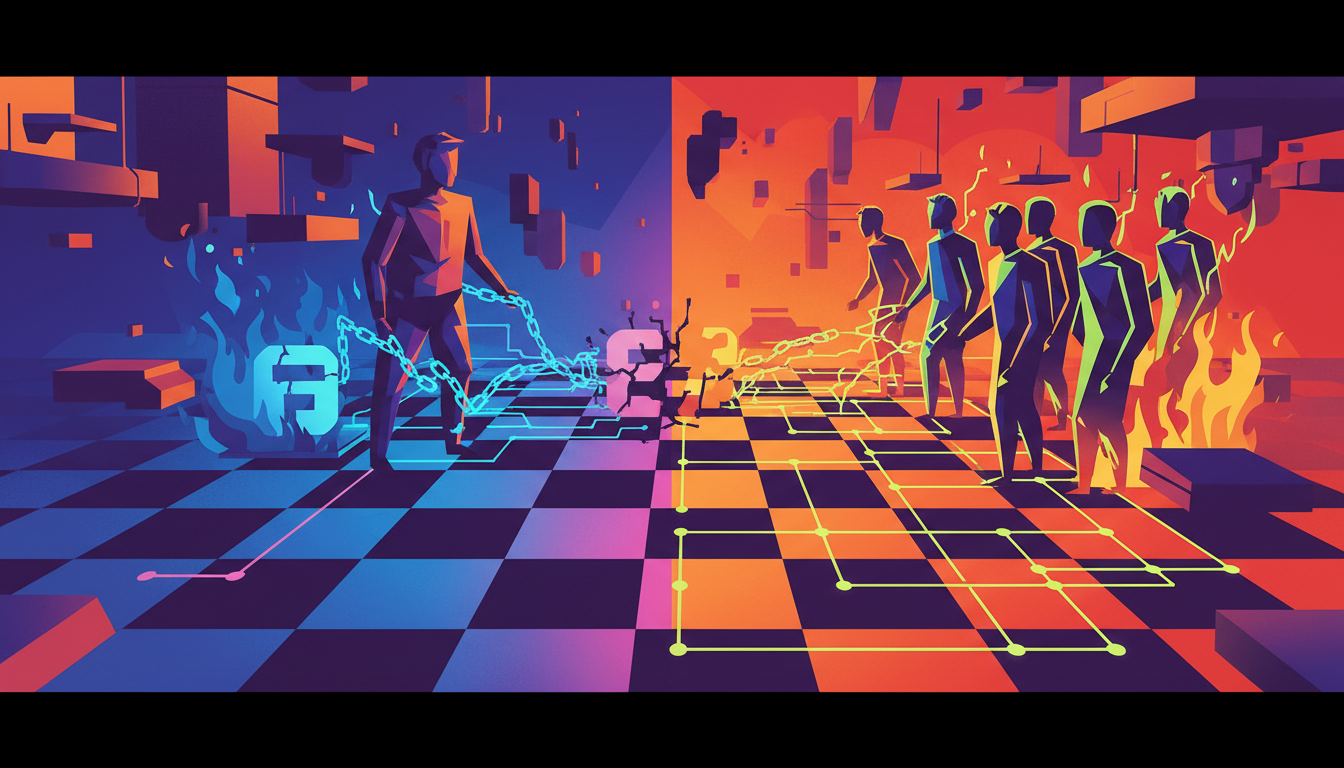
On January 24, 2026, Neynar co-founder rish announced the official takeover of Farcaster protocol operations and the integration of the Clanker team, promising to maintain the continuous operation of the Farcaster client, protocol, and Clanker. This power transfer has once again brought the governance structure of a protocol originally touted for "open, decentralized social" into the spotlight: when operational power is highly concentrated in a few builders, how can long-term commitments to developers and ecosystem participants be fulfilled? Meanwhile, the statement by André Casterman that "2026 is the turning point for the crypto market from proof of concept to infrastructure implementation" is approaching. Neynar's takeover of Farcaster is not just a personnel change in a single project, but is seen by the entire industry as a key example during a shift in the infrastructure cycle.
Change of Protocol Ownership and Questions on Decentralized Social
● Takeover Action and Public Commitment: On January 24, 2026, at 8 AM UTC+8, rish officially announced the takeover of Farcaster protocol operations, incorporating the Clanker team, which was originally responsible for the client and related infrastructure, into a unified operational structure, and clearly stated that they would "maintain the continuous operation of the Farcaster client, protocol, and Clanker." Such public commitments provide users and developers with predictable service continuity in the short term, indicating that there will be clearer accountability and decision-making centers in protocol iteration and operational resource allocation.
● Role and Short-term Impact After Clanker Integration: After the integration of the Clanker team, its accumulated experience in client development and operational capabilities is expected to be incorporated into Farcaster's unified technical roadmap, forming a more integrated product and infrastructure stack. For existing users, the most direct perception may be an improvement in product rhythm and experience consistency; for developers and third-party client operators, there is greater concern about the "infrastructure layer's certainty" regarding API stability, documentation maintenance, and compatibility strategies, all of which will be profoundly influenced by the new operator's governance style and prioritization.
● Controversy of Power Concentration Under the Decentralized Narrative: However, as the protocol's operational power becomes concentrated in a few core operators, the doubts surrounding the narrative of "decentralized social" are also amplified. Opponents worry that once key operational and technical decisions are highly centralized within a single team, the balance of power in content moderation, interface permissions, and feature prioritization will be disrupted, ultimately evolving into a "centralized platform disguised as a protocol." Supporters argue that in the early stages of infrastructure construction, moderate centralization helps improve execution efficiency and clarity of direction, and as long as an open governance structure is retained for the future, there is no need to exaggerate the risks brought by short-term centralization.
Can the Commitment to Builders Be Fulfilled?
● Commitment to Developers' Sense of Security and Constraints: rish repeatedly emphasized during the takeover that they would ensure Farcaster and Clanker continue to operate, which is interpreted as a form of "infrastructure availability commitment" to developers and client operators. For teams relying on the Farcaster protocol to build applications, this equates to gaining basic security that the underlying services will not be interrupted and interfaces will not be arbitrarily deprecated before the critical year of 2026. Meanwhile, this public commitment also creates a reverse constraint on the operators themselves; if they adjust their direction in the future due to commercial pressures or resource constraints, their legitimacy will be tested against their current statements.
● Specific Game Scenarios of "Builder First": When "builder first" moves from slogan to execution, the game first occurs in protocol upgrades, feature roadmaps, and resource allocation. For example, under the constraints of limited bandwidth and storage, should the performance needs of large clients within the ecosystem take precedence, or should the compatibility of numerous small experimental applications be prioritized? In the order of new feature rollouts, should the focus be on enterprise-level tools with commercial potential, or should community-driven open-source extensions be supported first? Each decision will be a tug-of-war between "maximizing efficiency" and "ecological diversity," testing the operators' true preferences for different types of builders, rather than just a friendly posture at the promotional level.
● Trade-offs Under Route Divergence and Commercialization Pressure: As user scale and external attention increase, Farcaster will inevitably face pressures from commercialization path choices and changes in the regulatory environment. If future divergences arise regarding privacy, content distribution algorithms, or data access permissions, the operators will need to weigh between "centralized decision-making to ensure execution speed" and "expanding governance participation to maintain open legitimacy." Choosing efficiency means moving closer to traditional internet platform governance models; choosing openness may sacrifice iteration speed and consistency in the short term but aligns more closely with the values emphasized in the crypto world, such as anti-censorship and user sovereignty.
Patience for Infrastructure in a Macroeconomic Shift
● Amundi's Rebalancing Signal: On a larger scale, European asset management giant Amundi is adjusting its asset allocation structure of approximately €2.3 trillion, reducing exposure to U.S. stocks, which is seen as a reflection of traditional institutions re-evaluating and rebalancing global risk assets. Although the specific proportion of its crypto asset allocation was not disclosed in the briefing, the fact that such large-scale institutions are beginning to reassess the risk-return of U.S. stocks versus emerging assets at the macro allocation level speaks more to the notion that "slow money" is redefining the boundaries of capital than any single project's financing news.
● Public Companies' BTC Holdings Entering a Low-Volatility Phase: According to BitcoinTreasuries.NET, the top 100 publicly traded companies globally hold a total of 1,127,981 BTC, and it has been observed that they have entered a "low-volatility holding period." This means that, at least at this stage, this portion of institutional capital views Bitcoin more as a "long-term reserve asset" rather than a high-frequency trading target. The stability of the holding structure provides a more predictable environment for the derivative infrastructure surrounding mainstream crypto assets and shifts attention from short-term price fluctuations to service and governance design centered around existing capital.
● The Rhythm of Slow Money and the Coexistence of Crypto Social Infrastructure: As giants like Amundi and publicly traded companies holding over one million BTC adjust their allocations with a "slow money logic," the construction of crypto social infrastructures like Farcaster is also forced to be re-evaluated on the same time scale. What truly attracts such funds is not a single cycle of traffic peaks, but the protocol's governance stability, developer activity, and compliance expectations across multiple cycles. If Neynar can continue to fulfill its commitments to builders and users in the coming years, it has the opportunity to become a configurable asset from the perspective of slow money in this shift "from proof of concept to infrastructure implementation," rather than just a fleeting application story.
AI Judgments, Prediction Markets, and Technical Forks in Protocol Governance
● a16z's AI Judgment Concept and Its Significance: In the prediction market space, a16z Crypto has proposed a plan to enhance market settlement transparency through an AI judgment mechanism, hoping to automate the determination of event facts through large models, reducing subjectivity and delays caused by human intervention. a16z believes that AI can quickly extract key evidence from a large amount of public data and text information, forming auditable conclusions, thus providing greater scalability and transparency for infrastructures like prediction markets. This idea also opens up technical imagination for other crypto protocols that require "fact-based judgments."
● Cost Differences Between Traditional Oracles and AI Judgments: Compared to traditional oracle systems that rely on human price feeds, multi-party arbitration, or specialized arbitration institutions, AI judgments emphasize model-centric automated processes, attempting to find a new balance between efficiency and trust costs. In the traditional model, multi-round human arbitration, while more interpretable in extreme dispute events, is costly and slow; the AI route, on the other hand, primarily invests in computing power and model training, resulting in lower marginal decision costs but facing challenges of model bias, attack surfaces, and transparency audits. The divergence of these two technical routes essentially represents a choice between "placing trust in humans" or "placing trust in machines," which will similarly replay across a broader range, including social protocols.
● Imagination of AI Judgments Embedded in Farcaster Governance: Translating the AI judgment mechanism envisioned by a16z into social protocols like Farcaster, several potential embedding points can be imagined: for example, preliminary machine judgments on content disputes, account appeals, spam determinations, or the authenticity of governance proposals, which are then confirmed by human governance layers; or providing data and factual analysis to assist in community fork disputes regarding "what constitutes the original intent of the protocol" and "what constitutes consensus behavior." If such mechanisms are adopted, Farcaster's governance structure will evolve from a simple "human governance and code" binary model to a "human—AI—protocol" trinary game, shifting the power concentration issue from "concentrated in humans" to "concentrated in the models and algorithms behind humans."
Time Discrepancy Between Fast Money Speculation and Slow Infrastructure
● Strategic Differentiation in Meme Coins like PENGUIN: At the on-chain trading level, Meme coins represented by PENGUIN continue to attract professional traders, with clear strategic differentiation. Some teams prefer to frequently enter and exit using short-cycle quantitative models to capture slippage profits from extreme price fluctuations; others emphasize liquidity depth and market-making fee returns, rolling adjustments over a longer time window. The high-frequency hedging and gaming between different strategies on the same asset form a narrative of "rotation whirlpools," contrasting sharply with the medium to long-term perspectives of infrastructure projects like Farcaster.
● The Case of Cooker.hl Missing Out on $1.4 Million: According to on-chain tracking cases, trader Cooker.hl missed out on approximately $1.4 million in potential profits during a Meme coin market due to selling too early or failing to increase positions as planned. This event was widely circulated, not only because of the significant amount but also because it reflects the reality that emotion-driven and strategy execution deviations are magnified in high-volatility assets: regardless of how sophisticated the model is, once an emotional decision is made at a critical juncture, the outcome can diverge from the ideal returns by orders of magnitude within days.
● The Gap Between Fast Money Logic and Slow Infrastructure: On one side is the high-frequency rotation and emotional amplification in Meme coins like PENGUIN, while on the other side are the iterations and trial-and-error of "slow infrastructures" like Farcaster, prediction markets, and AI judgments over many years. The former attracts fast money chasing extreme returns, measuring risk in minutes; the latter can only rely on long-term commitments to developers, users, and institutional capital to gradually build credibility. From this perspective, the true challenge for Neynar in taking over Farcaster is not whether it can attract attention in the next market trend, but whether it can maintain the protocol's predictability across multiple bull and bear cycles, preventing it from being overwhelmed by short-term speculative noise.
Long-term Coordinates After the Power Transfer
● Governance Concentration, Developer Expectations, and User Trust: Overall, Neynar's takeover of Farcaster has significantly increased the concentration of protocol operations and decision-making in the short term, making it easier for the outside world to identify responsible parties and technical routes. However, it has also raised the trust threshold surrounding the narrative of "decentralized social." If rish's team can consistently fulfill the commitment to "maintain the operation of the Farcaster client, protocol, and Clanker," and genuinely implement "builder first" in protocol upgrades and ecological resource allocation, developer expectations and user trust are likely to gradually stabilize over the next one to two cycles. Conversely, if there is a sudden shift in direction that contradicts previous commitments, the negative effects will be magnified.
● Multidimensional Narrative Intersection at the 2026 Turning Point: Looking back at the macro judgment of the 2026 infrastructure implementation turning point, the story of Farcaster intersects with the asset rebalancing of institutions like Amundi, the "slow money posture" of the top 100 publicly traded companies holding 1,127,981 BTC, and the exploration of AI judgment mechanisms promoted by a16z, forming a multidimensional intersection. On one end is the long-term allocation logic of capital, on the other end is the bifurcation of technical routes between efficiency and governance, and in the middle are protocols like Farcaster, which seek a sustainable balance between real constraints and ideal narratives.
● Key Observational Indicators for the Next 1-2 Cycles: Looking ahead to the next one to two crypto cycles, several key indicators will be particularly important for assessing the direction of the Farcaster ecosystem: first, governance openness—whether more community participation and transparent decision-making mechanisms are gradually introduced, rather than maintaining a highly centralized operational structure in the long term; second, developer activity—the number of third-party applications around the protocol, trends in ongoing maintenance projects, and new builders entering will directly reflect whether "builder first" is being realized; third, external capital participation—whether it is infrastructure investment from institutional capital or long-term support from ecological funds, will determine whether Farcaster can transform from a single application into a broader part of social infrastructure. Until these indicators provide clearer answers, "concentration of power or victory for builders" will remain an unresolved open question.
Join our community to discuss and grow stronger together!
Official Telegram community: https://t.me/aicoincn
AiCoin Chinese Twitter: https://x.com/AiCoinzh
OKX Benefits Group: https://aicoin.com/link/chat?cid=l61eM4owQ
Binance Benefits Group: https://aicoin.com/link/chat?cid=ynr7d1P6Z
免责声明:本文章仅代表作者个人观点,不代表本平台的立场和观点。本文章仅供信息分享,不构成对任何人的任何投资建议。用户与作者之间的任何争议,与本平台无关。如网页中刊载的文章或图片涉及侵权,请提供相关的权利证明和身份证明发送邮件到support@aicoin.com,本平台相关工作人员将会进行核查。