Recently, I've been closely monitoring the memory chip market. In 2025, a group of fan partners and I positioned ourselves with Micron Technology (#MU) and made a significant profit, moving from $160 👉 and soon to break $400.
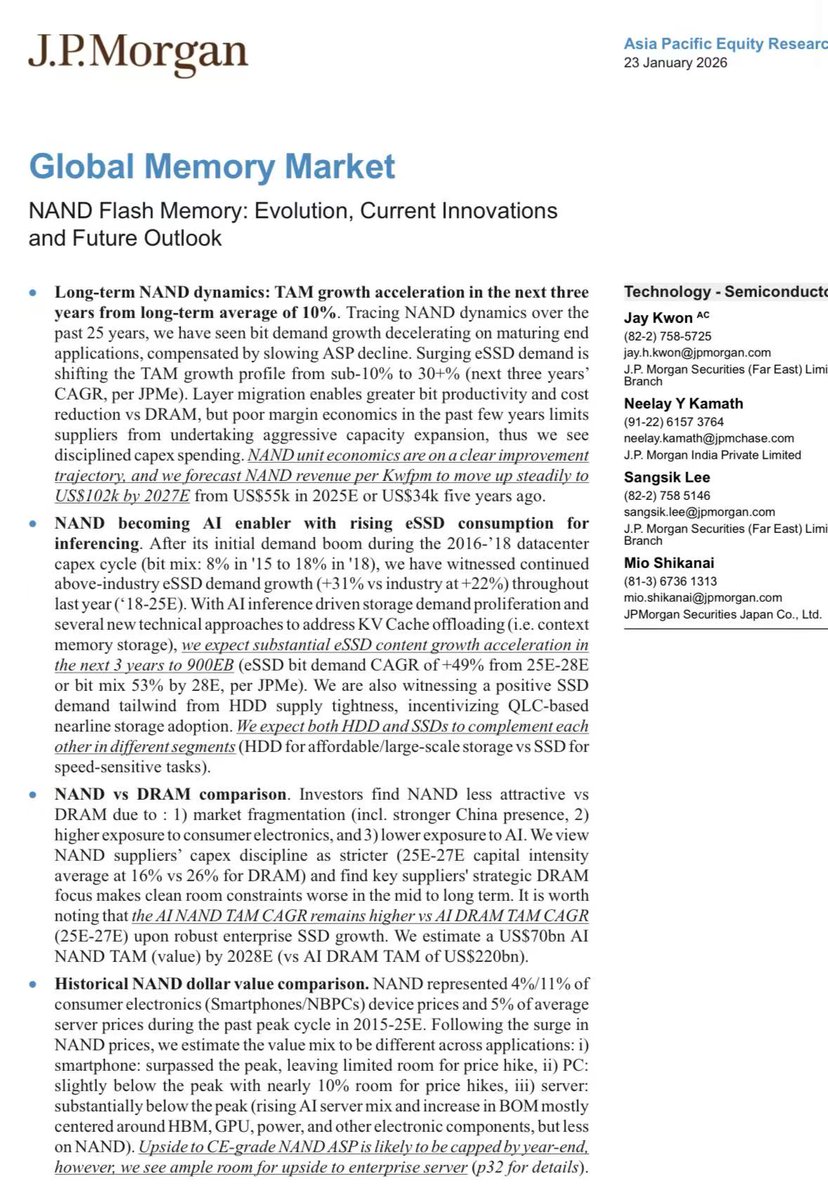
Today, I happened to read JP Morgan's report on the global memory market, and there's an overlooked hidden market: NAND flash memory, which deserves attention. 🧐
Previously, when we researched memory chips, we had a fixed mindset that #NAND flash memory was a "struggling" industry. Compared to the high-end DRAM or the recently hyped HBM, NAND seemed like a lowly assistant—low barriers to entry, intense competition, and only engaging in price wars.
However, after digging through a lot of data recently, I was taken aback. I suddenly realized that NAND is no longer the discarded pawn it once was; it is becoming the next severely undervalued "gold mine" in the AI era. Let's discuss why the market is starting to favor NAND, along with the logic behind it, in conjunction with JP Morgan's report.
We previously didn't have much faith in NAND because it was too cyclical, and when smartphone sales slowed, it would crash. But now, the logic has completely changed.
The core change is that NAND is no longer just the storage card that holds photos in your phone; it is now an indispensable "high-speed warehouse" in AI servers. Over the past three years, this market has grown at an astonishing rate due to the skyrocketing sales of enterprise solid-state drives (eSSD).
This situation can be explained through two phases of #AI:
The first phase was the "knowledge acquisition" training phase: Previously, everyone was frantically buying cards to train models, competing on computing power and ultra-fast memory (HBM), while NAND was largely overlooked.
Now we are in the "knowledge application" reasoning phase: The models are trained and ready to serve, answering user queries. At this point, the models do not need to relearn but must quickly retrieve answers from vast amounts of data.
🎯 This creates two pain points:
1️⃣ Not only does it need to be fast, but it also needs to be large: To ensure quick response times, models must keep a lot of frequently used data, such as the so-called KV Cache, readily available. Expensive memory can't hold it all, and mechanical hard drives (HDD) are too slow. eSSD has become the only choice—fast and large.
2️⃣ Mechanical hard drives (HDD) are truly inadequate: Data centers previously used HDDs to save costs, but the speed requirements for AI reasoning are now too high; HDDs simply can't keep up with their rotation speeds. Additionally, manufacturers of HDDs have been cautious in expanding production in recent years, leading to a current shortage.
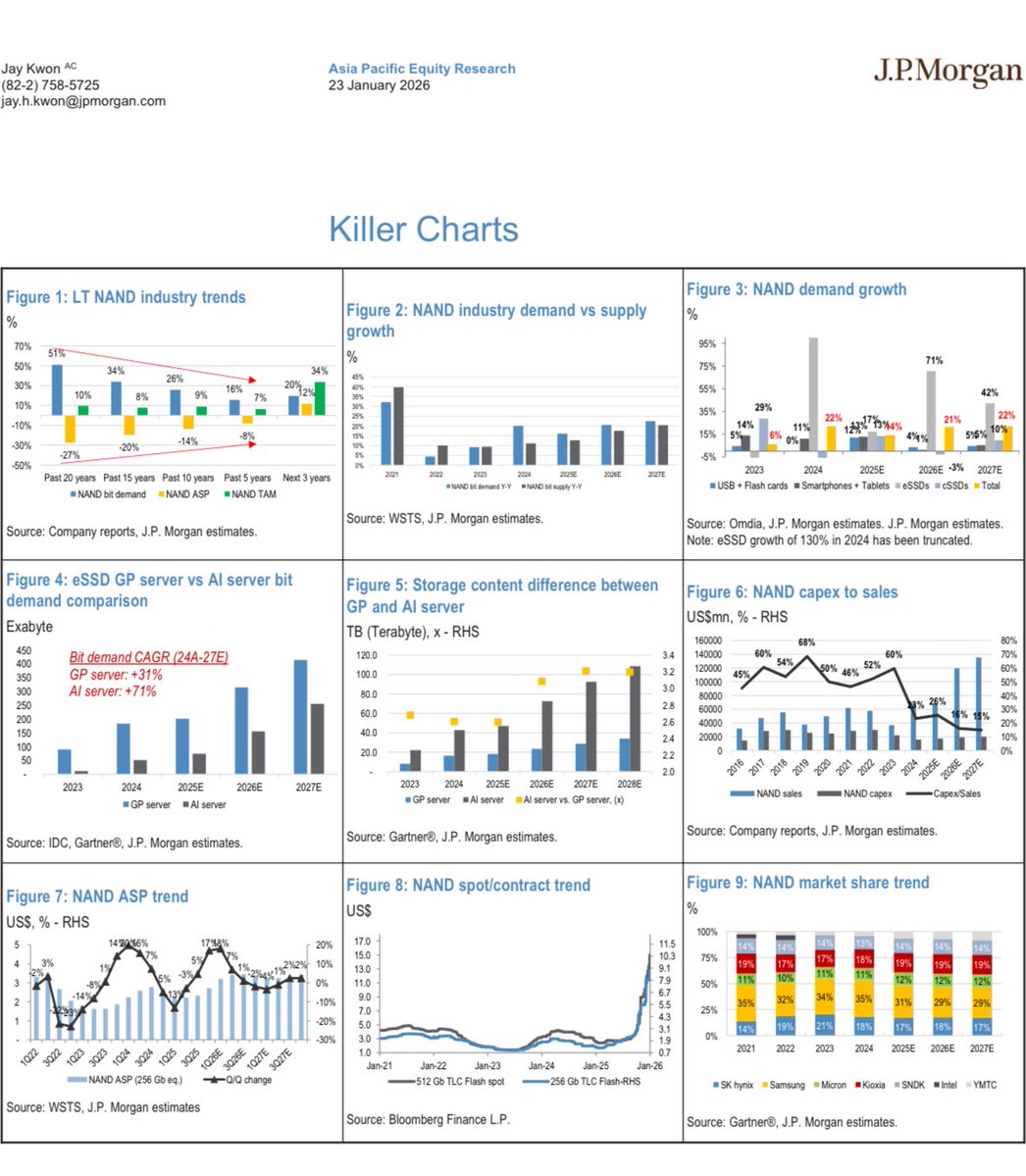
Ultimately, this has forced AI data centers to replace mechanical hard drives with eSSD on a large scale, especially those with large capacity and slightly lower-cost QLC flash memory. JP Morgan predicts that by 2027, eSSD will account for nearly 50% of total NAND demand, which is a terrifying growth rate (as shown in Figure 2).
🧐 Why do I think NAND might be even more powerful than DRAM this time?
Previously, we believed that when buying memory chip stocks, DRAM was the first choice because it was essentially monopolized by Samsung, SK Hynix, and Micron, making the landscape stable. But this time, the logic for NAND may be more enduring. The core reason is the shortage.
Looking at those NAND manufacturers, they have been cautious due to losses over the past two years and have become more prudent. From 2025 to 2027, the NAND industry's expansion will be very limited, with capital expenditures tightly controlled, and not many new factories being built.
On one side, manufacturers are unwilling to expand production, while on the other, AI reasoning demand is exploding. Just imagine this scenario; supply and demand imbalance is a certainty. It is expected that by 2026, NAND prices will rise by another 40%, and manufacturers' profits and performance reports will be very impressive.
🏆 Finally, returning to the essence, from an investment perspective, who should we buy, and how should we place our bets?
SK Hynix: Solidigm was previously Intel's business and has been acquired by Hynix. They started early in ultra-large capacity eSSD (QLC) and are now perfectly positioned to capitalize on the market left by retiring mechanical hard drives. A South Korean listed company, not easy to participate (KRX: 000660).
Samsung: Although they were slightly slower to react, they are the industry leader, with production capacity in place and a strong technical foundation (V9 technology), making them an unavoidable giant. A South Korean listed company, not easy to participate (KRX: 005930).
Kioxia: A Japanese company that originated from Toshiba's storage division, it is one of the major NAND technology suppliers globally. Although it has not yet gone public, this company is worth keeping an eye on. They focus solely on NAND and previously had little server business, but they are now rapidly catching up, and it is expected that server business will become a significant part of their operations in a few years.
Micron Technology (#MU): Our old friend, don't just focus on its core HBM; its explosive potential in NAND is also worth noting. As the only player in the US stock market, its technology is quite aggressive, such as being the first to mass-produce 232 layers and managing production capacity very well. For North American data center clients who are obsessed with data security and must buy "American goods," Micron is the go-to choice, representing a typical "politically correct + technically sound" dual insurance.
Yangtze Memory Technologies Co. (YMTC): A Chinese company that has not yet gone public but is a formidable player to watch. Its Xtacking technology architecture is very impressive and has made established giants feel uneasy. It is the undisputed leader in NAND in China and is also one of the top five suppliers globally. Although it is not publicly listed, its partnerships with A-share listed companies, such as Zhaoyi Innovation and SMIC, are worth noting.
SanDisk (after being spun off from Western Digital and listed independently, code #SNDK): This company is the only "two-legged" oddity in the market. It produces mechanical hard drives (HDD) with one hand and flash memory (NAND) with the other. Previously, people thought it was a jack of all trades but master of none, but now it is seen as a brilliant move; customers need to upgrade from HDD to eSSD, and it provides a one-stop solution. It is also one of the top five suppliers in the NAND market globally.
Among the aforementioned storage companies, Micron Technology and SanDisk are both available on #MSX. If you are still limited by the inconvenience of opening a US stock account domestically, you can try using U to trade US stocks for a smooth experience. I personally use the #RWA US stock tokenization platform #MSX to participate in the US stock market: http://msx.com/?code=Vu2v44
Early US stock investment fans and partners can message me privately. After filling out the form, you can enter the US stock discussion and exploration community for free (currently limited to 10 people per week, assistant review may take some time, thank you 🙏)!
免责声明:本文章仅代表作者个人观点,不代表本平台的立场和观点。本文章仅供信息分享,不构成对任何人的任何投资建议。用户与作者之间的任何争议,与本平台无关。如网页中刊载的文章或图片涉及侵权,请提供相关的权利证明和身份证明发送邮件到support@aicoin.com,本平台相关工作人员将会进行核查。


