A massive winter storm, powered by an Arctic blast and a wobbling polar vortex, is now sweeping across much of the United States, dumping heavy snow, sleet, and freezing rain while driving temperatures to levels that make thermostats nervous across a wide swath of states.
On Saturday, theminermag.com published a report noting that miners had been gearing up to curb block production to help ease pressure on regional power grids. By the following day, the outlet followed up via its Telegram channel, saying Foundry was already seeing significant curtailment take hold. The update said:
“ Bitcoin hashrate on Foundry USA alone is down by nearly 200 EH/s, or 60%, since Friday amid continued curtailment. Temporary block production has slowed down to 12 minutes.”
A sizable share of bitcoin miners operate in Texas, and North, Central, and Southeast Texas are all expected to take a hit from the storm. Houston is under a winter storm warning, with an Arctic front triggering rapid overnight temperature drops.
As of Sunday, an estimated 840,000 people were without power, according to a ksat.com report. Foundry is the largest bitcoin mining pool by hashrate, and estimates from 2023 show a massive portion of its operations are rooted in Texas.
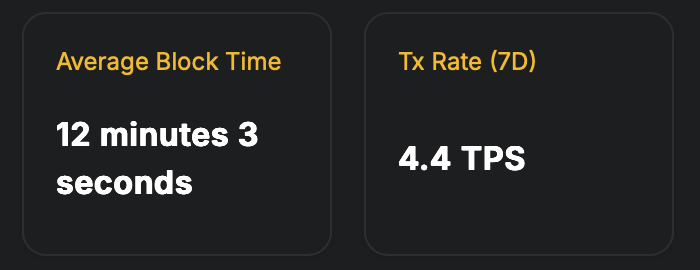
Current block time average at 11 a.m. Eastern time on Sunday, Jan. 25, 2026, via hashrateindex.com.
Hashrate readings from mempool.space and hashrateindex.com show the network cruising between roughly 961 exahash per second (EH/s) and 991 EH/s. Those figures, however, reflect the seven-day simple moving average, smoothing out the bumps. Coinwarz.com offers a sharper snapshot, estimating the 24-hour hashrate at about 700 EH/s as of block 933745.
Also read: Bitcoin Difficulty Slides to September 2025 Levels as Miner Margins Stay Squeezed
Hashrate is generally best read through the seven-day simple moving average over a long period of time, but zooming in on shorter time frames can offer a more intriguing peek under the hood.
Hashrateindex.com and mempool.space both indicate block intervals stretching beyond 12 minutes at the time of writing. If that pace holds through the Feb. 8, 2026, difficulty epoch, the adjustment could clock in at a hefty 17.25% drop. Still, odds are that once the storm loosens its grip, block times will quicken as sidelined hashrate plugs back into the network.
This should help steady the difficulty epoch, though it’s still shaping up to be a pretty hefty adjustment. That said, the broader Arctic blast—with its punishing cold and biting wind chills—is not expected to fully clear nationwide until late January or early February 2026.
- Why did bitcoin block times slow during the Arctic storm?
Extreme cold pushed miners—especially in Texas—to curtail operations, reducing hashrate and lengthening block intervals. - How much hashrate did Foundry lose during the storm?
Foundry’s hashrate reportedly fell by nearly 200 exahash per second (EH/s), or about 60%, due to widespread curtailment. - Could bitcoin mining difficulty change because of this event?
If slower block times persist until the Feb. 8, 2026, difficulty epoch, the adjustment could be notably lower. - When is bitcoin mining activity expected to normalize?
Hashrate is likely to rebound once the storm passes and miners reconnect as power conditions stabilize.
免责声明:本文章仅代表作者个人观点,不代表本平台的立场和观点。本文章仅供信息分享,不构成对任何人的任何投资建议。用户与作者之间的任何争议,与本平台无关。如网页中刊载的文章或图片涉及侵权,请提供相关的权利证明和身份证明发送邮件到support@aicoin.com,本平台相关工作人员将会进行核查。


