Written by: David Hoffman, Founder of Bankless
Translated by: Hu Tao, ChainCatcher
This year's Davos Forum was truly spectacular.
It brought together many heavyweight figures from the cryptocurrency industry, including Brian Armstrong, Jeremy Allaire, CZ, and Larry Fink.
Although cryptocurrency was the focus of the forum, what really drew attention was the Trump administration's clear statement regarding the phased shift in global order.
Two important speeches at the Davos Forum highlighted this point. U.S. Secretary of Commerce Howard delivered a speech titled "Globalization Has Failed," while Canadian Prime Minister Mark responded, "The rules-based international order is experiencing a fracture, not a transformation."
Rules-Based International Order vs. Law of the Jungle
Since World War II, the international community has maintained a certain order and cooperation. The United Nations, although relatively weak, is highly respected in the decision-making of various countries and plays a crucial role.
"International law" once truly existed, primarily because we all believed in it. We collectively endowed it with meaning.
The Trump administration decided to shatter this shared illusion.
Trump believes that this "rules-based international order" exists solely because the United States allows it to exist. As the strongest nation with the most powerful military, this means we are the true architects of this "rules-based international order," and Trump's "America First" philosophy signifies that he no longer wishes to coexist amicably with other countries.
According to Trump, as Lutnick articulated in his speech, this model does not align with America's best interests, so we must now forge a new path.
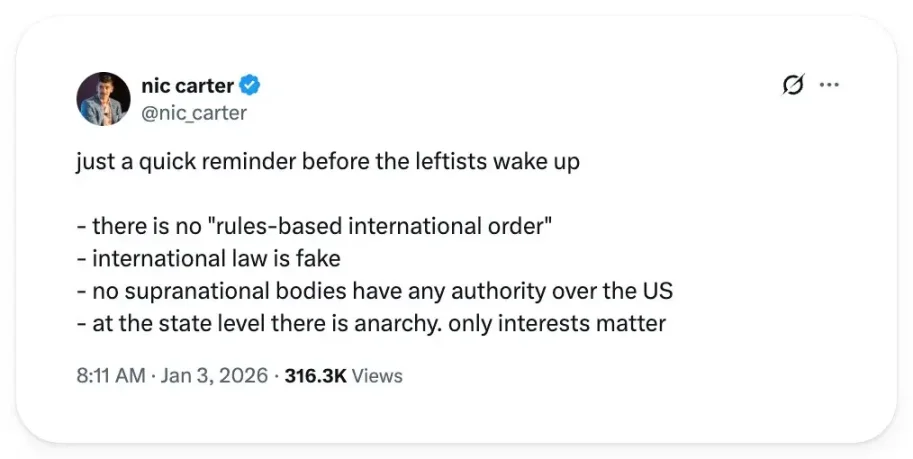
Nic Carter is right—nations are the highest level of organization created by humanity. Before the emergence of nation-states, religion and monarchy were the highest organizational structures humanity could create, and prior to that were feudalism and tribes.
We attempted to build a higher-level organizational structure through "common agreements" with institutions like the United Nations, but these agreements ultimately proved to be very fragile, with minimal impact on the world.
Thus, our current situation is as follows: by 2026, the United States abandoned attempts to construct a higher-level unified organizational structure and claimed that it is best to be self-reliant.
It is worth mentioning that "pariah states" like Russia and Iran have thrived precisely because of the weak international order. They have always adhered to the law of power and exploited the weaknesses of the "rules-based international order" to expand their own power, committing human rights violations that the United Nations can only condemn.
While it is regrettable to see global cooperation attempts ultimately fail, at least we can finally point out frankly that countries like Russia have never truly adhered to these rules.
Bitcoin, Ethereum, and Decentralized Crypto Protocols
Decentralized crypto protocols are powerful and autonomous "higher-level organizational structures" that have failed to emerge from the "rules-based international order" paradigm.
Trump's division of the unified international community is precisely the situation that Ethereum aims to balance.
When a unified world collapses into regional powers, Ethereum re-unifies it in cyberspace.
These protocols do not enforce laws nor protect their members. They will not replace nation-states. However, they serve as a ubiquitous, autonomous coordinating layer for the people of the world to unite.
The conversation between Brian Armstrong and the Governor of the French Central Bank exemplifies this power. The central bank governor made the mistake that all central bank governors make: misunderstanding and underestimating Bitcoin. Brian corrected him, pointing out that "Bitcoin has no issuer—it is a decentralized protocol…" and then elaborated on Bitcoin's most important role in unifying the world: "…[Bitcoin] is actually the most effective accountability mechanism for deficit spending."
No, we cannot establish a "rules-based international order" through voluntary coordination and cooperation between nations. But can we derive a "rules-based international order" from a decentralized, cryptographically-based internet protocol?
The operational mechanism of Bitcoin is a statement of "if… then…". To me, this sounds like a "rules-based international order." Isn't Ethereum simply extending the same principles to Turing-complete smart contracts?
Despite the current atmosphere of despair and negativity in the cryptocurrency industry, I still firmly believe that we have yet to fully tap into the potential of smart contracts.
So, perhaps we cannot obtain a "rules-based international order" from the United Nations.
Perhaps we will obtain it from unexpected places.
Perhaps we will obtain it from Ethereum.
免责声明:本文章仅代表作者个人观点,不代表本平台的立场和观点。本文章仅供信息分享,不构成对任何人的任何投资建议。用户与作者之间的任何争议,与本平台无关。如网页中刊载的文章或图片涉及侵权,请提供相关的权利证明和身份证明发送邮件到support@aicoin.com,本平台相关工作人员将会进行核查。


