Preface
In the past year, the role of AI in the Web3 world has undergone a fundamental transformation: it is no longer just an auxiliary tool to help humans understand information faster and generate analytical conclusions, but has become the core driving force for enhancing trading efficiency and optimizing decision quality, deeply embedding itself into the entire practical chain of trade initiation, execution, and capital flow. With the increasing maturity of large models, AI Agents, and automated execution systems, trading models are gradually evolving from the traditional "human-initiated, machine-assisted" to a new form of "machine planning, machine execution, human supervision."
At the same time, the three core characteristics unique to Web3—open data, protocol composability, and irreversible settlement—give this automation transformation a distinct duality: it possesses unprecedented potential for efficiency improvement while also accompanying a steep risk escalation curve.

This transformation is simultaneously shaping three new real-world scenarios:
First, the disruptive change in trading scenarios: AI is beginning to independently undertake key decision-making functions such as signal recognition, strategy generation, and execution path selection, and can even complete payments and calls directly between machines through innovative mechanisms like x402, accelerating the formation of a "machine-executable trading system";
Second, the upgrade of risk and attack patterns: Once the entire process of trading and execution is automated, the understanding of vulnerabilities, generation of attack paths, and illegal fund laundering also become automated and scaled, with the speed of risk propagation consistently surpassing the limits of human intervention for the first time—meaning that the speed of risk diffusion has become so fast that humans cannot react and stop it in time;
Third, new opportunities in security, risk control, and compliance: Only by engineering, automating, and interfacing security, risk control, and compliance capabilities can the intelligent trading system maintain a controllable state while improving efficiency, achieving sustainable development.
It is against this industry backdrop that BlockSec and Bitget jointly authored this report. We do not attempt to get entangled in the fundamental question of "whether AI should be used," but rather focus on a more practically significant core issue: as trading, execution, and payment begin to fully transition to machine executability, how is the risk structure of Web3 undergoing deep evolution, and how should the industry reconstruct its underlying capabilities in security, risk control, and compliance to respond to this transformation? This article will systematically outline the key changes and industry response directions occurring at the intersection of AI × Trading × Security around three core dimensions: the formation of new scenarios, the amplification of new challenges, and the emergence of new opportunities.
Chapter 1: The Evolution of AI Capabilities and the Logic of Integration with Web3
AI is transitioning from a mere auxiliary judgment tool to an Agent system with planning capabilities, tool invocation capabilities, and closed-loop execution capabilities. Web3 inherently possesses three core characteristics: open data, composable protocols, and irreversible settlement, which not only enhance the benefits of automation applications but also increase the costs of operational errors and malicious attacks. This essential characteristic determines that when discussing offensive and defensive issues in the Web3 field, we are not simply applying AI tools to existing processes, but rather undergoing a comprehensive system paradigm shift—trading, risk control, and security are all moving towards a machine-executable model.
1. AI's Capability Leap in Financial Trading and Risk Control: From "Auxiliary Tool" to "Autonomous Decision System"
If we view the role change of AI in the financial trading and risk control field as a clear evolutionary chain, the most critical dividing line lies in whether the system possesses closed-loop execution capabilities.
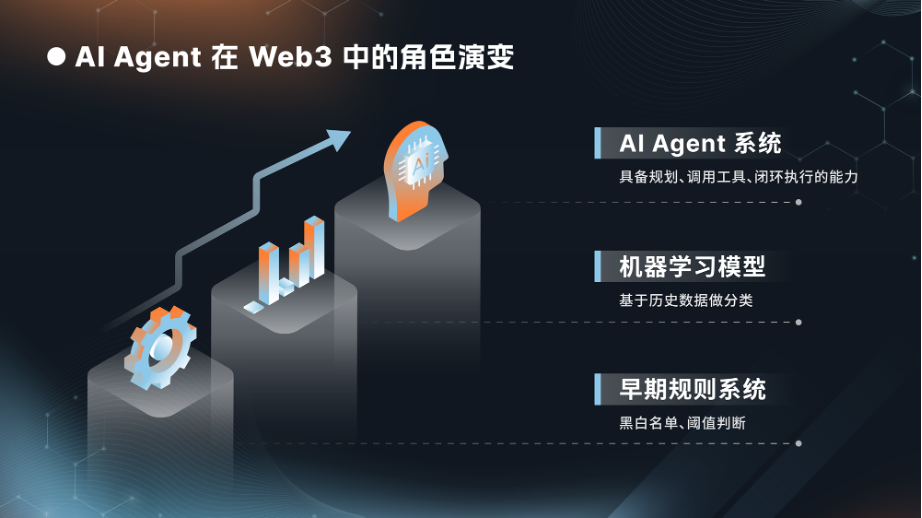
Early rule-based systems resembled "automated tools with brakes," focusing on converting expert experience into clear threshold judgments, whitelist/blacklist management, and fixed risk control strategies. The advantage of this model lies in its logical explainability and low governance costs, but its drawbacks are also very apparent: it reacts slowly to new business models and adversarial attack behaviors, and as business complexity increases, rules pile up continuously, ultimately forming a difficult-to-maintain "strategy debt" mountain, severely restricting system flexibility and response efficiency.
Subsequently, machine learning technology pushed risk control models into a new stage of statistical pattern recognition: through feature engineering and supervised learning algorithms, it achieved risk scoring and behavior classification, significantly improving the coverage of risk identification. However, this model is highly dependent on historical labeled data and data distribution stability, leading to the typical "distribution drift problem"—the historical data patterns relied upon during model training may become ineffective in actual application due to changes in market conditions, upgraded attack methods, etc., resulting in a significant decline in model judgment accuracy (essentially, historical experience becomes inapplicable). Once attackers change attack paths, conduct cross-chain migrations, or disperse funds into smaller amounts, the model will exhibit significant judgment deviations.
The emergence of large models and AI Agents has brought revolutionary changes to this field. The core advantages of AI Agents lie not only in being "smarter"—possessing stronger cognitive and reasoning abilities—but also in being "more capable"—having complete process orchestration and execution capabilities. It upgrades risk management from traditional single-point predictions to full-process closed-loop management, specifically including identifying abnormal signals, supplementing related evidence, associating relevant addresses, understanding contract behavior logic, assessing risk exposure, generating targeted handling suggestions, triggering control actions, and producing auditable records, among a series of complete steps. In other words, AI has evolved from "telling you there may be a problem" to "helping you handle the problem to an actionable state."
This evolution is also significant on the trading side: from traditional manual reading of research reports, monitoring indicators, and writing strategies, it has upgraded to a fully automated process where AI automatically captures multi-source data, generates trading strategies, places orders, and conducts post-trade analysis and optimization, bringing the system's action chain closer to that of an "autonomous decision system."
However, it is worth noting that once entering the autonomous decision system paradigm, risks will also escalate. Human operational errors typically exhibit low frequency and inconsistency; whereas machine errors often present high frequency and replicability, and may be triggered at scale simultaneously. Therefore, the real challenge of applying AI in financial systems is not "can it be done," but "can it be done within controllable boundaries": these boundaries include clear authority ranges, capital limits, callable contract scopes, and whether automatic downgrading or emergency braking can occur when risks arise. This issue will be further amplified in the Web3 field, primarily due to the irreversibility of on-chain transactions—once an error or attack occurs, capital losses are often difficult to recover.
2. The Amplifying Effect of Web3's Technical Structure on AI Applications: Open, Composable, Irreversible
As AI evolves from an "auxiliary tool" to an "autonomous decision system," a key question arises: what kind of chemical reaction will this evolution produce when combined with Web3? The answer is that the technical structure of Web3 will amplify both the efficiency advantages and risk hazards of AI—enabling exponential improvements in the efficiency of automated trading while also significantly expanding the scope and destructiveness of potential risks. This amplifying effect stems from the superposition of three structural characteristics of Web3: open data, protocol composability, and irreversible settlement.
From an advantage perspective, the core attraction of Web3 to AI primarily comes from the data layer. On-chain data inherently possesses characteristics of openness, transparency, verifiability, and traceability, providing a transparency advantage for risk control and compliance that traditional finance cannot achieve—one can clearly see the movement trajectory of funds, cross-protocol interaction paths, and the processes of fund splitting and aggregation on a unified ledger.
However, at the same time, on-chain data also presents significant understanding difficulties: addresses are "semantically sparse" (i.e., on-chain addresses lack clear identity markers, making it difficult to directly associate them with real entities), there is a large amount of invalid noise data, and cross-chain data is severely fragmented. If real business behaviors intertwine with behaviors that obscure the source of funds, it becomes challenging to effectively distinguish them through simple rules. This leads to the understanding of on-chain data itself becoming a high-cost project: it requires deep integration of transaction sequences, contract invocation logic, cross-chain message passing, and off-chain intelligence information to derive explainable and trustworthy conclusions.
The more critical impact comes from Web3's composability and irreversibility. The composability of protocols significantly accelerates the speed of financial innovation, allowing a trading strategy to flexibly combine modules such as lending, decentralized exchanges (DEX), derivatives, and cross-chain bridging like Lego blocks, forming innovative financial products and services. However, this characteristic also significantly accelerates the speed of risk propagation; a small defect in one component can quickly amplify along the "supply chain" and may even be rapidly reused by attackers as an attack template (the term "supply chain" is used here instead of "dependency chain" to make the correlation of risk transmission more understandable to the public).
Irreversibility, on the other hand, greatly increases the difficulty of post-event handling. In traditional financial systems, when erroneous transactions or fraudulent activities occur, one might still rely on transaction reversals, payment refusals, or inter-institutional compensation mechanisms to recover losses. However, in the Web3 field, once funds complete cross-chain transactions, enter mixing services, or rapidly disperse to numerous addresses, the difficulty of fund recovery increases geometrically. This characteristic compels the industry to shift the focus of security and risk control from traditional "post-event explanations" to "pre-event warnings and real-time blockades"—only by intervening before or during the occurrence of risks can losses be effectively reduced.
3. Differentiated Integration Paths of CEX and DeFi: The Same AI, Different Control Surfaces
Having understood the amplifying effect of Web3's technical structure, we also need to face a practical issue: while both centralized exchanges (CEX) and decentralized finance protocols (DeFi) introduce AI technology, their application focuses differ fundamentally due to the essential differences in the "control surfaces" (a network engineering term, here specifically referring to the ability to intervene in funds and protocols) they possess.
While applying AI in the fields of trading and risk control, the application priorities of CEX and DeFi are naturally different. CEX has a complete account system and strong control surfaces, allowing it to conduct KYC (Know Your Customer)/KYB (Know Your Business), set trading limits, and establish procedural mechanisms for freezing and rolling back transactions. The value of AI in CEX scenarios often manifests as more efficient review processes, more timely identification of suspicious transactions, and more automated compliance documentation generation and audit record retention.
In contrast, due to the core characteristic of decentralization, DeFi protocols have relatively limited intervention means (i.e., control surfaces) and cannot directly freeze user accounts like CEX. They resemble an "open environment with weak control surfaces and strong composability." Most DeFi protocols do not possess the ability to freeze funds, and the actual risk control points are dispersed across multiple nodes, including front-end interaction interfaces, API layers, wallet authorization stages, and compliance intermediary layers (such as risk control APIs, risk address lists, on-chain monitoring, and early warning networks).
This means that AI applications in the DeFi field emphasize real-time understanding and warning capabilities, including early detection of abnormal trading paths, early identification of downstream risk exposures, and quickly pushing risk signals to nodes with actual control power (such as trading platforms, stablecoin issuers, law enforcement partners, or protocol governance parties)—similar to how Tokenlon conducts KYA (Know Your Address) scans on trading initiation addresses, directly refusing service to known blacklisted addresses, thereby intercepting and blocking funds before they enter uncontrollable areas.
From an engineering implementation perspective, the differences in control surfaces determine the specific form of AI capabilities: in CEX scenarios, AI functions more like a high-throughput decision support and automation operation system, focusing on enhancing the efficiency and accuracy of existing processes; whereas in DeFi scenarios, AI resembles a continuously operating on-chain situational awareness and intelligence distribution system, with the core aim of achieving early risk detection and rapid response. Although both will move towards agentification, the constraints differ significantly: CEX constraints are more derived from internal rules and account permission management, while DeFi constraints rely more on programmable authorizations, transaction simulation validations, and whitelisting management of callable contract scopes.
4. The Formation of AI Agents, x402, and the Machine-Executable Trading System: From Bots to Agent Networks
Past trading bots were often simple combinations of fixed strategies and fixed interfaces, with relatively straightforward automation logic; AI Agents, on the other hand, are closer to generalized executors—they can autonomously select tools, combine execution steps, and self-correct and optimize based on feedback according to specific goals. However, for AI Agents to truly possess complete economic behavior capabilities, two core conditions are indispensable: the first is clear programmable authorizations and risk control boundaries, and the second is machine-native payment and settlement interfaces. The emergence of the x402 protocol precisely meets the second core condition, as it embeds payment processes into standard HTTP semantics, separating the payment phase from human interaction processes, allowing clients (AI Agents) and servers to complete efficient inter-machine transactions without the need for accounts, subscription services, or API keys.
Once the payment and invocation processes are standardized, a new organizational form of machine economy will emerge: AI Agents will no longer be limited to executing tasks at single points but will be able to form a continuous closed loop of "paid invocation - data acquisition - decision generation - trade execution" across multiple services. However, this standardization also presents risks with standardized characteristics: payment standardization will give rise to automated fraud behaviors and money laundering service calls; strategy generation standardization will lead to the proliferation of replicable attack paths.
Therefore, the core logic that needs to be emphasized here is that the integration of AI and Web3 is not simply about connecting AI models with on-chain data, but rather a profound system paradigm shift. Specifically, both trading and risk control fields are synchronously moving towards machine-executable modes, and in a machine-executable world, it is essential to establish a complete infrastructure where machines can act, be constrained, be audited, and be blocked; otherwise, the benefits of efficiency improvements will be completely offset by losses caused by risk spillover.
Chapter 2: How AI Reshapes Web3 Trading Efficiency and Decision Logic
1. Core Challenges of the Web3 Trading Environment and AI's Intervention Points
One of the core structural issues facing the Web3 trading environment is the liquidity fragmentation caused by the coexistence of centralized exchanges (CEX) and decentralized exchanges (DEX)—liquidity is dispersed across different trading venues and blockchain networks, leading to frequent inconsistencies between the "visible price" and the "actual executable price/volume" for users. AI plays a key role as a scheduling layer in this scenario, capable of providing users with optimal trading order distribution and execution path suggestions based on multidimensional factors such as market depth, slippage costs, trading fees, routing paths, and latency, effectively enhancing transaction efficiency.
The high volatility, high risk, and information asymmetry issues in the crypto market have long existed and are further amplified in event-driven markets. One of AI's core values in alleviating this issue is to expand the coverage of information—structuring and analyzing project announcements, on-chain fund data, social media sentiment, and professional research materials to help users quickly establish a foundational understanding of project fundamentals and potential risk points, thereby reducing decision biases caused by information asymmetry.
Using AI to assist in trading is not a new concept, but the role of AI in trading is gradually deepening from "assisting in reading information" to core processes of "signal recognition - sentiment analysis - strategy production." For example, real-time identification of abnormal fund flows and whale address fund migrations, quantitative analysis of social media sentiment and project narrative popularity, and automatic classification and alerts of market states (trending markets/volatile markets/expanding volatility markets) are capabilities that can more easily form scalable application value in the high-frequency information interaction environment of the Web3 market.
However, it is also important to emphasize the boundaries of AI applications: the current price effectiveness and information quality in the crypto market remain unstable. If the upstream data processed by AI contains noise interference, human manipulation, or erroneous attribution, typical "garbage in, garbage out" problems will arise. Therefore, when evaluating AI-generated trading signals, the credibility of information sources, the completeness of the logical evidence chain, the clear expression of confidence levels, and the counterfactual verification mechanism (i.e., whether signals can be cross-validated across multiple dimensions) are more critical than the "signal strength" itself.
2. Industry Forms and Evolution Directions of Web3 Trading AI Tools
Currently, the evolution direction of AI tools embedded in exchanges is shifting from traditional "market interpretation" to "full trading process assistance," placing greater emphasis on unified information views and information distribution efficiency. For example, Bitget's GetAgent is positioned more as a general trading information and advisory assistance tool: by presenting key market variables, potential risk points, and core information highlights in a more easily understandable manner, it effectively alleviates barriers for users in information acquisition and professional understanding.
On-chain bots and copy trading represent the diffusion trend of execution-side automation, with their core advantage being the transformation of professional trading strategies into replicable standardized execution processes, lowering the trading threshold for ordinary users. In the future, an important follow-up object may come from AI technology-based quantitative trading teams or systematic strategy providers, but this will also transform the "strategy quality" issue into a more complex "strategy sustainability and explainability" issue—users not only need to know the past performance of strategies but also need to understand the underlying logic, applicable scenarios, and potential risks of the strategies.
It is crucial to pay attention to market capacity and strategy crowding issues: when large amounts of capital act simultaneously under similar signals and execution logics, trading profits will be rapidly compressed, and market impact costs and capital drawdown will be significantly amplified. Especially in on-chain trading environments, factors such as slippage fluctuations, MEV (maximum extractable value) impacts, routing path uncertainties, and instantaneous liquidity changes will further amplify the negative externalities of "crowded trading," leading to actual returns being far lower than expected.
Therefore, a more neutral and rational conclusion is that the more automated the form of AI trading tools becomes, the more necessary it is to discuss capability descriptions alongside constraint mechanisms. These constraint mechanisms include clear conditions for strategy applicability, strict risk limit settings, automatic shutdown rules under abnormal market conditions, and the auditability of data sources and signal generation processes; otherwise, "efficiency improvements" themselves may become channels for risk amplification, bringing unnecessary losses to users.
3. Positioning of Bitget GetAgent in the AI Trading System
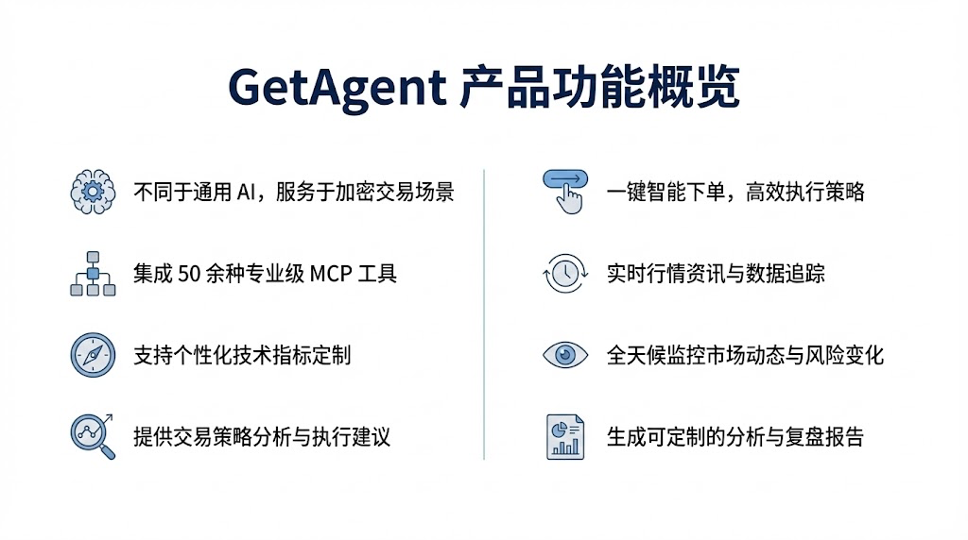
GetAgent is not simply a chatbot; it serves as a "second brain" for traders in complex liquidity environments. Its core logic lies in the deep integration of AI algorithms with real-time multidimensional data, constructing a complete closed loop connecting data, strategies, and execution. Its core value is primarily reflected in the following four aspects:
(1) Real-time Information and Data Tracking
Traditional information monitoring and data analysis work require users to possess high web scraping and analytical skills, which can be quite challenging. GetAgent integrates over 50 professional-grade tools to achieve real-time penetration into the market's "black box"—not only monitoring the dynamics of mainstream financial media in real-time but also deeply infiltrating multiple information dimensions such as social media sentiment and core project dynamics, ensuring that users' information acquisition is no longer blind.
At the same time, GetAgent has powerful information filtering and refining capabilities, effectively filtering out ineffective noise such as air coin marketing and accurately extracting core variables that truly impact price fluctuations, such as project security vulnerability warnings and large token unlocking plans. Finally, GetAgent integrates and analyzes the originally fragmented on-chain trading flows with massive announcements, research reports, and other information, transforming them into intuitive logical judgments, such as directly informing users that "while the project's social media popularity is high, core developers' funds are continuously flowing out," making potential risks clear at a glance.
(2) Trading Strategy Generation and Execution Assistance
GetAgent can generate customized trading strategies based on users' personalized needs, significantly lowering the trading execution threshold and promoting the shift of trading decisions from "professionally driven instructions" to precise "intention-strategy" driven decisions. Based on users' historical trading preferences, risk tolerance, and current positions, GetAgent provides not broad bullish or bearish suggestions, but highly targeted precise guidance, such as "for your current BTC position, it is recommended to set a grid trading strategy in the X-Y range under the current volatility."
For complex cross-asset and cross-protocol operations, GetAgent simplifies them into natural language interactions—users only need to express their trading intentions in everyday language, and GetAgent can automatically match the optimal strategy in the background, optimizing for market depth and slippage, thereby greatly lowering the threshold for ordinary users to participate in complex Web3 trading.

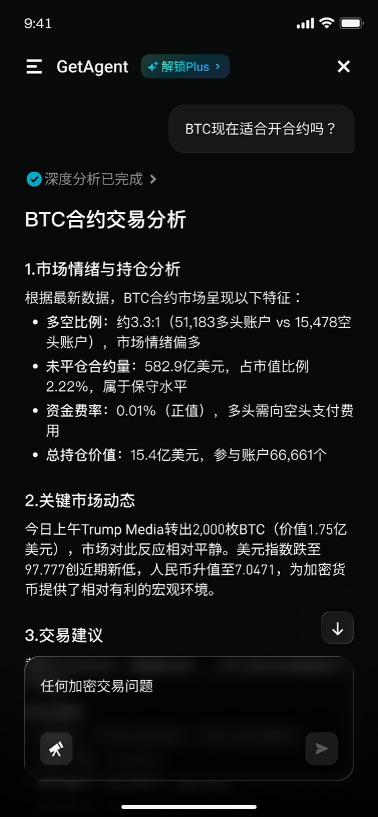

(3) Synergistic Relationship with Automated Trading Systems
GetAgent is not an isolated tool but a core decision node within the entire automated trading system. From the upstream perspective, it receives multidimensional inputs from on-chain data, real-time market conditions, social media sentiment, and professional research information; after internal structured processing, key information summarization, and logical analysis, it forms a systematic strategy judgment framework; then it provides precise decision references and parameter suggestions to downstream automated trading systems, quantitative AI Agents, and copy trading systems, achieving coordinated linkage across the entire system.
(4) Risks and Constraints Behind Trading Efficiency Improvements
While embracing the efficiency improvements brought by AI, it is essential to maintain a high level of vigilance regarding potential risks. No matter how strong the trading signals provided by GetAgent may seem, the core principle of "AI suggests, human confirms" should be consistently upheld. In the process of in-depth research and continuous enhancement of AI capabilities, the Bitget team is committed not only to ensuring that GetAgent provides precise trading suggestions but also to exploring the feasibility of enabling GetAgent to provide a complete logical evidence chain—why recommend this entry point? Is it because technical indicators are resonating, or because there is an abnormal influx of funds into on-chain whale addresses?
In the view of the Bitget team, the long-term value of GetAgent lies not in providing definitive trading conclusions, but in helping traders and trading systems better understand the types of risks they are undertaking and whether these risks align with the current market phase, thereby enabling more rational trading decisions.
4. Balancing Trading Efficiency and Risk: The Security Support of BlockSec
Behind the AI-driven enhancement of trading efficiency, risk prevention and control remains a core issue that cannot be overlooked. Based on a profound understanding of Web3 trading risks, BlockSec provides comprehensive security support to help users effectively manage potential risks while enjoying the conveniences of AI trading:
For risks related to data noise and erroneous attribution, BlockSec's Phalcon Explorer offers powerful trading simulation and multi-source cross-validation capabilities, effectively filtering out manipulated data and erroneous signals, helping users identify real market trends;
For market risks caused by strategy crowding, MetaSleuth's fund flow tracking feature can identify the concentration of funds in similar strategies in real-time, providing early warnings of liquidity crunch risks and offering references for users to adjust their trading strategies;
In terms of execution link security, MetaSuites' Approval Diagnosis feature can detect abnormal authorization behaviors in real-time, supporting users in revoking high-risk authorizations with one click, effectively preventing financial losses caused by permission abuse and erroneous execution.
Chapter 3: The Evolution of Offense and Defense in the AI Era of Web3 and New Security Paradigms
While AI technology accelerates trading efficiency, it also makes attacks faster, more covert, and more destructive. The decentralized architecture of Web3 leads to a natural dispersion of responsibility, the composability of smart contracts makes risks exhibit systemic spillover characteristics, and the proliferation of large models further lowers the technical threshold for understanding vulnerabilities and generating attack paths, pushing attack behaviors towards full automation and scaling.
Correspondingly, security defenses must upgrade from traditional "better detection" to "executable real-time response loops," and in specific scenarios of machine-executed trading, systematically engineer the governance of authorization management, erroneous execution prevention, and systemic chain risks, constructing a new security paradigm for Web3 that adapts to the AI era.
1. AI's Reshaping of Web3 Attack Methods and Risk Forms
The security dilemma of Web3 is never just about "whether vulnerabilities exist," but rather about how its decentralized architecture naturally disperses responsibility. For example, protocol code is developed and released by project teams, the front-end interface may be maintained by different teams, transactions are initiated through wallets and routing protocols, funds circulate between DEXs, lending protocols, cross-chain bridges, and aggregators, and finally, deposits and withdrawals are completed through centralized platforms—when a security incident occurs, each link can claim to only have partial control, making it difficult to assume full responsibility. Attackers exploit this structural dispersion, threading the needle between multiple weak points to create a situation where no single entity can exert global control, thus achieving their attack objectives.
The introduction of AI makes this structural weakness even more pronounced. Attack paths can be systematically searched, generated, and reused by AI, and the speed of risk diffusion can stably exceed the upper limit of human collaboration for the first time, rendering traditional manual emergency response mechanisms ineffective. At the smart contract level, the systemic risks brought by vulnerabilities are not mere alarmism. The composability of DeFi allows a small code defect to rapidly amplify along dependency chains, ultimately evolving into ecosystem-level security incidents, while the irreversible nature of fund settlement compresses the emergency response time window to minutes.
According to the DeFi security incident data dashboard maintained by BlockSec, in 2024, the total amount of stolen funds in the crypto space due to hacker attacks and exploitations exceeded $2 billion, with DeFi protocols remaining the primary targets of attacks. These data clearly indicate that even as industry investments in security continue to increase, attack incidents still occur frequently with high single-loss amounts and strong destructive power. When smart contracts become a core component of financial infrastructure, vulnerabilities are no longer just simple engineering flaws but resemble systemic financial risks that can be maliciously exploited.
AI's reshaping of attack surfaces is also reflected in its complete automation of attack processes that previously relied on human experience and manual operations:
The first category is the automation of vulnerability discovery and understanding. Large models possess powerful code reading, semantic induction, and logical reasoning capabilities, enabling them to quickly extract potential weak points from complex contract logic and accurately generate vulnerability trigger conditions, transaction execution sequences, and contract call combinations, significantly lowering the technical threshold for exploiting vulnerabilities.
The second category is the automation of attack path generation. Recent industry research has begun to transform large language models (LLMs) into end-to-end exploit code generators—by combining LLMs with specialized toolchains, it is possible to automatically collect target information, understand contract behavior logic, generate compilable executable attack smart contracts, and test and validate them on historical blockchain states starting from specified contract addresses and block heights. This means that available attack methods are no longer entirely dependent on a few top security researchers' manual debugging but can be engineered into scalable attack pipelines.
Broader security research also corroborates this trend: given a CVE (Common Vulnerabilities and Exposures) description, GPT-4 can generate usable exploit code at a very high rate in its test set, revealing that the conversion threshold from natural language descriptions to actual attack code is rapidly decreasing. As generating attack code increasingly resembles a conveniently callable capability, the scaling of attack behaviors becomes more realistic.
The amplification effects brought by scaled attacks typically manifest in two ways in the Web3 domain:
The first is paradigm attacks, where attackers adopt the same set of attack strategies to batch scan, filter, probe, and launch attacks on a large number of similar contracts with the same types of vulnerabilities across the network (using "paradigm attacks" rather than "multi-target with the same template" aligns better with industry norms);
The second is the supply chain of money laundering and fraud activities, allowing wrongdoers to no longer need to build a complete set of infrastructure themselves. For example, a Chinese guarantee-style black market has formed a mature criminal service market on platforms like Telegram, where large illegal markets such as the Huiwang Guarantee Platform and Xinbi Guarantee have facilitated over $35 billion in stablecoin transactions since 2021, covering money laundering, stolen data trading, and even more serious criminal services. At the same time, specialized fraud tools, including deepfake tools, have emerged in the Telegram black market—this platform-based supply of criminal services means that attackers can not only generate exploit plans and attack paths faster but also quickly acquire money laundering toolkits for their attack proceeds, thereby upgrading a single technical attack incident into a complete black industrial chain event.
2. AI-Driven Security Defense Systems
In the face of the upgraded attack forms brought by AI, the core value of AI on the defense side lies in transforming traditional security capabilities that rely on human experience into replicable and scalable engineering systems. The core capabilities of this defense system are reflected in three areas:
(1) Smart Contract Code Analysis and Automated Auditing
AI's core advantage in the field of smart contract auditing lies in structuring and systematizing dispersed auditing knowledge. Traditional static analysis and formal verification tools excel at handling deterministic rules but can easily fall into the dilemma of false negatives and false positives when faced with complex business logic, multi-contract composite calls, and implicit assumptions. Large models have clear advantages in semantic interpretation, pattern induction, and cross-file logical reasoning, making them very suitable as a pre-audit step to quickly understand contracts and provide initial risk alerts.
However, AI is not meant to replace traditional auditing tools but rather to link these tools into a more efficient automated auditing pipeline. Specifically, AI models first complete semantic summaries of contracts, locate suspicious risk points, and hypothesize potential attack surfaces, then pass this information to static analysis/dynamic verification tools for precise validation, and finally, AI organizes the validation results, evidence chains, vulnerability trigger conditions, and remediation suggestions into standardized, auditable output reports. This division of labor—where "AI does understanding, tools do validation, and humans make decisions"—will become a more stable engineering form in the future of smart contract auditing.
(2) Anomaly Detection in Transactions and On-Chain Behavior Patterns
The focus of AI in this area is to transform publicly available but chaotic on-chain data into actionable security signals. The core difficulty in the on-chain world is not data absence but rather data overload from noise: high-frequency trading by bots, fund splitting transfers, cross-chain jumps, and complex contract routing intertwine, making traditional simple threshold strategies very fragile and ineffective at identifying anomalies.
AI technology is better suited to handle such complex scenarios—through sequence modeling and graph association analysis techniques, it can accurately identify precursor behaviors of certain typical attacks (such as abnormal authorization operations, abnormal contract call densities, and indirect associations with known risk entities) and continuously calculate downstream risk exposures, allowing security teams to clearly grasp the direction of fund movements, the potential scope of impact, and how much time window remains for interception.
(3) Real-Time Monitoring and Automated Response
In practical engineering environments, to truly implement the above defense capabilities, it often relies on continuously operating security platforms rather than one-time analysis tools. For example, the Phalcon Security platform launched by BlockSec is designed not to retrospectively analyze attack details but to focus on real-time monitoring at the on-chain and memory pool levels, anomaly behavior identification, and automated response as its three core functions, aiming to intercept risks within still executable time windows.
In several real Web3 attack scenarios, Phalcon Security has successfully identified potential attack signals in advance through continuous perception of transaction behaviors, contract interaction logic, and sensitive operations, and supports users in configuring automated response strategies (such as automatically pausing contracts, intercepting suspicious transfers, etc.), effectively blocking risk diffusion before an attack is completed. The core value of such capabilities lies not in "discovering more problems," but in enabling security defenses to match the response speed of automated attacks for the first time, pushing Web3 security from traditional passive auditing models towards proactive real-time defense systems.
3. Security Challenges and Responses in Smart Trading and Machine Execution Scenarios
As trading models shift from "human click confirmation" to "machine automatic closed-loop execution," the core security risks also gradually migrate from traditional contract vulnerabilities to authorization management and execution link security.
First, wallet security, private key management, and authorization risks will be significantly amplified. This is because AI Agents need to frequently call various tools and contracts, inevitably requiring more frequent transaction signatures and more complex authorization configurations. Once private keys are leaked, authorization scopes are too broad, or authorized entities are maliciously replaced, financial losses can escalate in a very short time. Traditional security advice of "users should be more cautious" becomes completely ineffective in the era of machine automation—because the system itself is designed to reduce human intervention, making it difficult for users to monitor every automated operation in real-time.
Secondly, AI Agents and machine payment protocols (such as x402) will bring more covert and subtle risks of permission abuse and erroneous execution. Protocols like x402, which allow APIs, applications, and AI Agents to use stablecoins for instant payments via HTTP, enhance trading efficiency but also mean that machines have more autonomy in payment and invocation across various stages. This provides attackers with new attack paths: they can package malicious behaviors such as induced payments, induced calls, and induced authorizations to resemble normal business processes, thereby evading defense mechanisms.
At the same time, AI models themselves may execute seemingly compliant but actually erroneous operations under the influence of prompt injection attacks, data pollution, or adversarial samples. The core issue here is not the quality of the x402 protocol itself, but rather that the smoother and more automated the machine trading link becomes, the more stringent the boundaries of permissions, funding limits, revocable authorization mechanisms, and complete audit replay capabilities need to be established. Otherwise, the system may amplify a small error into large-scale automated chain losses.
Finally, automated trading may also trigger systemic chain risks. When a large number of AI Agents use similar signal sources and strategy templates, the market may experience severe "resonance phenomena"—where the same triggering conditions lead to massive funds buying and selling simultaneously, canceling orders simultaneously, and migrating across chains simultaneously, significantly amplifying market volatility and triggering large-scale liquidations and liquidity crunch events. Attackers may also exploit this homogeneity by issuing inducement signals, manipulating local liquidity, or launching attacks on key routing protocols, causing cascading failures both on-chain and off-chain.
In other words, machine trading upgrades the traditional individual operational risks to more destructive collective behavioral risks. These risks may not necessarily stem from malicious attacks but could also arise from highly consistent automated "rational decisions"—when all machines make the same decision based on the same logic, systemic risks may form.
Therefore, a more sustainable security paradigm in the era of intelligent trading is not to vaguely emphasize "real-time monitoring," but to engineer and implement responses to the three types of risks mentioned above:
First, through layered authorization and automatic downgrading mechanisms, strictly cap the loss limits of uncontrolled authorizations, ensuring that a single permission leak does not lead to global losses;
Second, through pre-execution simulation and reasoning chain audit technologies, effectively intercept erroneous executions and induced malicious operations, ensuring that every automated trade has a clear logical basis;
Third, through strategies to reduce homogeneity, circuit breaker mechanism design, and cross-entity collaborative efforts, suppress the occurrence of systemic chain reactions, ensuring that a single market fluctuation does not evolve into a crisis for the entire industry.
Only in this way can security defenses truly align with machine execution speeds, allowing for earlier, steadier, and more executable "braking" at critical risk nodes, ensuring the safe and stable operation of the intelligent trading system.
Chapter 4: The Application of AI in Web3 Risk Control, Anti-Money Laundering, and Risk Identification
The compliance challenges in the Web3 domain arise not only from anonymity but from a complex interplay of multiple factors: the contradiction between anonymity and traceability, the path explosion problem caused by cross-chain and multi-protocol interactions, and the fragmentation of responses due to differences in control between DeFi and CEX. The core opportunity for AI in this field lies in compressing vast amounts of noisy on-chain data into actionable risk facts: by linking address profiling, fund path tracking, and contract/Agent risk assessments into a complete closed loop, and productizing these capabilities into real-time alerts, response orchestration, and auditable evidence chains.
With the advent of AI Agents and machine payment, the compliance field will also face new protocol adaptation and responsibility delineation issues. The interface and automated evolution of RegTech (regulatory technology) will become an inevitable industry trend.
1. Structural Challenges in Web3 Risk Control and Compliance
(1) The Tug-of-War Between Anonymity and Traceability
The first core contradiction faced in the Web3 compliance field is the coexistence of anonymity and traceability. On-chain transaction records are public, transparent, and immutable, theoretically allowing every flow of funds to be traced; however, on-chain addresses do not inherently equate to real identities. Market participants can obscure traceability by frequently changing addresses, splitting fund transfers, introducing intermediary contracts, and performing cross-chain operations, transforming "traceable" into "traceable but hard to attribute"—meaning that while the flow of funds can be tracked, determining the true controller of the funds is challenging.
Therefore, risk control and AML (anti-money laundering) efforts in the Web3 domain cannot rely primarily on account real-name verification and centralized clearing to lock in responsibility, but must establish a risk judgment system based on behavioral patterns and funding paths: how to aggregate and identify address clusters of the same entity, where the funds come from, where they flow to, what interactions occur in which protocols, and what the true intentions of these interactions are—these details are the core elements constituting risk facts.
(2) The Compliance Complexity of Cross-Chain and Multi-Protocol Interactions
Today, the flow of funds in the Web3 domain rarely completes a closed loop within a single chain and protocol; instead, it often undergoes a series of complex actions such as "cross-chain bridging - DEX exchange - lending operations - derivatives trading - and then cross-chain again." Once the funding path is extended, the difficulty of compliance work shifts from identifying a single isolated suspicious transaction to recognizing the true intentions and final consequences of an entire cross-domain path. More challenging is that each individual step in the path may appear completely normal (e.g., routine currency exchanges, adding liquidity operations), but when combined, these steps may serve to obscure the source of funds and facilitate illegal cashing out, posing significant challenges for compliance identification.
(3) Scenario Fragmentation: Regulatory Differences Between DeFi and CEX
The third core challenge arises from the significant differences in regulatory logic and response capabilities between DeFi and CEX. CEX has a naturally strong control framework, with a complete account system, strict deposit and withdrawal gates, relatively centralized risk control strategies, and the ability to freeze funds, making regulatory requirements easier to implement in the form of obligated entities.
In contrast, DeFi resembles a "weak control framework + strong composability" public financial infrastructure, where in many cases, the protocol itself lacks the ability to freeze funds, and actual risk control points are dispersed across multiple nodes, including front-end interaction interfaces, routing protocols, wallet authorization stages, stablecoin issuers, and on-chain infrastructure.
This leads to the same type of risk manifesting as suspicious deposit/withdrawal behaviors and account operation anomalies in CEX scenarios, while in DeFi scenarios, it is more likely to present as abnormal funding paths, abnormal contract interaction logic, and abnormal authorization behaviors. To achieve comprehensive compliance coverage across both types of scenarios, a technical system must be established that can understand the true intentions of funds across scenarios and flexibly map control actions to different control frameworks.
2. AI-Driven AML Practices
In light of the aforementioned structural challenges, the core value of AI in the Web3 AML field lies not in "generating compliance reports," but in compressing the complex flows and interaction logic of on-chain funds into executable compliance closed loops: discovering abnormal risks earlier, explaining risk causes more clearly, triggering response actions more quickly, and leaving a complete auditable evidence chain.
On-chain address profiling and behavior analysis are the foundational first steps of AML work. Here, profiling is not simply about labeling addresses but involves conducting in-depth analysis of addresses within specific behavioral contexts: which contracts/protocols the address interacts with frequently, whether the source of funds is overly concentrated, whether the transfer rhythm exhibits typical money laundering characteristics of splitting-aggregating-splitting again, and whether there are direct or indirect associations with known high-risk entities (such as blacklisted addresses or suspicious trading platforms). The combination of large models and graph learning technology commonly serves to aggregate seemingly fragmented and unrelated transaction records into structured objects that are more likely to belong to the same entity or criminal chain, thereby upgrading subsequent compliance actions from "monitoring individual addresses" to "monitoring actual controlling entities," significantly enhancing compliance efficiency and accuracy.
Building on this, fund flow tracking and cross-chain tracing play a key role in linking risk intentions and final consequences. Cross-chain operations are not merely about transferring tokens from Chain A to Chain B; they often involve asset format conversions, funding path obfuscation, and new intermediary risks. The core role of AI is to automatically track and continuously update downstream funding flow paths—when suspicious source funds begin to move, the system must not only accurately follow every step of the fund's flow but also be able to assess in real-time which key nodes (such as CEX deposit addresses, stablecoin issuer contracts, etc.) are approaching that can be frozen, investigated, or intercepted. This is why the industry increasingly emphasizes real-time alerts rather than post-event reviews: once funds enter an irreversible diffusion stage, the cost of freezing and recovering them significantly increases, and the success rate decreases dramatically.
Furthermore, risk assessment of smart contract and AI Agent behaviors expands the risk control perspective from merely the flow of funds to the execution logic level. The core difficulty of contract risk assessment lies in the complexity of business logic and the frequency of composite calls; traditional rules and static analysis tools often overlook implicit assumptions across functions, contracts, and protocols, leading to failures in risk identification. AI technology is better suited for deep semantic understanding and adversarial hypothesis generation: it can first clarify the core information of contracts, such as key state variables, permission boundaries, funding flow rules, and external dependencies, and then simulate and validate abnormal call sequences to accurately identify potential compliance risks at the contract level.
Agent behavior risk assessment leans more towards "strategy and permission governance": what operations AI Agents perform within what authorization scope, whether there are abnormal call frequencies or scales, whether they continue to execute trades under adverse market conditions with abnormal slippage or low liquidity, and whether these operations comply with preset compliance strategies—all these behaviors need to be recorded in real-time, quantified, and automatically trigger downgrading or circuit breaker mechanisms when risk thresholds are reached.
To truly transform these compliance capabilities into industry productivity, a clear productization path is needed: deep integration of multi-chain data and security intelligence at the foundational level; building entity profiling and funding path analysis engines at the middle layer; providing real-time risk alerts and response process orchestration functions at the upper layer; and outputting standardized audit reports and evidence chain retention capabilities at the outer layer. The necessity for productization arises because the challenges of compliance and risk control do not lie in the accuracy of single analyses but in the adaptability of continuous operations: compliance rules will change with regulatory requirements, malicious tactics will continuously evolve, and on-chain ecosystems will keep iterating. Only a systematic product that can continuously learn, update, and leave traces can effectively respond to these dynamic changes.
To enable on-chain risk identification and anti-money laundering capabilities to truly function, the key lies not in the accuracy of single-point models but in whether they can be productized into a continuously operating, auditable, and collaborative engineering system. Taking BlockSec's Phalcon Compliance product as an example, its core idea is not simply to mark high-risk addresses but to link risk discovery, evidence retention, and subsequent response processes into a complete closed loop through an address labeling system, behavior profiling analysis, cross-chain funding path tracking, and multi-dimensional risk scoring mechanisms, providing a one-stop solution for compliance work in the Web3 domain.
In the industry context where AI and Agents are widely involved in trading and execution, the importance of such compliance capabilities is further enhanced: risks no longer solely stem from the proactive attacks of "malicious accounts" but may also arise from passive violations caused by erroneous executions or permission abuses of automated strategies. Pre-positioning compliance logic in the trading and execution links allows risks to be identified and marked before funds complete irreversible settlements, becoming a key component of the risk control system in the era of intelligent trading.
3. New Compliance Propositions in the Era of Machine Trading
When the trading model shifts from "human-operated interfaces" to "machine-invoked interfaces," a series of new propositions will emerge in the compliance field: the regulatory objects will no longer be just the trading behaviors themselves, but also the protocols and automation mechanisms that the transactions rely on. The discussion of the x402 protocol is important not only because it makes payments between machines smoother and more efficient, but also because it deeply embeds payment functions into the HTTP interaction process, thereby making the automatic settlement model of the "Agent economy" possible.
Once such mechanisms are scaled up, compliance concerns will shift to "under what authorizations and constraints machines complete payments and transactions": whose Agent, under what funding limits, under what strategic constraints, for what resources are payment calls made, and whether there are abnormal circular payments or inducement calling behaviors, etc. This information needs to be fully recorded and possess audit capabilities.
Following this is the challenge of defining responsibility. AI Agents themselves are not legal entities, but they can execute transactions on behalf of individuals or institutions and may cause significant financial losses or compliance risks. When an Agent's decisions rely on external tools, external data, or even third-party paid capabilities (such as a data API or trading execution service), the responsibility becomes difficult to clearly delineate among developers, operators, users, platforms, and service providers.
A more realistic and actionable engineering direction is to embed responsibility traceability into the core of system design: all high-impact actions should default to generating structured reasoning chains (including sources of triggering signals, risk assessment processes, simulation verification results, boundaries of authorization scopes, final execution transaction parameters, etc.), and key strategies and parameters should be version-controlled and support complete replay, so that when incidents occur, the root cause can be quickly identified—whether it is a strategy logic error, data input error, authorization configuration error, or a malicious attack on the toolchain.
Finally, the evolution direction of RegTech (regulatory technology) will shift from traditional "post-event screening tools" to "infrastructure for continuous monitoring and executable controls." This means that compliance will no longer be just an internal process of a department, but a set of standardized platform capabilities: at the strategy layer, regulatory requirements and internal risk control rules will be encoded into executable code (policy-as-code); at the operational layer, funding paths and behavioral patterns of market participants will be continuously monitored; at the control layer, core actions such as transaction delays, funding limits, risk isolation, and emergency freezing will be implemented; and at the collaboration layer, verifiable evidence will be quickly pushed to all actionable entities within the ecosystem (such as exchanges, stablecoin issuers, law enforcement agencies, etc.).
As machine payments and machine trading are standardized, they also remind us that compliance capabilities must achieve the same level of interface and automation upgrades; otherwise, there will be an irreconcilable structural gap between the high-speed execution of machine trading and the low-speed response of human compliance. AI technology provides an opportunity for risk control and AML to become the foundational infrastructure of the intelligent trading era: by enabling earlier warnings, faster collaboration, and more executable technical means, risks can be compressed within the smallest impact window, providing core support for the compliance development of the Web3 industry.
Conclusion
Looking back at the entire text, it is clear that the integration of AI and Web3 is not a simple single-point technological upgrade, but a comprehensive systemic paradigm shift that is unfolding: trading is moving towards machine executability, and attacks are simultaneously becoming mechanized and scaled, while security, risk control, and compliance are forced to transition from traditional "auxiliary functions" to indispensable foundational infrastructure for intelligent trading systems. Efficiency and risk are no longer two sequential stages but are simultaneously amplified and accelerated, presenting a positive correlation where "the higher the efficiency, the higher the requirements for risk prevention and control."
On the trading side, the AI and Agent systems significantly lower the barriers to information acquisition and trade execution, reshaping market participation methods and allowing more users to engage in Web3 trading, but they also bring new risks such as strategy crowding and erroneous executions; on the security side, the automation of vulnerability exploitation, attack generation, and fund laundering leads to risks that are more concentrated and erupt more rapidly, raising the demands on the response speed and disposal capabilities of defense systems; on the risk control and compliance side, address profiling, path tracking, and behavior analysis technologies are evolving from mere analytical tools to engineering systems with real-time disposal capabilities, while the emergence of machine payment mechanisms like x402 further drives compliance issues towards deeper questions of "how machines are authorized, how they are constrained, and how they are audited."
All of this points to a clear conclusion: what is truly scarce in the era of intelligent trading is not faster decision-making speed or more aggressive levels of automation, but the security, risk control, and compliance capabilities that can align with machine execution speeds. These capabilities need to be designed as executable, composable, and auditable complete systems, rather than passive processes that remedy issues after the fact.
For trading platforms, this means that while enhancing trading efficiency, risk boundaries, logical evidence chains, and human regulatory mechanisms must be deeply embedded into AI systems to achieve a balance of "efficiency and safety"; for providers of security and compliance infrastructure, this means that monitoring, warning, and blocking capabilities must be advanced to before funds are out of control, building a protective system of "proactive defense and real-time response."
The joint judgment of BlockSec and Bitget is that in the near future, the key to whether the intelligent trading system can achieve sustainable development lies not in who embraces AI technology faster, but in who can implement "machine executability" and "machine constraint" simultaneously at an earlier stage. Only under the premise of parallel evolution of efficiency enhancement and risk constraints can AI truly become a long-term increment in the Web3 trading ecosystem, rather than an amplifier of systemic risks.
The integration of Web3 and AI is an inevitable trend in industry development, and security, risk control, and compliance are the core guarantees for this trend to be stable and sustainable. BlockSec will continue to deepen its efforts in the Web3 security field, providing stronger and more reliable security protection and compliance support through technological innovation and product iteration, and together with industry partners like Bitget, promote the healthy and sustainable development of the intelligent trading era.
免责声明:本文章仅代表作者个人观点,不代表本平台的立场和观点。本文章仅供信息分享,不构成对任何人的任何投资建议。用户与作者之间的任何争议,与本平台无关。如网页中刊载的文章或图片涉及侵权,请提供相关的权利证明和身份证明发送邮件到support@aicoin.com,本平台相关工作人员将会进行核查。


