Written by: JayLovesPotato
Translated by: Block unicorn
In the past few days, a series of protocol announcements—along with Vitalik's comments—have reignited discussions in the decentralized social space. While these events may seem isolated, together they clearly indicate that the platformization of protocols is now advancing in a "strategic" manner.
1. News and the Strategic Context Behind It
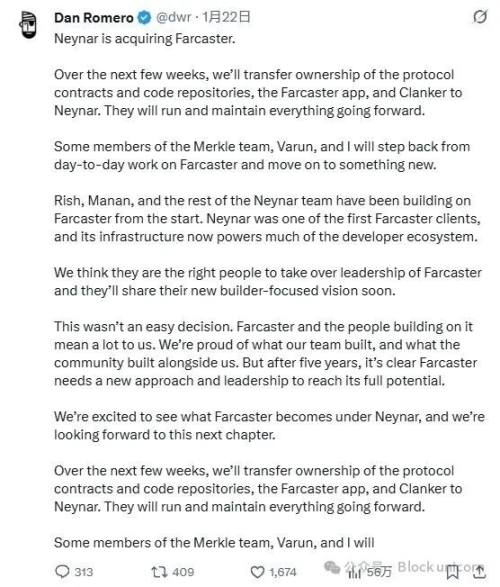
Last Wednesday, Dan Romero, co-founder of the decentralized social platform Farcaster, announced that Neynar, one of the earliest and most influential clients of Farcaster, will acquire Farcaster. As part of this transition, the protocol contracts, core codebase, official applications, and even the ownership of Clanker will be transferred in phases. Meanwhile, Romero pointed out that the founding team will step back from daily operations to focus on new projects.
The decision made by Farcaster seems to reflect an increasingly strong consensus within its team: the long-term sustainability of social protocols relies less on continuous iteration at the protocol design level and more on the increasingly specialized infrastructure and operational execution capabilities at this stage.
In fact, this means that control is naturally shifting to those infrastructure providers who have successfully aggregated developer resources and traffic—Neynar has emphasized since 2024 the costs and complexities of running Farcaster's central servers, abstracting these challenges into APIs and infrastructure layers so that developers can focus on product development rather than struggling with the internal mechanisms of the protocol.
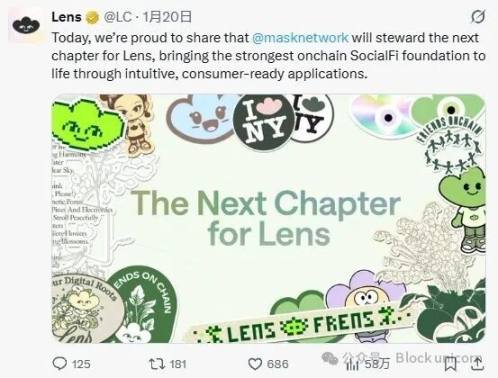
In contrast, Lens has taken a more advanced—though conceptually aligned with Farcaster—approach. Lens already possesses a relatively richer set of tools, resources, and a mature user base, thus choosing to further advance in the operational direction.
On January 20, 2026, Lens Labs officially announced that Mask Network will take on the role of "manager" for the next phase of Lens, shifting the project's focus from infrastructure development to consumer-facing products. Mask stated that this move aims to translate the protocol's validated results into experiences available to the mass market.
It is noteworthy that both Lens and Aave have specifically emphasized that this transition does not involve changes in ownership, financial structure, or governance structure. The focus is not on the acquisition itself, but rather on the clear redistribution of responsibilities—specifically, who will be responsible for turning the protocol into a product that people will use daily.
2. The Key to Platformization Lies in Clear Role Definition
From a broader perspective, these two cases point to the same conclusion: as protocols evolve into platforms, the key requirement is no longer to add more features, but to clearly define roles and responsibilities—specifically, how to efficiently optimize the complete operational stack required for a platform, including infrastructure resources, developer onboarding tools, distribution capabilities, and more.
From a wider viewpoint, both cases point to a common conclusion: as protocols evolve into platforms, the key demand is not to add more features, but to clearly delineate roles and responsibilities—specifically, how to efficiently optimize the complete operational stack required for the platform, including infrastructure resources, developer onboarding tools, distribution, and so on.
The core value that Neynar builds within the Farcaster ecosystem lies in the standardization of social data and user behavior through APIs. Neynar enables developers to immediately start product experimentation without dealing with the complexities of central operations or protocol layers. Therefore, this acquisition marks Neynar's entry into the next phase—enhancing Farcaster's development and operational layers by integrating the protocol itself.
Although Lens has followed a different development path, it ultimately falls into a similar framework. With Lens Chain and V3 already laying the groundwork, the next challenge is no longer to build more protocols, but to provide consumer experiences that users will truly use daily. The collaboration with Mask Network aims to bridge this gap.
3. The Battle for the Super Layer
In fact, the integration and consolidation of protocols is not a new phenomenon. Since around 2025, similar patterns have emerged in the realms of Web 2 and Web 2.5. Wallet providers, crypto payment companies, exchanges, and infrastructure providers are increasingly seeking to integrate adjacent services or make acquisitions for vertical expansion, building what is referred to as the "super layer."
However, the most important aspect is not the range of functionalities these participants attempt to bundle. Instead, the decisive shift lies in how they carefully design integration plans—selecting the technology stack and operational platforms to integrate based on clearly defined target audiences.
The cases of Neynar–Farcaster and Mask–Lens indicate that the Web3 ecosystem is also moving beyond the phase of loosely connected experimental protocols into an era of large-scale network ecosystems, where organization, operations, and technology are closely intertwined. Even in the realm of building an open internet, long constrained by founder-centric, semi-closed structures of Web3 product teams, the reality of competition now faces them: independent team structures, clear delineation of responsibilities, and the ability to operate products long-term are no longer optional but essential.
Looking ahead, the market dynamics surrounding the construction of super layers (covering both Web2 and Web3) may become more strategic and intense.
免责声明:本文章仅代表作者个人观点,不代表本平台的立场和观点。本文章仅供信息分享,不构成对任何人的任何投资建议。用户与作者之间的任何争议,与本平台无关。如网页中刊载的文章或图片涉及侵权,请提供相关的权利证明和身份证明发送邮件到support@aicoin.com,本平台相关工作人员将会进行核查。