Original | Odaily Planet Daily (@OdailyChina)
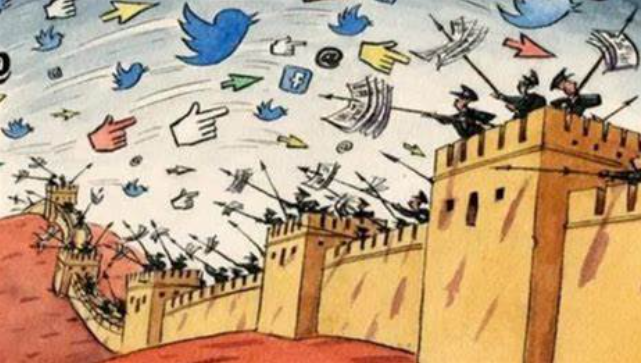
Last weekend, X once again sparked a concentrated outcry against Binance. This time, it was a rekindling of old grievances.
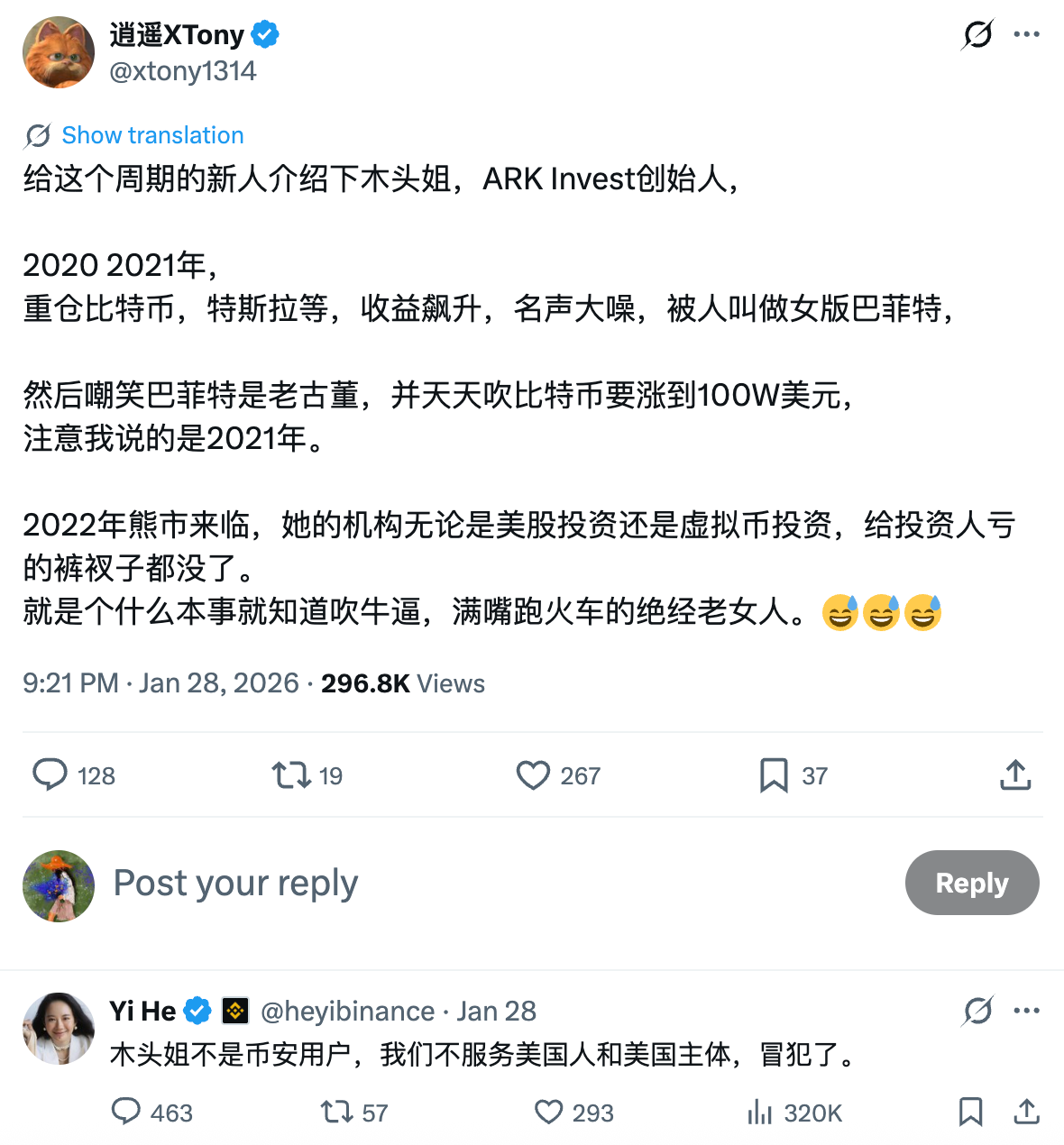
The catalyst for the turmoil was on January 26, when ARK Invest CEO Cathie Wood (nicknamed "Wood Lady") stated in an interview with Fox Business that while gold, silver, and U.S. stocks have been surging recently, the reason cryptocurrency has not risen is due to the system failure at Binance on October 11 last year (referred to as the "1011 incident"), which left the aftershocks of $28 billion in leveraged liquidations unresolved.
As an early investor in Coinbase and one of the first Wall Street fund managers to incorporate Bitcoin into institutional investment narratives, Wood has a natural cross-industry voice between traditional finance and the crypto industry. Therefore, her remarks quickly reignited the market's collective memory of the 1011 incident. Moreover, at a time when the market sentiment was low, the public's curiosity intensified, causing the matter to continue to ferment.
Binance quickly responded. Co-CEO He Yi stated that Cathie Wood is not a Binance user and that Binance does not serve U.S. entities. The implication seemed to suggest that Cathie Wood does not understand the real situation or that there is some conspiracy behind it.
The Cause and Effect of the 1011 Incident: A Butterfly Effect Triggered by a "System Failure"
To understand this campaign, one must first clarify the ins and outs of the 1011 incident. In simple terms, this was a "black swan" event in the crypto market: on that day, the market suddenly experienced severe fluctuations, with the total market value of the global crypto market evaporating by over $500 billion, and the scale of leveraged liquidations exceeding $19 billion, marking the largest leveraged liquidation event in the history of the crypto industry, causing significant losses for many ordinary users, as well as several well-known market makers and VCs.
Binance was accused of being the "culprit" because at a critical juncture of market volatility, there were obvious liquidity anomalies within its platform. Whether described officially as a "software issue" or a "temporary failure of the trading module," the result seen by the market was extremely brutal: the automatic deleveraging (ADL) mechanism was triggered, cross-account liquidations began, and some market maker accounts suffered catastrophic losses in a short period, even being forced to exit the market. (For details, read: A Detailed Explanation of the ADL Mechanism for Perpetual Contracts: Why Your Profitable Orders Get Automatically Liquidated?).
Another clue that has been repeatedly brought up points to Binance's USDe incentive program at the time. This program, which boasted a 12% annualized return, also allowed users to leverage USDe and other assets through circular loans, amplifying both returns and risks. When USDe "depegged" (more accurately, the price discrepancies between platforms and on-chain and off-chain), it triggered large-scale liquidations.
After the incident, Binance issued statements emphasizing that the sell-off was primarily driven by a broader market environment rather than a failure of its own system. Subsequently, Binance compensated users affected by the decoupling and related issues with approximately $283 million. This compensation did indeed quell some of the anger among crypto users in the short term.
However, the controversy did not disappear. Perhaps due to Binance's retrospective modifications to the K-line trends of certain cryptocurrencies after the incident, or the long-standing doubts surrounding the Binance Alpha listing mechanism, these accumulated grievances found an outlet through the 1011 public opinion incident.
As public sentiment heated up, it seemed to gradually evolve into a division of camps. Odaily Planet Daily will introduce some key figures from both sides of the public opinion in the following text.
One Camp of Accusation: Leonidas's Long-term Offensive
The first to intensively fire shots was ZapApp co-founder Leonidas, an important figure in the Bitcoin inscription ecosystem and a core promoter of DOG (a popular meme coin on Bitcoin).
He has been criticizing Binance almost daily on X, becoming one of the most prominent representatives of the current anti-Binance camp. However, a closer look at his expressions reveals that he is not solely focused on the 1011 incident itself. For Leonidas, 1011 is more like "evidence": an example that can be used to prove that Binance is draining the entire crypto industry.
His grievances with Binance stem from his public request for Binance to list a certain token, which was not approved. Leonidas accused Binance of demanding an excessively high proportion of token supply (he claims as high as ~10%) as a "listing fee," after which Binance or its insiders would sell off large amounts, leading to significant losses for the project and retail investors.
Leonidas directly called CZ "the biggest liar in crypto history" and "the biggest liar in human civilization," believing that although CZ has ostensibly stepped down as CEO, he still holds 90% of Binance's shares, making Binance his "proxy tool." Every time CZ posts, Leonidas interprets it as hypocrisy, as he believes that CZ is simultaneously "exploiting the market" through Binance while preaching to retail investors. In his view, the $283 million that Binance later compensated users with precisely proves its direct responsibility, stating, "Only guilty companies would pay out so much money."
From this perspective, there is a direct conflict of interest at the project level between Leonidas and Binance, and his emotional expressions are clearly mixed with personal grievances. At the same time, he also represents a group that has long been dissatisfied with the power structure of centralized exchanges (CEX).
"Competitor" Steps In: Xu Mingxing's Systemic Risk Accusations
The one who truly escalated the conflict was OKX founder Star (Xu Mingxing). He pointed out that after 1011, the microstructure of the crypto market underwent fundamental changes, with its destructiveness even surpassing the collapse of FTX. He believes the core inducement lies in Binance's user growth activities—offering a 12% annualized return for USDe and allowing it to enjoy the same collateral treatment as USDT and USDC, but lacking sufficient restrictions.
In his view, USDe is essentially closer to a "tokenized hedge fund" rather than a low-risk money market product like BlackRock BUIDL. Under the inducement of returns, users exchanged stablecoins for USDe, creating implied returns of 24%—70% through circular lending, causing systemic risks to accumulate sharply in a short period. When volatility truly arrived, the decoupling of USDe and the risk management flaws of WETH and BNSOL amplified the impact, causing some asset prices to approach zero.
Xu Mingxing emphasized that he does not intend to attack Binance but hopes the industry faces real issues; as the largest platform globally, Binance should prioritize stability and transparency rather than covering risks through high-leverage marketing.
However, the reality is that as one of Binance's main competitors, OKX has long been suppressed by Binance. As the leader of OKX, Xu Mingxing's statements highlight OKX's "compliance and user-oriented" image, which is reasonable in weakening Binance's market monopoly.
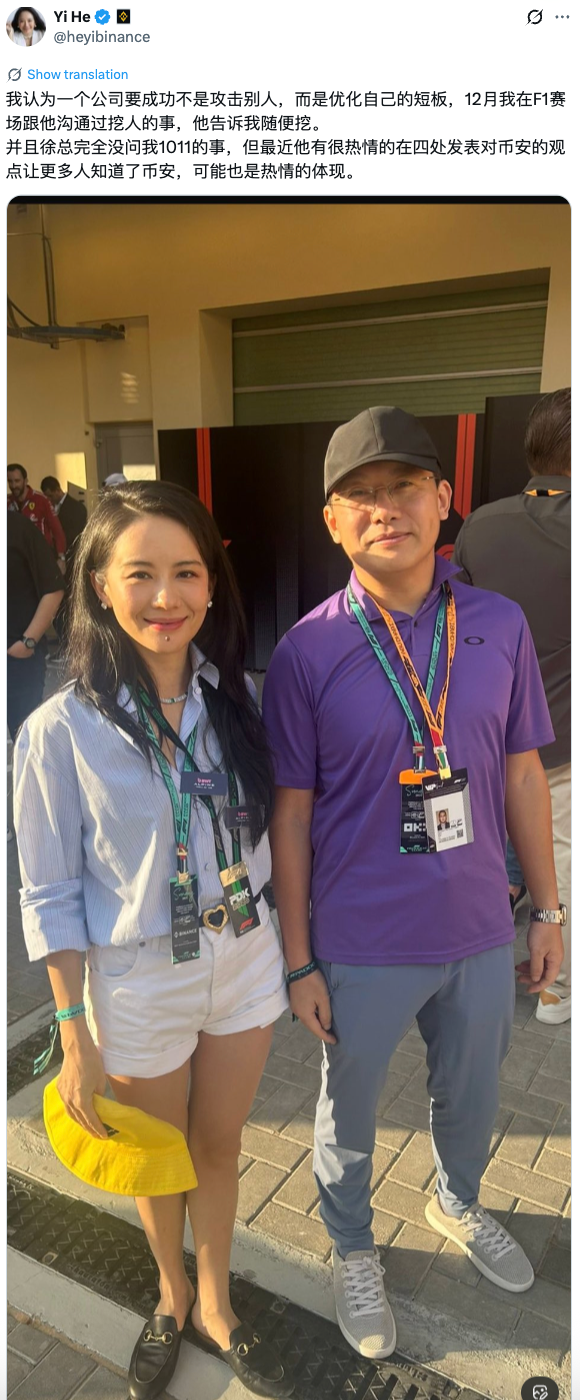
In response to Xu Mingxing's accusations, both sides naturally engaged in a war of words. However, it is interesting to note that both CZ and He Yi were once employees under Xu Mingxing. Although tensions are high online, the offline relationships within the industry remain delicate. He Yi even shared a "friendly" photo with Xu Mingxing from December, claiming they privately discussed "poaching" (Binance poached OKX's product manager), but did not discuss the 1011 incident, adding a layer of irony.
CZ Unfollows Toly: Another Underlying Competition in Public Chains?
Another explosive point in this campaign is that CZ unfollowed Solana co-founder Anatoly Yakovenko's X account. The reason is that Toly retweeted Xu Mingxing's tweet criticizing Binance, accompanied by a meaningful comment: "It has only been 18 months since the incident occurred and recovery has happened." This indirectly suggests that Solana (SOL) took 18 months to return to the 2021 bull market level after the FTX collapse, and now Binance is being implied as a similar "accident" responsible party. Toly's action is equivalent to indirectly taking a side, supporting the criticism against Binance.
Some crypto users began to worry: will it be harder for Solana ecosystem tokens, especially meme coins, to be listed on Binance in the future?
Behind this is the direct competition between BSC and Solana in meme liquidity. The former is striving to seize a new round of meme narratives, while the latter was once the most important incubator of this wave. The competition among public chains may quietly emerge in this public opinion battle.
Support Camp: Truth or Public Relations?
Perhaps benefiting from Binance's long-term maintenance of relationships with KOLs, the attitude towards Binance in the Chinese community is relatively mild. However, in the face of these serious accusations, there are still few KOLs willing to publicly support Binance, among them is EnHeng, who has been dubbed the "Prince of Binance." (For further reading: The Post-05 Crypto Maniac EnHeng: "Prince of Binance" is Just My Protective Color).
Currently, those who can support Binance are more likely to come from relatively neutral analysts. For example, trader Benson pointed out that Binance does bear some responsibility, but USDe was not the starting point of the collapse. From the timeline, when the market bottomed at 5:20, USDe only slightly decoupled, with the real drop to 0.65 occurring after the rebound.
He believes that what is more abnormal is the large-scale price discrepancies that occurred between Binance and other exchanges between 5:18 and 5:20: half of the cryptocurrencies reached their lowest prices on Binance, with some deviations as high as 100%, and USDT was significantly lower than USD. He argues that, in retrospect, it is more likely that there were issues at the system level of Binance rather than simply due to market makers withdrawing liquidity, and calls for a more thorough and open discussion of the event in light of the review Binance has published.
Dragonfly Managing Partner Haseeb Qureshi holds a similar view. He believes that the claim that "Binance and Ethena triggered the collapse" is difficult to establish in terms of timeline, market dissemination paths, and evidence. He points out that Bitcoin's price had already bottomed about 30 minutes before USDe exhibited anomalies on Binance, indicating that the causal relationship is clearly inverted; at the same time, the price deviation of USDe only occurred on Binance and did not spread to other trading platforms, which cannot explain the large-scale liquidations across the entire market, differing fundamentally from events like Terra that caused global balance sheet shocks. In fact, regarding the decoupling of USDe, Haseeb had already provided an interpretation shortly after the 1011 incident, for details refer to Dragonfly, an Investor in Ethena: USDe Did Not Decouple, It Was Just Binance's "Localized Price Dislocation".
In his view, a more reasonable explanation is the combination of multiple factors: Trump's tariff remarks disturbed the market on Friday evening, Binance's API anomalies prevented market makers from cross-platform hedging, liquidations and the ADL mechanism amplified volatility, and the crypto market lacks traditional financial-style circuit breakers and self-stabilizing mechanisms, ultimately causing the market to evolve along an unfavorable path. He emphasized that there is no simple and conspiratorial "single culprit" for 10/11; although the market suffered heavy losses, it has not been permanently damaged in the long run, only requiring time to restore liquidity and confidence.
After Haseeb expressed support for Binance, CZ retweeted this post, adding, "Dragonfly was once one of the largest investors in OKX." However, Xu Mingxing later denied this, stating that Dragonfly has never invested in OKX, whether as a small or large investment.
SAFU Adjustment: Remediation or Signal?
As Binance faced FUD, on January 30, Binance announced in an "Open Letter to the Crypto Community" that it would adjust the asset structure of the SAFU fund, gradually converting the original $1 billion stablecoin reserve into Bitcoin reserves, with plans to complete the exchange within 30 days of this announcement. Binance will conduct regular checks on the asset scale of the SAFU fund, and if the market value of the SAFU fund falls below $800 million due to Bitcoin price fluctuations, Binance will supplement Bitcoin to restore the fund's scale to $1 billion.
However, Binance did not specify the exact method of purchasing this $1 billion in BTC in the announcement. Odaily Planet Daily has inquired about this matter with Binance but has not yet received a response.
Conclusion
Looking back at this debate, the reason Binance has once again become the focus may not only be because it "did something wrong," but because it is now large enough that any structural issues will first manifest in it.
This is not the first time Binance has faced such scrutiny, and it likely will not be the last. What is truly important is not just how the responsibility for the event is divided, but whether, as an industry hub, leading exchanges are willing to take on a higher level of stability responsibility.
In a market that still heavily relies on leverage, emotions, and narrative-driven dynamics, this debate itself may be more important than the outcome.
免责声明:本文章仅代表作者个人观点,不代表本平台的立场和观点。本文章仅供信息分享,不构成对任何人的任何投资建议。用户与作者之间的任何争议,与本平台无关。如网页中刊载的文章或图片涉及侵权,请提供相关的权利证明和身份证明发送邮件到support@aicoin.com,本平台相关工作人员将会进行核查。


