Eastern Standard Time, early November 2024, the crypto world reveals a common thread amidst several seemingly unrelated news stories: on one side, BNB Chain launches BAP-578, a new standard aimed at enabling AI to autonomously operate on-chain, attempting to ignite imagination for the next narrative; on the other side, Bitcoin is embroiled in multi-million dollar ransom emails, and a whale has exposed a hole of approximately $230 million in a high-leverage environment, revealing the abuse of technology and the fragile chain of finance. Against the backdrop of Orderly Network launching single-stock perpetual contracts and the Hong Kong police's large-scale anti-fraud operation that arrested 682 people, the technological frenzy of AI-driven assets is colliding head-on with real-world law enforcement and risk.
BNB Promotes AI Asset Standards: A 24/7 Autonomous Code Experiment
● Standard Setting and Vision: According to a single source, BNB Chain recently released a new batch of BAPs, among which the NFA Standard BAP-578 is described as an AI-driven asset that can autonomously operate on-chain. The official vision is to allow these assets to automatically execute strategies, interact, and settle on-chain 24/7, forming a type of "autonomous code entity," which some industry observers interpret as introducing programmable property rights and incentives for AI, creating a new foundational layer for applications.
● Market Pricing and Divergence: At the same time this narrative emerged, BNB's price briefly surpassed $760, with a 24-hour decline of 1.67% (according to a single source). This "rise and fall" trend reflects the rapid speculation and cooling of funds regarding the new story: some funds bet that BAP-578 could replicate the diffusion path of past DeFi and NFT narratives, while others cashed out at high levels, reflecting a cautious attitude towards the standard's implementation capability, ecological depth, and regulatory uncertainties.
● Autonomous Assets and Systemic Risk: The so-called "on-chain autonomous AI assets" superficially bring imagination to application scenarios—from automated market making and strategic investment to on-chain service robots, all of which could be packaged as tradable, combinable NFAs. However, due to the irreversibility or interference of deployed code, if algorithmic logic, incentive mechanisms, or external dependencies fail, these assets will programmatically amplify errors, creating systemic risks that are difficult to manually halt, thus embedding new uncertainties within the entire BNB ecosystem.
AI-Driven Assets On-Chain: Ideal Blueprint and Edge of Control
● Imagination of a New Era of Autonomous Assets: The market's views on "NFA or the dawn of a new era of on-chain autonomous assets" are rapidly fermenting. Supporters believe that the combination of AI and tokenization can give birth to a truly meaningful "economic robot": they can be self-sustaining, allocate profits algorithmically, and even collaborate across protocols, providing continuous services for DeFi, GameFi, and even on-chain infrastructure. BNB Chain thus has the opportunity to reshape its ecological narrative and attract new developers and funds.
● Structural Exposure of New Risks: However, as AI's autonomous execution becomes deeply intertwined with tokenized incentives, new risks can grow geometrically. Models may make extreme decisions under volatile conditions, amplifying market fluctuations; strategies relying on oracles and external data sources may collectively misfire or chase highs when manipulated; attackers could even induce these autonomous assets to make devastating moves for themselves and the market at critical moments by training adversarial samples or phishing data, transforming traditional "vulnerability attacks" into "cognitive and data layer attacks."
● Compliance Shortcomings in the BNB Ecosystem: Against this backdrop, the BNB ecosystem's shortcomings in compliance, auditing, and risk control are further magnified. The lack of mandatory code audits and continuous monitoring could turn standards like BAP-578 into a guise for "packaging high-risk strategies"; if identity verification and source of funds checks are weak, AI-driven assets may be used for more covert on-chain manipulation and cross-border fund transfers. Once technological benefits overlap with gray behaviors, it can easily trigger concentrated backlash from regulatory agencies, turning the overall innovation dividend into a compliance crisis.
Bitcoin Ransom Resurfaces: Shadows of a Technological Utopia
● Details of the Missing Person Case and Ransom Email: According to a single source, in the case of the mother of a host from the U.S. "TODAY" show who went missing, police are investigating a ransom email involving Bitcoin, with the ransom amount described as "in the millions of dollars" in BTC. Although the specific amount and on-chain address have not been fully disclosed, this information alone is enough to place Bitcoin back in the spotlight of public opinion, becoming one of the symbols connecting "technology and crime."
● Tension Between Technological Neutrality and Abuse: This incident is merely the latest example of the role crypto assets play in ransom and cross-border fund transfers. The high accessibility and borderless nature of on-chain transfers, originally designed to be technologically neutral, are being used in reality to circumvent traditional financial system controls. Law enforcement can trace fund flows through on-chain analysis, but the general public often only sees "ransom," "fraud," and Bitcoin being mentioned together, creating a cognitive gap that continuously erodes the narrative of a technological utopia.
● Renewed Discussion on Innovation and Regulation: As the relevant investigation progresses, "regulatory discussions are expected to resurface." On one side are new asset standards like BAP-578 that emphasize AI autonomy and disintermediation, while on the other side are ransom emails and suspicious fund flows also relying on on-chain infrastructure, presenting a duality of the same technology being used by entirely different forces. This contrast may lead regulators to prefer requiring on-chain activities to be "monitorable and checkable," thus forming external constraints on the ideal of AI governance on-chain.
Whale's $230 Million Liquidation: The Death Spiral of High Leverage and Automation
● Timeline of Liquidation and Key Actions: According to a single source, a whale recently faced severe fluctuations in its long position in the ETH market, ultimately resulting in a liquidation loss of approximately $230 million, followed by an on-chain sale of 50,000 ETH. The timeline indicates that this was the result of passive liquidation and active cutting of positions after a sharp market reversal, with on-chain data clearly recording a series of actions from large margin additions to margin exhaustion and forced liquidation, followed by panic selling of the spot.
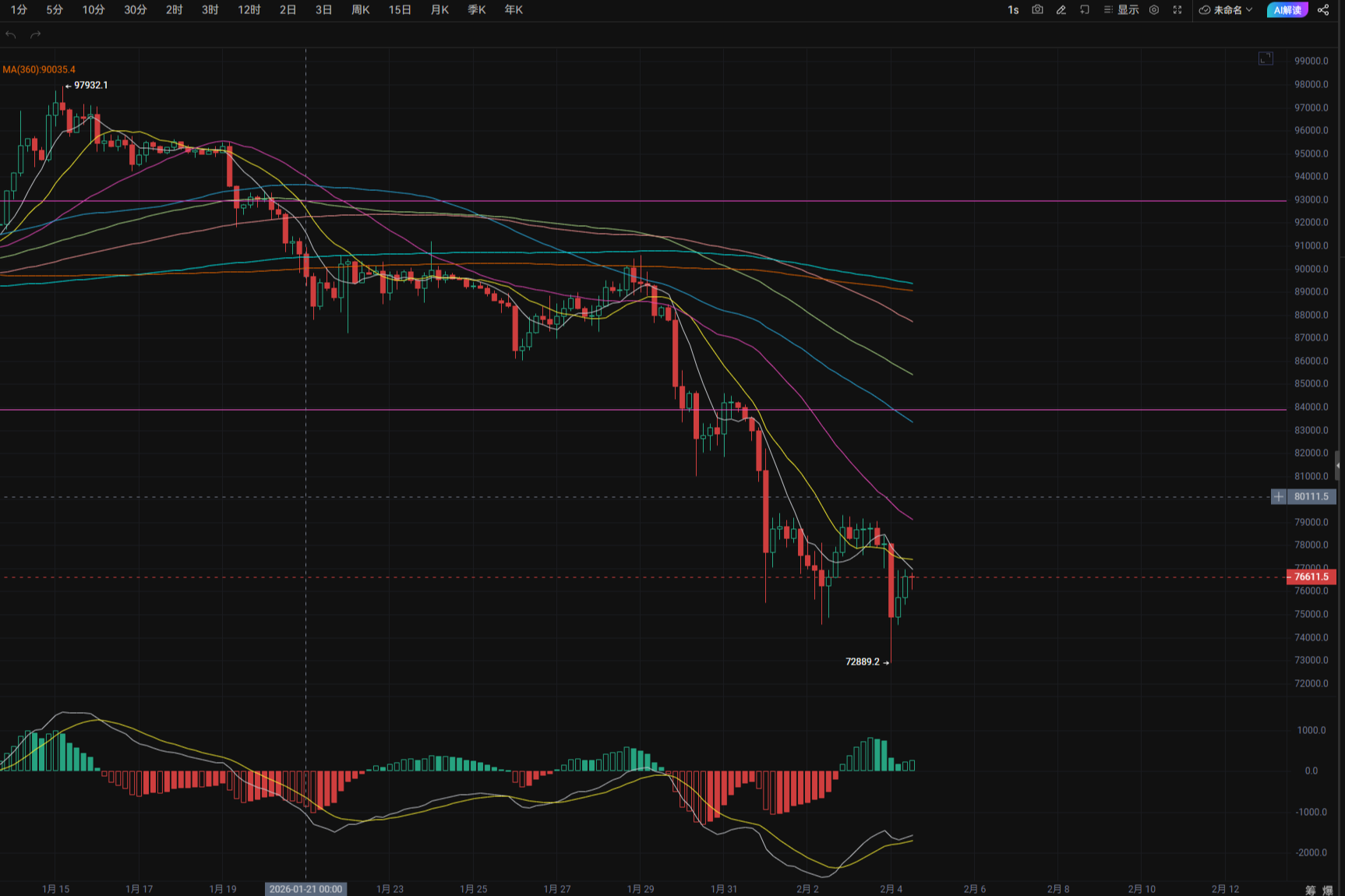
● Market Amplification and Chain Reactions: Meanwhile, Bitcoin briefly reached a high of $76,400 on November 6, 2024 (according to a single source), with the overall market experiencing extreme swings in sentiment during unilateral fluctuations. In a high-leverage environment, a sudden price drop can trigger a series of concentrated liquidations, leading to a liquidity vacuum and further declines, creating a chain reaction. The whale's $230 million loss is not just an individual tragedy but a magnifying glass reflecting the fragility of the entire leverage chain under extreme volatility.
● Future Amplification Effects of Automated Strategies: When we place this event within the future landscape of "AI-driven strategies" and "automated contracts," the situation for retail investors becomes even more concerning. If a whale can stumble in high-frequency fluctuations, retail investors lacking professional risk control and capital buffers are even more susceptible to being ruthlessly harvested by automated liquidation logic. If in the future, large-scale funds are entrusted to AI strategies and autonomous contracts, in extreme market conditions, these systems may simultaneously trigger sell-offs and deleveraging, creating a death spiral even more severe than the current one, with retail investors at a double disadvantage in terms of information and reaction speed.
From Single Stock Perpetuals to Hong Kong Police Actions: The Race Between Regulation and Innovation
● Cross-Border Impact of Single Stock Perpetuals: According to a single source, Orderly Network recently launched single stock perpetual contracts, supporting 20x leverage, USDC settlement, and 24/7 trading. This means that single stock exposures, traditionally constrained by time, geography, and regulation in the stock market, have been "moved" on-chain, offering higher leverage and longer trading hours to global users. Such products blur the boundaries between traditional finance and crypto derivatives, also adding risks from on-chain clearing and smart contracts to those previously only found in brokerage accounts.
● Hong Kong Police's High-Pressure Law Enforcement: In stark contrast, according to a single source, the Hong Kong police recently arrested 682 people in a series of technology and crypto-related fraud cases, involving amounts as high as 620 million HKD. These actions target the real soil for fraud and money laundering using technology platforms and crypto assets, highlighting the regulatory agencies' high-pressure stance against on-chain crime and sending a clear signal that "innovation will not become a haven for illegal activities."
● The Tug-of-War Between High-Risk Products and Strict Crackdowns: On one side are increasingly accessible, lower-threshold, and higher-leverage on-chain financial products; on the other side are increasingly broad and forceful cross-border law enforcement actions. Globally, regulation and innovation are in a high-speed race: overly stringent measures may stifle compliant innovation, while overly lenient ones may condone scams and the accumulation of systemic risks. For ordinary users, enjoying a 24/7 market and highly elastic products also requires awareness of their position in the gap between regulation and risk.
After AI Goes On-Chain: A New Battlefield for Regulators, Whales, and Retail Investors
Connecting the AI asset standard BAP-578, Bitcoin's involvement in multi-million dollar ransom emails, the whale's $230 million liquidation, and the large-scale cross-border nature of single stock perpetuals reveals a clear main thread: technological innovation and risk spillover always run parallel. AI on-chain, leveraged derivatives, and borderless settlement together form a highly coupled, high-speed financial technology system that promises efficiency and returns while continuously accumulating tail risks and compliance pressures.
In the era of AI-driven assets, the battlefield is shifting from mere "code innovation" to a comprehensive game of "code auditing, identity and compliance, risk education, and exchange risk control." Those who can build a verifiable, error-correctable AI contract system, introduce effective identity and fund screening mechanisms without stifling innovation, and reduce the passive slaughter of retail investors in extreme market conditions through product-level education and risk control will be the ones qualified to dominate the next cycle.
In the coming years, public chains like BNB will continue to race in AI standards, performance, and ecological incentives; regulatory agencies in various countries will keep ramping up cross-border enforcement, licensing mechanisms, and data requirements; traditional and crypto institutional funds will cautiously test the waters between yield temptations and compliance red lines. For ordinary investors, the more dangerous risks often lie not in visible volatility but in being swept up by new narratives, entrusting their fate to a set of "seemingly smart" codes or a carefully packaged product description without understanding the underlying logic and risk boundaries.
Join our community to discuss and become stronger together!
Official Telegram community: https://t.me/aicoincn
AiCoin Chinese Twitter: https://x.com/AiCoinzh
OKX Benefits Group: https://aicoin.com/link/chat?cid=l61eM4owQ
Binance Benefits Group: https://aicoin.com/link/chat?cid=ynr7d1P6Z
免责声明:本文章仅代表作者个人观点,不代表本平台的立场和观点。本文章仅供信息分享,不构成对任何人的任何投资建议。用户与作者之间的任何争议,与本平台无关。如网页中刊载的文章或图片涉及侵权,请提供相关的权利证明和身份证明发送邮件到support@aicoin.com,本平台相关工作人员将会进行核查。