Written by: Ryan Yoon
Translated by: Shaw Golden Finance
Key Points
The cryptocurrency winter follows this sequence: major events → trust collapse → talent loss
Past winters were caused by internal issues; the current fluctuations are driven by external factors; it is neither a winter nor a spring.
The post-regulation market is divided into three tiers: regulated areas, unregulated areas, and shared infrastructure; the trickle-down effect has disappeared.
ETF funds remain in Bitcoin and will not flow out of the regulated area.
The next bull market requires killer application scenarios and a favorable macro environment.
1. How Did Past Cryptocurrency Winters Occur?
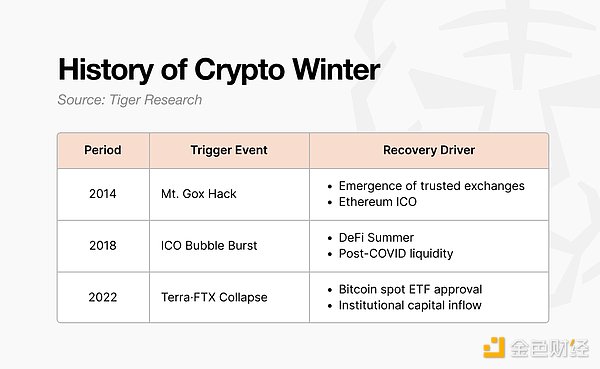
The first winter occurred in 2014. At that time, Mt. Gox handled 70% of the global Bitcoin trading volume. A hacker attack led to the disappearance of about 850,000 Bitcoins, causing a collapse in market trust. Subsequently, new exchanges with internal controls and auditing mechanisms emerged, and trust began to be restored. Ethereum also entered the market through an ICO, opening up new possibilities for vision and financing.
This ICO became the catalyst for the next bull market. When anyone could issue tokens and raise funds, the boom of 2017 followed. Numerous projects raised billions of dollars based solely on a white paper, but most lacked substantive content.
In 2018, South Korea, China, and the United States introduced regulatory policies, leading to a bubble burst and the arrival of the second winter. This winter lasted until 2020. After the COVID-19 pandemic, liquidity surged, and decentralized finance (DeFi) protocols like Uniswap, Compound, and Aave gained attention, bringing funds back into the market.
The third winter was the harshest. After the collapse of Terra-Luna in 2022, Celsius, Three Arrows Capital, and FTX followed suit. This was not merely a drop in coin prices; the entire industry's structure was impacted. In January 2024, the U.S. Securities and Exchange Commission (SEC) approved a spot Bitcoin exchange-traded fund (ETF), followed by Bitcoin halving and the introduction of Trump’s pro-cryptocurrency policies, leading to another influx of funds into the cryptocurrency market.
2. The Cryptocurrency Winter Model: Major Events → Trust Collapse → Talent Loss
All three winters followed the same pattern: first, a major event occurred, then trust collapsed, and finally, talent was lost.
It always starts with a major event. For example, the hacking of Mt. Gox, ICO regulatory reforms, the collapse of Terra-Luna, and the subsequent bankruptcy of FTX. Each event varied in scale and form, but the outcome was the same: the entire market fell into panic.
The shock quickly spread, leading to a collapse of trust. People who were once discussing the next steps began to question whether cryptocurrency was truly a meaningful technology. The collaborative atmosphere among developers vanished, and they began to blame each other, arguing over who should be held responsible.
Doubt led to talent loss. Those builders who once created new momentum in the blockchain space began to become skeptical. In 2014, they shifted to fintech and large tech companies. In 2018, they turned to financial institutions and artificial intelligence. They left in search of what seemed to be a more stable environment.
3. Is It Currently a Cryptocurrency Winter?
The patterns of past cryptocurrency winters are still visible today.
Major Events:
Trump Meme coin issuance: Market cap soared to $27 billion in one day, then plummeted by 90%.
October 11 liquidation event: The U.S. announced a 100% tariff on Chinese goods, triggering the largest liquidation in Binance's history ($19 billion).
Trust Collapse: Doubt spread throughout the industry. The focus shifted from developing the next product to mutual blame.
Talent Loss Pressure: The rapid development of the AI industry promises faster exits and greater wealth than cryptocurrency.
However, it is difficult to call this a cryptocurrency winter. Past winters often stemmed from internal issues within the industry. The hacking of Mt. Gox, the exposure of most ICO projects as scams, and the collapse of FTX led to a loss of trust in the industry itself.
The situation is different now.
The approval of ETFs has opened the door to a bull market, while tariff policies and interest rates have triggered declines. External factors have both driven the market up and pulled it down.
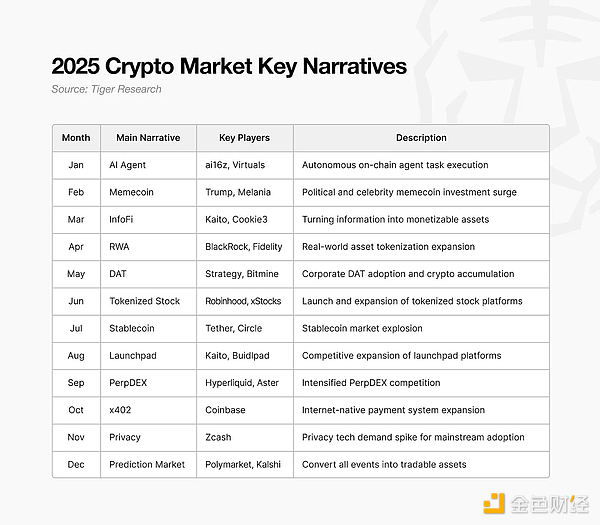
Builders have not left either.
Real-world assets (RWA), perpetual decentralized exchanges (PerpDEX), prediction markets, InfoFi, and privacy protection. New narratives continue to emerge and are still being created. While they have not shaken the entire market like DeFi, they have not disappeared either. The industry has not collapsed; what has changed is the external environment.
We have not created a spring, so there is no winter to speak of.
4. Changes in Market Structure Post-Regulation
This reflects a significant shift in market structure brought about by regulation. The market has differentiated into three tiers: 1) regulated areas, 2) unregulated areas, and 3) shared infrastructure.
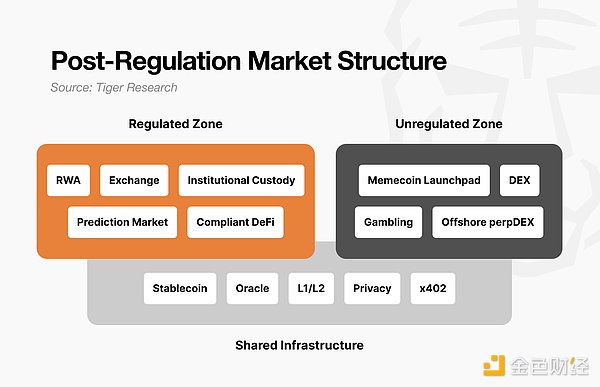
The regulated sector encompasses RWA tokenization, exchanges, institutional custody, prediction markets, and compliant DeFi. These areas require audits, information disclosure, and legal protection. Growth is slow, but the capital scale is large and stable.
However, once you enter the regulated area, it becomes difficult to achieve explosive returns like in the past. Volatility decreases, and the upside potential is limited, but the downside potential is also restricted.
On the other hand, the unregulated area is likely to become more speculative in the future. The barriers to entry are low, and volatility is rapid. It will become more common to see a 100-fold increase in one day and a 90% drop the next.
However, this area is not without significance. Industries born in the unregulated area are full of creativity, and once recognized, they will enter the regulated area. DeFi has done this, and prediction markets are now following suit. It serves as a testing ground. But the boundaries between the unregulated area and the industries within the regulated area will increasingly blur.
Shared infrastructure includes stablecoins and oracle services. They are applicable in both regulated and unregulated areas. Institutional RWA payments and Pump.fun transactions use the same USDC. Oracles provide data for tokenized bond verification and anonymous DEX settlements.
In other words, as the market differentiates, capital flows have also changed.
In the past, when Bitcoin rose, other cryptocurrencies would also rise through the trickle-down effect. But the situation is different now. Institutional capital entering the market through ETFs remains in Bitcoin and stops there. Funds in the regulated area will not flow into the unregulated area. Liquidity only remains where value has been validated. Even so, Bitcoin's value as a safe asset relative to risk assets has yet to be proven.
5. Conditions for the Next Bull Market
Regulatory issues are gradually being resolved. Developers are still building. So, two things remain.
First, new killer use cases must emerge in the unregulated area. They must create unprecedented value, similar to the "DeFi Summer" of 2020. AI agents, InfoFi, and on-chain social are all candidate cases, but their scale is still insufficient to drive the entire market's development. We need to re-establish the process for experimental results in the unregulated area to be validated and enter the regulated area. DeFi has achieved this, and prediction markets are now doing the same.
Second, the macroeconomic environment is crucial. Even if regulatory issues are resolved, developers start building, and infrastructure continues to improve, if the macroeconomic environment does not support it, its development space will still be limited. The "DeFi Summer" of 2020 saw explosive growth in the DeFi market with the release of liquidity after the COVID-19 pandemic. The rise after the approval of ETFs in 2024 coincided with market expectations of interest rate cuts. No matter how well the cryptocurrency industry performs, it cannot control interest rates and liquidity. For the industry to gain recognition, the macroeconomic environment must improve.
The kind of "cryptocurrency bull market" where all cryptocurrency prices rise in sync is unlikely to happen again. Because the market has differentiated. The regulated areas grow steadily, while the unregulated areas experience significant volatility.
The next bull market will eventually come, but not everyone will benefit.
免责声明:本文章仅代表作者个人观点,不代表本平台的立场和观点。本文章仅供信息分享,不构成对任何人的任何投资建议。用户与作者之间的任何争议,与本平台无关。如网页中刊载的文章或图片涉及侵权,请提供相关的权利证明和身份证明发送邮件到support@aicoin.com,本平台相关工作人员将会进行核查。