The compliance enforcement in the stablecoin sector is continuously intensifying. As the issuer of USDT, Tether's freezing operations on various addresses have sounded the alarm for risks in the industry. In 2025, Tether blacklisted a total of 4,163 unique addresses, freezing funds amounting to $1.26 billion, of which 55.6% ($698.42 million) was destroyed, and only 3.6% of the blacklisted addresses were unfrozen that year. Behind these figures is a profound change in the regulatory landscape for stablecoins, presenting an urgent risk response challenge for all USDT users.
1. Analysis of Tether's Freezing Data and Trend Review for 2025
We analyzed all AddedBlackList (addresses added to the blacklist), RemovedBlackList (addresses removed from the blacklist), and DestroyedBlackFunds (destroyed black funds) events related to USDT on Ethereum (ERC20) and TRON (TRC20) throughout 2025, and found the following two conclusions.
1. More than half of the frozen USDT was ultimately permanently destroyed. Of the total frozen $1.26 billion USDT, Tether destroyed $698 million, accounting for 55.6% of the total frozen funds. This data indicates that most of the blacklisted funds are associated with closed investigation cases. It is important to note that the destroyed funds are usually re-minted for victims or law enforcement agencies.
2. The proportion of addresses removed from the blacklist is relatively low. In 2025, Tether blacklisted a total of 4,163 unique addresses, while only 150 addresses (3.6%) were removed from the blacklist that same year. Additionally, there were another 231 address removal events in 2025, all involving addresses that had been blacklisted prior to 2025. This means that once an address is added to Tether's blacklist, the likelihood of it being successfully removed afterward is extremely low.
From the freezing data of 2025, Tether's blacklist operations exhibit significant structural characteristics and trend changes, providing important reference dimensions for market participants.
First, there is a clear on-chain distribution difference, with TRON becoming a high-risk area. Among the addresses blacklisted in 2025, 84.2% (3,506) came from the TRC20 (Tron) ecosystem, corresponding to frozen funds of $853 million, reflecting a preference for illegal activities on chains with low transaction costs and fast confirmation speeds. Although ERC20 (Ethereum) addresses accounted for only 15.8% (657), the average frozen amount per address reached $613,000, which is 2.5 times that of TRC20 addresses, highlighting the regulatory focus on large funds on the Ethereum chain.
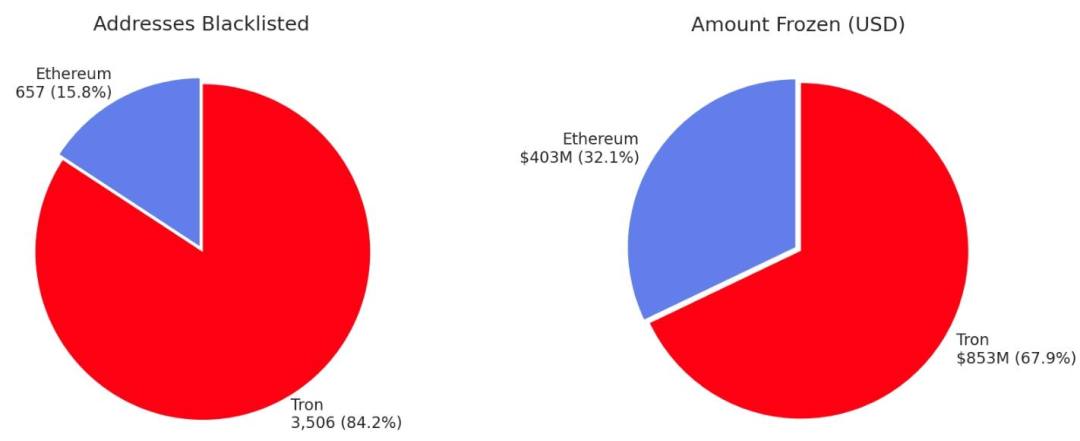
2025 USDT Blacklist: Chain Distribution
Second, the time dimension shows concentrated peaks, with significant enforcement characteristics on weekends. July became the peak month for freezing, with 1,158 addresses frozen, corresponding to funds of $154 million. This surge is highly correlated with the implementation of the GENIUS Act and global anti-terrorism joint actions. In terms of weekly distribution, Saturday was the most active day for freezing (22.4%), while Sunday dropped to 2.1%, indicating that compliance monitoring needs to cover all time periods.
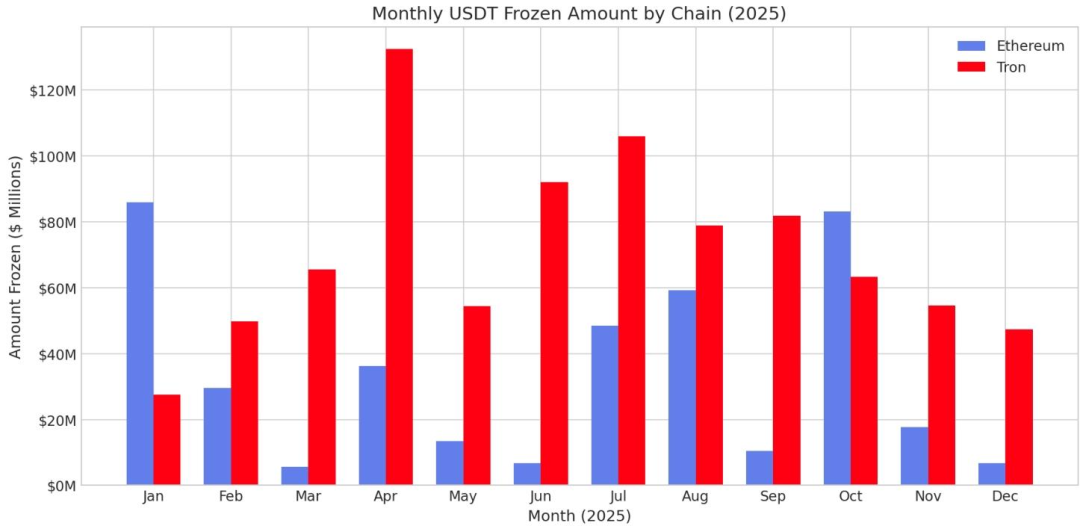
Monthly USDT Freezing Volume by Chain in 2025
Finally, the long-term trend continues to tighten, with the scale of freezing increasing year by year. From 2023 to 2025, Tether has frozen funds exceeding $3.29 billion, involving 7,268 addresses. At the beginning of 2026, Tether froze $182 million in funds from five TRON addresses in a single action, indicating that regulatory intensity will further escalate, and compliance has shifted from an "optional" to a "mandatory" requirement.
2. Why Are Addresses Frozen?
Based on Tether's official statements, public disclosures, and industry practices, freezing actions mainly stem from three types of compliance scenarios, all revolving around legal regulatory requirements and risk prevention.
First, responding to requests from law enforcement agencies, which is also the primary trigger for address freezing. Tether has established deep cooperation with over 275 law enforcement agencies across 59 jurisdictions worldwide, allowing for a high degree of flexibility in freezing operations—formal court orders are not required; freezing can be executed based solely on verification requests from cooperating law enforcement agencies. In emergencies, freezing measures can even be taken based on informal email notifications. Statistics show that over the past three years, Tether has handled more than 900 law enforcement freezing requests, with requests initiated by U.S. agencies accounting for over 50%, highlighting the concentration of enforcement needs in Europe and the U.S.
Second, actively implementing sanction compliance requirements and fulfilling international regulatory obligations. Since December 2023, Tether has officially launched a proactive sanction screening mechanism, executing freezing operations for all addresses appearing on the OFAC (Office of Foreign Assets Control) Specially Designated Nationals (SDN) list without the need for external agency intervention. At the initial stage of this policy, Tether quickly completed the bulk freezing of 161 addresses on the list, demonstrating its strict adherence to international sanction rules and commitment to compliance.
Third, relying on blockchain intelligence to conduct proactive risk prevention. Through deep collaboration with the T3 Financial Crime Joint Unit, Tether can proactively screen and freeze related addresses for various illegal financial activities such as hacking, telecom fraud, and terrorist financing, with some freezing operations even occurring before formal law enforcement requests, achieving preemptive risk control. As of October 2025, this joint unit has successfully frozen over $300 million in illegally associated assets across 23 jurisdictions worldwide, effectively curbing the circulation and spread of illegal funds.
3. How to Prevent Freezing? Building a Full-Process Protection System with BlockSec KYT
In the face of escalating freezing risks, passive responses are no longer sustainable. It is necessary to build a proactive prevention system through professional KYT (Know Your Transaction) tools. BlockSec Phalcon Compliance, with its extreme convenience and precise risk control capabilities, provides efficient solutions for market participants.
Precise pre-screening to avoid source risks. Conducting a comprehensive scan of counterpart addresses before transactions is the first line of defense against freezing. Phalcon Compliance supports instant scanning without account registration; simply input the address or transaction hash to obtain a risk score, covering not only Tether's blacklist but also linking to the OFAC sanction list, known scam addresses, mixing service nodes, and over 4 million tagged addresses, achieving full-dimensional risk identification across 20+ blockchains, far exceeding traditional basic screenings that only check contract status.
Real-time monitoring during transactions to track dynamic risks. A single static screening cannot address the dynamic changes in address risks; 33.7% of blacklisted addresses had a zero balance at the time of freezing, indicating that risks were exposed after the transaction was completed. Phalcon Compliance's real-time monitoring feature can track multi-hop fund flows, processing over 500 transactions per second and analyzing over 200 risk signals. When the risk level of a counterpart address changes (e.g., associated with sanctioned entities), alerts are pushed through multiple channels to help timely block risky transactions.
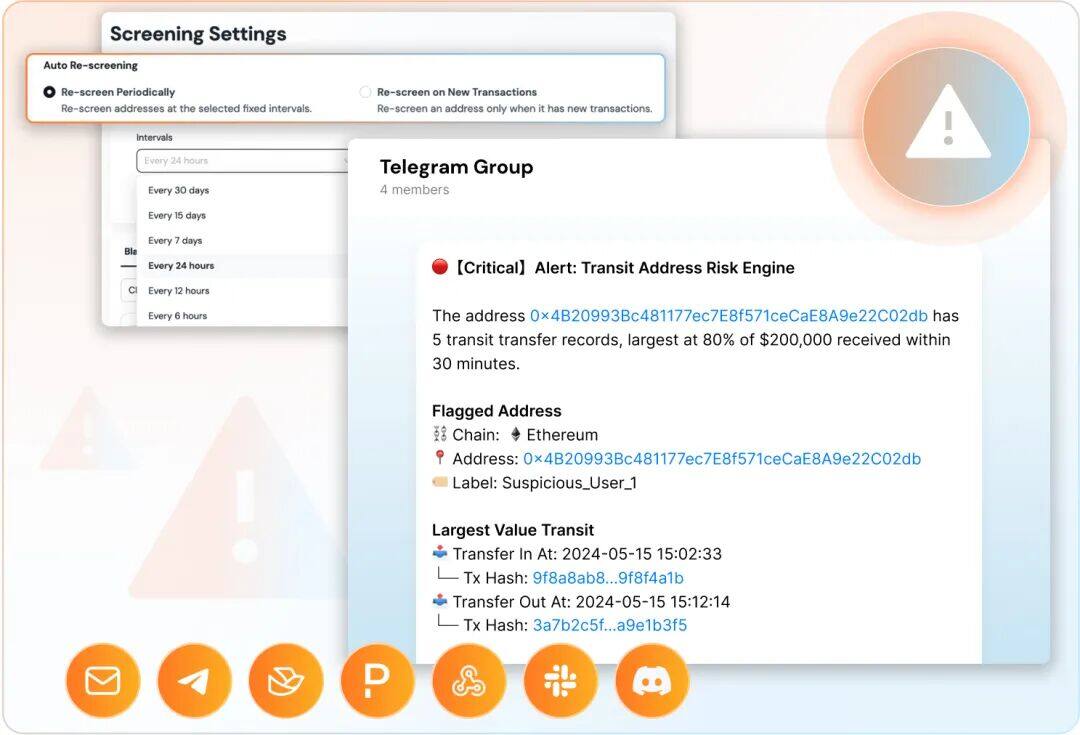
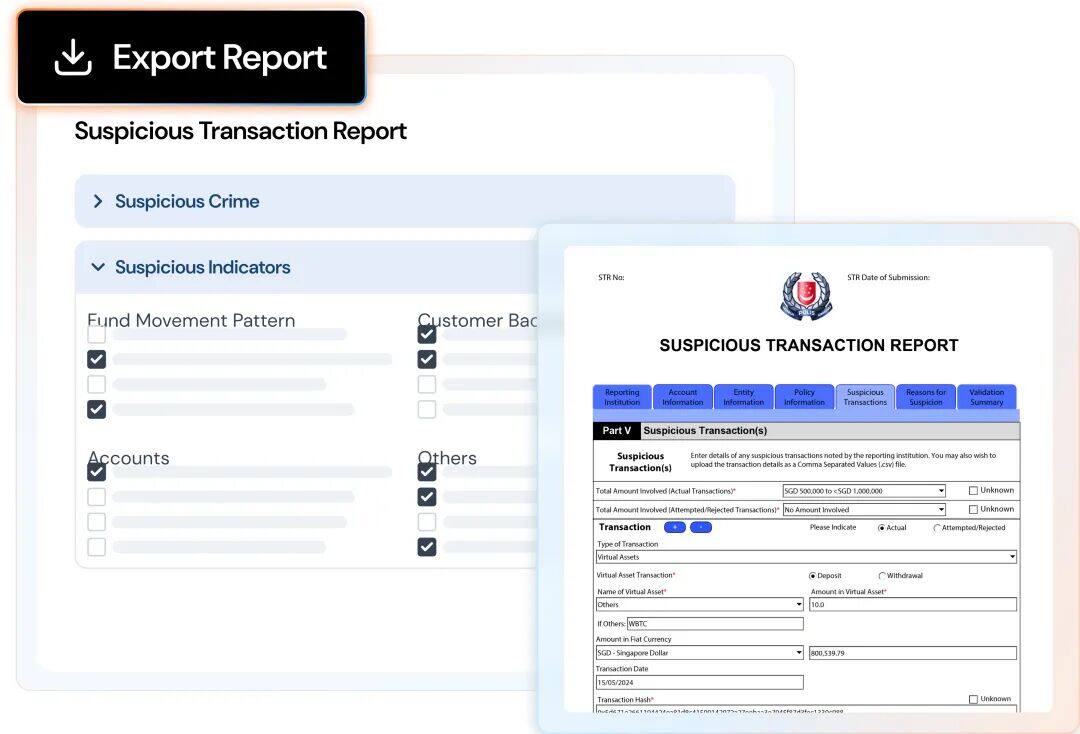
Post-incident compliance documentation to solidify response foundations. The platform supports one-click generation of suspicious transaction reports (STR) that comply with FATF standards, adapting to regulatory requirements in over 27 jurisdictions, and fully records the entire process of screening, monitoring, and handling. These compliance records will serve as crucial evidence when facing regulatory inspections or appeals for erroneous freezing, significantly improving problem resolution efficiency.
4. How to Check if a Wallet is Frozen?
Compared to the complex operations of checking contract status through blockchain explorers, Phalcon Compliance offers a more convenient and comprehensive method for verifying freezing status, balancing professionalism and ease of use.
Simplified operation process for instant results. Users do not need to learn contract function query methods; they can directly access the Phalcon Compliance product page, input the wallet address to be checked, and quickly obtain results on whether it has been blacklisted by Tether, while also displaying associated risks (such as whether it touches the sanction list or has financial transactions with illegal activity addresses), informing not only "whether it is frozen" but also "the reason for the risk."
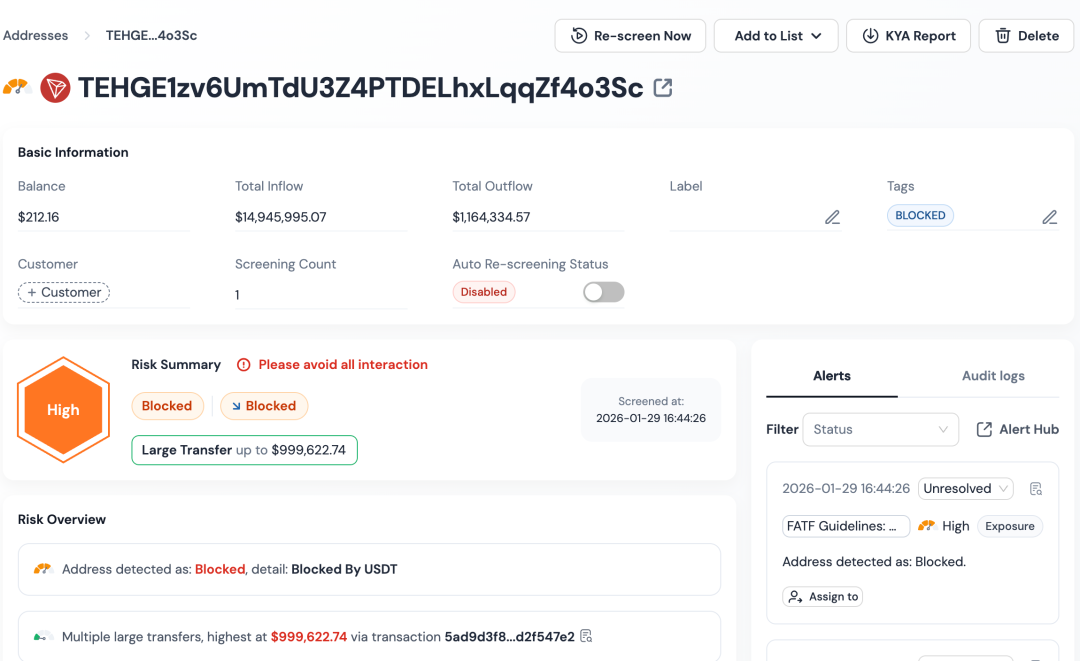
Multi-chain full coverage for thorough verification. Whether the wallet is in TRC20 or ERC20 format, verification can be completed through the platform, avoiding omissions due to on-chain differences. The platform's millisecond-level API response speed ensures quick decision-making in emergency scenarios and supports batch query functions to meet the compliance needs of enterprise-level bulk transactions.
5. What to Do if Unfortunately Frozen?
If an address is inadvertently blacklisted, it is essential to actively respond during the investigation lag period before fund destruction, while maximizing the success rate of appeals based on compliance records.
Step 1: Confirm freezing status and associated reasons. Verify the freezing status through Phalcon Compliance while reviewing transaction records to clarify whether it is linked to the counterpart address, whether the source of funds is legitimate, and other key information, avoiding blind appeals due to unclear reasons. It is important to note that freezing (addBlackList) and destruction (destroyBlackFunds) are two separate operations; the former is a temporary lock, while the latter is a permanent disposal, and appeals must be completed before destruction.
Step 2: Initiate appeals through multiple channels. Prioritize submitting requests through Tether's official channels by visiting the Tether website contact page (https://cs.tether.to), providing the frozen address, complete transaction records, proof of legitimate source of funds, etc. If it is related to a law enforcement investigation, contact the corresponding agency to explain the situation, allowing the agency to coordinate with Tether for unfreezing. This is the main pathway for the 150 addresses successfully unfrozen in 2025. If necessary, hire a lawyer experienced in handling cryptocurrency asset confiscation to protect rights through legal means.
Step 3: Strengthen the appeal with compliance records. Submit compliance materials such as address screening reports and transaction monitoring logs generated by Phalcon Compliance to prove that sufficient due diligence obligations have been fulfilled. If it is an erroneous freeze, this can significantly increase the probability of unfreezing. Be wary of scams; any claims to "unlock contracts for unfreezing" are fraudulent, as the blacklist can only be adjusted by Tether's multi-signature governance team.
With the implementation of the GENIUS Act, stablecoin issuers are included in the regulatory category of "financial institutions," and a comprehensive compliance deadline before mid-2028 has been set. Tether's blacklist operations are likely to continue to escalate. For market participants, building a proactive compliance system with professional KYT tools is not only a necessary means of risk prevention but also a core competitive advantage in adapting to the new industry landscape. BlockSec Phalcon Compliance offers low-threshold compliance solutions with an extremely simple experience, precise risk control, and flexible pricing, helping various entities navigate the wave of regulatory upgrades steadily.
免责声明:本文章仅代表作者个人观点,不代表本平台的立场和观点。本文章仅供信息分享,不构成对任何人的任何投资建议。用户与作者之间的任何争议,与本平台无关。如网页中刊载的文章或图片涉及侵权,请提供相关的权利证明和身份证明发送邮件到support@aicoin.com,本平台相关工作人员将会进行核查。