Author | @plur_daddy
Compiled by | Odaily Planet Daily (@OdailyChina)
Translator | Dingdang (@XiaMiPP)
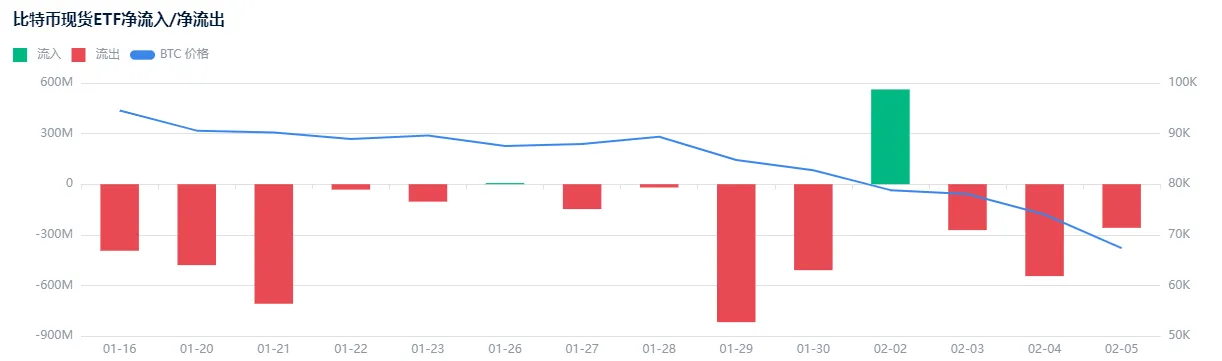
Editor's Note: Both gold and silver have suffered significant losses, U.S. stocks have plummeted across the board, and the cryptocurrency market has been particularly brutal, with over $2.6 billion liquidated in 24 hours. Bitcoin briefly crashed to the $60,000 mark, falling nearly 20% in a single day; since the peak of $126,000 last October, the BTC price has been cut in half. Even more frightening is that there has been almost no significant resistance from the market.
Everyone is frantically searching for reasons: U.S. tech stocks dragged down crypto; Trump's nomination of Warsh triggered hawkish expectations; the dollar is too strong, and employment data is poor… These explanations sound reasonable. However, in the author's view, they are more superficial rather than the core of the issue. The real underlying reason is: the world's money is becoming insufficient. The massive capital expenditure cycle of AI is shifting from "injecting liquidity" to "withdrawing liquidity," leading to a substantial shortage of global financial capital. The following content is the author's original text, which will break down how this mechanism operates step by step.

We are experiencing a paradigm shift in the market, driven by the financial capital shortage caused by the AI capital expenditure cycle. This has extremely far-reaching implications for asset prices, as capital has been excessively abundant for a long time. The Web 2.0 and SaaS paradigms that drove the market boom of the 2010s are essentially extremely light capital business models, allowing a large amount of excess capital to flow into various speculative assets.
Yesterday, while discussing the market landscape, I suddenly had an "epiphany." I believe this is the most differentiated article I have written in a long time. Below, I will break down layer by layer how all of this operates.
There is actually a highly similar mechanism between AI capital expenditure and government fiscal stimulus, which helps us understand its underlying logic.
In fiscal stimulus, the government issues national debt, and the private sector absorbs the duration risk; then the government receives cash and puts it into circulation. This cash circulates in the real economy and generates a multiplier effect. The net impact on financial asset prices is positive, precisely because of the existence of this multiplier effect.
In AI capital expenditure, large-scale tech companies either issue bonds or sell national debt (or other assets), similarly with the private sector absorbing the duration risk; then these companies receive cash and put it to use. This cash also circulates in the real economy and generates a multiplier effect. Ultimately, the net impact on financial asset prices remains positive.
As long as this funding comes from the "dry gunpowder" (unused idle capital) in the economic system, this process can operate smoothly. It works well, almost able to "push everything up." In the past few years, this has been the dominant paradigm—AI capital expenditure acts like an incremental stimulus policy, injecting a stimulant into the economy and the market.
The problem is: once the dry gunpowder is exhausted, any dollars flowing into AI capital expenditure must be drawn from elsewhere. This will trigger a convex competition for capital. When capital becomes scarce, the market will be forced to reassess: where is capital "most useful"? Meanwhile, the cost of capital (i.e., the interest rates determined by the market) will rise.
Let me emphasize again: when money becomes scarce, there will be a "survival of the fittest" among assets. The most speculative assets will suffer disproportionately—just as they benefited disproportionately when capital was excessively abundant but lacked productive uses. In this sense, AI capital expenditure actually plays a role akin to "reverse QE," bringing about negative asset portfolio rebalancing effects.
Fiscal stimulus typically does not face this problem because the Federal Reserve often ultimately becomes the ultimate absorber of duration risk, thus avoiding the "crowding out effect" on other capital uses.
The "money" referred to here can be used interchangeably with "liquidity." However, the term "liquidity" can be confusing because it has different meanings in different contexts.
Let me give an analogy: money or liquidity is like water. You need the water level in the bathtub to be high enough for financial assets (those floating rubber ducks) to rise together. To achieve this, there are several ways:
- You can increase the total amount of water (lower interest rates / QE)
- You can clear the inflow pipes (similar to current RRP (reverse repurchase) / RMP (reserve management purchase) "pipeline engineering" operations)
- Or you can reduce the speed at which water flows out of the bathtub.
Discussions about liquidity in the economy almost always focus on the money supply. But in fact, the demand for money is equally important. And the problem we currently face is: demand is too high, leading to a significant crowding-out effect.
Media reports suggest that the group of people with the "deepest pockets" in the world—Saudi Arabia and SoftBank—has basically been drained. Over the past decade, the world has been frantically consuming assets, and now it is "stuffed." Let's take a closer look at what this means.
Suppose Sam Altman (founder of OpenAI) reaches out to them, asking them to fulfill their previous commitments. Unlike the times when they still had dry gunpowder, now they must first sell something to free up money for him. So, hypothetically, what would they sell?
They would examine their portfolios and select the assets they have the least confidence in: sell some underperforming Bitcoin; sell some SaaS software assets facing disruption risks; redeem funds from hedge funds with poor long-term performance. And these hedge funds, in order to cope with redemptions, must sell assets. Asset prices fall, confidence is weakened, the availability of margin tightens, leading to more passive selling elsewhere. These effects will cascade and amplify throughout the financial markets.
Worse yet, Trump chose Warsh. This is particularly problematic because he believes the current issue is too much money, whereas in reality, we are facing the opposite problem. Because of this, the pace of these market changes has noticeably accelerated since he was selected.
I have been trying to understand why storage chip manufacturers like DRAM / HBM / NAND (such as SNDK, MU) have performed far better than other stocks. Of course, the underlying product prices are indeed skyrocketing. But more importantly, these companies are currently and will soon be in a state of excess profitability—despite the fact that their profits are cyclical and will eventually decline. When capital costs rise, the discount rate increases accordingly. The result is: long-duration, speculative assets that rely on forward expectations will be hit hard, while assets with near-term cash flows will benefit relatively.
In such an environment, crypto assets will naturally face "catastrophe," as they are the frontline probes of changing liquidity conditions. This is also why the market feels like it is "falling endlessly."
Highly speculative retail momentum stocks can hardly hold any gains, and even those sectors with improving fundamentals are struggling.
Due to demand for money exceeding supply, sovereign debt and credit rates are both rising.
This is not a time to comfortably maintain extreme long positions. This is a phase that requires defense, extreme selectivity in holdings, and serious risk management. I am not telling you to liquidate; this article is not a trading directive. You should view it as a contextual framework to help you understand what is happening.
I personally sold gold and silver at the peak, and most of my positions are currently in cash. I am not in a hurry to buy anything. I believe that if you are patient enough, there will be extremely rare opportunities this year.
Finally, thanks to the genius friends who thoroughly discussed these issues with me in the group chat, including @AlexCorrino, @chumbawamba22, @Wild_Randomness.
免责声明:本文章仅代表作者个人观点,不代表本平台的立场和观点。本文章仅供信息分享,不构成对任何人的任何投资建议。用户与作者之间的任何争议,与本平台无关。如网页中刊载的文章或图片涉及侵权,请提供相关的权利证明和身份证明发送邮件到support@aicoin.com,本平台相关工作人员将会进行核查。