Written by: Max.S
On February 6, 2026, the temperature outside in Shanghai dropped to 0 degrees, but for practitioners in the global capital markets, this moment is experiencing a winter more bone-chilling than the freezing point.
In the past 24 hours, global financial assets have faced an indiscriminate wave of selling, a typical characteristic of a liquidity crisis. As the anchor of the crypto asset market, Bitcoin (BTC) was not spared, breaking through the psychological and technical dual defenses of $65,000 amidst a panic sell-off. The waterfall-like red candlesticks on the screen seem to mock all linear extrapolation models regarding "halving cycles" and "super cycles."
At a time when market sentiment is extremely pessimistic and social media is filled with "zeroing out" rhetoric, MicroStrategy and its founder Michael Saylor have once again become the eye of the storm. Accompanied by the plummeting stock price of MSTR, rumors of a "MicroStrategy liquidation spiral" spread like a virus.
However, in a recently released video, Michael Saylor's voice sounded calm, even with an almost fervent coolness. He asserted, "Even if Bitcoin drops to $1, we will not be liquidated." Is this a bluff in a desperate situation, or is it based on the precise confidence derived from capital structure design?
The biggest misunderstanding in this round of plummeting is the confusion between "hedge fund leverage" and "corporate bonds of listed companies."
The vast majority of retail investors and some institutional investors are accustomed to the logic of DeFi lending or exchange contracts: when the value of collateral falls to the maintenance margin line, forced liquidation will be triggered. This linear thinking has led to a misjudgment of MicroStrategy. According to Michael Saylor's latest audio content, he not only denied the risk of liquidation but also aggressively stated that he would "buy all the Bitcoin." This confidence stems from MicroStrategy's unique capital structure design.
The Essential Difference in Debt Attributes The funds MicroStrategy uses to purchase Bitcoin mainly come from two sources: equity financing (issuing new shares) and debt financing (issuing convertible preferred notes). The key point is that these convertible bonds are unsecured debt. Creditors lend money to MicroStrategy, focusing on its long-term repayment ability or potential gains from converting shares, rather than specific Bitcoin as collateral. This means that regardless of whether the price of Bitcoin drops to $60,000 or $1 today, as long as the debt is not due, creditors have no right to demand early repayment.
The only "liquidation" exposure and LTV defense MicroStrategy does have some secured loans. However, in the previous debt restructuring, Saylor cleverly utilized the premium during high stock price periods, replacing most high-interest loans with hard collateral requirements by issuing convertible bonds at extremely low interest rates. As of now, it is estimated that among the tens of thousands of Bitcoins held by MicroStrategy, the proportion that is truly "pledged" and subject to LTV restrictions is very low. Its liquidation line is also far below the current $65,000, possibly even below $3,000.
Although there is no immediate risk of liquidation, investors must face the valuation reconstruction brought about by the shrinkage of net asset value (NAV). To more intuitively quantify the current risk, I established an MSTR net asset sensitivity analysis model. Based on MicroStrategy's current estimated holdings (approximately 390,000 BTC) and the scale of issued debt, I deduced the changes in NAV per share under extreme market conditions:
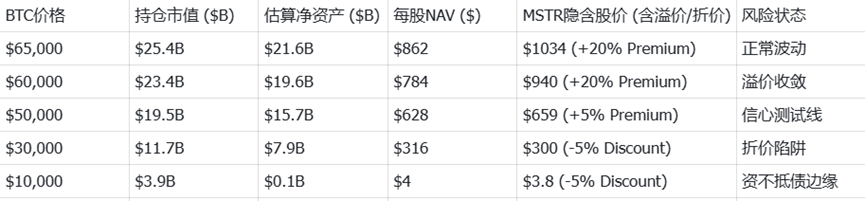
(Note: The model assumes that MSTR's diluted share capital is approximately 25 million shares, with the core software business and cash reserves valued at $1.2 billion, and total debt at $5 billion. Data is for reference only.)
From the model, it can be seen that even if BTC is halved to $30,000, MicroStrategy still has nearly $8 billion in net assets, far from being insolvent. However, the real danger lies in the disappearance of the premium. Once BTC falls below $50,000, the collapse of market confidence may cause MSTR to shift from "premium trading" to "discount trading." At that time, Saylor's proud "share issuance to buy Bitcoin" flywheel will temporarily fail, this is the real liquidity dilemma he faces, not creditor liquidation.
To clarify the true movements of institutional funds, I summarized the latest research reports from top Wall Street investment banks regarding the recent crash in the crypto market over the past 24 hours.
J.P. Morgan - "Miner capitulation is a bottom signal" In its latest "Digital Asset Liquidity Brief," JPM strategists pointed out that BTC's drop below $6.5k triggered a wave of shutdowns among high-cost miners. The report warns: "The current hashrate correction has not yet ended, and we expect to see large-scale selling of miner inventories in the $58,000-$62,000 range." JPM maintains a "reduce" rating, believing that under the macro tightening cycle, the valuation bubble of crypto assets still needs to be squeezed.
Goldman Sachs - "Tactical opportunities after deleveraging" In contrast, Goldman Sachs' global markets department has a more nuanced view. They mentioned in their morning meeting minutes: "Although retail sentiment is in extreme panic, the inquiry volume from institutions in the OTC market surged after the crash." Goldman believes that this drop was primarily driven by long liquidations in the derivatives market, rather than a deterioration in fundamentals. The report suggests that high-net-worth clients pay attention to the implied volatility mismatch opportunities of high beta assets like MSTR, implying that the crash may be an entry point for long-term funds.
BlackRock - "Silent whales" Notably, as the largest ETF issuer, BlackRock did not release public comments today, but on-chain data shows that its associated custody addresses exhibited significant accumulation signs around $64,000. This "buying without speaking" behavior may be more instructive than any research report.
Looking back at the macro level, BTC's drop below $65,000 is not an isolated event, but the result of global real yields strangling long-duration assets. The current crash is rapidly clearing leverage. The contract open interest has plummeted in the past 24 hours, which is a healthy signal. Only when speculative leverage is thoroughly cleaned out can the market find a true bottom.
Despite facing the pain of premium withdrawal in the short term, MicroStrategy is essentially a perpetual, low-cost Bitcoin call option. Saylor's firm stance is actually sending a signal to the market: he will not sell at the bottom. This "diamond hands" certainty is a scarce resource in a panicked market. As long as MicroStrategy does not sell Bitcoin, a portion of Bitcoin's circulating supply is effectively locked. If Bitcoin stabilizes in the $60,000 - $64,000 range, MicroStrategy is likely to use this panic to announce further capital operations and increase its position against the trend. This aligns with Saylor's consistent logic - using the inflation expectations of fiat currency systems to conduct inter-temporal arbitrage through debt instruments.
For investors, now is not the time to blindly bottom-fish or panic sell. Paying attention to the changes in MSTR's premium rate and the flow of funds from Wall Street giants may reveal the truth behind the fog more clearly than staring at candlestick charts. In this gamble about the future, volatility is the only ticket to entry.
免责声明:本文章仅代表作者个人观点,不代表本平台的立场和观点。本文章仅供信息分享,不构成对任何人的任何投资建议。用户与作者之间的任何争议,与本平台无关。如网页中刊载的文章或图片涉及侵权,请提供相关的权利证明和身份证明发送邮件到support@aicoin.com,本平台相关工作人员将会进行核查。


