On February 6, 2026, the People's Bank of China, the China Securities Regulatory Commission, and seven other departments jointly issued a notice on "Further Preventing and Handling Risks Related to Virtual Currencies," raising the risk prevention threshold within the existing regulatory framework and signaling a continued strict policy stance towards related activities. On the same trading day, Bitcoin's price briefly rebounded to over $65,000, while spot gold saw an intraday increase of about 3% (according to a single source). Global risk aversion and risk asset sentiment warmed simultaneously, reflecting the market temperature on the day the policy was implemented. The current central contradiction lies in how this round of regulatory upgrades will reshape the participation boundaries for domestic institutions and individuals amid significant fluctuations in global crypto assets and accelerated innovation, as well as China's long-term positioning in the intersection of virtual assets and RWA.
Renewing Old Regulations: From the 2021 Ban to Risk Framework Upgrades
● Historical Context Review: Since around 2021, Chinese regulators have implemented strict crackdowns on virtual currency "mining," centralized trading, brokerage matchmaking, and other aspects. The main logic is to exclude related activities from financial systems and real industry policy support, compressing their connections with banks, payment institutions, and trading platforms, thereby achieving the bottom-line thinking of "preventing financial risks and maintaining economic and financial order," and forming a long-term deterrent effect through joint actions by multiple departments.
● Continuation Rather Than Shift: This notice is officially described as a "revision based on summarizing previous work experiences and in conjunction with new risk situations," indicating that the regulatory goal remains anchored in "preventing and handling risks related to virtual currencies," with no strategic relaxation or directional reversal. It can be understood as further refining risk identification dimensions and addressing execution and collaboration shortcomings on top of the existing prohibitions and restrictions, institutionalizing and normalizing the regulatory consensus formed since 2021, rather than opening new policy tracks.
● Expanded Risk Scope: With the explicit mention of "new risk situations," regulatory attention has extended from the relatively singular early focus on price speculation and retail losses to more complex issues such as cross-border capital flows, on-chain technology applications, and financial stability. For example, decentralized protocols, cross-chain bridges, and tokenization tools may amplify money laundering and illegal fundraising risks, and may also create imperceptible leverage and mismatches through links with traditional financial products. These emerging risks are the key observation areas that this revision aims to include.
Regulatory Focus Shift: From Trading Crackdowns to Precise Risk Type Identification
● Focus on Traditional Pain Points: Without fabricating specific provisions, this notice still explicitly focuses on high-risk models that have long been of concern to regulators, including using virtual assets as a guise for illegal fundraising, utilizing token issuance or "wealth management" to package pyramid schemes, and bypassing traditional financial systems for large-scale money laundering or fund transfers. These behaviors often amplify social harm through complex technical packaging and cross-platform dissemination, thus remaining the core crackdown direction for the eight departments' coordinated law enforcement.
● Intertwining Virtual Assets and RWA: As more tokenized products based on real estate, bonds, and artworks emerge overseas, the boundaries between virtual assets and RWA are becoming blurred. For domestic investors, even if trading and custody occur on overseas platforms, the risks of such products may still be transmitted to the domestic market through price fluctuations, credit events, or intermediary channels, compounded by information asymmetry and legal applicability issues, posing new challenges for regulators in investor protection and cross-border judicial cooperation. This is also the implicit background of this round of upgrades.
● Attention to Linked Areas: The generalized expression of "related risks" in the notice points not only to the single asset itself but also to the interconnected areas between on-chain assets and the real financial system, as well as cross-border capital flows. For instance, if enterprises or individuals pledge tokenized assets for financing or achieve large-scale capital inflows and outflows through over-the-counter channels, it may exert pressure on macro-control and capital project management. Regulators may increasingly focus on these "gray interfaces" in the future, aiming to curb the spillover effects of on-chain activities on financial stability through enhanced departmental collaboration and data monitoring.
Price and Risk Aversion Resonance: Bitcoin Rebound and Gold Surge as Misaligned Signals
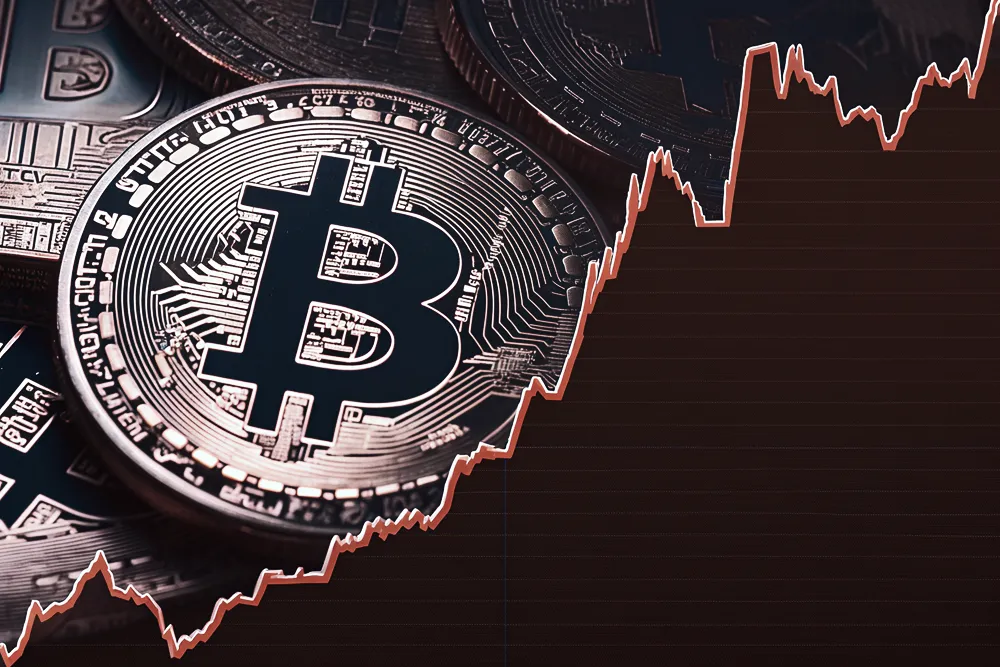
● Daily Resonance Data: On the day the notice was released, according to a single source, Bitcoin's price briefly rebounded to over $65,000, while spot gold saw an intraday increase of about 3%, creating a rare trend of traditional safe-haven assets and mainstream crypto assets strengthening in tandem. It is important to emphasize that there is currently no evidence to suggest a direct causal relationship between this round of price fluctuations and the notice; the two can only be viewed as parallel events in time, reflecting the complex state of overall market risk appetite and aversion sentiment on that day.
● Fluctuations in a Larger Cycle: Looking at a longer time scale, since the historical high in October 2025, Bitcoin has seen a maximum drawdown of nearly 50% (according to a single source), indicating that the current rebound is still in a phase of significant fluctuations rather than a one-sided bull market. The combination of policy news and macro expectations has led to frequent tug-of-war in price within a relatively high volatility range; any strong daily rise is more like an emotional release in a high Beta environment rather than a sufficient proof of trend reversal, requiring investors to retain a greater degree of uncertainty when interpreting price signals.
● Compression and Substitution of Safe-Haven Narratives: The simultaneous strengthening of gold and Bitcoin reflects a reallocation of funds between traditional and crypto "safe-haven narratives" against the backdrop of increasing global macro uncertainty. On one hand, some investors still view gold as a benchmark asset for hedging against inflation and geopolitical risks; on the other hand, crypto assets are being used by some funds as alternative tools to hedge against fiat currency credit and capital controls. When regulation tightens around virtual assets, safe-haven demand may flow back to traditional assets; conversely, during periods of overseas liquidity easing and strengthened innovation narratives, crypto may compete for allocation shares from assets like gold, making the relationship between the two more akin to a dynamic game rather than a simple substitution.
Global Hedging: Tether Expansion and China's High Pressure Alignment
● USDT Settlement Network Layout: On the same day, February 6, Tether announced an investment in the t-0 Network, a settlement platform based on USDT (according to a single source), aimed at strengthening its infrastructure position for dollar-denominated tokens in cross-border payments and settlements. By building an independent clearing layer and supporting service network, Tether seeks to upgrade from a single trading medium to a provider of "crypto dollar" infrastructure, seizing the discourse power and market inertia in cross-border capital flows and trade settlements in the gap where global regulatory frameworks have not yet fully formed.
● Global Landscape Differentiation: On one side, China's eight departments are further upgrading the prevention and handling of risks related to virtual currencies; on the other side, overseas entities are accelerating the expansion of underlying settlement networks around dollar-pegged tokens like USDT. The spatial distribution of global crypto finance is showing more pronounced differentiation. The former isolates the domestic financial system from high-volatility on-chain assets through strict regulation, while the latter explores deep binding of tokenization with traditional payment and trade scenarios in a more relaxed environment. This strategic difference will profoundly impact the geographical flow of capital and innovation activities in the coming years.
● Regulatory Arbitrage and Risk Spillover: Under the continued high-pressure framework domestically, the expansion of overseas dollar-pegged crypto infrastructure may induce some entities to participate "around" through overseas accounts, on-chain protocols, and intermediary services, creating regulatory arbitrage space. The related risks may not directly erupt visibly within the domestic market but could spill over in the form of severe asset price fluctuations, credit events, and liquidity shocks, affecting the asset safety and expected stability of domestic investors, and also raising higher demands for regulators in cross-border data sharing, judicial assistance, and KYC/AML collaboration.
Normalization of High Pressure: Boundaries and Future of China's Crypto Participation
● Main Line and New Signals: Overall, this notice from the eight departments continues the long-term main line of "preventing risks and maintaining bottom lines," prioritizing financial stability and social risk control over virtual assets and related innovations. At the same time, by incorporating "new risk situations" and RWA intersection scenarios into the narrative, it releases a signal of maintaining a strict examination in the direction of deep binding between virtual and real assets, emphasizing that regardless of how the technical packaging updates, once the underlying risk attributes touch the financial security red line, they will be brought into the scope of strict regulation.
● Three Paths for Compliant Participation: In terms of funding, domestic institutions and individuals can primarily only access global crypto and tokenization innovations indirectly through compliant financial products, regulated tools provided by licensed institutions, and approved cross-border investment channels, making it difficult to directly participate in high-leverage, anonymous on-chain activities; in terms of technology, there is still room for underlying blockchain technology, privacy computing, and distributed identity to serve the real economy and financial infrastructure, but they must maintain a clear separation from token issuance and speculative scenarios; in terms of compliance, any attempts to engage in tokenization, on-chain financing, or cross-border settlements must seek positioning within the existing legal and regulatory framework, avoiding crossing the red lines of illegal fundraising, money laundering, or unapproved cross-border financial activities.
● Long-term Impact Outlook: Currently, regulatory details and specific execution rhythms have not been disclosed, and in the short term, market sentiment may oscillate repeatedly between policy interpretations, global liquidity, and price fluctuations. However, from a longer cycle perspective, the normalization of high pressure will force funds and projects to gradually concentrate in compliant jurisdictions, transparent structures, and high-quality underlying assets, while rough issuance of tokens, pseudo-RWA packaging, and high-risk leverage structures will be continuously squeezed out of the mainstream view. For participants with genuine technical strength and compliance awareness, finding safe and effective innovation space amid the misalignment of rules across multiple global jurisdictions will become a core issue in the coming years.
Join our community to discuss and grow stronger together!
Official Telegram community: https://t.me/aicoincn
AiCoin Chinese Twitter: https://x.com/AiCoinzh
OKX Welfare Group: https://aicoin.com/link/chat?cid=l61eM4owQ
Binance Welfare Group: https://aicoin.com/link/chat?cid=ynr7d1P6Z
免责声明:本文章仅代表作者个人观点,不代表本平台的立场和观点。本文章仅供信息分享,不构成对任何人的任何投资建议。用户与作者之间的任何争议,与本平台无关。如网页中刊载的文章或图片涉及侵权,请提供相关的权利证明和身份证明发送邮件到support@aicoin.com,本平台相关工作人员将会进行核查。