On February 6, 2026, the People's Bank of China, in conjunction with eight major departments, released document No. 42 [Yinfa〔2026〕42] again. There have been many interpretations in the market, and this article aims to conduct a vertical analysis more from the perspective of RWA combined with the current state of the on-chain market.
From on-chain data, from the beginning of 2025 to the beginning of 2026, on-chain RWA assets surged fivefold, reaching a total of 23.7 billion US dollars, which is already a market that cannot be ignored.

1. How to Understand Document No. 42
In my view, when looking at the original text combined with the attached document "Regulatory Guidelines for Issuing Asset-Backed Securities Tokens for Domestic Assets Overseas," it reveals a lot. The core idea is that Document No. 42 dedicates a lot of space to defining and regulating "Real World Asset Tokenization" (RWA), which effectively means that the regulatory authorities have officially recognized RWA as a business form and have provided paths for compliance application and filing.
The key is three pieces of information, which I will present in the original text and then provide contextual interpretation.
First, RWA is accurately characterized:
"Real world asset tokenization refers to the activities of using cryptographic technology and distributed ledgers or similar technologies to convert ownership, income rights, and other rights of assets into tokens (certificates) or other rights with token (certificate) characteristics and to issue and trade them."
With this definition, how to apply it? Hence, the following sentence continues:
"Except for business activities that have been approved in accordance with laws and regulations by the business authorities, based on specific financial infrastructure."
So who can specifically participate? Therefore, there are now clear regulations on the application and use of RWA assets:
The domestic entity that actually controls the underlying assets must file with the China Securities Regulatory Commission and submit a filing report, foreign full set of issuance materials, and other materials, fully explaining the information of the domestic filing entity, underlying asset information, token issuance plans, and so on.
Thus, in my view, the combination of the two can be stated that it has clearly separated RWA assets from the virtual currencies that were originally strictly targeted for ban, and the two do not fit the same management approach.
The significance is also substantial, as it completely addresses the previous regulatory gray areas. After all, the biggest obstacle that domestic assets face when tokenized through RWA going overseas is not a technical problem or a market problem.
Moreover, RWA tokenization has almost continued to follow the existing securities regulatory framework. This is also beneficial for financial institutions, as they can legally conduct compliant RWA operations. Objectively speaking, RWA issued by standardized financial institutions is the best way to prevent and eliminate risks.
Within such restrictions in the mainland, it can avoid arbitrary issuance of assets; if RWA is treated as a meme, it would instead damage the market.
2. Global Standard Evolution of RWA
Accompanying the regulatory definition on the mainland, how is the global RWA market developing now? When regulatory issues are alleviated, the subsequent application has become a realistic problem that needs to be faced directly.
In fact, the current market is long-term trapped in an era of chaotic Token standards.
This complexity has created a predicament of industry compatibility for RWA, so let’s take a closer look at the mainstream RWA token application standards today.
This article will start from the HK ABT (Asset-backed Token) of 2022, through to the bond-oriented ERC-3525 and ERC-3475, then to the DeFi era examples of AAVE's Atoken, stETH, and AMPL, and the latest head platforms for on-chain stocks, Ondo and xStock, examining how they respond to the characteristics of stock tokenization.
2.1 HK and ABT
The Hong Kong government’s "Policy Declaration on the Development of Virtual Assets in Hong Kong" released on October 31, 2022, highlighted the Asset-backed Token (ABT).
Typically, tokens are classified into four main types, distinguished based on the purpose and source of value of the token.
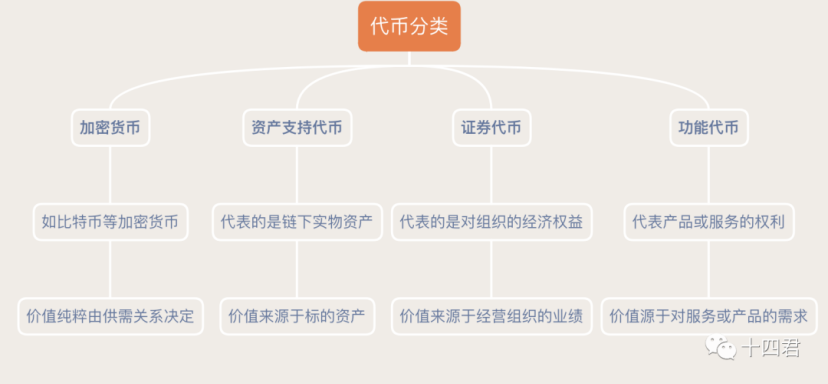
In fact, the considerations of current mainland documents and the practices previously conducted by HK follow a continuous line of thought, inevitably linked to real-world physical assets or rights serving as value targets.
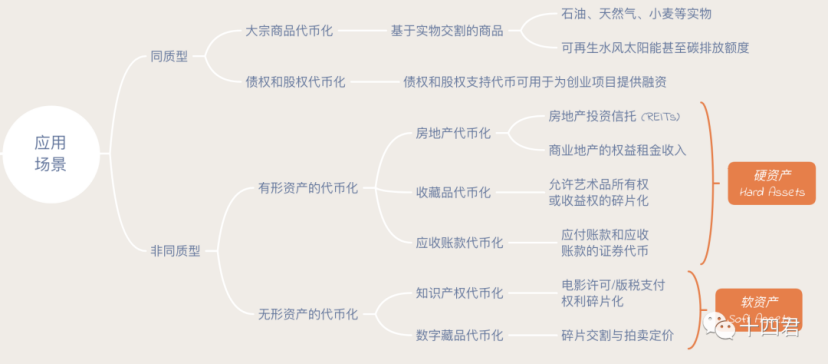
This way, asset tokenization through compliance offers increased advantages thanks to characteristics of on-chain technology:
- Fragmentation: the division of ownership into smaller pieces for selling purposes, making it easier to set transaction pricing and circulation
- Liquidity: liquidity is defined by the speed at which assets can be converted into cash, with order databases shared and broadcasted on-chain
- Cost efficiency: using blockchain-based smart contracts for transactions eliminates or significantly reduces the costs associated with external parties
- Automation: blockchain-based smart contracts do not require manual interactions, providing a reliable technological foundation
- Transparency: one of the most notable features of on-chain transactions is the immutable record storage
From the audience's perspective:
- For institutions, the breakdown of large orders brings efficiency and cost savings through fragmented liquidity
- For users, having a transparent and automated trusted environment ensures their rights
The most directly applicable and valuable now is stocks and bonds, as both can perfectly fit into the aforementioned advantages of liquidity, automation, and fragmentation characteristics.
3. Bond Scenario Standards: ERC-3525 and ERC-3475
These asset types saw considerable evolution before and after HKABT, with the industry standard being established by ERC-3525 and ERC-3475:
- ERC-3525 focuses on the management of semi-homogeneous tokens, improving the numerical aspects of asset composition division, emphasizing traditional financial assets on chain
- ERC-3475 emphasizes the definition of semi-homogeneous tokens, making the definitions of low-standard contracts more regulated, focusing on traditional commercial contracts on chain
Objectively speaking, the application of these two standards is not widespread, as they were established prior to the emergence of associated business, rather than summarizing off existing business. Thus, their actual voice is dwindling (far less than the Atoken and stEth mentioned earlier).
In my opinion, the intention behind such design standards is to be broad and comprehensive, like ERC-3475 (as shown below), which is practically a representative of inclusiveness, directly leading to a high threshold for user understanding and a high entrance barrier for applications.
In the end, having too many elements to write about amounts to nothing; the market is understandable regarding the lack of application.
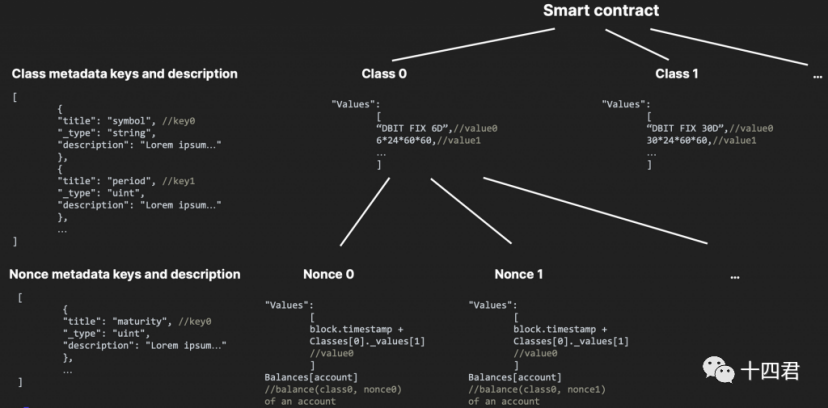
For more detailed interpretations, see: Review of the five major token standards: are they sufficient to support Hong Kong's Web3 development pilot?
4. Bond Scenario Applications: AToken & seEth
Rather than starting with standards and then types of applications, let's look at examples that began with applications and then established standards.
4.1 Real-time Compound Interest Model: Aave’s Atoken
Aave is a leading DeFi infrastructure in the web3 sector, engaged in on-chain asset staking, lending, and interest earning, where Atoken serves as a staking certificate with the following key functions:
- Proof of deposit: holding an aToken is equivalent to owning a corresponding quantity of assets in the Aave protocol, and these assets automatically earn interest over time.
- Lending mechanism: aTokens can be used to assess a user's deposit amount and determine the amount of loan the user can take.
- Automatic interest distribution: the quantity of aTokens will automatically increase based on the current deposit interest rate.
- Transferability and liquidity: users can transfer or pledge aTokens to other protocols to earn more profit or use them in other DeFi products.
From this perspective, it can be said that each point represents the path that RWA aims to take in the future.
Looking at its market status, Atoken has been steadily growing, with total assets reaching around 30 billion US dollars.
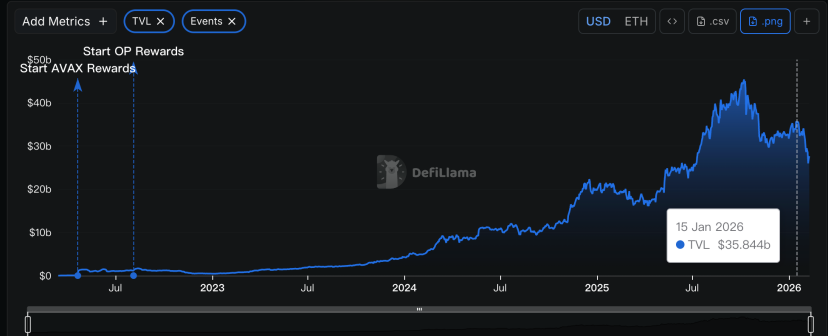
Why is Atoken so successful?
Clearly, nearly 100% growth rate year over year can be considered a model of success.
At the core, it’s because Atoken is highly adaptable to the existing market; after all, it originates from Aave, who understands that adaptability in the blockchain market is a key developmental pathway. The two earlier-mentioned standards ultimately faltered on adaptability, as existing asset dashboards and wallets haven't easily incorporated these asset types.
Adaptability is not a simple term; it must resolve a critical question: if on-chain assets cannot earn interest, their practical significance is greatly diminished.
But if they are to earn interest, how does this interest get paid to the user?
Considering everyone has different staking times and every time period might present varying staking interest rates, and different assets face different market demands, thereby corresponding to different borrowing and lending interest margins.
If interest were simply distributed based on time periods, it would obviously increase the project's costs and management complexity, leading to a situation of costs being shifted back to the users.
Some claim this is a on-chain performance issue, prompting the creation of new high-performance public chains to rival web2 server capabilities, but they would be stymied by user migration costs.
Aave's answer is to embed interest in users' daily transactions.
Atoken fundamentally employs a Scaled Balance mechanism to compute users' actual balances:
Liquidity Index = Initial Index × (1 + Interest Rate × Time)
This logic allows interest to be automatically calculated and accumulated during transfers (whether sending or receiving), triggering new minting events during the transfer.
This, for the project side, reduces the need for dividend transactions, and users' interest is realized seamlessly. Even if it’s not visible, it will still be accounted for in their next actions, ensuring no losses.
This clever design, amounting to just a few lines of code, reflects a profoundly native mindset.
Moreover, this type of approach has opened up the subsequent inheritance and evolution of seEth and the ondo, xStock on-chain asset standards.
4.2 Rebase Model: Lido’s seETH
SeEth builds on the previous interest model, simplifying the logic of staking and withdrawal from merely calculating interest based on time, to a simpler notion of shares.
stETH = Amount of ETH staked by user * (Total assets in protocol / Total internal shares)
You might wonder why it can operate without interest. Since staking earns interest and if someone deposited for one year while I only deposit for one day, shouldn’t the shares change?
This is due to Lido’s daily automatic rebase mechanism. For example:
- If I bought 1 ETH a year ago and joined a stake totaling 100 ETH, my share is 1%.
- Lido acquires staking rewards from the Ethereum beacon chain daily and executes a rebase on the protocol.
- The next year when I withdraw, I will naturally receive around 4%.
- If I were to purchase this 1% share on the last day, it would be based on nearly a year's worth (364 days) of accumulated stake, priced close to 104%, thus I could only benefit from that rebase one time.
Why has it been designed this way?
Because making the stETH yield become automatically distributed daily without requiring wait time or manual retrieval is its greatest convenience.
In contrast, Atoken requires a transaction to realize the benefits, whereas this can automatically update balances every day, making it easy for various wallets to be compatible.
Ultimately, this allows users to visibly see the increase in interest on their accounts, aligning with our conventional understanding of savings, where interest is deposited automatically every day, leading to peace of mind.
Fundamentally, the two concepts differ in application scenarios.
Aave focuses on lending, where interest rates experience significant real-time fluctuations, with high-rate periods equating a day's worth of interest to that of a month; while Lido offers stable and smooth fixed yields that do not heavily concern the daily interest, thus enhancing user experience.
Do either of these represent suitable token standard approaches for the RWA era?
I believe neither is suited, but they can be referenced. Now let’s turn to today’s main subject, the on-chain stock model.
5. On-Chain Stock RWA Scenarios
Despite the overall RWA market value being relatively small (900M vs 27B), due to the characteristics of stocks, it remains one of the scenarios with the most trading liquidity and a vibrant vision for on-chain applications.
The main players here are Ondo and xStock.
Over the past six months, some leading DEX and wallet markets have begun to invest here. Objectively speaking, the perspectives these top platforms share regarding future trends seem surprisingly aligned.
- On July 1, 2025, Jupiter supported xStock trading and initiated large-scale promotions.
- On September 25, 2025, Solana's official account announced a new RWA Twitter account.
- On January 22, 2026, Jupiter launched over 200 tokenized stocks in partnership with Ondo Finance.
- On January 24, 2026, Binance Wallet in professional mode began supporting Ondo asset trading.
- On February 3, 2026, MetaMask launched tokenized US stocks and ETFs and stated that the market is shifting on-chain.
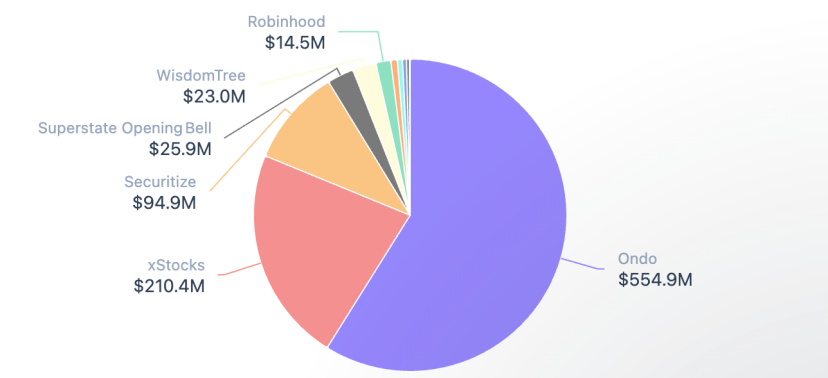
They fundamentally rely on the share-based Rebase model, applying a "on-chain share + Multiplier scaling" rebase mechanism.
On the Solana chain, this mechanism serves as an extension in its mainstream token 2022 standard, where each token can have a set parameter called Multiplier determined by the project party, while the balance users receive is termed the raw amount, denoting shares.
Then, during scenarios such as mergers, splits, and dividend distributions, project parties dynamically adjust the token parameters' Multiplier to alter the displayed amount multipliers.
This distinction essentially delineates a dividing line; users employing wallets not supporting this parameter might feel like their assets look somewhat inaccurate. In supported situations, they see the UI amount, which is reflected on the client-side.
6. Summary and Reflection
The previous text has already been quite extensive, detailing over four thousand words, outlining the main players and developmental trajectories of mainstream on-chain asset tokenization and real asset tokenization.
Various localized thoughts have also been discussed across different sections, but now we should return to the theme of “cold reflection.”
In a broader sense, RWA has been developing for almost 10 years now.
- Early exploration, 2016-2019: Asset on-chain experimental stage primarily focused on stablecoins.
- Early institutional phase, 2020-2022: RWA entered the DeFi lending realm, namely the BN/FTX tokens that once attempted tokenized stocks before shutting down shortly thereafter.
- Compliance phase, 2023-present: Regulation becomes clear, some RWA assets rapidly expand (stablecoins, US Treasury bonds, etc.), with positive trends for new asset types and platforms.
Therefore, I believe that the mainland's classification of RWA is objectively a positive development but not a wholly favorable one; it can even be viewed as a belated notification. Additionally, HK had previously launched a similar ABT system, but has it actually progressed?
Comparatively, observing the other hemisphere's situations, it hasn't seen much improvement, which is closely related to HK's cautious management of licenses. Whether one can proceed boldly or should take tentative steps under restrictions, both scenarios can drive away much hope from platform builders.
The new system has introduced openness, but what is open is not necessarily what users genuinely need or what the market demands.
We see that Aave's Atoken is exceptionally successful because it addresses the issue of idle on-chain assets, enabling users to lend them out.
SeETH is also impressive, as it paves the way for the POS (Proof of Stake), despite the potential risk of Lido accumulating excessive amounts (stake), but it solidly ensures stable yield from staking. Similarly, one can read my other piece on Jito, which also describes a different staking model.
Furthermore, both are very user-centric, intricately handling compatibility and the little details affecting the cost for project parties.
Thus, issuance itself is not the goal; applying on-chain liquidity, fragmentation, transparency, and automation to tokens is where the value lies.
Rather than prematurely defining a perfect standard, it’s more about respecting rules and consensus to make gradual, leveraging progress.
Just like common stocks, various exchanges do not operate 24/7, unlike on-chain systems.
Different markets have specific opening hours for trading precious metals, while on-chain does not.
This gap in timing represents true value on-chain since it can resolve issues of value discovery in non-trading markets. Compared to pre-market trading, it is more sensitive; in contrast to price differences between exchanges, it bears lower friction. Additionally, the global liquidity provides a completely different perspective for value discovery; the future pricing of companies may not necessarily depend on current chains based on the New York Stock Exchange, but it could be that companies examine on-chain conditions before listing on the New York Stock Exchange.
Disclaimer
This article is dense with information since many structural overviews are highly condensed, and the technology is not fully open-source, derived from analyses of publicly available information.
Additionally, this discussion purely from a technical perspective does not imply any positive or negative evaluations of individual products.
免责声明:本文章仅代表作者个人观点,不代表本平台的立场和观点。本文章仅供信息分享,不构成对任何人的任何投资建议。用户与作者之间的任何争议,与本平台无关。如网页中刊载的文章或图片涉及侵权,请提供相关的权利证明和身份证明发送邮件到support@aicoin.com,本平台相关工作人员将会进行核查。


