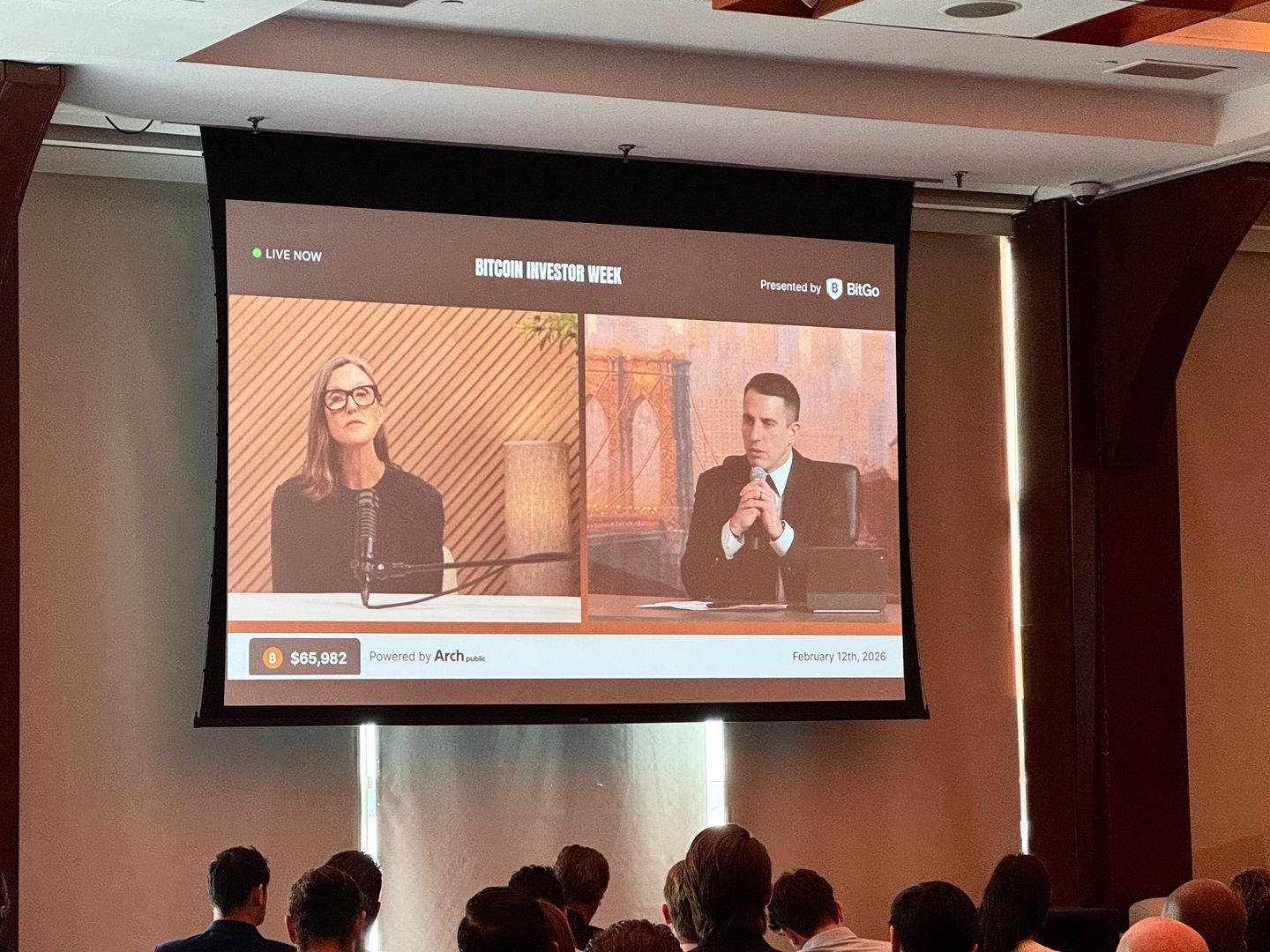
What to know : Cathie Wood argues that bitcoin is a hedge not only against inflation but also against a coming wave of technology-driven, productivity-led deflation. She says rapid cost declines in artificial intelligence and other exponential technologies will trigger "deflationary chaos" that traditional financial institutions and the Federal Reserve are unprepared for. In her view, bitcoin’s decentralized design and fixed supply make it a safer alternative to fragile, debt-based financial systems that could be strained by deflation and disrupted business models.
New York — Bitcoin isn’t just a hedge against inflation, according to ARK Invest CEO Cathie Wood, but against something more disruptive: deflation driven by technological acceleration.
In a conversation with Anthony Pompliano at Bitcoin Investor Week in New York, Wood argued that traditional financial systems are unprepared for a coming “productivity shock” powered by artificial intelligence (AI), robotics, and other exponential technologies. That shock, she said, will push prices down rapidly, upend legacy business models, and create what she called “deflationary chaos.”
“If these technologies are so deflationary, it’s going to be tough for the traditional world — used to 2% to 3% inflation — to adjust,” Wood said. “They’ll have to embrace these technologies faster than expected.”
That deflation, in her view, won’t come from economic collapse, but from breakthroughs that slash costs and boost output. She cited data showing AI training costs falling 75% per year and inference costs (what it takes to generate an AI response) dropping by as much as 98% annually. As a result, businesses are becoming far more productive with fewer inputs, leading to lower prices.
Wood said this kind of innovation-led deflation is being misread by the Federal Reserve, which still relies on backward-looking data. “They could miss this and be forced into a response when there’s more carnage out there,” she warned.
In that scenario — where traditional financial institutions are caught flat-footed — bitcoin’s appeal becomes clearer.
“Bitcoin is a hedge against inflation and deflation,” she said. “The chaotic part of this is... disruption all over the place,” referencing underperformance in software-as-a-service stocks and emerging counterparty risks in areas like private equity and private credit. “Bitcoin doesn’t have that problem.”
Bitcoin, she argued, offers a trustless alternative that is insulated from the fragility of traditional finance. As central counterparties and legacy institutions come under pressure, bitcoin’s decentralized architecture and fixed supply become strategic advantages.
Wood also noted that bitcoin’s simplicity stands in contrast to the complexity of layered financial systems, which may face pressure as deflation compresses margins and undermines debt-based growth models.
“This is the opposite of the tech and telecom bubble,” she said. “Back then, investors threw money at tech when the technologies weren’t ready. Now, they’re real — and we’re on the flip side of the bubble.”
She emphasized that ARK’s portfolios have been built around the convergence of disruptive technologies, including blockchain, for years. The firm remains one of the largest holders of Coinbase (COIN) and Robinhood (HOOD) among many other allocations in crypto companies.
While markets remain volatile, Wood argued that bitcoin — and innovation-focused investments more broadly — stand to benefit as the economic narrative shifts from inflation to productivity-driven deflation.
“Truth will win out,” she said. “We believe we’re on the right side of change.”
免责声明:本文章仅代表作者个人观点,不代表本平台的立场和观点。本文章仅供信息分享,不构成对任何人的任何投资建议。用户与作者之间的任何争议,与本平台无关。如网页中刊载的文章或图片涉及侵权,请提供相关的权利证明和身份证明发送邮件到support@aicoin.com,本平台相关工作人员将会进行核查。


