Written by: Maher, Foresight News
On February 13, the U.S. stock market experienced a sudden crash, with the Dow Jones index closing down 1.34%, the Nasdaq index dropping 2.03%, and the S&P 500 index falling 1.57%. Gold plummeted over 4% at one point, and silver collapsed 11%. The price of Bitcoin dropped to $66,000, and Ethereum fell to $1,900.
Coinbase, the largest cryptocurrency exchange platform in the U.S., saw its stock price drop to around $140 after releasing its Q4 and full-year financial report for 2025. Despite strong annual performance, the net loss in Q4 and slowdown in trading volume became direct triggers for investor sell-off.
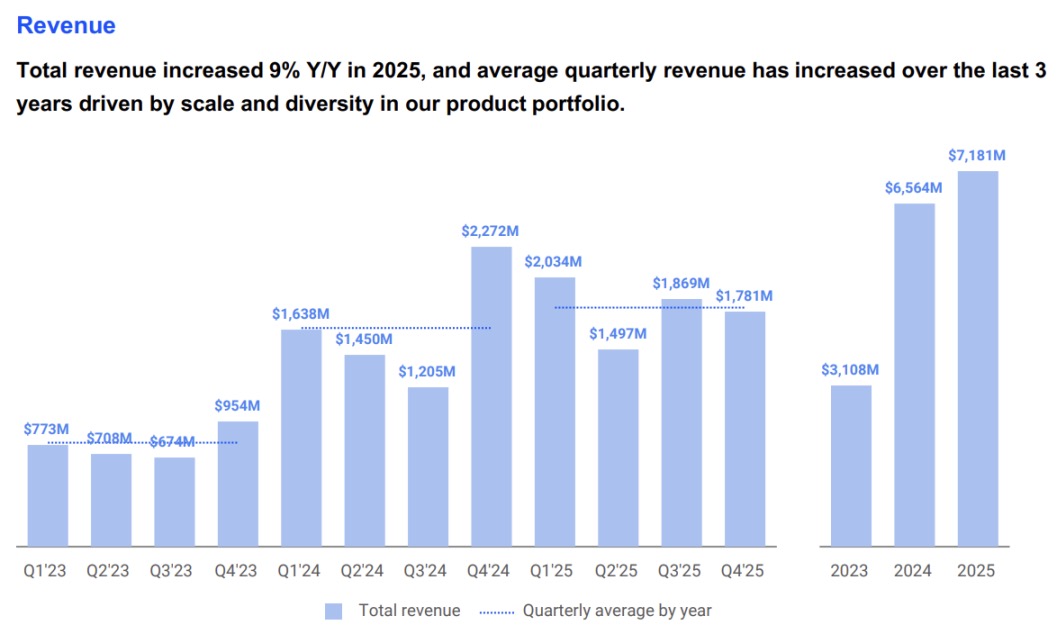
For the entire year of 2025, Coinbase reported a revenue of $7.181 billion, an increase of approximately 9% from $6.564 billion in 2024, with a net income of $6.883 billion. Although Q4 showed a net loss of $667 million due to paper losses from the cryptocurrency asset portfolio, the company still achieved a net profit of $1.26 billion for the entire year.
Since Q4 of 2022, Coinbase has stopped disclosing the "total verified user number" directly in its financial reports (which was 110 million at that time). According to the latest data from DemandSage, by the end of 2025, the total number of verified users on Coinbase is expected to reach about 120 million.
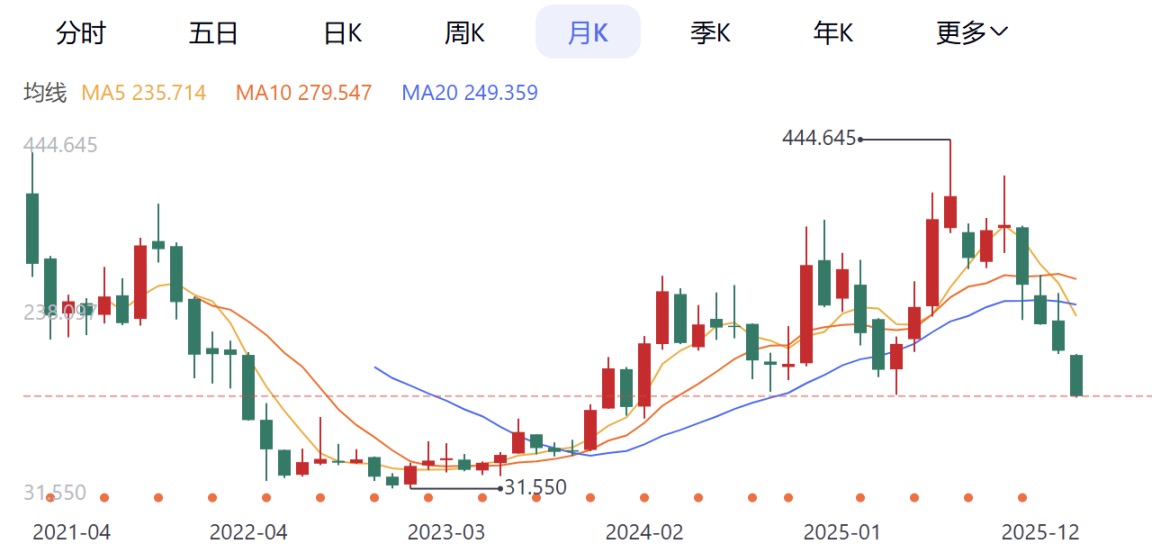
In addition, its stock price performance has been heavily criticized. Currently, the COIN stock price has fallen to a new low since March 2024.
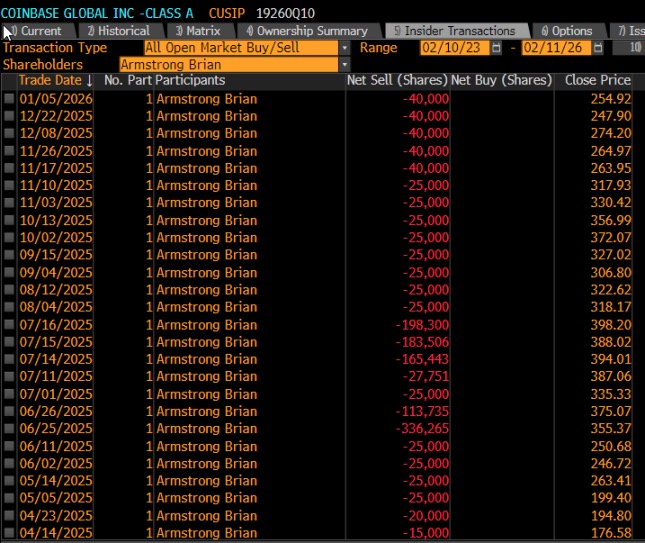
Meanwhile, Matthew Sigel, head of digital asset research at VanEck, stated that Coinbase CEO Brian Armstrong sold 40,000 shares of COIN again on January 5, amounting to about $10.16 million based on the stock price at that time. VanEck's chart added that Brian Armstrong sold over 1.5 million shares of Coinbase stock between April 2025 and January 2026, cashing out approximately $550 million.
Q4 2025 Trading Volume at $18 Billion, but Slowing Down
On February 13, Coinbase's financial report provided detailed insights into the financial data for the entire year of 2025 and Q4, showcasing a pattern of growth intertwined with concerns.
For the year, Coinbase's total trading volume (including spot and derivatives) grew by 156% year-over-year, reaching $5.2 trillion, and the market share of cryptocurrency trading volume doubled to 6.4% (up from 3.2% in 2024 and 1.8% in 2023).
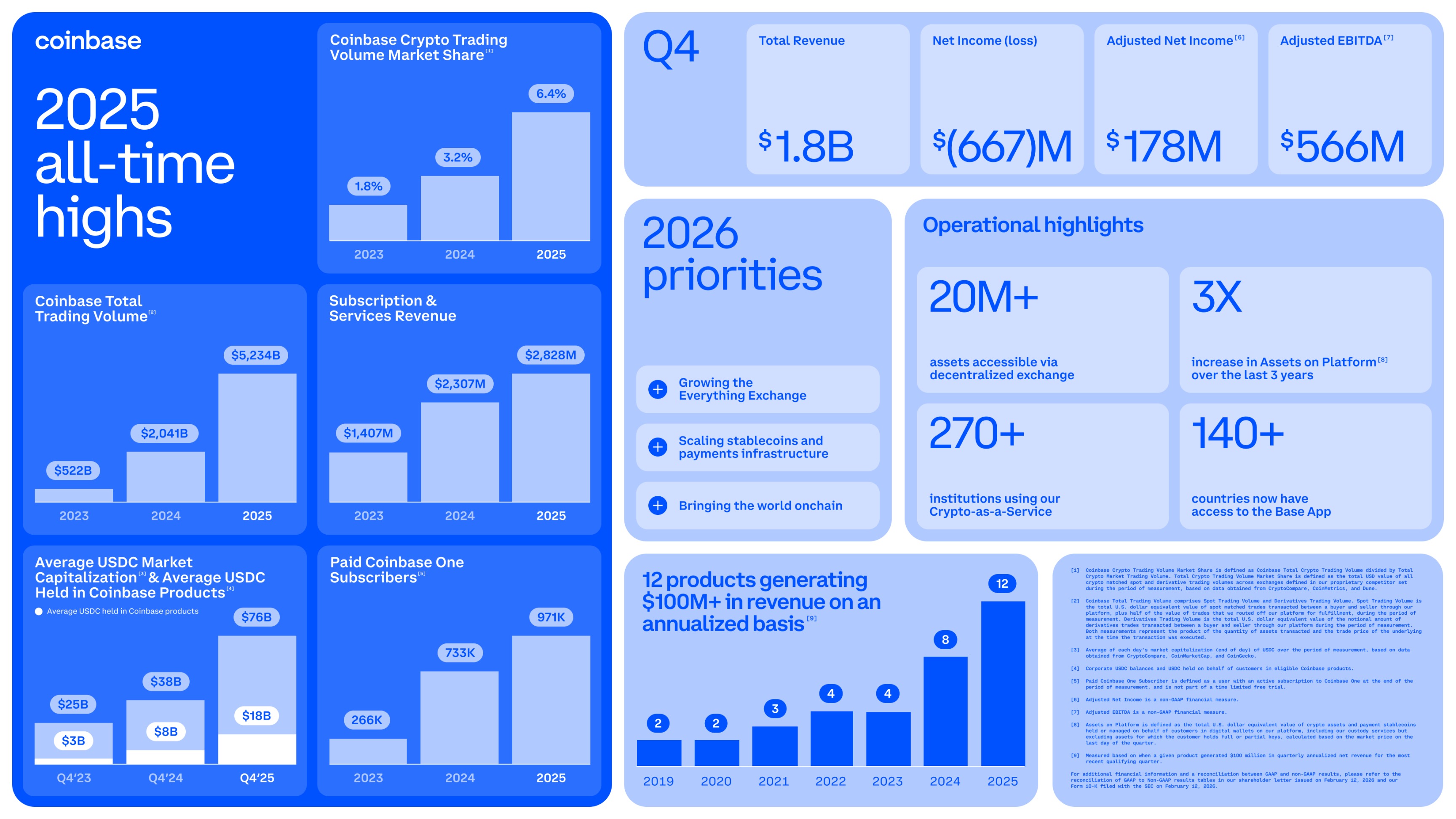
Subscription and service revenue also hit a record high, reaching $2.328 billion for the year, an increase of 65% from $1.407 billion in 2024.
Among these, the stablecoin business stood out, with USDC's market cap rising to $76 billion (up significantly from $38 billion in 2024 and $25 billion in 2023). The average USDC holdings within Coinbase products in Q4 reached $8 billion (the annual trend increased from $3 billion in Q4 '23 to $18 billion in Q4 '24, then to $8 billion in Q4 '25, showing volatility but an overall upward trend).
The number of paid Coinbase One subscription users reached 971,000, significantly growing from 733,000 in 2024 and 266,000 in 2023, enhancing value through new tiers and products like the Coinbase One Card.
Q4 Total Revenue at $1.8 Billion, $667 Million Loss Leads to Stock Price Plummet
The company revealed in its financial report that there are already 12 products with annualized revenue exceeding $100 million, half of which exceed $250 million, and two products exceed $1 billion.
Coinbase's transformation from a simple exchange to an "Everything Exchange" covers fields such as cryptocurrencies, derivatives, stocks, and prediction markets. However, specific data from Q4 exposed short-term pressures, becoming the core driver of the stock price drop.
Total revenue for Q4 was $1.8 billion, with both year-over-year and quarter-over-quarter growth, but it fell short of Wall Street's expectations of $1.95 billion.
Even more glaring was the net income: a loss of $667 million was recorded, turning from profit in the same period last year and Q3 to a deficit. This loss was primarily attributed to unrealized losses from strategic investments, fluctuations in cryptocurrency asset prices (such as Bitcoin's retracement at the end of Q4), and rising operational costs, including acquisition integration costs and regulatory compliance expenses.
If these non-core factors are excluded, the adjusted net income stands at $178 million, with adjusted EBITDA at $566 million, which, while positive, is a 12% decrease from Q3, indicating pressure on core profitability.
Transaction fee revenue was $1.05 billion, with company cash and equivalents at $11.3 billion.
Transaction revenue, a traditional pillar, contributed about $1.05 billion in Q4 (approximately 55% for the year), but trading volume slowed quarter-over-quarter: while total trading volume for the year was $5.2 trillion, Q4 saw only about $1.2 trillion. Both retail and institutional trading were affected by market volatility, with average trading size declining by 15%. Spot trading volume fell by 10% year-over-year. Derivatives trading increased through the acquisition of Deribit but overall failed to compensate for user loss due to bearish market sentiment—monthly active trading users decreased by 800,000 to 9.5 million.
Subscription and service revenue in Q4 was $730 million, a year-over-year increase of 18%, but slightly decreased by 2% quarter-over-quarter. Breaking it down, benefiting from the integration of the Base chain and developer tools, stablecoin revenue (mainly USDC) was $380 million, but staking rewards dropped to $120 million, reducing by 18% quarter-over-quarter due to lower network yield; interest and financial revenue was $65 million, while other service income was $165 million.
The balance sheet shows that the company's cash and cash equivalents reached $11.3 billion, an increase of $800 million compared to Q3, benefiting from annual profit accumulation, while Q4’s loan issuance and cryptocurrency investments (such as Bitcoin holdings) led to a net decrease of $300 million in dollar resources.
The company's Bitcoin holdings were not updated in Q4, but the annual trend shows a total holding of over 12,000 coins, with a total cost of about $800 million, averaging $66,000 per coin. The current value fluctuates with the Bitcoin price to about $1.1 billion (based on a Bitcoin price of $90,000 at the time of the financial report). If calculated at the Bitcoin price on February 13, it would show a slight paper loss.
Although SEC regulation has eased, a new round of competition in derivatives is intensifying, with Binance expanding globally and Robinhood's cryptocurrency products eroding share.
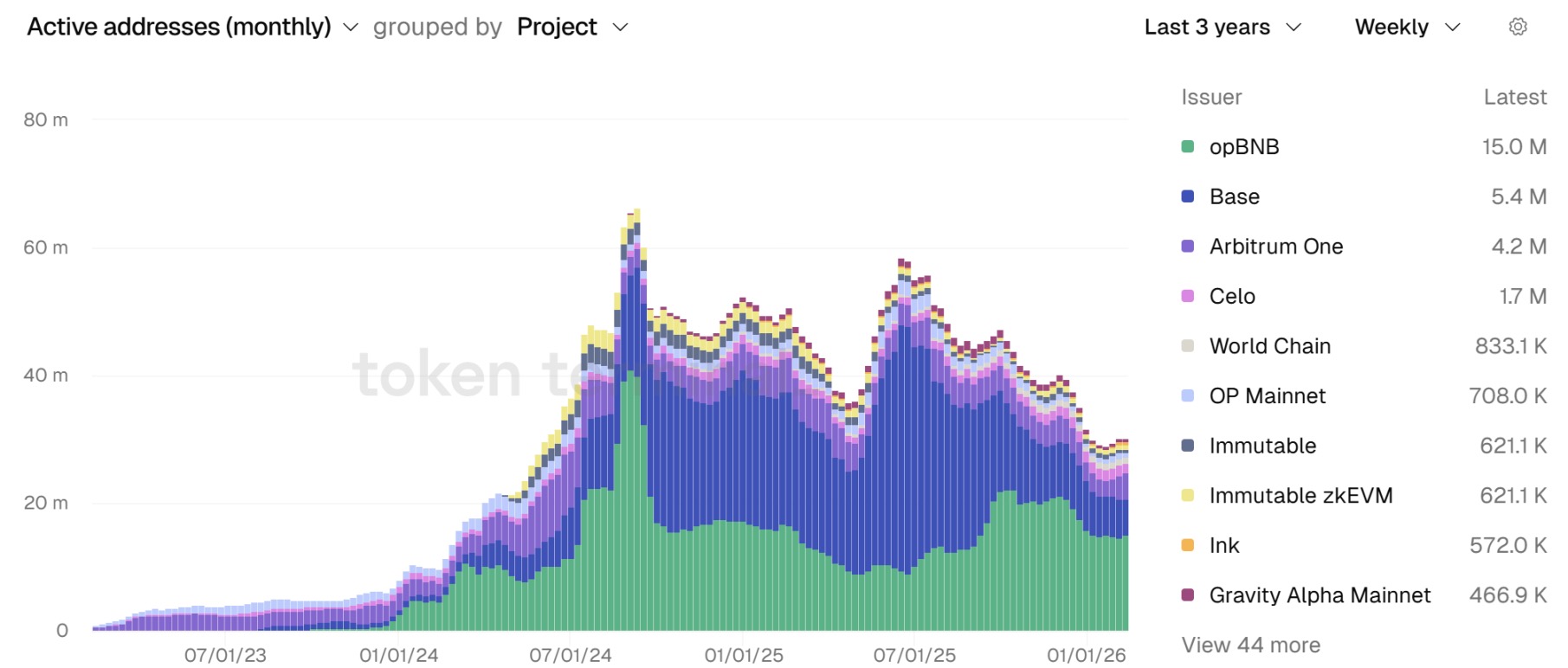
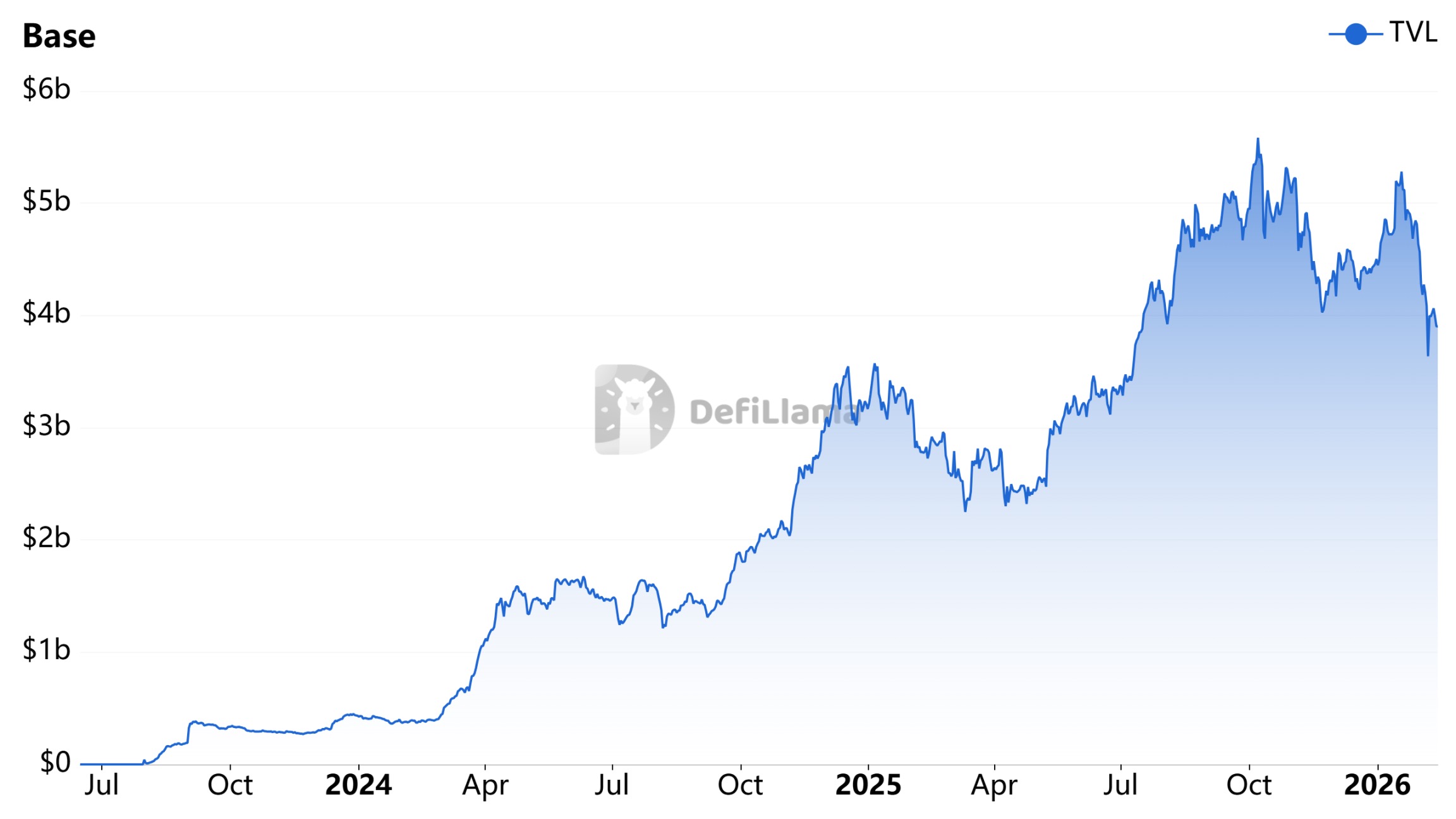
The financial report indicates that Coinbase's priorities for 2026 include expanding Everything Exchange, expanding stablecoin payments, and building on-chain finance. The number of active addresses on the Base chain has surpassed Optimism and Arbitrum, with a TVL of $3.5 billion.
According to the latest data from Token Terminal, the weekly activity on Base is now only second to opBNB.
Latest data from DefiLlama shows that the TVL of Base has risen to $3.905 billion.
In summary, Coinbase’s financial report reveals the duality of the crypto giant: innovation driven diversification throughout the year, yet Q4 losses and trading fatigue expose a reliance on asset prices. The plummet in stock prices is not only a reaction to emotions but also a questioning of market sustainability. If there is no strong recovery or regulatory favor in 2026, Coinbase will face more stringent tests.
免责声明:本文章仅代表作者个人观点,不代表本平台的立场和观点。本文章仅供信息分享,不构成对任何人的任何投资建议。用户与作者之间的任何争议,与本平台无关。如网页中刊载的文章或图片涉及侵权,请提供相关的权利证明和身份证明发送邮件到support@aicoin.com,本平台相关工作人员将会进行核查。


