——Triple Dialogue Between Digital Assets and Traditional Finance: Strategic Integration, Corporate Transformation, and Gold Reconstruction
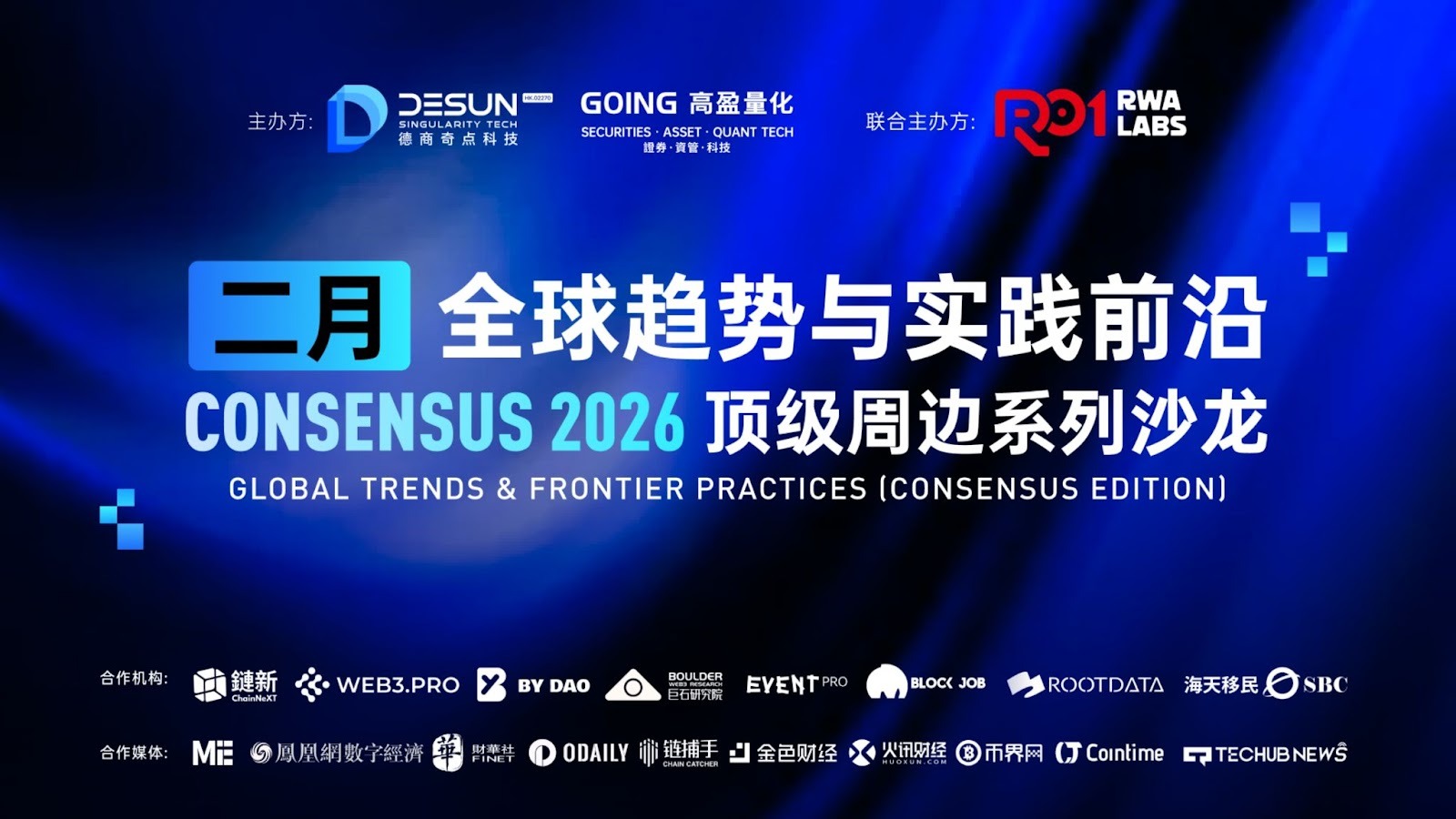
From February 10 to 12, 2026, the "Global Trends & Frontier Practices" Consensus 2026 top-level peripheral salon series, jointly initiated by Derivative Commerce Singularity Technology and GaoYing Quantitative, and co-hosted by Huaxia Digital Capital, was successfully held in Hong Kong. The three events focused on the three major themes of "Integration of Digital Assets and Traditional Asset Strategies", "RWA and Corporate Web3 Transformation Path", and "Hong Kong Gold RWA and Stablecoin Innovation", gathering dozens of industry representatives from quantitative asset management, traditional finance, Web3 infrastructure, legal compliance, and academic research for three days of in-depth dialogue.
This series of salons revolved around the main line of "from strategy migration to structural reconstruction." The attendees no longer focused on macro judgments of "whether to enter" but discussed practical issues such as the transferability of strategies, the tokenization boundaries of assets, and the executable framework of compliance, presenting a series of industry dialogues that combined industry depth with institutional rationality.
Day One · February 10:Integration and Breakthrough of Digital Asset and Traditional Asset Strategies
The first day's activities targeted quantitative asset management, focusing on the strategic positioning and execution logic of digital assets in the global asset allocation system. Lin Mingxuan, head of asset management at Derivative Commerce Singularity Technology, pointed out in his keynote speech that there are still numerous pricing error opportunities in the digital asset market that can be identified quantitatively. The significant mismatch between arbitrage space and traditional financial markets is primarily due to the coexistence of high volatility and weak efficiency. He systematically showcased the team's real-market accumulations in futures arbitrage, cross-exchange arbitrage, and fee arbitrage, and introduced the transition path from traditional statistical arbitrage to machine learning-driven strategy frameworks.
Xu Cheng, Deputy General Manager of the Product Department at GaoYing International, further explored the cross-market migration practices of high-frequency market-making strategies and CTA strategies. He demonstrated the strategy adaptation path that incorporates crypto-exclusive factors such as funding rates and on-chain capital flows based on price-volume models and shared GaoYing Quantitative's technical accumulation in AI-driven trading systems and ultra-low latency architectures as one of the few institutions with global multi-market trading capabilities in Greater China. Robin, the head of the Giant Stone WEB3 Research Institute, added from a macro perspective that digital currency is transitioning from a high-risk speculative tool to a long-term investment vehicle, with RWA tokenization becoming an essential infrastructure in this transformation process.
The roundtable discussion was moderated by Mr. Lin Mingxuan, CIO of Derivative Commerce Singularity Technology, with participations from YT, founder and CEO of SDM Group (Nasdaq: SDM), Austin Liu, Chairman of Puying Hedge Fund, Jack Chen, Co-Founder & CEO of Moon Lab, Keaton, CMO of MSX, and Stella, COO of ArrivalX. The attendees believed that digital assets are evolving from early narrative-driven approaches to strategy-driven ones, with the explainability of revenue sources and the executability of risk management becoming the core of institutional focus. Cross-border payments, especially in the "global workers" scenario, are seen as the current application direction of stablecoins with the most grounded potential, with on-chain transactions providing new pricing scenario supplements for some traditional market liquidity-discounted assets.
Day Two · February 11: RWA and Tokenized Economy: Corporate Web3 Transformation Path
The second day's activities shifted the focus from trading strategies to the corporate side, concentrating on the structural role of RWA tokenization in corporate digital transformation. Joy, CMO of Derivative Commerce Singularity Technology, pointed out in the opening address that Web3 technology has transitioned from technical experimentation to a core element of corporate strategic decision-making, helping companies redefine asset allocation, market operations, and business models.
The roundtable session was hosted by Ms. Bai Lu, founder of Forest Bai Lu Consulting, with guests including Vito, founder and chairman of Hanfang Capital Group and CEO of China Property Investment (HK0736) RWA division, Dean, founder of Digireal Assets, Suki, VP of Web3Labs, Ronnie, AI Mall Ecosystem Expander, and Jue Hui, partner and lawyer at Mankun Law Firm. The attendees reached a clear consensus: the core value of RWA tokenization does not lie in the "token issuance narrative" but in reconstructing asset liquidity and enhancing the underlying capability of capital efficiency. The biggest challenge faced by enterprises in the transformation process is not technology itself, but how to build a digital asset management framework that meets regulatory requirements while being commercially efficient.
The triangular relationship between compliance, technology, and rights confirmation permeated the entire discussion. Guests pointed out that the evolution of RWA is transitioning from proof of concept to structural implementation, and future competition will no longer be a contest of technical narratives but a comprehensive competition of compliance capability, asset quality, and ecological collaboration efficiency. For companies hoping to enter this field, clarifying their asset characteristics, building compatible compliance pathways, and finding real buyer needs is the fundamental way to navigate through cycles.
Trev Ng, Founder & CEO of ChainNeXT Group, further explained the role of RWA tokenization in bridging decentralized finance and traditional assets in his keynote speech. After the speech, ChainNeXT Group and Derivative Commerce Singularity Technology announced a strategic partnership, where both parties will jointly develop enterprise-level Web3 solutions centered around RWA tokenization and digital asset infrastructure construction.
Hunter, Co-founder of RootData, supplemented from a data perspective that the realization of RWA tokenization relies on the transparency and verifiability of multidimensional asset data. Their platform, through real-time on-chain and off-chain data tracking and transparency scoring systems, is providing infrastructure-level support for asset filtering and investor decision-making in the RWA track.
Day Three · February 12: Hong Kong Gold RWA and Stablecoin Innovation: Real Assets, Currency Forms, and Digital Finance Boundaries
The concluding day pushed the discussion to deeper institutional levels. The event anchored on gold, this traditional core asset, exploring its tokenization path from "asset on-chain" to "extension of monetary attributes."
Xiao Geng, a practice professor at the Chinese University of Hong Kong (Shenzhen) and chairman of the Hong Kong International Finance Society, delivered a macro analysis in the opening address. He pointed out that the core value of gold RWA lies not only in enhancing the liquidity and transparency of traditional assets but also in providing a credit foundation that can be anchored for the deep integration of traditional finance and the digital economy. Hong Kong's completeness in institutional components such as vaults, licenses, and clearing laws gives it an irreplaceable geographical advantage in the institutional experimentation and cross-border circulation system construction of gold RWA.
Lin Mingxuan, head of asset management at Derivative Commerce Singularity Technology, used the analogy of "mobile cross-store arbitrage" to systematically explain the underlying logic of quantitative arbitrage in digital assets. He pointed out that the digital asset market offers pricing error opportunities that far exceed traditional finance due to high volatility and weak efficiency, and through examples of real data from strategies such as futures arbitrage and cross-exchange arbitrage, validated the sustainability of this structural window period. In terms of strategy iteration, the team is transitioning from traditional statistical arbitrage to a machine learning-driven framework to address high-frequency changes and non-linear market characteristics. In risk control, the integration of a multi-layered risk control mechanism and a global real-time monitoring system ensures the robust operation of strategies under high volatility. As a fintech institution under Derivative Commerce Capital Investment Service Group (02270.HK), a Hong Kong listed company, this presentation by Derivative Commerce Singularity Technology fully showcased its strategic thinking and evolutionary path from traditional markets to the digital asset track.
Ye Kai, founding partner of Huaxia Digital Capital, combined with the latest regulatory guidelines from the China Securities Regulatory Commission on the overseas issuance of asset-backed securities tokens for domestic assets on February 6, systematically proposed the "Gold RWA × Gold Stablecoin" closed-loop path. He emphasized that the key to gold RWA lies not in the "token issuance narrative" but in complementing the financial infrastructure of gold—constructing a structured framework that coordinates the asset end, cash end, and transaction end around three major hard issues: rights confirmation, reconciliation, and settlement.
Kong Jianping, founder of Nano Labs and director of the Hong Kong Cyberport, observed from the perspective of compliance integration and industry integration the developmental phase differentiation of Web3 and RWA. Nathan Ma, founder of DMZ.Finance, dissected the four core elements of gold tokenization. Jeremy Lin, founder of On.Nexus, discussed its potential forms at the settlement and clearing level from the angle of gold-backed synthetic assets.
Around the topic of "the real challenges of gold tokenization", the first roundtable was hosted by Ye Kai, founding partner of Huaxia Digital Capital, with participants including Wang Zhonghe (senior financial professional), Cynthia Xi (CRO of DigiFT Singapore), and Hazel Yang (Head of BD at HashKey CaaS), who systematically explored the compliance boundaries of the Hong Kong license system, on-chain rights confirmation and off-chain custodian reconciliation mechanisms, the design of the "three-account alignment" structure, and institutional information disclosure standards.
The second roundtable, hosted by Charles Zeng, head of RWA at Guofu Quantum, gathered representatives from institutions such as Wang Long, Chairman of the Greater Bay Area Financier Association, Yoyee Wang, B2B Business Executive at Bybit, Frankie Zeng, CRO of CICC, and Pearce, VP of BenPay, to conduct in-depth analysis of the underlying logical distinctions between gold stablecoins and gold RWA. The attendees reached a consensus: the transformation of gold stablecoins from "asset anchor" to "payment tool" relies not on conceptual innovation but on the authenticity of the redeemable mechanism, the completeness of the compliance framework, the sustainability of liquidity provision, and whether the integration costs with the existing financial system can form a closed loop.
Conclusion | Triple Dialogue, Same Proposition
From the cross-market migration of quantitative strategies, to the structural reconstruction of corporate assets, and to the digital expression of the millennium-old asset of gold—while the three events appeared to tackle different topics, they all pointed to the same proposition: the relationship between digital assets and traditional finance is shifting from "whether to integrate" to "how to integrate."
This process does not have a unified answer, but there is a clear direction. It does not rely on breakthroughs of a single technology but on the verifiability of strategies, the confirmability of assets, the executability of compliance, and the interoperability of infrastructure. It is not a subversion of existing systems, but a re-examination and redesign of traditional logic under new technological and market conditions.
The discussions over the three days did not provide a conclusion, but outlined a path. With more institutions coming in, more assets being brought on-chain, and more institutional adaptations, the integration of digital assets and traditional finance will evolve from "node events" into "system evolution." And Hong Kong, with its institutional connectivity and market depth, is becoming an indispensable practical field in this evolutionary process.
The "Global Trends & Frontier Practices" will continue to track this process, and in subsequent series of salons, will continue to build a rational dialogue platform across fields and markets, focusing on more segmented tracks and institutional issues.
[Organizer]
[Derivative Commerce Singularity Technology (HK.02270)]
Derivative Commerce Singularity Technology is the core fintech institution under Derivative Commerce Capital Investment Service Group (02270.HK), a Hong Kong listed company dedicated to becoming Asia's leading alternative asset and digital financial service provider.
The company uses top-notch self-developed quantitative systems as its core engine, deeply engaging in rigorous low-risk arbitrage strategies and machine learning strategies in the digital currency market, creating resilient value for clients across cycles. At the same time, we provide TRS and OTC derivatives strategy design services for overseas institutions and ultra-high-net-worth clients.
Leveraging a profound insight into digital finance and traditional capital logic, Derivative Commerce Singularity strategically lays out full-cycle RWA (Real World Asset Tokenization) services. Through an integrated solution from asset identification, compliance design to issuance and operation, we aim to transform high-quality assets and excellent operational capabilities into credible digital financial products, driving the deep integration of traditional capital and the digital future.
[GaoYing Quantitative]
GaoYing Quantitative is a fintech institution based in Hong Kong and oriented towards the global market, focusing on quantitative investment and smart trading. The company deeply integrates quantitative strategy research and technological innovation capabilities, relying on its self-developed intelligent algorithm system and high-performance computing platform to combine global multi-market data resources, providing professional and robust asset management services and technology empowerment support to institutional investors and high-net-worth clients. GaoYing Quantitative adheres to the core philosophy of "Profession creates value, Technology empowers the future", strictly follows international compliance standards, and is committed to collaborating with global partners to promote the intelligent development of quantitative finance, assisting clients in achieving long-term and stable wealth growth.
[Co-organizer]
[Huaxia Digital Capital]
Huaxia Digital Capital is a digital investment banking institution focusing on the RWA (Real World Asset Tokenization) track, dedicated to market research and education on the RWA sector, issuance and investment incubation, RWA asset management platforms, and digital financial innovation solutions, aiming to build a bridge between real-world assets and the value of the crypto world.
免责声明:本文章仅代表作者个人观点,不代表本平台的立场和观点。本文章仅供信息分享,不构成对任何人的任何投资建议。用户与作者之间的任何争议,与本平台无关。如网页中刊载的文章或图片涉及侵权,请提供相关的权利证明和身份证明发送邮件到support@aicoin.com,本平台相关工作人员将会进行核查。


