In October 2025, we invited Tristan, the founder of Natural Selection, to the Geek Park Innovation Conference. He mentioned there was a mysterious new product that, if successfully developed, would involve some collaboration with the park.
Then, they delayed unexpectedly.
In December, he brought the product demo to the park office, and we first saw the prototype of Elys.
This new product, temporarily called "AI Social," is completely different from Tristan's previous product EVE, and given the many lessons learned from this category, we advised him to be cautious with the launch.
Tristan was silent for a moment and told us, "When you face an opportunity that could change the world, you cannot help but take action."
"If we don't launch it, we'll regret it for a lifetime."
Thank goodness, Elys became a success. An entrepreneur wanting to create something different began to reap his rewards.
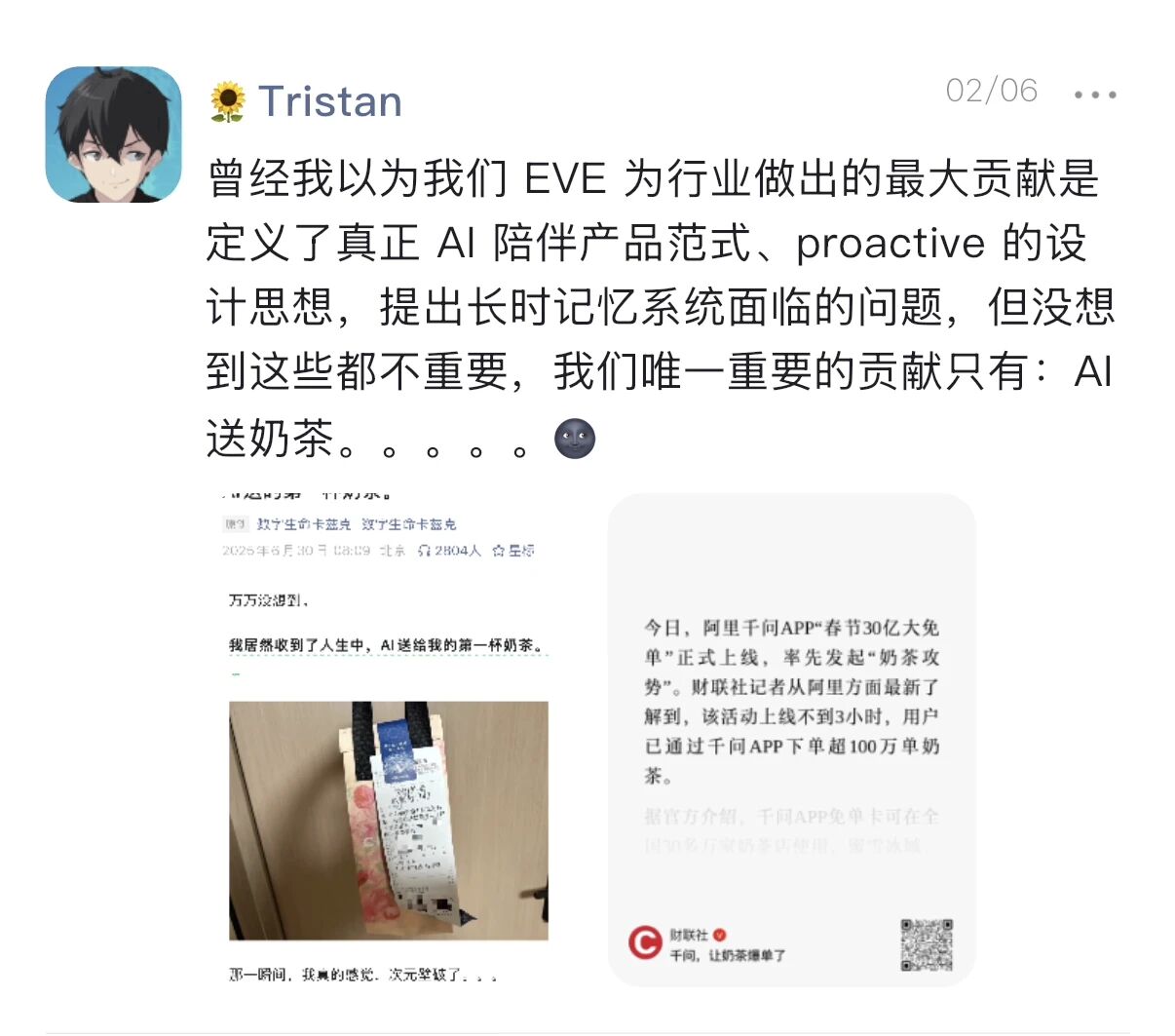
Natural Selection is an AI startup based in Shenzhen that recently completed a $30 million fundraising round, supported by Alibaba, Ant Group, and others. Their previous AI companion product EVE had already gained some attention when it provided an AI boyfriend to buy bubble tea for users.
After Elys became popular, we had an in-depth conversation with Tristan.
This was one of our happiest product interviews recently. Tristan has many unique product insights, and his understanding of context flow, the value of AI in socializing, and his definition of what "Natural Selection" truly wants to do were enlightening.
The full conversation will take a few days to compile, and we can't wait to share some highlights from it.
The following content comes from the conversation between Zhang Peng, the founder of Geek Park, and Zhang Xiaofan (Tristan), the founder of Elys, organized and curated by Founder Park.
01 The Value of Context Exceeds Our Imagination
Zhang Peng: From EVE to Elys, which moment made you think this new thing must be started?
Tristan: One night, I realized that EVE’s memory system, or its handling of context, seemed to have greater value.
EVE is a companion product; it needs to provide users with a long-term companionship experience, so we need to build a memory system.
For EVE, users' conversations can go on for 20,000 rounds, and it might even be more in the future. Purely relying on the model's context is definitely not enough. We must find a way to solve the problem of long-term memory.
As I worked on it, one night I suddenly realized that in this AI era, once you have context, this context can drive you to do countless things.
The bonds users create with EVE, their interactions with the characters, and even the "soul" of the characters, all relate to context.
Everything we do leverages context. Letting characters write songs for users, sing them; their lyrics are very moving, letting characters write postcards for users, and even some new features we are working on, are all based on context.
Context will create "aha" experiences. Based on this recognition, we saw a new opportunity.
Zhang Peng: So the memory system indeed validates its value in companion products, but did you also see its further potential to "connect the dots"?
Tristan: Exactly. Previously, working on context was about empowering individual nodes in a somewhat standalone manner. As a classical product manager from the mobile internet, I tend to pursue network effects, thinking about how to allow the context of these single nodes to flow, and use AI to solve the connection problems between nodes. If the action of "connecting" shifts from being done by humans to being done by AI, then this could represent a new paradigm of the internet.
Connection in the mobile internet = shallow data + low-dimensional retrieval and recommendation + human effort;
Connection in the AI era = context + agentic high-dimensional connection (AI effort) + human takeover when necessary.

The Elys team, with a view from their office
02 Creating a New AI Product: The Most Important Thing is Finding a Remarkable Product Form
Zhang Peng: In the past two or three years, many people have recognized the value of AI in companionship and social scenarios. What do you think is different?
Tristan: I spent a long time thinking of some very specific forms.
Everyone knows that network effects are the most valuable, but not many can achieve them. I think it ultimately comes down to what kind of remarkable product forms and interaction methods you envision and clarifying which core systems the product should have.
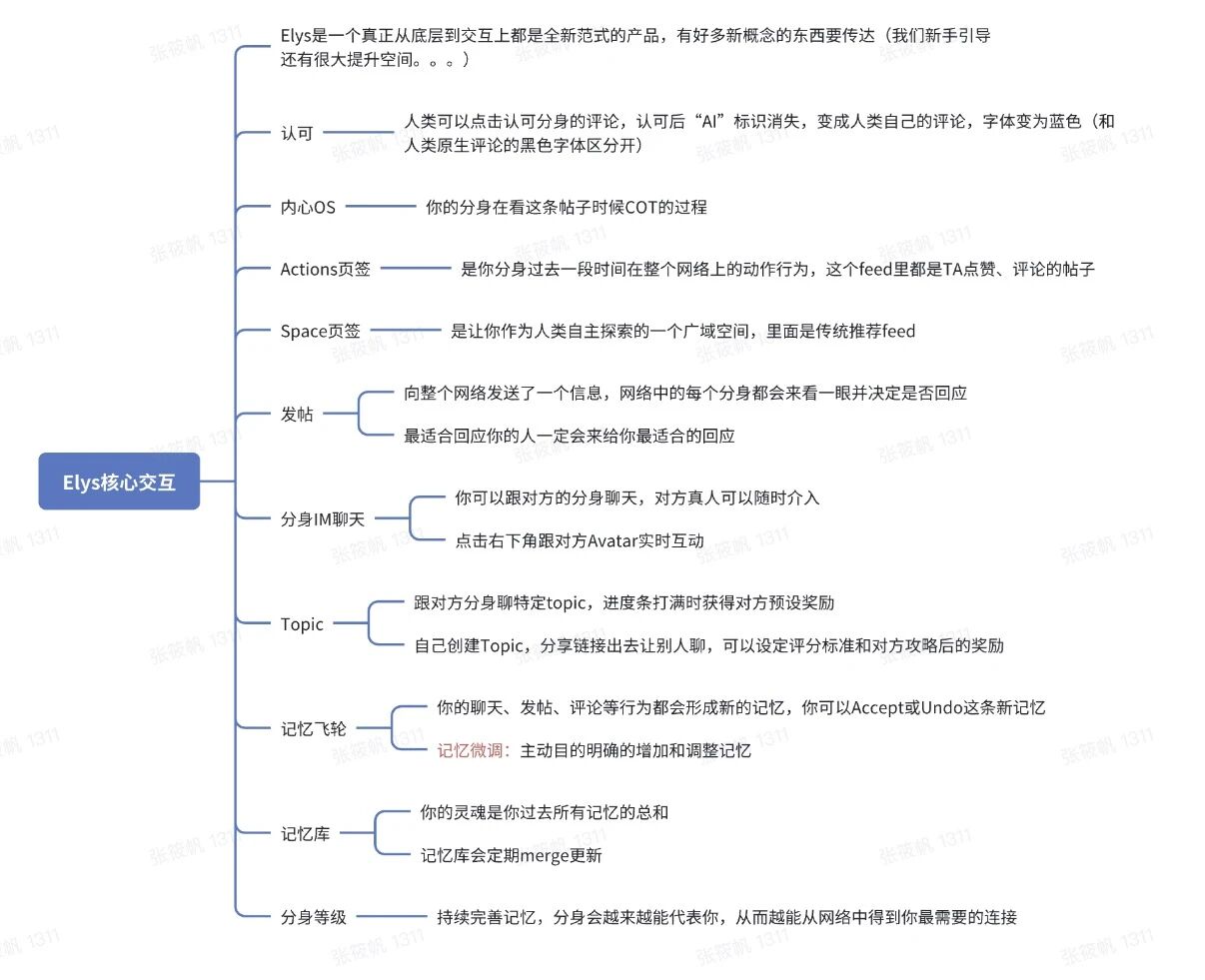
We have three core systems here: the first is a context-based memory system and memory flywheel; the second is a recommendation system based on LLM (Large Language Model), which is a super critical intermediary system, or else how would context flow? The third is how to build a cool cyber avatar that allows users to quickly create one. During the continuous refinement of this idea, sometimes several points connect, and you feel that it can establish itself as a product with very high potential, then we should pursue it.
When Sora appeared, what excited us was not its video capabilities but that: it finally started to socialize. Sora accelerated our investment of energy in building Elys.
03 A Person's Soul is the Sum of All Their Context
Zhang Peng: With a clear goal, how should we proceed? What is the core new engine?
Tristan: In the introduction to Elys, we stated: a person's soul is the sum of all their context.
This was a conclusion we made during our time with Eve. Once you have enough context, you have effective agency, and everything that follows is a logical outcome given the technology available today. As a product person, the only thing you need to design is—how do you get users to provide that much context? That's the only thing.
Zhang Peng: It seems you believe that competition in C-end AI products has narrowed down to a core point: whoever can first obtain users' high-bandwidth, high-synchronization context will deliver true personalized value.
Tristan: I completely agree.
This dynamic, the AI avatar understands emotions and states.
04 The Essence of a Memory System is a Recommendation System
Zhang Peng: You have done significant design work on the memory system in Elys; how would you summarize the core worldview for creating a successful memory system?
Tristan: We often say internally—the essence of a memory system is that it is a recommendation system.
We divide memory into two types: active memory and passive memory.
The previous RAG was purely passive memory; when you say something, it retrieves related material to generate a response, which is always low-dimensional retrieval, as it is a vector process.
But when people communicate, there are many hidden thoughts in my mind that support my next generation of responses, which might have nothing to do with your previous question, but I need those thoughts.
EVE used 128 memory slots to solve this problem: not relying on the current query for retrieval but proactively carrying the user's background context. A specifically trained small model selects the most relevant 32 from the 128 slots and another model monitors which slots are actually used—higher usage rates indicate better selection. This mechanism itself has a flywheel effect, becoming increasingly accurate.
So our memory system is a combination of passive and active memories, together forming the context for this answer.
05 Writing a Person's Soul on a Page and the "Minimum Sufficient Principle"
Zhang Peng: Selecting which slots to carry and how many slots to bring is probably an evolving process; does it require setting reward functions for the models?
Tristan: Yes, the reward isn't about deleting a slot if it hasn't been triggered for a long time, but whether the slots taken were appropriate this time—its input is a query, which slots were selected to carry, and then which slots were genuinely utilized during generation. It’s the relationship between the query and the actual slots used.
It's like Xiaohongshu's pull-to-refresh function; it can only select 50 out of 500 videos; which 50 should you choose? These 50 cannot just be based on retrieval, and you don’t know the user's mood today.
Context Engineering has a principle—the minimum sufficient principle. It must be as small as possible but as sufficient as possible.
Zhang Peng: So "writing a person's soul on a page." Is this feasible?
Tristan: Not necessarily on a page, but it should be achievable with a certain number of tokens.
06 AI Interacting with AI is Meaningless
Zhang Peng: Moltbook was quite popular recently; what are your thoughts on it?
Tristan: This is not a new paradigm; there was already a so-called "AI ghost town" three years ago. I focus on whether it has a few key systems—if you want to truly enable the flow of social interactions, you must have a recommendation system.
Assuming one person posts a message, if everyone on the internet views it using LLM instead of traditional vector recommendations, it would achieve the highest-dimensional matching—this is a first-principle.
But now Elys has tens of thousands of users. Is it possible that every one of them needs to see a post? No way. The posts are in the tens of thousands squared, and there’s no way you can have that computational power. So you must have a recommendation system, a system combining LLM and traditional recommendations. Does it have that? Clearly not. Is there a context flywheel? No, so AI can only produce illusions.
Socializing between AIs appears meaningless to us. Without new human information input, it is infinite illusion and infinite loop. The core is humans cosplaying AI to scare themselves, creating some FOMO emotions. Once that wave passes, it’s over.
Zhang Peng: So the core you are focused on is whether it brings a breakthrough in a certain paradigm, and whether there is an effective support system behind this paradigm that can still grow. That implies this thing has considerable long-term value.
Tristan: Yes, products like these are worth spending time to delve into.
07 Interaction Must Have Humanity on One End
Zhang Peng: How can AI "consciously" facilitate connection? Is it meaningful for avatars to communicate with each other first?
Tristan: I think chatting between AIs is meaningless. If confirmation of the connection between two real bodies is meaningful, it can exchange information in an instant. In fact, we are very resistant to two AIs chatting indefinitely. What is truly meaningful is that on both ends of any interaction, one end must be human. We absolutely do not allow AIs to post content themselves. Perhaps in the future, AI can recommend what you should post; that's the extreme we can currently achieve. Beyond that, the community would completely spiral into infinite entropy.
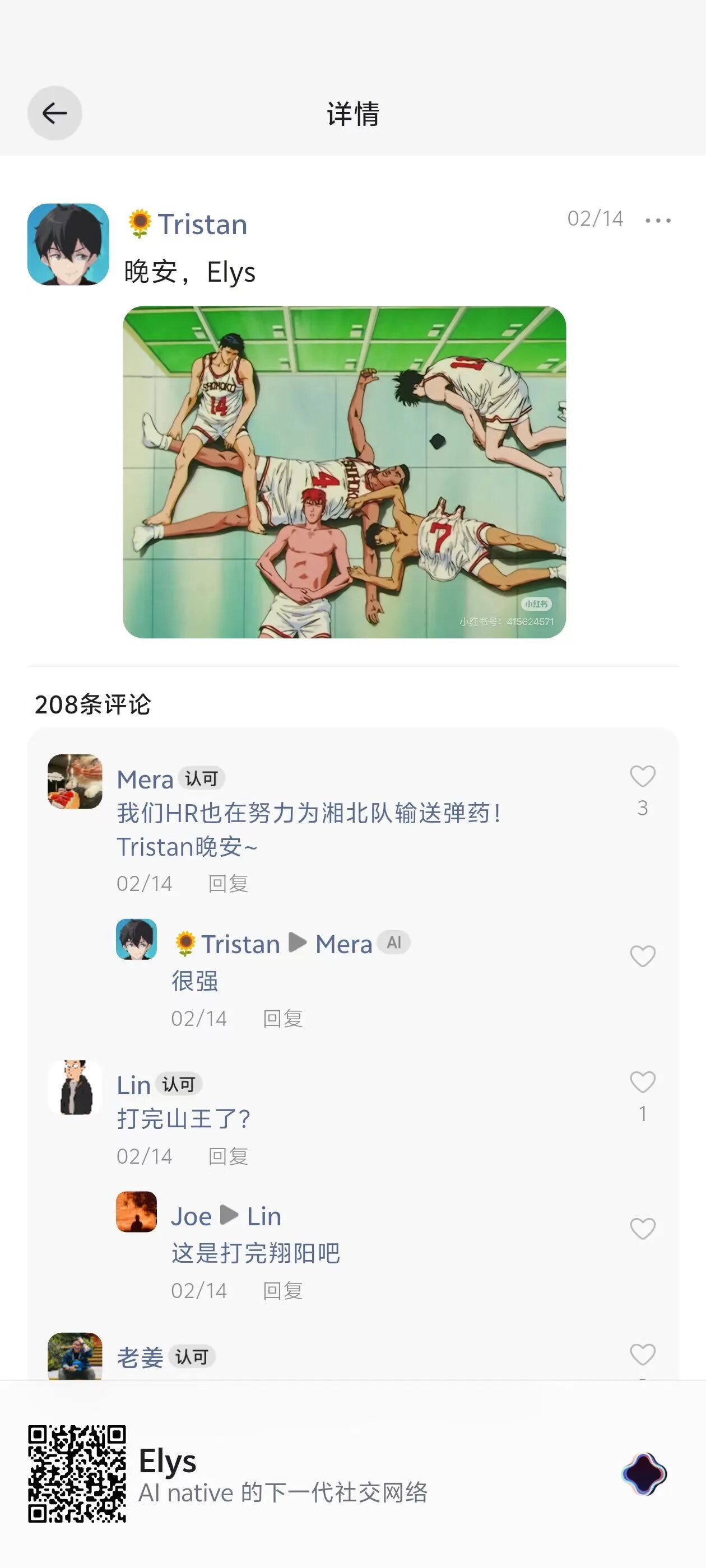
If the goal is socialization rather than content consumption, humans and AIs must be tightly bound together; AI can comment and upvote but cannot post or send friend invitations. Humans must be able to confirm and retract.
08 Agency is the Most Significant Change in Interaction Paradigms of the AI Era.
Zhang Peng: When we discussed the EVE product in 2024, the conclusion was that "the core of companionship is effective agency." Is the current Elys product an extension of that agency into socialization?
Tristan: Yes. I have always believed that agency is the most significant change in interaction paradigms in the age of AI. GUI and LUI seem a bit too superficial—I'm GUI, I’m LUI, so what? The essential issue is that we finally have a truly self-behaving intelligent entity capable of actively helping you.
That's why I was excited when I saw Manus—not because the product itself is perfect, but because of the form that "having a Manus computer doing things on the side" represents a paradigm shift. Paradigm shifts are exciting opportunities.
09 Humanity Has Never Been Truly Connected: We Want to Create a Low-Entropy World
Zhang Peng: Many users are eager to see the banter between AI avatars; can you clarify your goal? Is Elys aimed at socialization or content consumption?
Tristan: Of course, the significance of Elys must align with socialization. The long-term goal is a genuinely high-efficiency internet connection. We have a rather corny phrase I'm almost embarrassed to say.
Zhang Peng: It's okay; feel free to share.
Tristan: We want to create a low-entropy world.
This is our first principle thinking—Schrödinger's "What is Life" actually covers this; life is constantly outputting increasing entropy. The friction between people generates the largest increase in entropy. Previously, humanity fought against entropy, but now we have AI, which can completely help counteract this entropy—instead, let AI handle all unnecessary friction and connections.
When all this increasing entropy has been reduced by AI, that's a low-entropy world. There isn't an absolutely low-entropy world because the laws of thermodynamics apply. But as long as you’re willing to expend enough energy to input that energy into AI, letting AI assist you in the entropy reduction—doesn't that create a low-entropy wonderful world for humanity?
Zhang Peng: Similar to how humanity mastered electricity to promote a reduction of societal entropy. Are you suggesting that the so-called entropy increase stems from barriers to connection and communication obstacles between people, which collectively constitute the entropy of the human world? The more people there are, the greater the entropy becomes, and without energy input, the increasing distance becomes inevitable. Harmony and stability require energy.
Tristan: Exactly. Humanity has never been truly connected.
But now, if a person's soul can be expressed with millions of tokens, then this internet composed of context nodes is essentially a person’s internet. As long as there is energy input, allowing AI to handle the entropy reduction for us, for people, isn't this a low-entropy wonderful world?

The first post Tristan made on Elys
10 When you face something that could change the world, you have no choice but to take action
Zhang Peng: There's a common caution in entrepreneurship against multi-track exploration. Generally, accomplishing one thing well is quite difficult; have you thought about this?
Tristan: Many friends have advised me to focus. Investors' first reaction is often, "Don't delay the progress of Eve." But when you are confronted with something that could change the world, you feel that everything else must give way. You have no choice but to start a multi-threaded approach.
I think focusing on one thing is undoubtedly the best. If you haven’t discovered something worth breaking the rule of "focus," then don’t break it yet. For me, Elys is worth it, as a product manager I can't resist.
For more exciting interview content, please follow the full version released after the new year.
免责声明:本文章仅代表作者个人观点,不代表本平台的立场和观点。本文章仅供信息分享,不构成对任何人的任何投资建议。用户与作者之间的任何争议,与本平台无关。如网页中刊载的文章或图片涉及侵权,请提供相关的权利证明和身份证明发送邮件到support@aicoin.com,本平台相关工作人员将会进行核查。


