Contrary to early speculation, no full acquisition took place. OpenAI did not buy Openclaw. Instead, Peter Steinberger, the project’s creator, is heading to OpenAI to focus on advancing personal AI agents, while Openclaw transitions into an independent foundation that will continue operating as an open-source project with OpenAI’s backing.
The announcement, made Feb. 15, 2026, first made public by OpenAI CEO Sam Altman on X, frames the move as a talent-driven alignment rather than a corporate takeover. Financial terms were not disclosed, and Openclaw will remain MIT-licensed and community-driven.
For a project that launched in November 2025 and rapidly amassed more than 180,000 Github stars, the shift is significant. It has been one of the fastest-growing projects ever. Openclaw’s appeal stemmed from its ability to function as an autonomous AI agent running on personal devices, integrating with messaging platforms such as Whatsapp, Telegram, Slack, and Discord, and handling real-world tasks without constant supervision.
At its core, Openclaw leverages large language models (LLMs) such as Anthropic’s Claude Opus and OpenAI’s GPT Codex and several others to manage inboxes, execute shell commands, automate browser actions, and schedule tasks via a “heartbeat” system that wakes the agent proactively. That proactive design distinguishes it from passive chat interfaces and positions it as a true agent capable of multi-step reasoning.
The project’s ascent was not frictionless. It endured rebranding turmoil, security concerns and reported monthly losses between $10,000 and $20,000, according to statements from Steinberger during a Lex Fridman interview. During a trademark dispute, scammers hijacked accounts and packages, forcing rapid defensive measures and nearly derailing the effort entirely.
Steinberger also fielded concrete acquisition offers from both OpenAI and Meta, with Meta CEO Mark Zuckerberg reportedly reaching out directly via Whatsapp to discuss model preferences and integration possibilities. Altman, meanwhile, emphasized compute access and long-term alignment, a factor that appears to have weighed heavily in the final decision.
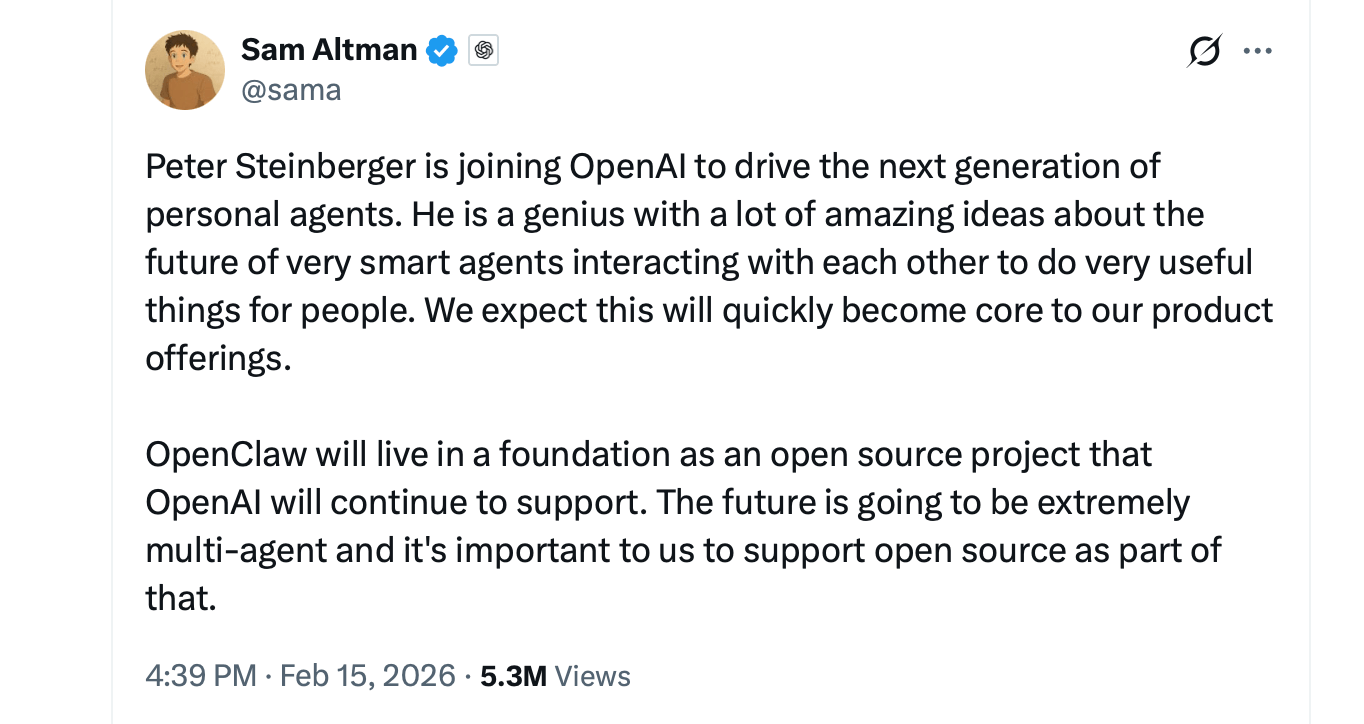
Community reactions have been mixed. Some developers view the move as validation and an opportunity to scale agentic systems within mainstream products such as ChatGPT. Others worry that deeper corporate entanglement could dilute the anarchic, community-first ethos that fueled Openclaw’s viral growth. Several commentators used the term “Closedclaw.”
The same day Steinberger’s move became public, Moonshot AI unveiled Kimi Claw, a browser-native, cloud-hosted implementation of the Openclaw framework integrated directly into kimi.com. The timing did not go unnoticed.
Kimi Claw runs on Moonshot’s Kimi K2.5 model and offers persistent, 24/7 agent functionality in a managed environment, complete with 40GB of cloud storage, access to more than 5,000 community skills, and real-time data integration. It also supports a “Bring Your Own Claw” model that allows users to link self-hosted instances into the cloud interface.
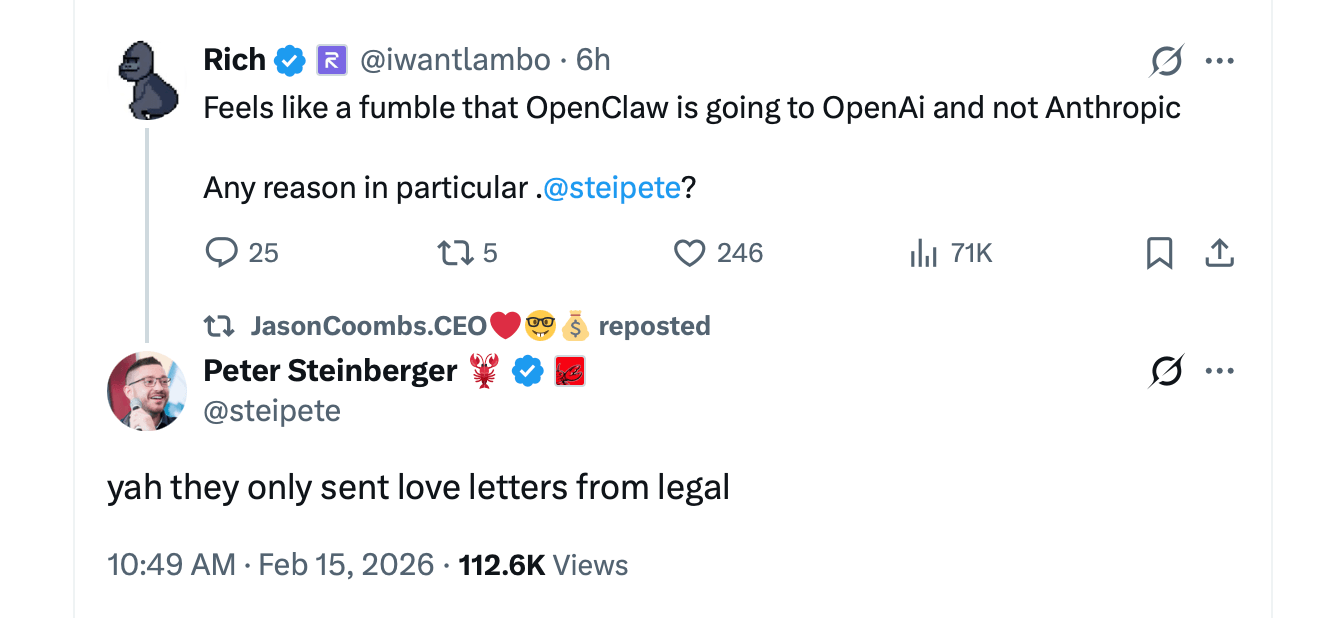
Anthropic got roasted for “dropping the ball” or “fumbling” the Openclaw play. Steinberger’s comment cut deep as he addressed the issue of when his project was first called “Clawdbot” and he had to change the name.
By shifting Openclaw’s architecture into a hosted browser tab, Moonshot aims to eliminate local setup friction — no Docker installs, no manual security configuration — while addressing vulnerabilities such as prompt injection and exposed API keys that have challenged self-hosted deployments. The trade-off, critics note, is data residency: as a Chinese-hosted service, Kimi Claw introduces geopolitical and privacy questions that are already circulating in Washington policy circles.
Essentially, the latest developments illustrate a broader strategic pivot in artificial intelligence (AI). The competition is no longer confined to model benchmarks. It is now about distribution, ecosystem control, and who owns the layer that automates everyday digital life. OpenAI is betting on talent integration and multi-agent system design. Moonshot is betting on cost efficiency and frictionless hosting. Openclaw’s foundation model sits between them — open, independent, and now more central to the agent conversation than ever.
The result is a three-way tension among open-source idealism, corporate scaling power and geopolitics. If personal AI agents are indeed the next interface layer, the decisions made in February 2026 may be remembered as an inflection point.
- What happened to OpenClaw?
OpenClaw was not acquired; it is becoming an independent foundation-backed open-source project with continued support from OpenAI. - Why is Peter Steinberger joining OpenAI?
He is joining to focus on advancing next-generation personal AI agents inside OpenAI’s broader product ecosystem. - What is Kimi Claw?
Kimi Claw is a browser-native, cloud-hosted version of the OpenClaw framework launched by Moonshot AI on Feb. 15, 2026. - Why is the launch of Kimi Claw significant?
It provides a managed, scalable alternative to self-hosted agents while raising new data privacy and geopolitical considerations.
免责声明:本文章仅代表作者个人观点,不代表本平台的立场和观点。本文章仅供信息分享,不构成对任何人的任何投资建议。用户与作者之间的任何争议,与本平台无关。如网页中刊载的文章或图片涉及侵权,请提供相关的权利证明和身份证明发送邮件到support@aicoin.com,本平台相关工作人员将会进行核查。


