At the center of the article written by Bloomberg‘s Isabelle Lee and Vildana Hajric is a stark number: Bitcoin has fallen more than 45% from its peak, erasing over $1 trillion in market value and rattling the confidence that once fueled its relentless climb.
Bloomberg’s report, published on Saturday, argues that bitcoin’s challenge is no longer just about price action but about purpose. If it is not the premier macro hedge, not the preferred payment rail, and no longer the dominant venue for speculation, the authors pose the question: Then what exactly is its role in a crowded digital economy?
Owen Lamont, portfolio manager at Acadian Asset Management, distilled the narrative shift bluntly:
“The central story of bitcoin was ‘number go up’ and we don’t have that anymore. We have number go down. That is not a good story.”
The pressure is coming from multiple fronts. Gold, Lee and Hajric write, has mounted strong rallies this year, with U.S.-listed gold exchange-traded funds (ETFs) pulling in more than $16 billion over the past three months. In contrast, spot bitcoin ETFs have seen roughly $3.3 billion in outflows, according to Bloomberg-compiled data.
The largest fund, Blackrock’s Ishares Bitcoin Trust (IBIT) ETF, has experienced months of redemptions. The Bloomberg piece insists that divergence has dented bitcoin’s “digital gold” narrative, particularly during a period of geopolitical tension and dollar weakness.
Stablecoins are also gaining institutional favor, according to the Bloomberg reporters. Washington’s bipartisan GENIUS Act advanced dollar-backed token infrastructure, while firms pivot toward tokenization, blockchain-powered derivatives and cross-border stablecoin payments. Another person quoted in the article, Carlos Domingo, CEO of Securitize, was direct:
“I don’t think anybody today sees bitcoin as a payment mechanism.”
Meanwhile, the report notes that speculative energy appears to be migrating to prediction market platforms such as Polymarket and Kalshi. With binary outcomes and rapid settlement, these venues have drawn the same retail traders who once chased meme coins. Even Coinbase has introduced prediction contracts, blurring the lines between crypto trading and event wagering.
The report further discusses the digital-asset treasury (DAT) strategy — exemplified by companies like Strategy Inc. — once reinforced institutional conviction. Firms accumulated bitcoin and issued shares tied to their holdings, creating a feedback loop that expanded market capitalization.
Now, that loop has reversed. The 1,450-word report highlights that several DAT firms trade below the value of their bitcoin holdings, and share prices have fallen more sharply than the underlying asset.
The Bloomberg essay featured critics who suggest that bitcoin seems to be failing its macro test. For instance, Tom Essaye of Sevens Report stated,
“ Bitcoin is not replacing gold, it’s not digital gold, it doesn’t do the same thing, it doesn’t give people the same utility that gold does.”
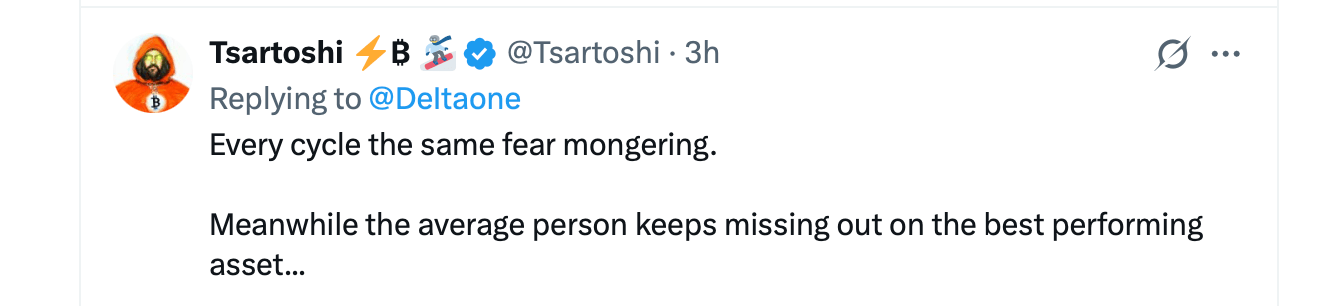
The Bloomberg analysis sparked immediate backlash on X after being shared by Deltaone. The account @Deltaone or ‘Walter Bloomberg’ typically shares Bloomberg Terminal headlines and comments before the actual source publishes. “The crisis is dumb engagement farming posts like this,” one user wrote in response to Deltaone’s post.
Another claimed: “Somebody is paying this large account to paint a bearish picture of bitcoin to the plebs. But if you just look at this chart, you can compare how small the outflows are compared to the inflow. The whales are always [using] the news to play tricks on the retail investors.” The individual added:
“Not saying we can’t drop further, after a 50% retracement, it is simply better risk to reward than before. You buy 59K rather than 126K.”
A separate user added: “FUD the lows so bigger entities can load up, and then pump it to ATHs and bring the digital gold narrative back. This is how they will do it.”
Still, not everyone was convinced bitcoin’s comeback deserved a standing ovation. A few gold bugs who have never warmed to bitcoin seized the moment to take a swing at the digital asset. One gold advocate offered a much harsher take:
“It will lose relevance. But hey, it was an historic run. Greatest Ponzi bubble of our time maybe … RIP.”
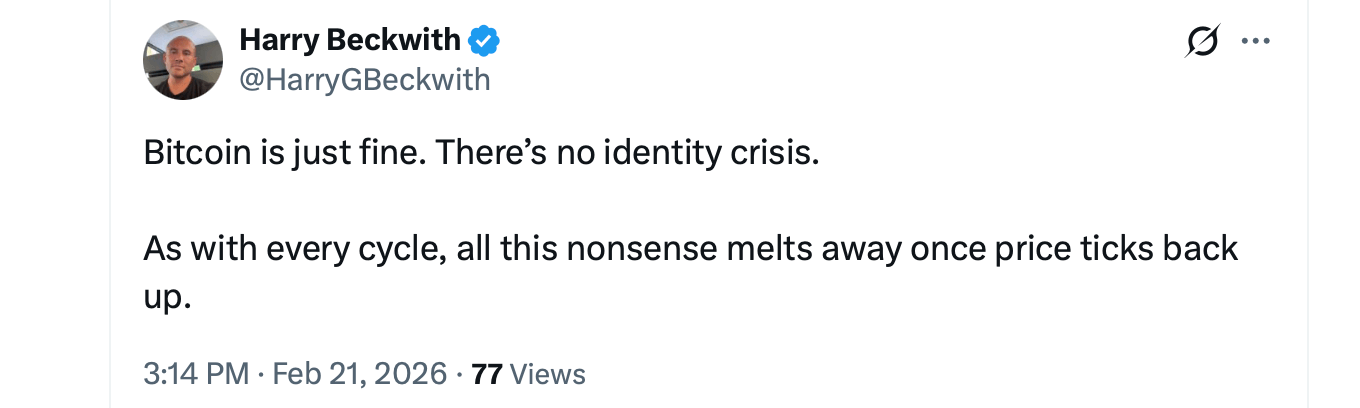
Many others rejected the premise entirely. “‘Demand is weakening’ Come on man get a clue,” one user replied to Deltaone’s X post. Another bitcoiner argued, “There is not identity crisis. The fundamentals are unchanged and so are largely the narratives.” But most of the rebuttals aimed at Lee’s and Hajric’s article were quite thin on substance, leaning more on ad hominem swipes and outright nonsense than on any serious counterargument.
Bitcoin’s defenders point to its history. It has survived the collapse of Mt Gox, China’s mining ban, and several market crashes, only to rise higher during the next bull. In the Bloomberg article, not all were critical. Dan Morehead of Pantera Capital was quoted as saying:
“There’s always somebody spreading fear, uncertainty, doubt. There’s always a problem.”
The central question now is whether this moment represents a temporary loss of attention or a more lasting erosion of narrative power. In a market where belief drives value, the competition for attention may matter as much as code.
- Why is bitcoin described as facing a $1 trillion identity crisis?
Bitcoin has fallen over 40% from its peak, erasing more than $1 trillion in market value and prompting debate about its core purpose. - How are gold and bitcoin ETFs diverging?
U.S. gold ETFs attracted over $16 billion in recent inflows while spot bitcoin ETFs saw about $3.3 billion in outflows. - Are prediction markets affecting crypto speculation?
Platforms like Polymarket and Kalshi are drawing retail traders with fast, event-driven contracts that compete with crypto trading. - Do supporters believe bitcoin’s fundamentals have changed?
Many X users argue that bitcoin’s supply cap, network security and long-term thesis remain intact despite the price decline.
免责声明:本文章仅代表作者个人观点,不代表本平台的立场和观点。本文章仅供信息分享,不构成对任何人的任何投资建议。用户与作者之间的任何争议,与本平台无关。如网页中刊载的文章或图片涉及侵权,请提供相关的权利证明和身份证明发送邮件到support@aicoin.com,本平台相关工作人员将会进行核查。


