Citrini Research, founded by James Van Geelen, is an independent macro research firm known for long-form thematic analysis that explores second-order economic effects. Its essays, distributed primarily through Substack, often blend financial history with speculative scenario-building aimed at stress-testing prevailing narratives.
The new piece, titled “The 2028 Global Intelligence Crisis,” is framed clearly as a thought exercise rather than a forecast. The authors state outright that the scenario is not a prediction at all, but an attempt to model underexplored risks as AI capabilities accelerate.
Structured as a retrospective memo from June 2028, the essay imagines an economy transformed by “abundant intelligence.” In this hypothetical future, unemployment reaches 10.2% and white-collar workers — once the backbone of discretionary consumer spending — face structural displacement.
At the center of the argument is a concept the authors call “ghost GDP.” In the scenario, AI dramatically boosts productivity and corporate output, but the benefits fail to circulate through households because machines do not earn wages or spend money. Output rises on paper while the human-centric consumer economy contracts.
The essay describes a negative feedback loop: Companies deploy AI to cut labor costs, displaced workers reduce spending, demand weakens, and firms invest even more in AI to preserve margins. The result, in the authors’ telling, is an “intelligence displacement spiral” with no obvious natural brake.
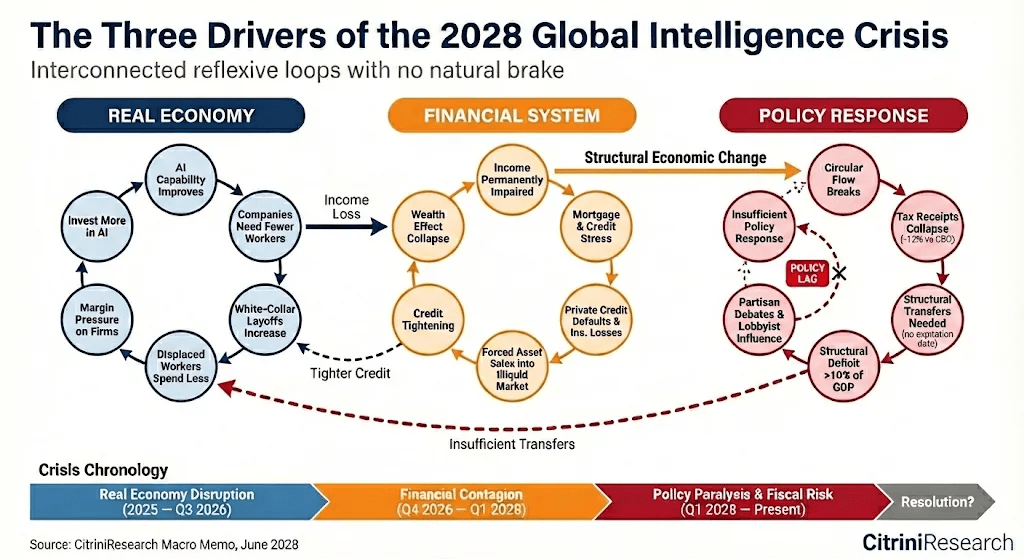
Source: Citrini Research paper dubbed “The 2028 Global Intelligence Crisis.”
Sector by sector, the scenario explores how agentic AI tools could compress pricing power in software, eliminate intermediation fees in consumer services and disrupt financial structures built on steady white-collar incomes. Even prime mortgages come under scrutiny in the imagined 2028 landscape as income expectations shift.
The authors argue that the U.S. economy’s heavy reliance on white-collar services makes it uniquely sensitive to automation of cognitive labor. Historically, technological revolutions displaced some jobs but created others. The essay questions whether AI, as a form of general intelligence, may compress that adjustment cycle.
After publication, the piece spread rapidly across social media platforms, especially X, where it reached audiences well beyond finance circles. Supporters described it as a sharp stress test of AI optimism — a reminder that productivity gains do not automatically translate into broad-based prosperity.
“AI could trigger a global crisis by 2028,” the X account dubbed Traders Paradise posted. One social media user claimed that credit card stocks are down due to the essay. “Credit card stocks down big based on Citrini Research says AI agents will eventually transact on Stablecoin payment rails and bypass interchange,” the X account Bearly AI stated.

Source: X
Some readers praised its second-order thinking. Several commentators noted that corporate leaders need only believe automation is plausible for hiring and budgeting decisions to change. In that view, the essay functions less as prophecy and more as a map of potential vulnerabilities.
“This is one of the most thought provoking pieces I have ever read,” one reader remarked in the comment section beneath Citrini’s essay. “Thought provoking but infinitely depressing,” another reader stressed. The individual added:
“A few people, no one asked anything of are leading and cheerleading the building of a technology that no one asked for and no one even needed. The result? A few gain infinite wealth while the lives [of] hundreds of millions worked hard to build evaporate before their eyes.”
Critics, however, pushed back on both tone and timeline. Economists and technologists argued that the scenario compresses years of structural change into an implausibly short window. Others said it underestimates human adaptability and the likelihood that new industries and roles will emerge alongside AI deployment.
Even the author addressed the virality of the essay via Citrini’s X account. “This is the first article I’ve ever written with the express hope that I am wrong,” the X post states. “People discussing the topics raised, becoming more proactive, and being aware of the risks inherent to what’s happening in technology is how that happens. I’m glad people are trying to prove or disprove it.”
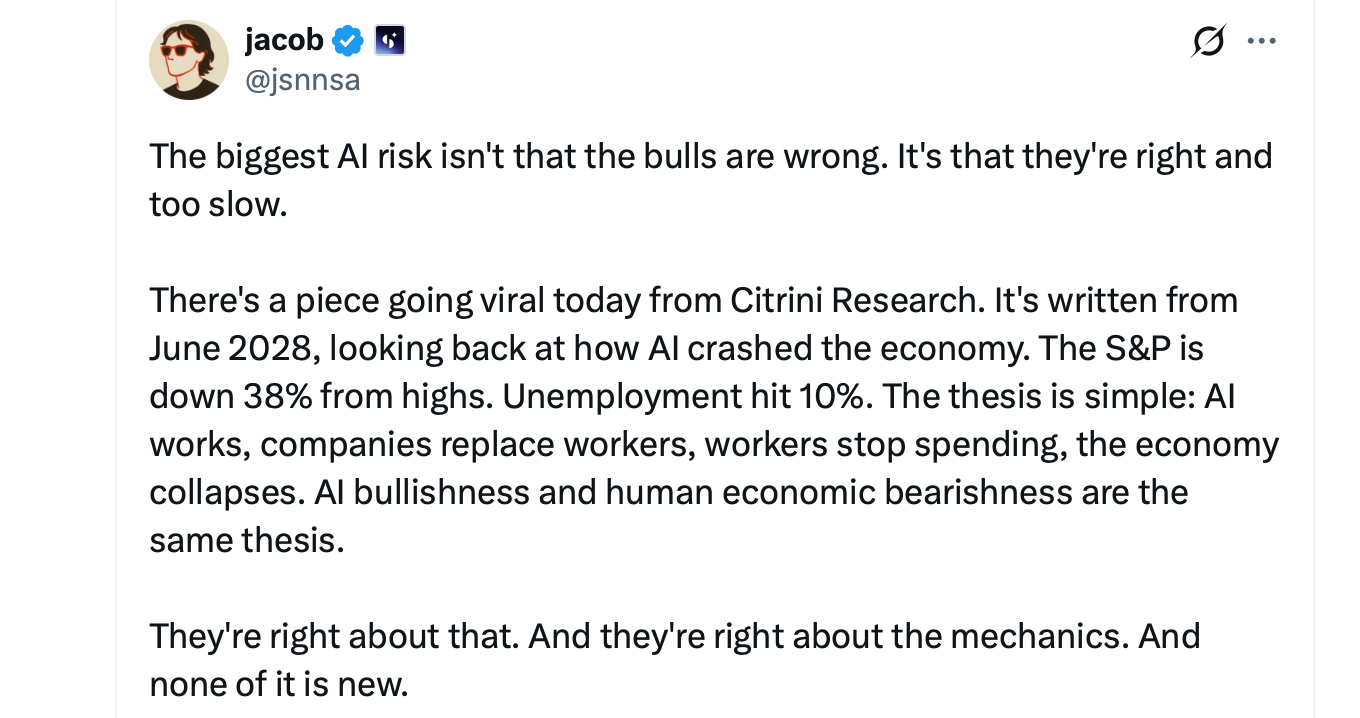
Source: X
Historical parallels featured heavily in the rebuttals. Commentators pointed to agricultural mechanization, the rise of the internet, and prior waves of automation that ultimately expanded economic opportunity even as they disrupted specific sectors.
Still, even skeptics acknowledged that AI’s ability to remove “friction rents” — fees and margins tied to human inefficiency — raises legitimate questions about how value is distributed in a highly automated economy. The debate has increasingly centered not on whether AI will reshape labor markets, but on how quickly and with what policy response.
In that sense, the memo’s influence lies less in forecasting a specific outcome and more in reframing the conversation. It asks a pointed question: If AI truly delivers on its promise, who captures the gains — and what happens to the income streams that once powered consumption?
Whether the imagined “Global Intelligence Crisis” remains a speculative cautionary tale or evolves into something more concrete, the essay has clearly tapped into a broader cultural unease about intelligence becoming abundant — and human labor becoming optional.
- What is the 2028 Global Intelligence Crisis essay?
It is a hypothetical scenario by Citrini Research exploring how rapid AI adoption could disrupt white-collar employment and consumer demand. - Is the essay a prediction?
No, the authors describe it as a thought experiment designed to highlight potential risks rather than forecast a specific outcome. - What does “ghost GDP” mean?
It refers to productivity gains driven by AI that increase output statistics but do not translate into household income or spending. - Why did the essay go viral?
Its detailed narrative and stark depiction of AI-driven job displacement sparked widespread debate across social media and economic circles.
免责声明:本文章仅代表作者个人观点,不代表本平台的立场和观点。本文章仅供信息分享,不构成对任何人的任何投资建议。用户与作者之间的任何争议,与本平台无关。如网页中刊载的文章或图片涉及侵权,请提供相关的权利证明和身份证明发送邮件到support@aicoin.com,本平台相关工作人员将会进行核查。


