A wave of panic has swept through the global capital markets, originating from a "future" scenario. A report that was originally obscure has sparked a sell-off storm comparable to a real crisis, having struck a sensitive nerve in the market this past weekend.
When report co-author Alap Shah appeared this week and admitted that "the market response far exceeded expectations," this AI narrative-driven financial shock had quietly split into two distinct paths: one with a bloodbath in software stocks and the white-collar economy, and the other with a new narrative around chip stocks and Bitcoin.
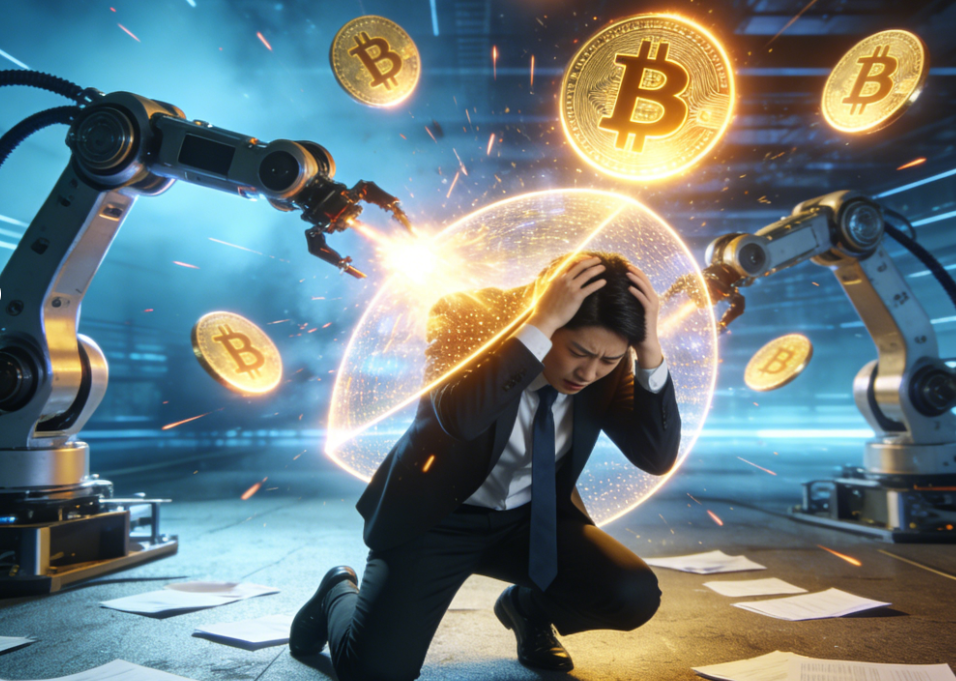
1. A “Letter of Warning” from 2028: Ghost GDP and a Tsunami of Unemployment
● The source of this storm is a scenario report titled "Global Intelligent Crisis of 2028." It is not a dull data forecast, but a "letter of warning" written from the perspective of June 2028. The report depicts a counterintuitive and horrific future: AI did not disappoint; rather, it exceeded expectations.
● In this hypothetical 2028, AI agents have massively replaced white-collar jobs, leading to skyrocketing corporate profits, while human workers' purchasing power collapses due to a wave of unemployment.
○ A concept called “Ghost GDP” emerges—where national accounts show dazzling outputs created by machines, but this wealth does not flow into the consumption cycle of the real economy like a ghost.
○ The report warns that this “high productivity, low circulation of money” vicious cycle will lead to unemployment rising to 10.2% and ultimately drag the S&P 500 index down 38% from its peak.
● This is not alarmism, but a strict negative feedback logic: the stronger the AI capabilities → the fewer people companies hire → the more layoffs in white-collar jobs → the weaker total consumer demand → the more the economy relies on AI → further layoffs. As Shah put it, this is a vicious cycle with “no natural braking mechanism.”
2. The Market Votes with Its Feet: From IBM to Visa, No One is Immune
● Although the report clearly notes that "the following content is a hypothetical scenario," the market chose to "fire first and ask questions later." On February 23 (Monday), US stocks opened in panic.
● The Blue Giant IBM became the main target, with its stock price plunging 13% in a single day, marking the largest single-day drop in 25 years. The trigger was not only the report but also the Claude Code tool released by AI company Anthropic—capable of upgrading COBOL language software still heavily relied upon by many governments and major banks that use IBM systems. This means even the oldest code fortresses are being breached by AI.
● Panic quickly spread.
○ Software ETFs (IGV) saw a significant decline, with a cumulative drop of about 35% from its peak in September last year.
○ Even more shockingly, payment giants were not spared: Visa fell 4.5%, MasterCard fell 5.77%, and American Express dropped more than 7%.
● The logic of the Citrini report targets the core of their business models—AI agents can save users money by eliminating transaction fees, thereby disrupting the entire payment industry. Companies like American Express, KKR, Blackstone, which rely on intermediary services and disposable income, all suffered severe blows.
3. The Proposal for an “AI Tax”: Building a Firewall for the Tsunami of Unemployment?
In the face of potential social fractures caused by technological advancements, Alap Shah proposed a controversial remedy—levying an “AI tax”.
● In an interview with Bloomberg, this chief investment officer called on the government to consider taxing the incremental or unexpected gains brought by AI to offset the impact of labor displacement and protect the most vulnerable consumer demand.
○ His core concern is that the replacement of white-collar labor will create a terrible negative feedback loop: companies will lay off workers to boost profit margins, reinvesting the saved funds into more advanced AI, thereby driving the next round of layoffs. Ultimately, as the wave of unemployment erodes purchasing power, the entire “consumer economy” will face the risk of collapse.
● Shah warns that within the next 18 months, AI could lead to a 5% reduction in white-collar jobs in the United States, and the US, due to its more “dynamic” labor market (i.e., easier to fire), will be the most impacted frontier. He does not intend to hinder technological progress but seeks to install a societal buffer for this runaway train to prevent “Ghost GDP” from becoming reality.
4. Bitcoin's “Opportune Moment”: Will AI Agents Choose Digital Gold?
As humans worry about their jobs, a more intriguing question arises: if the future is an economy dominated by AI agents, what currency will they use? How will they store value?
● Simon Gerovich, CEO of publicly listed Metaplanet in Japan, provided a disruptive answer: Bitcoin. He believes that with the leap in productivity driven by AI, the global economy is moving towards an era of “machine-to-machine transactions.” AI agents will not have brand preferences when making financial decisions, nor will they rely on traditional bank accounts or high-friction credit card networks.
● “AI agents will prefer a digital asset system that is more efficient and frictionless,” Gerovich noted. In contrast, the 2% to 3% fees of traditional payment networks seem clumsy, while low-cost blockchain settlements are far more attractive.
● More importantly, when AIs need to store value, they won't deposit money into money market funds like humans do; instead, they will choose assets with anti-inflation properties, verifiable scarcity, and decentralized security models—strongly aligning with Bitcoin's value-storing logic.
● In a sense, if the assumptions of the Citrini report come true, a wave of mass unemployment prompting expectations of depreciating fiat currency, AI agents might actually become marginal buyers of Bitcoin, pushing it to become a core value-storing tool in a “machine economy”.
5. The Business of Fear: Who are the Real Winners and Losers?
This “AI apocalypse narrative”, while frightening to the market, also serves as a mirror reflecting the clear boundaries between winners and losers.
● Losers are evident: Any business model reliant on “headcount” fees. Software as a Service (SaaS) companies are at the forefront, as AI is forcing the value of coding to approach zero. Wealth management, insurance, process mediation, and other white-collar intensive industries are all being placed on the hot seat. Since the beginning of this year, the US software stock index has dropped 24%, and the sell-off is far from over.
● The winners are concentrated in Asia. Shah explicitly revealed his investment strategy: “We typically short those companies that will be disrupted by AI. On the other hand, we hold substantial semiconductor stocks, as we believe these companies will benefit.” Global capital is confirming this with action: shares of Asian chip giants like TSMC, SK Hynix, and Samsung Electronics are soaring, and the MSCI Asia-Pacific Index has had the strongest opening relative to US stocks in history.
● Famed “Black Swan” author Nassim Taleb warned that software companies could go bankrupt, while Michael Burry, the protagonist of “The Big Short”, shared this report, insinuating that the market has not yet priced in the worst scenarios. However, there are also calm voices; economist Claudia Sahm pointed out that the report underestimates policymakers' strong ability to intervene in the face of labor market crises.
● Tech investor Jason Calacanis further refuted with real data: Currently, running a single AI agent costs $300 daily and can only replace 10-20% of human labor, a cost far from the critical point of replacing human workers.
A “thought experiment” leading to a trillion-dollar sell-off demonstrates just how fragile the market's valuations and positions have become. Alap Shah’s warnings, Simon Gerovich’s visions, and the panic of global investors all point to an unavoidable future: AI is rewriting the underlying codes of the economy.
In this process, humanity needs safety valves like the “AI tax” and new paradigms like Bitcoin. The only certainty is that the turbulence has just begun.
Join our community, let's discuss and become stronger together!
Official Telegram community: https://t.me/aicoincn
AiCoin Chinese Twitter: https://x.com/AiCoinzh
OKX Welfare Group: https://aicoin.com/link/chat?cid=l61eM4owQ
Binance Welfare Group: https://aicoin.com/link/chat?cid=ynr7d1P6Z
免责声明:本文章仅代表作者个人观点,不代表本平台的立场和观点。本文章仅供信息分享,不构成对任何人的任何投资建议。用户与作者之间的任何争议,与本平台无关。如网页中刊载的文章或图片涉及侵权,请提供相关的权利证明和身份证明发送邮件到support@aicoin.com,本平台相关工作人员将会进行核查。


