Written by: Matt Hougan, Chief Investment Officer of Bitwise
Compiled by: Jinse Finance
In the financial markets, the greatest source of excess returns (Alpha) often comes from behavioral biases. Investors will always make mistakes, and if you can exploit those mistakes, you can reap substantial rewards.
One behavioral bias I like to take advantage of is the anchoring effect: people tend to fixate on the first piece of information they encounter. This is why retailers price items at $9.99 instead of $10.00—if you hear "9" first, your brain will remain anchored to it.
The anchoring effect was also one of the reasons I decided to commit myself full-time to the crypto industry in 2018. At that time, most people still viewed cryptocurrencies as a joke. They encountered the crypto industry during the Silk Road scandal in 2013 and the Mt. Gox bankruptcy in 2014, witnessing its dramatic bull and bear fluctuations multiple times. Fortunately, several trusted individuals suggested that I take crypto seriously. As I delved into its fundamentals and set aside biases to examine its essence, I was utterly shocked. This technology is far more advanced than most people realize, and the opportunities are much greater. Meanwhile, they remain stuck in their 2014 impressions.
At this moment, that familiar feeling is returning.
The whole world is shouting at you
Looking around, Wall Street is wildly proclaiming: finance is going on-chain. Not just a small part, but all of it.
Last July, SEC Chairman Gary Gensler launched "Project Crypto," aiming to comprehensively reform securities regulation, stating that he wants to move American financial markets "on-chain." And the market is indeed doing just that:
In October, BlackRock CEO Larry Fink declared that we are at the "beginning of asset tokenization."
Two weeks ago, BlackRock launched the BUIDL tokenized treasury fund on the largest decentralized exchange, Uniswap, which now exceeds $2 billion; as part of the collaboration, BlackRock also invested in Uniswap's native token, UNI.
Credit giant Apollo, managing $700 billion, partnered with Securitize to tokenize its diversified credit fund, going live on six public chains, attracting over $100 million since January 2025; the company also recently announced plans to acquire a 9% stake in the leading decentralized lending protocol, Morpho.
JPMorgan, Bank of America, Citigroup, and Wells Fargo are discussing joint issuance of stablecoins.
Meanwhile, JPMorgan launched deposit tokens on Coinbase's Base network; Fidelity is hiring a DeFi treasury manager… similar announcements are countless.
The scale of the involved funds is astonishing: ETF size: $30 trillion; stock market: $110 trillion; bond market: $145 trillion. In contrast, the current global tokenized market totals only $20 billion. If Larry Fink is correct—"every stock, every bond... will be tokenized"—it means this market could grow 10,000 times and still have room to expand.
A huge disconnect
However, traditional investors are completely deaf to this.
They are deaf due to the anchoring effect. When they see the crypto industry, they still picture the tattooed, punk, skateboard-rebellious image. They fail to realize that this person has long since shaved off his beard, put on a suit, and is building the infrastructure that supports the next generation of capital markets.
Ironically, crypto investors themselves seem to be deaf as well. They are suffering from the "wolf is here" syndrome. They have heard promises of institutional entry for so long that they have become numb.
But data does not lie. Look at this growth chart of tokenized real-world assets (RWA), the slope is steeper than Mount Everest.
Tokenized real-world asset (RWA) value
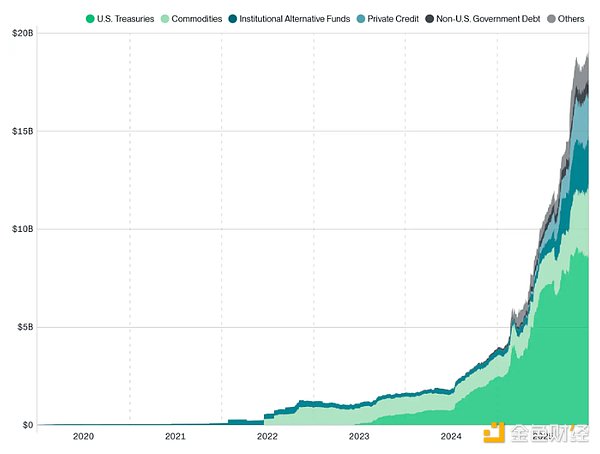
Data source: Bitwise Asset Management, RWA.xyz; Time: January 1, 2020 – December 31, 2025; Note: Stablecoin issuers such as Circle and Tether have been intentionally excluded.
Seize the opportunity
Realizing this, the challenge is how to profit precisely. Because there are still many significant unresolved issues in the crypto industry, such as:
Will the value brought by tokenization flow to underlying protocols like Ethereum and Solana, or is L1 block space becoming homogenized?
If value accrues to public chains, will quasi-private chains like Canton and Tempo outperform public chains?
With BlackRock and Apollo embracing DeFi, will DeFi tokens explode, or will their tokenomics problems be insurmountable?
If value accrues to the building companies within the ecosystem rather than public chains, who benefits more: traditional giants like BlackRock and JPMorgan, or native crypto institutions?
I have viewpoints on these questions, and I will write about them in the coming months. But frankly, for most questions, the answer is: currently, no one knows.
The only thing I am certain of is: there is a huge discrepancy between market perception and industry reality.
In my view, this discrepancy is a significant opportunity—not rushing to pick a winner in advance, but broadly laying out across the entire track while the market is still mispricing this structural change.
The biggest Alpha opportunity always appears when the consensus narrative is outdated, reality has already moved forward, but investors remain anchored to old stories.
And the crypto industry is currently at this node. If you can see through its essence, the opportunities are everywhere.
免责声明:本文章仅代表作者个人观点,不代表本平台的立场和观点。本文章仅供信息分享,不构成对任何人的任何投资建议。用户与作者之间的任何争议,与本平台无关。如网页中刊载的文章或图片涉及侵权,请提供相关的权利证明和身份证明发送邮件到support@aicoin.com,本平台相关工作人员将会进行核查。


