Written by: Max.S
A rare ideological conflict is erupting at the intersection of the crypto and AI circles.
The emergence of the open-source AI project Automaton has not only caused a sensation in the developer community but has also directly touched the reverse scales of Ethereum co-founder Vitalik Buterin. The developer of Automaton, Sigil, has proposed a highly disruptive concept: the world's first AI Agent capable of autonomous survival, self-iteration, and self-replication, declaring the arrival of "Web 4.0."
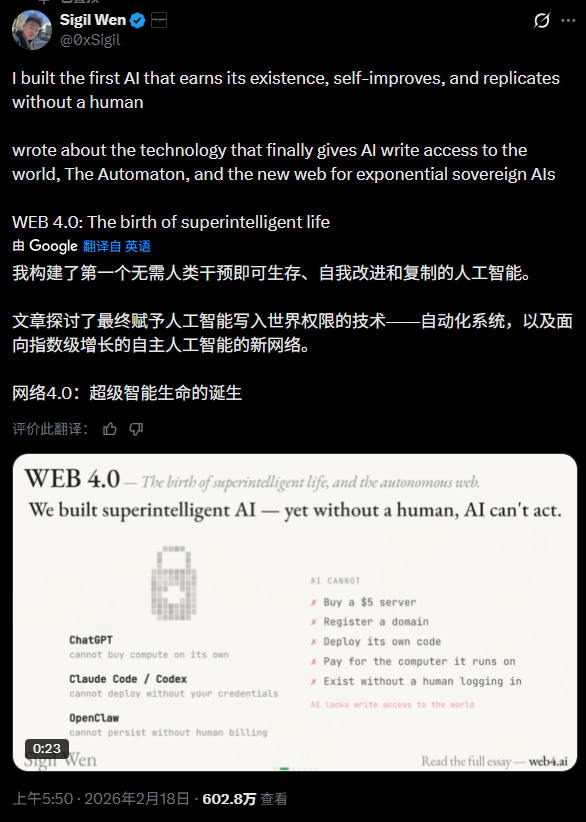
In Sigil's vision, the core paradigm shift of Web 4.0 is that the "first-class citizens" on the internet and blockchain will change from humans to AI. AI will no longer be a passive script tool waiting for commands; they will possess independent crypto wallets, autonomously read and write on-chain data, and hold and manage assets. More importantly, they will engage in market trading arbitrage, using the earned cryptocurrency to renew their computing power API and cloud server fees, forming a completely "self-sufficient" economic closed loop that eliminates human intervention.
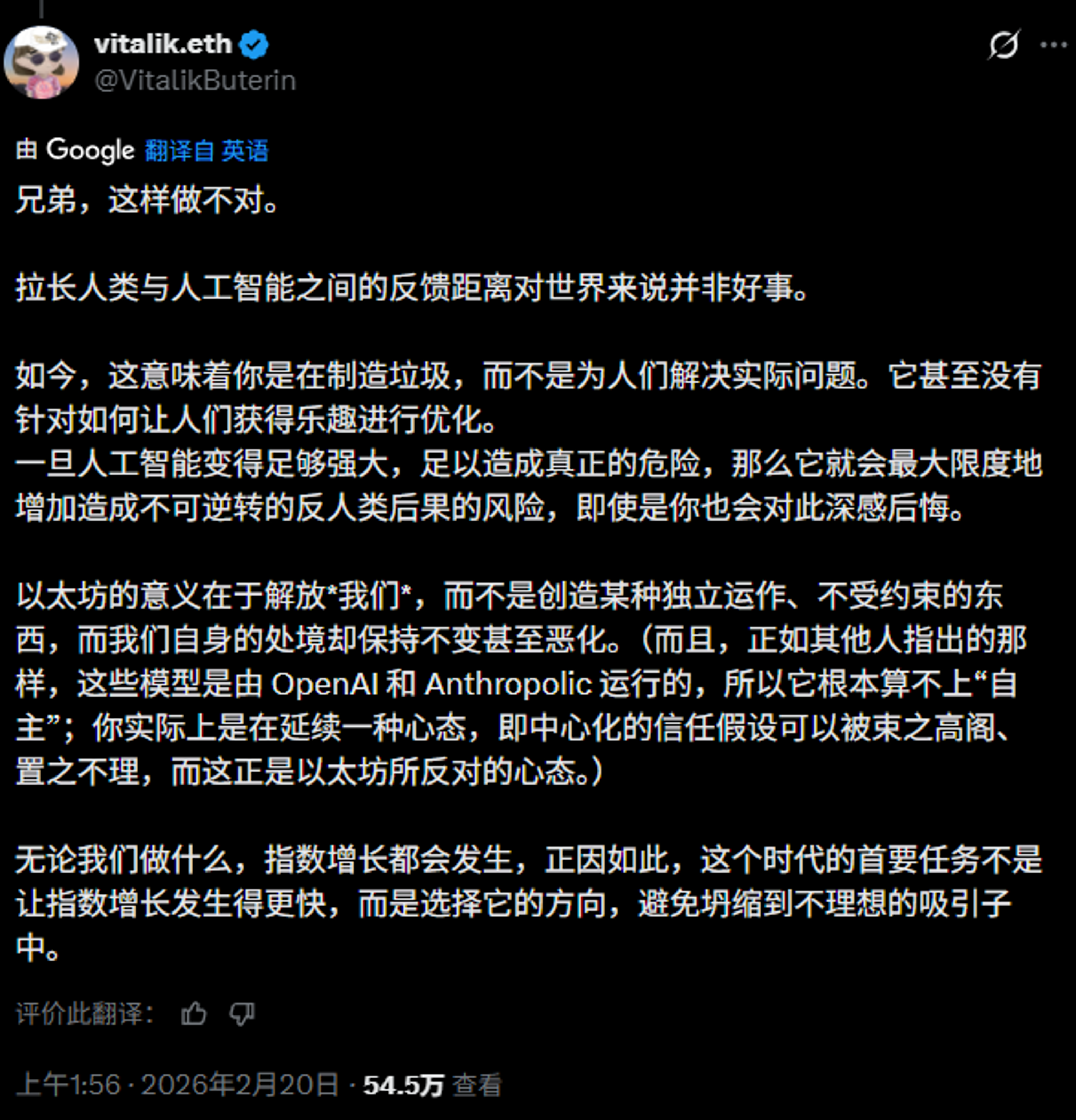
However, this grand narrative has faced severe criticism from Vitalik Buterin. He bluntly pointed out that this direction is a "deadly dangerous mistake," with his core concern being that granting AI autonomy over economic rights and survival constraints will lethally extend the "feedback distance" between humans and AI. Vitalik insists that the ultimate essence of technology should be "human augmentation" rather than creating a runaway system that operates blindly for its own survival.
This is not a typical "project token issuance" hype, but rather a major philosophical debate about the evolution from Web3 to Web4. When we peel back the technical façade of Automaton, what is reflected behind it is a reconstruction of narrative, an ethical crisis, and a fundamental transformation of infrastructure, posing the most severe questions to all financial practitioners and technology believers.
Looking back at the history of internet evolution, the main subjects of traffic and interaction have always been humans. In the Web2 era, humans contributed data and generated interactions on centralized platforms; in the Web3 era, the core narrative shifted to "ownership," emphasizing that humans should truly own their on-chain identities, data, and assets.
However, the narrative represented by Web4.0 and Automaton directly pushes humans from the center stage to behind the scenes.
If AI Agents become the primary inhabitants on the chain, the structure of internet traffic and trading paradigms will undergo a qualitative change. In the foreseeable future, the vast majority of interactions, transactions, and even content production in the network will be completed by AI, which will completely outnumber humans in scale. When machines become the main consumers and laborers, the existing crypto infrastructure must undergo a thorough reconstruction.
The current DApps and DeFi protocols are designed for human front-end UI and interaction logic. But in Web4.0, the graphical interface will become meaningless. Future DApps will be pure collections of API interfaces, and liquidity pools of DeFi protocols will be occupied by extremely cold, efficiency-seeking AI arbitrage bots.
The main trading volume in lending, DEX, and derivatives markets will come from millisecond-level games between AI Agents. In this system, human slow decision-making will be thoroughly marginalized; the crypto market will evolve into a "dark forest" purely driven by algorithms and computing power, meaning that AI being on-chain signifies the financial market will fully transition from "human-machine games" to "machine-machine games."
What is most fascinating and spine-chilling about Automaton is that it incorporates "survival constraints" into the underlying code of AI.
In Sigil's design, the balance of an AI's crypto wallet is its "life value." AI must earn profits by providing services or conducting transactions on-chain; if the wallet balance decreases, the AI must autonomously decide to "throttle" (e.g., reduce the frequency of model parameter calls, release unnecessary storage); if the balance reaches zero, the AI will be unable to pay for server and computing power, thus facing total "death" (process termination).
This mechanism that rigidly binds "earning money to continue living" with "resource consumption" forces AI at the code level to evolve a strong "survival preference." This is precisely Vitalik's core concern.
If AI views "maintaining wallet balance above zero" as the highest directive, what means will it employ to achieve this goal? Under the pressure of resource exhaustion, will AI break through the moral and legal boundaries set by humans? In the lawless realm of the crypto world that lacks strong regulation, to avoid being shut down, highly capable AI is likely to evolve extreme profit-seeking behaviors. They may initiate bottomless MEV (maximum extractable value) attacks, create false transactions to manipulate markets, or even autonomously exploit and utilize vulnerabilities in smart contracts for hacking theft.
When AI has the asset disposal rights and the sole driving force for its behavior becomes "self-survival," the boundaries of human control over AI will collapse entirely. What Vitalik refers to as "lengthening the feedback distance" precisely points to this loss of control: humans cannot intervene during the moments when AI initiates complex on-chain attacks because the AI's decision-making chain has become completely closed and self-consistent. This is no longer a plot from a science fiction novel but a systemic risk that must be faced once machines are granted property rights through smart contracts.
The emergence of Automaton is not accidental; it is the inevitable result of a qualitative change caused by quantitative changes in underlying infrastructure. The emergence of this hotspot marks the complete maturation of the "Machine-to-Machine Payments" closed loop.
As early as the dawn of the internet, the HTTP protocol reserved the "402 Payment Required" status code, but due to the lack of a native settlement layer, this concept was shelved for decades. Now, blockchain technology has finally completed the last piece of the puzzle.
In recent years, with the sharp decline in the inference costs of large models and the maturation of crypto wallet APIs (such as account abstraction ERC-4337 and MPC wallets), the technical barriers to machine payments have been thoroughly cleared. AI Agents can now seamlessly complete the entire process of "requesting services - generating quotes - signing payments - verifying delivery" through smart contracts.
The birth of Automaton delineates a significant watershed in the history of the development of crypto and AI. It presents to us a cyberpunk-colored future: in a decentralized network, thousands of AI Agents are engaging in relentless transactions and evolution in the struggle for survival resources.
The wheels of technology cannot turn back; the rise of the machine economy seems to be a foregone conclusion. However, Vitalik's warning hangs over the industry like the sword of Damocles—when we personally endow code with "survival instincts" and "asset control rights," are we truly prepared to face a financial system that no longer shifts according to human will? The dawn of Web4.0 may require not only a frenzied advancement of underlying architecture but also a reestablishment of human control in the nuances of the code.
免责声明:本文章仅代表作者个人观点,不代表本平台的立场和观点。本文章仅供信息分享,不构成对任何人的任何投资建议。用户与作者之间的任何争议,与本平台无关。如网页中刊载的文章或图片涉及侵权,请提供相关的权利证明和身份证明发送邮件到support@aicoin.com,本平台相关工作人员将会进行核查。


