Bitcoin is entering a phase where macro rhythms are more important than narratives.
The stock market is near historical highs, real yields remain elevated, and the credit market is expanding into increasingly opaque corners of the financial system. These conditions do not guarantee an immediate crisis, but together they create a backdrop where risk assets might face a high volatility window.
For Bitcoin, the core issue is whether stress will manifest in an underlying financial system with high asset valuations, and how quickly policymakers can act to control it.
Macro strategist Michael Pento describes the current landscape as a "triple bubble": stock market valuations approaching historical extremes, real estate suppressed by mortgage rates near 6%, and private credit management scaling up to $2 trillion. This characterization is eye-catching, but the framework is useful as it emphasizes sequence.
If credit issues arise first, liquidity can dry up instantly, and Bitcoin is likely to be sold off alongside other assets. If policymakers step in to support before the crisis spreads, Bitcoin is likely to become a high beta liquidity trading asset, rebounding faster than traditional risk assets.
Financial systems rarely collapse simply due to high valuations. Collapses often occur when the credit and bond chains are forced to sell off. Bitcoin's all-weather liquidity means its volatility in panic and bailout scenarios is almost more extreme than any other asset.
Recent data shows that stress signals are accumulating, but have not yet triggered a collapse.
On February 23, the adjusted spread for U.S. bank high yield debt options was 2.95%, still tight compared to crisis times.
On February 18, the Federal Reserve's balance sheet stood at $6.613 trillion, having increased by about $28.8 billion over four weeks, representing mild expansion, not indicative of emergency liquidity.
On February 20, the real yield on 10-year Treasury Inflation-Protected Securities (TIPS) was around 1.80%, a level that can exert pressure on non-yielding assets.
The market capitalization of stablecoins is about $308.8 billion, with a 30-day change of -0.18%, essentially flat.
Since early 2026, Bitcoin spot ETFs have seen total outflows of about $2.6 billion, with around $4.3 billion flowing out in the past five weeks.
Bitcoin Drops First, Reasons to Be Discussed Later
Deflationary liquidations often begin in the credit market, rather than in stock indices.
Spreads on high yield bonds widen sharply, financing markets come under pressure, and volatility surges, making cash the only position everyone wants.
The performance of Bitcoin in this phase is predictable: perpetual funding rates turn negative, leveraged liquidations lead to a plummet in positions, liquidity exits trigger a contraction in stablecoin supply, ETF fund outflows accelerate.
March 2020 is a typical reference. Amid a global liquidity shock, Bitcoin plunged nearly 40% on March 12, sold off alongside stocks, credit, and commodities, as market participants scrambled for dollar liquidity.
A credit-driven liquidation can easily cause Bitcoin to experience -20% to -40% volatility within days.
Investment firm VanEck noted in early February 2026 that Bitcoin futures open interest peaked above $90 billion in October 2025, then reduced leverage by over 45%. If credit stress truly materializes, there remains room for further forced selling.
Rating agency Moody's projects that private credit management will exceed $2 trillion by 2026 and approach $4 trillion by 2030. According to Reuters, U.S. banks have already invested $25 billion in this area.
This growth concentrates credit risks in structures with lower transparency, longer lock-up periods, and weaker covenant protections.
Once a credit event forces the sale of assets from private credit portfolios, the ripple effects will hit the public market through margin calls and collateral pressures. As the most liquid and always-traded risk asset, Bitcoin will disproportionately absorb sell pressure.
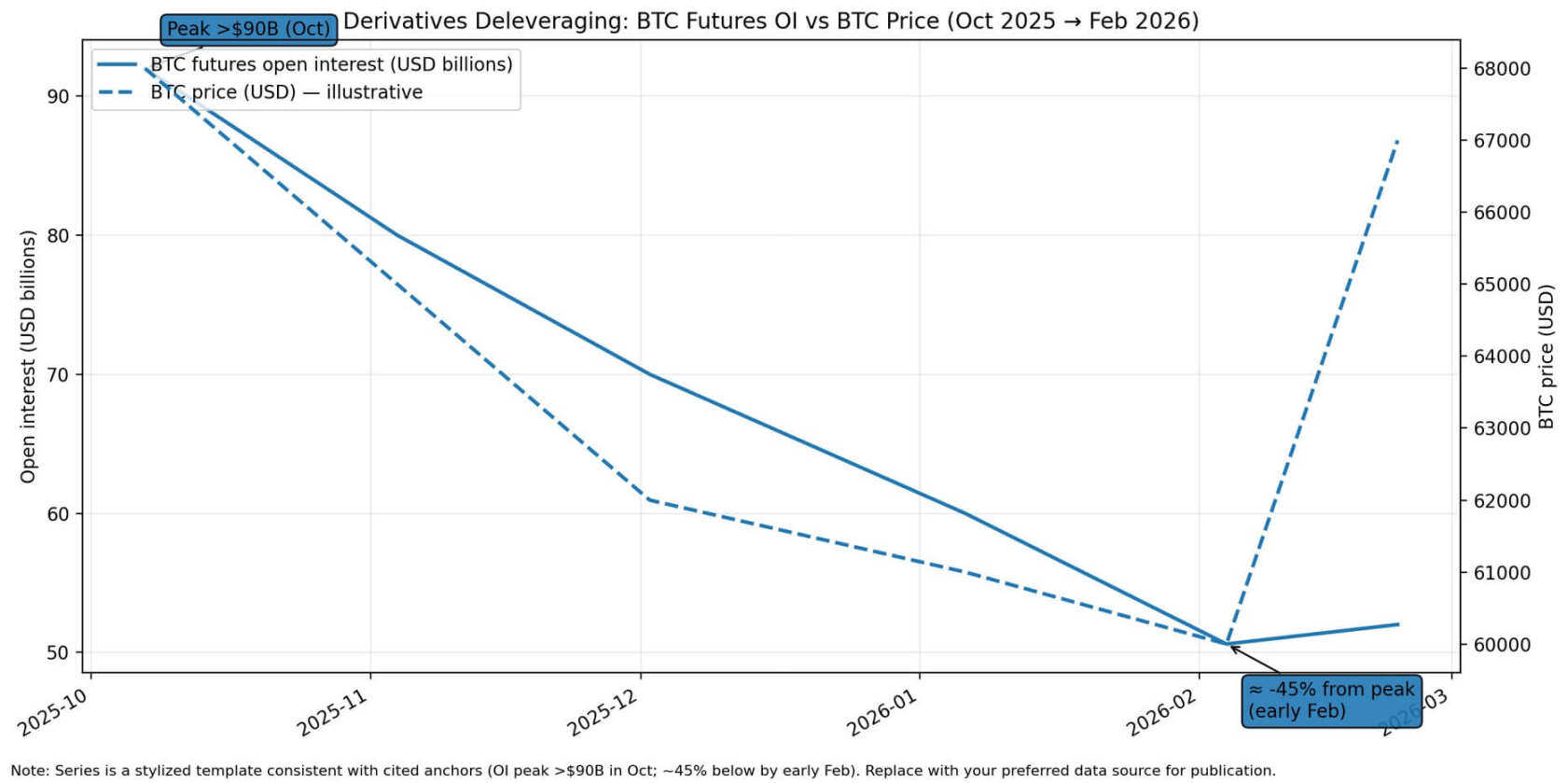
Bitcoin futures open interest has decreased by about 45% from a peak of over $90 billion in October 2025, dropping to early February 2026 levels, while Bitcoin's price fell from about $68,000 to nearly $60,000, before rebounding to around $67,000
Bitcoin Could Outpace Policy Bailouts
The opposite scenario begins with clear policy support.
The Federal Reserve expands its balance sheet, implements emergency tools, and real yields decline. Bitcoin's response in such an environment is also predictable: funding rates and basis normalize, liquidity returns driving an increase in stablecoin supply, ETF funding flows stabilize or even turn positive, positions accumulate again.
In a clear bailout environment, Bitcoin tends to act as a high beta liquidity asset, often rebounding faster than traditional risk assets because it has no credit risk and no potential for performance blow-ups. It serves as a liquid claim on a fixed supply monetary asset, benefiting as real yields decline.
The banking turmoil in March 2023 is a case in point. As market expectations shifted towards policy easing, Bitcoin surged 26% in one week and about 40% in ten days, racing ahead of the Fed's eventual liquidity support.
In February 2026, Bitcoin rose in a single day from about $60,000 to over $70,000, marking the largest single-day increase since March 2023, highlighting that macro risk sentiment remains a dominant driving force during pressure windows.
In March 2020, Bitcoin collapsed along with all assets, but the Federal Reserve also lowered interest rates to zero within weeks, initiated unlimited quantitative easing, and established emergency loan tools.
Bitcoin rebounded from its March 12 low and increased fivefold over the following year as real yields remained deeply negative and fiscal spending expanded significantly.
The lesson is that Bitcoin's response beta to liquidity cycles is almost higher than any asset, with timing being more important than narrative.
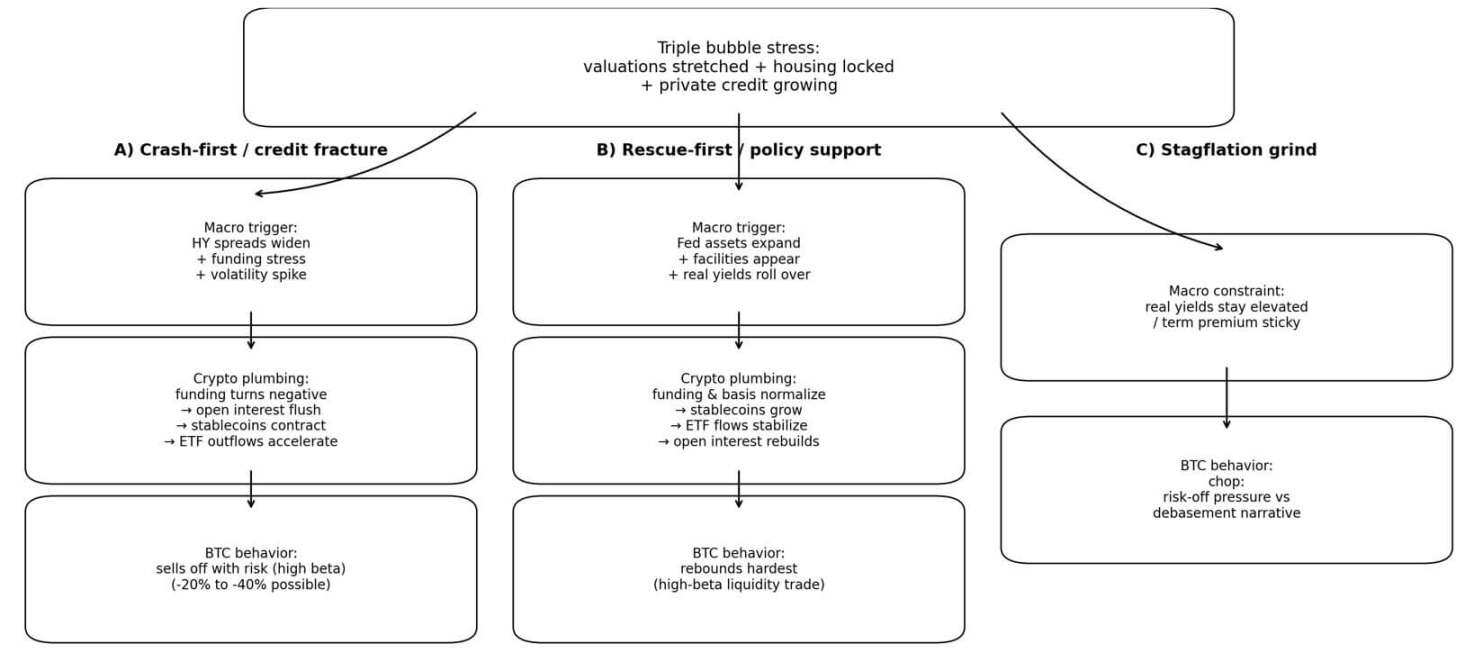
A flowchart shows the three potential paths for Bitcoin under triple bubble pressure: credit breakdown leading to a sell-off of 20% to 40%, policy bailouts triggering a high beta rebound, or stagflation causing price fluctuations between safe-haven pressures and currency devaluation narratives
When Neither Path Is Dominant
The most chaotic scenario is persistent inflation, the bond market demanding higher term premiums, and real yields remaining elevated, limiting policymakers' ability to act quickly without reigniting inflation fears.
In such an environment, Bitcoin would enter a period of oscillation. Safe-haven pressures and devaluation hedges pull against each other. When real yields are high, or policy support falls short of expectations, the rebound will fade.
The 10-year TIPS yield at 1.80% is far above the zero or negative real yields during Bitcoin's strongest market periods.
The average 30-year fixed mortgage rate for Fannie Mae was 6.01% on February 19.
The Buffett Indicator (total market capitalization / GDP) is approximately 206%, according to Advisor Perspectives data, representing the highest historical level for this metric. This means there is almost no further room for stock market valuations to expand unless earnings grow or discount rates decline.
If credit stress emerges, but policy does not shift rapidly, Bitcoin would enter a turbulent pattern that is neither liquidated nor bailed out.
Framework for Tracking Market Shifts
A simple tracking framework updated weekly with four indicators:
- Changes in the Federal Reserve's total assets over 4–8 weeks;
- 30-day changes in stablecoin market capitalization;
- Changes in high yield bond spreads over 2–4 weeks;
- Changes in the 10-year real yield over 2–4 weeks.
When indicators weaken significantly, Bitcoin often fluctuates like a high beta asset during liquidity events;
When indicators recover and inflation expectations rise, Bitcoin tends to outperform the market.
Current readings show a neutral to bearish liquidity environment.
- The Federal Reserve's balance sheet has slightly expanded but has not significantly loosened;
- Stablecoin supply is flat or slightly down;
- Credit spreads remain tight;
- Real yields are high and stubborn;
- Bitcoin spot ETFs continue to see outflows;
- Derivative open interest has nearly halved from its peak.
The market landscape feels like it is waiting for a catalyst: either credit stress leading to a liquidation, or policy support restarting liquidity trading.

Signals Appearing in the Credit Chain
An actionable monitoring framework focusing on credit and the underlying crypto chain:
- High yield bond spreads starting to rise from low levels → confidence in the credit market declines;
- U.S. Treasury volatility and term premiums rising → bond markets pricing policies are constrained;
- The Federal Reserve's balance sheet remains flat / declines while spreads widen → confirming there is no backstop.
Signals from the crypto side:
- Open interest significantly decreasing → forced selling;
- Stablecoin market capitalization contracting → liquidity exits;
- Ongoing ETF outflows → institutional hedging.
Confirmation signals for bailouts:
- Significant weekly increase in the Federal Reserve's total assets → actively providing liquidity;
- 10-year TIPS yield declining → real yields decreasing;
- Growth in stablecoin supply + normalized derivative funding rates → crypto liquidity returning.
The transition from liquidation to bailout often happens quickly. March 2020 is an example: Bitcoin first plummeted, then rebounded within weeks as policy support took effect.
The greatest value of the triple bubble theory is not predicting a crisis, but providing a sequential framework.
A credit breakdown leading to liquidation would see Bitcoin sold off cheaply;
Policy bailouts bringing an explosion of liquidity would see Bitcoin racing ahead of traditional assets.
The current macro landscape—high valuations, elevated real yields, tight credit spreads, flat stablecoin supply, and ongoing ETF outflows—indicates that the market has priced in pressure, but a credit chain collapse that forces selling has not yet occurred.
Bitcoin's next big market move does not depend on whether bubbles exist but on whether the credit breaks first or the Federal Reserve bails out first.
免责声明:本文章仅代表作者个人观点,不代表本平台的立场和观点。本文章仅供信息分享,不构成对任何人的任何投资建议。用户与作者之间的任何争议,与本平台无关。如网页中刊载的文章或图片涉及侵权,请提供相关的权利证明和身份证明发送邮件到support@aicoin.com,本平台相关工作人员将会进行核查。


