On February 24, 2026, the leading trading terminal in the Solana ecosystem, Trojan, announced the completion of deep integration with the high-performance decentralized derivatives exchange Hyperliquid, achieving on-chain perpetual contract trading of tokenized traditional financial (TradFi) assets for the first time. This milestone collaboration means that users can now trade a variety of traditional assets, including Tesla (TSLA) stocks, gold (XAU), silver (XAG), and even the S&P 500 index (SPX500), in a decentralized manner, breaking the barriers between the crypto world and traditional financial markets. This article will delve into the technical principles of this integration, its functional highlights, core user value, and its profound significance for the entire DeFi and Web3 industry.
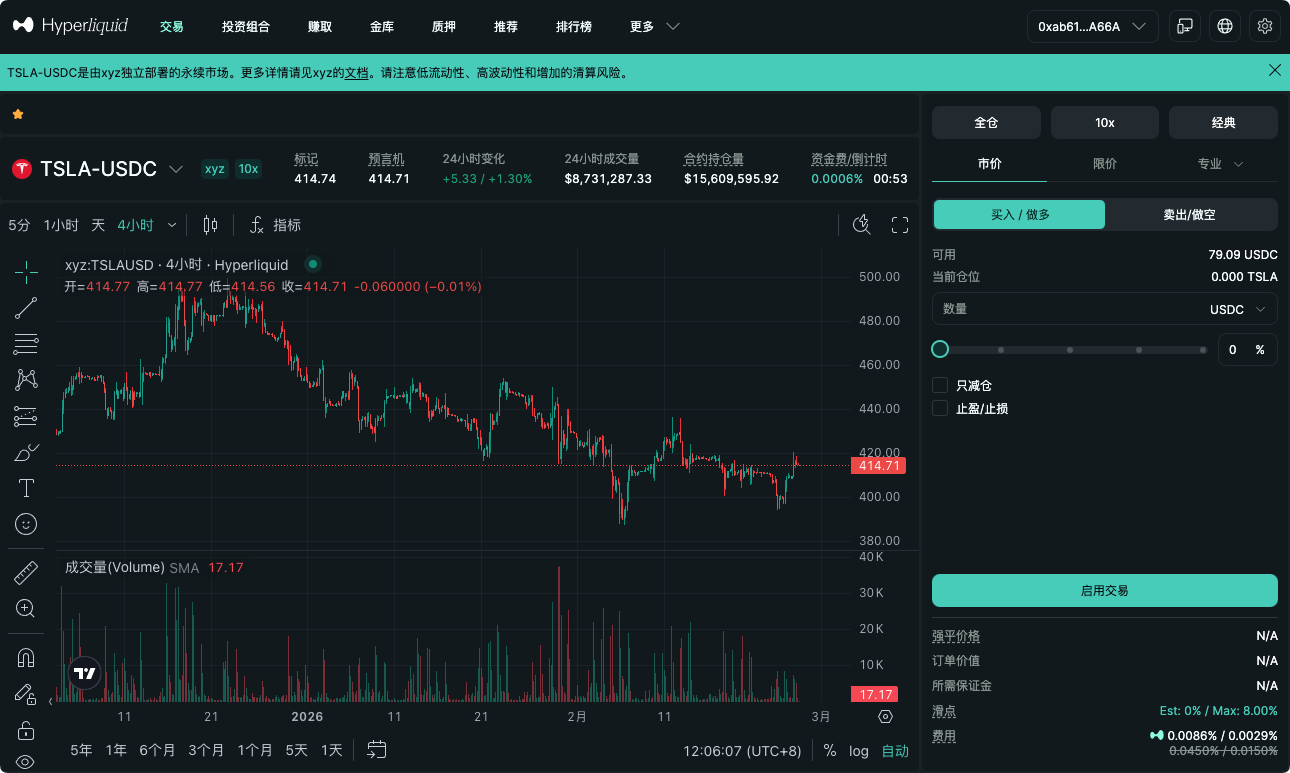
I. Technical Integration Explained: How to Trade Tesla On-Chain?
To understand how to trade Tesla stocks on-chain, two core concepts need to be clarified: Asset Tokenization and Perpetual Contracts.
1. Asset Tokenization: Bringing Real-World Assets onto the Blockchain
Asset tokenization refers to the process of transforming ownership of valuable real-world assets (such as stocks, bonds, real estate, commodities, etc.) into digital tokens through blockchain technology. These tokens represent ownership or rights to the underlying assets and can be traded in a peer-to-peer, intermediary-free manner on the blockchain.
In this integration, Hyperliquid has collaborated with regulated third-party entities to anchor the value of stocks from companies like Tesla and Apple, as well as commodities like gold and silver, onto tokens issued on its L1 blockchain. The price of these tokens is tracked in real-time through oracles to reflect their true market prices on traditional exchanges (such as NASDAQ and Chicago Mercantile Exchange), ensuring consistency between on-chain and off-chain prices.
2. Perpetual Contracts: Leverage Trading Tools without Delivery
Perpetual contracts are a unique type of futures contract that has no expiration date, allowing traders to hold positions indefinitely. Their prices are anchored to the spot price of the underlying asset through a funding rate mechanism. When the price of the perpetual contract exceeds the spot price, longs pay a funding fee to shorts; conversely, when the price is lower, shorts pay to longs. This mechanism incentivizes traders to arbitrage, causing perpetual contract prices to fluctuate around the spot price.
3. Synergy between Trojan and Hyperliquid
The core of this integration is that Hyperliquid is responsible for the tokenization of the underlying assets and the construction of the trading engine, while Trojan provides a user-facing, feature-rich trading frontend.
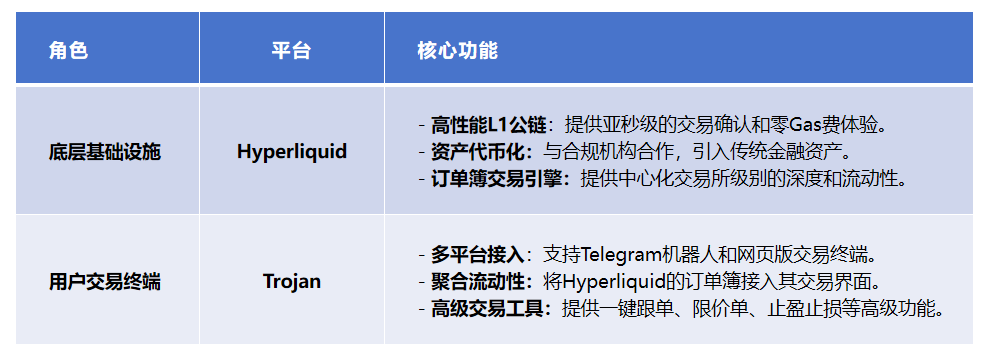
In simple terms, users place orders using Trojan's trading interface, and the trading instructions are sent directly to Hyperliquid's on-chain order book for matching and settlement via API. The entire process is completed on-chain, combining the decentralization, transparency, and security of decentralized exchanges with the efficiency and convenience of centralized exchanges.
II. Functional Highlights and User Value
This integration brings users an unprecedented trading experience and value proposition.
1. Asset Diversity: From Crypto-Native to Global Macro
Users are no longer limited to trading crypto-native assets like BTC and ETH. Through Trojan, traders can construct a cross-asset class investment portfolio in one stop, achieving truly global macro trading.
- Stocks: Tesla (TSLA), Apple (AAPL), Amazon (AMZN), Google (GOOGL), and other tech giants.
- Precious Metals: Gold (XAU), Silver (XAG).
- Commodities: Uranium.
- Stock Indices: S&P 500 Index (SPX500).
This means that when the Federal Reserve announces interest rate decisions, you can simultaneously go long on gold and short on US stocks; when earnings season arrives, you can directly leverage bets on Tesla's stock price. All of this can be accomplished on the same decentralized platform.
2. High Leverage and High Capital Efficiency
All tokenized traditional assets support a maximum 50x leverage. This means users can leverage larger positions with a small amount of capital, amplifying potential returns. Meanwhile, Hyperliquid’s combined margin mechanism allows users to share margin across different positions, significantly improving capital utilization efficiency.
3. 24/7 Continuous Trading
Unlike traditional stock markets with fixed trading hours, the blockchain never sleeps. Users can trade 7 days a week, 24 hours a day at any time, free from geographic and time constraints. This is crucial for capturing trading opportunities brought by major news events before and after market hours.
4. Decentralized Security and Transparency
All transactions are settled on Hyperliquid’s L1 blockchain, ensuring openness and transparency, available for anyone to audit. Users control their assets through their private keys, eliminating the need to trust any centralized entity, fundamentally preventing unfair practices that may exist in traditional exchanges, such as "price manipulation" and "circuit breaker" issues.
III. Industry Significance: Moving Toward the OEX Vision of "Everything is Tradable"
The integration of Trojan and Hyperliquid is not merely a simple functional update; it marks a solid step toward a grander vision for the DeFi industry—the Omnichain Exchange (OEX).
1. Breaking the Dimensional Wall Between DeFi and TradFi
For a long time, DeFi (Decentralized Finance) and TradFi (Traditional Finance) have been two relatively isolated worlds. DeFi boasts openness, transparency, and efficiency, but its asset classes are relatively singular; TradFi, on the other hand, possesses a vast array of assets and deep liquidity but has high entry barriers, inefficiencies, and significant centralized risks.
This integration successfully brings high-quality TradFi assets into the DeFi space through asset tokenization, allowing users to participate in trading mainstream global assets while enjoying the advantages of DeFi infrastructure. This is a strong practical demonstration of the assertion that "DeFi will consume TradFi."
2. Redefining the "Exchange"
The traditional concept of a "cryptocurrency exchange" is being disrupted. Future exchanges will no longer be mere places to trade cryptocurrencies but platforms capable of trading any valuable and tokenizable assets. From stocks and bonds to art pieces, carbon credits, and even personal time, virtually anything could become a tradable asset.
What Hyperliquid and Trojan are building is exactly such an "everything exchange." It is based on a high-performance blockchain, centered around perpetual contracts as the core trading tool, and aims to become the infrastructure for the future digital economy with open APIs and frontend access.
3. Empowerment of the Solana Ecosystem
As the leading trading terminal in the Solana ecosystem, Trojan's integration also greatly enriches the application scenarios and imaginative space of the Solana ecosystem. It proves that Solana can not only support high-frequency DeFi trading but also serves as a bridge connecting real-world assets and the digital world, attracting more developers, users, and funds from traditional finance.
IV. How to Participate in the Hyperliquid and Trojan Ecosystem: AiCoin Guides You
As a leading platform in Web3 data analysis, AiCoin is committed to providing global users with the most professional trading guidance and data support for Hyperliquid. If you are interested in the integration of Trojan and Hyperliquid, we have comprehensive support prepared for you.
Quick Start Trading on Hyperliquid
Step 1: Use the Exclusive AiCoin Invitation Code
To express our appreciation for AiCoin users' trust, we have secured exclusive trading fee discounts for you. By registering with our invitation code, you can enjoy additional fee discounts:
Invitation Code: AICOIN88
Registration Link:
https://app.hyperliquid.xyz/join/AICOIN88
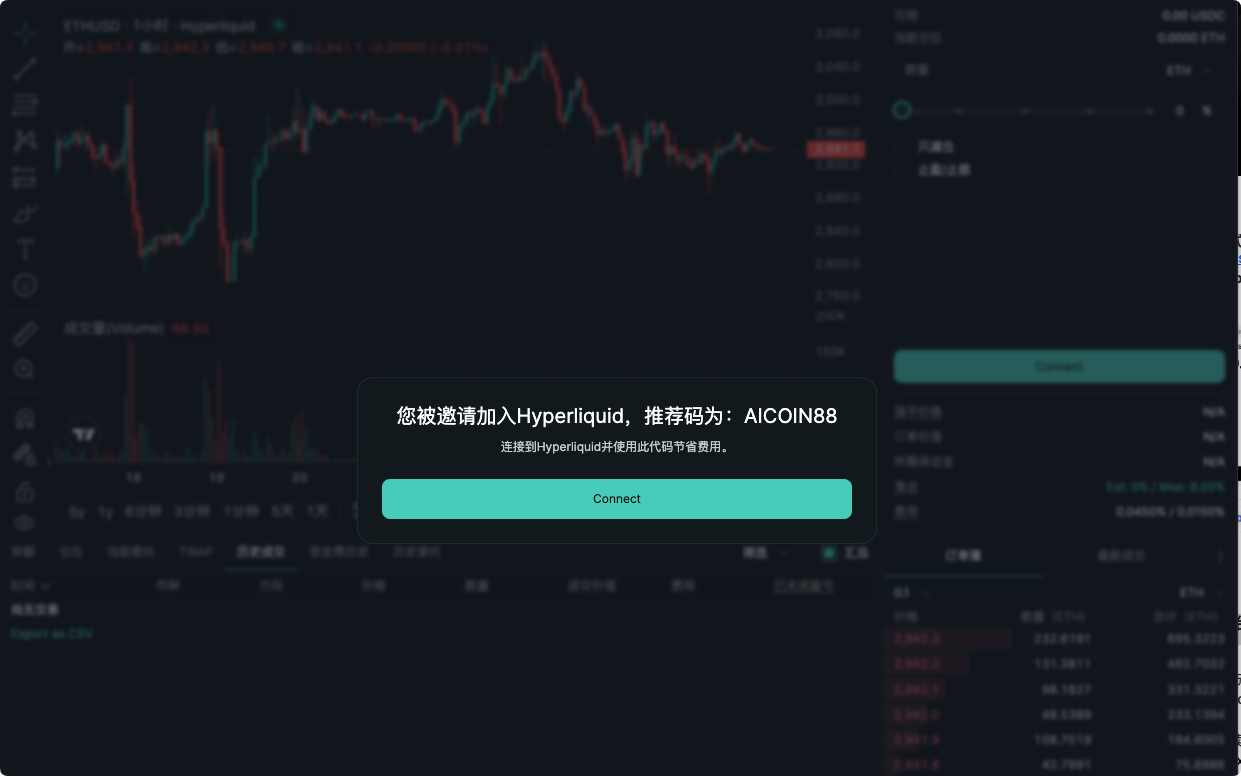
By registering through this link, you can receive 4% savings on trading costs, which means significant cost optimization for high-frequency traders.
Step 2: Trade through the Trojan Trading Terminal
Trojan supports various top-up methods, including direct deposits of USDC or through cross-chain bridging. The platform's zero Gas fee feature means you need not worry about network charges and can focus on executing your trading strategies.
Conclusion
The integration of Trojan and Hyperliquid is one of the most exciting developments in the DeFi space since the beginning of 2026. It is not merely a simple collaboration between two projects but a perfect combination of technological innovation and market demand. By bringing traditional assets like Tesla and gold onto the chain, it greatly expands the application boundaries of DeFi, providing users with unprecedented trading freedom and possibilities.
An era where "everything is tradable" is accelerating towards us. Hyperliquid and Trojan are undoubtedly at the forefront of this transformation. For any investor focused on the future of financial technology and seeking new-generation trading opportunities, this is a historic moment not to be missed.
If you are ready to explore the opportunities brought by Hyperliquid, Trojan, and the trading of tokenized traditional assets, AiCoin has prepared comprehensive support and guidance for you. Start your Hyperliquid journey now using the invitation code AICOIN88 and join the ranks of tens of thousands of users engaging in data-driven trading on the AiCoin platform.
免责声明:本文章仅代表作者个人观点,不代表本平台的立场和观点。本文章仅供信息分享,不构成对任何人的任何投资建议。用户与作者之间的任何争议,与本平台无关。如网页中刊载的文章或图片涉及侵权,请提供相关的权利证明和身份证明发送邮件到support@aicoin.com,本平台相关工作人员将会进行核查。


