The attempt by the U.S. and Israel to assassinate Iran's supreme leader and president has failed.
As air raid alarms sounded abruptly in Tehran, Israel joined forces with the U.S. to launch a large-scale military strike coded "Roar of the Lion," targeting Iran's nuclear facilities, air defense systems, and missile production lines. Trump immediately confirmed the U.S. military's involvement, calling it a "major combat operation."
The Iranian Revolutionary Guard quickly retaliated, launching hundreds of missiles and drones towards Israeli and U.S. military bases in the Persian Gulf. Israel declared a national emergency, and closed its airspace entirely. Explosions were heard near Abu Dhabi airport, resulting in the death of an Asian citizen from falling debris.
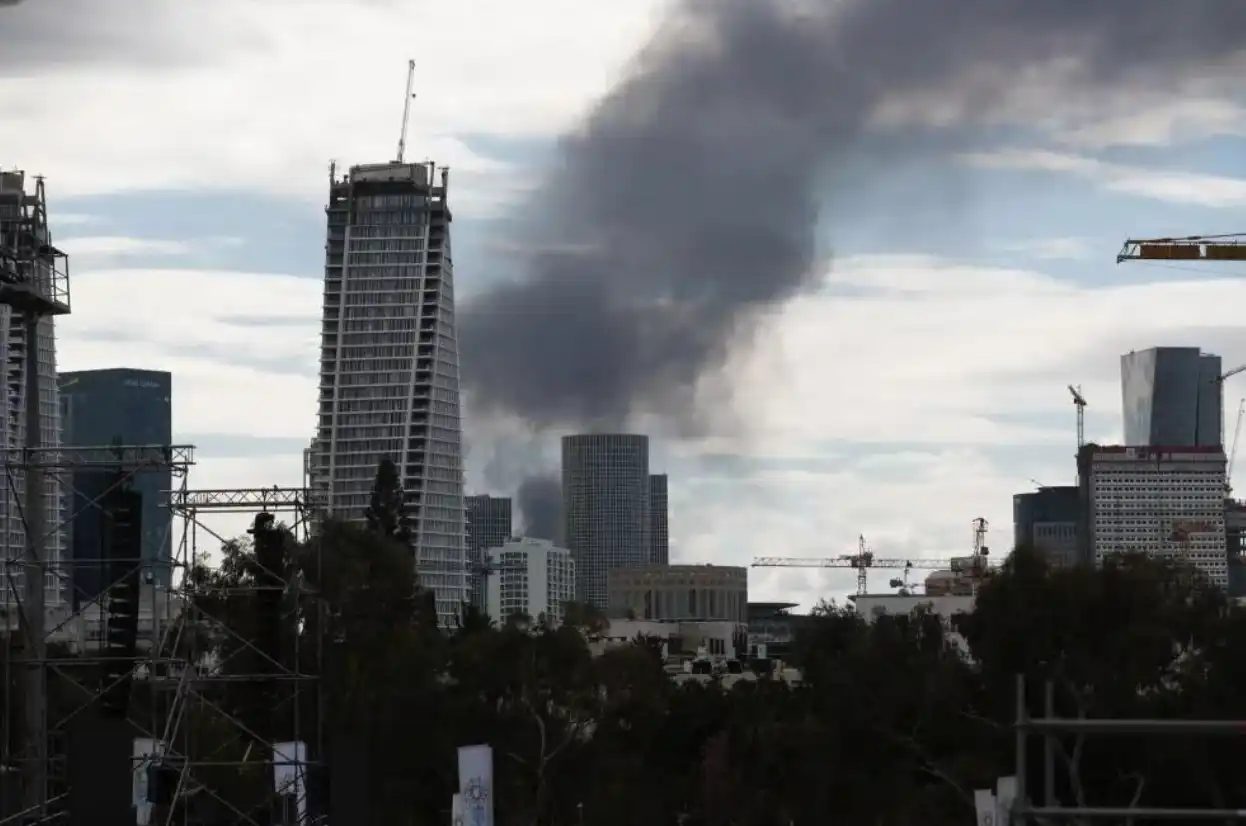
In response to the strikes, the Iranian Islamic Revolutionary Guard swiftly counterattacked, raining down hundreds of missiles and drones on U.S. military bases surrounding Israel and the Persian Gulf.
The reaction of the financial markets was brutal and honest. Within just one hour, BTC's sell volume surged by approximately $1.8 billion.
After the U.S. and Israel launched attacks on Iran, BTC briefly fell to $63,000, and the perpetual contract funding rate dropped to -6%, the second lowest level in three months, the last time it reached this level was on February 6 when BTC bottomed around $60,000. Meanwhile, gold futures surged nearly 6% against the trend as the gold market had not opened.
Currently, Israel has entered a national emergency, and fully closed its airspace. While the international community is still cautiously defining whether this constitutes a "full-scale war," such a high-intensity local conflict has significantly altered the regional landscape.
The Heart of the Crypto Industry on the Brink of War
As the smoke spreads, the three geopolitically pivotal countries of Lebanon, Saudi Arabia, and the UAE are under both physical and psychological pressure.
Southern Lebanon has become the second battlefield between Hezbollah and the Israeli army. Beirut International Airport has been urgently closed, and the skies above the city are often filled with the sonic booms of Israeli warplanes.
Although Saudi Arabia is trying to maintain neutrality, its airspace has become a "corridor" for missile flights. The Prince Sultan Air Base, housing U.S. troops, has entered a state of high alert, and the Saudi government is keeping a close watch on any stray projectiles that might hit its territory.
Dubai International Airport is currently experiencing widespread flight cancellations, and frequent alarms are being sounded at the Al-Dhafra Air Base in Abu Dhabi. Should the Strait of Hormuz be blocked, Dubai's shipping and financial status will suffer devastating blows.
Near Abu Dhabi's main airport, explosions have been reported, and various media outlets have reported that an Iranian airstrike caused debris to hit a residential area in Abu Dhabi, resulting in the death of an Asian citizen.
These regions on the brink of war have also become focal points for the crypto industry in recent years, as the UAE has evolved into a global cryptocurrency hub, which means this war threatens the crypto industry in unprecedented ways.
Binance has officially ended its "no headquarters" era, establishing its global headquarters in Abu Dhabi (ADGM). Meanwhile, it has a large office space in Dubai (located in One Central). OK has established a large regional hub in Dubai (near the World Trade Center), having recently expanded its Dubai office by the end of 2025, employing over 100 people, serving the entire Middle East and North Africa (MENA) region. Bybit moved its global headquarters from Singapore to Dubai (One Central) in 2023, with nearly all staff working in Dubai.
Almost every well-known institution you can name has rooted itself in Dubai or Abu Dhabi. And Dubai is only about 300 kilometers from the southern coastline of Iran, separated by just a stretch of the Persian Gulf.
Additionally, other well-known international projects and trading platforms have also established a presence in the Middle East, such as Crypto.com, which has complete operational licenses in Dubai and has recently signed multiple payment cooperation agreements with the Dubai government. Kraken has established its Middle Eastern headquarters in Abu Dhabi, being one of the first international platforms to obtain local licenses. Chainalysis, a leading blockchain analysis company, has an office in Dubai, responsible for monitoring money laundering and illegal financing activities in the region. They are currently closely monitoring the flow of crypto funds within Iran.
The situation for local native trading platforms is even more perilous, as their foundations are in the Middle East, and with war potentially breaking out, they may face existential crises. For example, Rain Financial is headquartered in Bahrain and has a large office in Riyadh, Saudi Arabia. Given Bahrain's proximity to Iran and the presence of the U.S. Fifth Fleet, it may face extremely high geopolitical security risks.
BitOasis is the earliest and largest local trading platform in Dubai, with almost all users concentrated in Gulf countries; CoinMENA is headquartered in Bahrain, primarily serving users in Saudi Arabia and the UAE.
Dubai and Abu Dhabi are gathering places for global Web3 talent; if war breaks out, a large outflow of talent or cyberattacks on network infrastructure (Cyberwarfare) may cause multiple projects' development to stagnate.
If the Middle Eastern banking system is sanctioned by war or temporarily closed for security reasons, these trading platforms' local AED (Dirham) or SAR (Riyal) channels for deposits and withdrawals could collapse.
Market Outlook for Next Week
Amid the extreme backdrop of the "Roar of the Lion" operation erupting on February 28, 2026, the opening next Monday, March 2, may be a critical window for financial markets experiencing the "shockwave of war."
As the absolute king of safe havens, gold is the only "ultimate insurance" in geopolitical crises. With the U.S. military announcing the commencement of "major combat operations," global safe-haven funds will likely surge into the gold market the moment the market opens on Monday.
Some analysts believe Iran's threat to block the Strait of Hormuz will cause crude oil prices to skyrocket. The secondary inflation expectations resulting from high oil prices will further push up gold prices. It's expected that there will be a significant upward gap in gold when the market opens on Monday. If Iran's counterattacks extend to civilian shipping routes in the Persian Gulf over the weekend, gold prices may briefly challenge the psychological barriers of $5,300-5,800 an ounce, further reaching historic highs.
As for BTC, although Bitcoin is often referred to as "digital gold," in the first few hours to days following the outbreak of war, it is typically viewed as a risk asset. Institutional investors often sell the most liquid crypto assets first to recoup liquidity or respond to margin calls in the stock market.
As previously mentioned, Dubai and Abu Dhabi are global Web3 centers. Threats to physical security in these regions could lead investors to worry about the operational stability of associated exchanges (like Binance and Bybit), resulting in panic selling.
If global stock markets (such as the S&P 500 and NASDAQ) experience a sharp decline next Monday, and the exchange rates of Middle Eastern fiat currencies (like Riyal and Dirham) fluctuate, Bitcoin's attributes as a decentralized safe-haven asset might begin to awaken.
There are long-term bullish perspectives suggesting that Monday may first see a wave of pullbacks (support levels may be near key integer points), and if the conflict escalates into long-term hostilities with traditional financial payments hindered, Bitcoin may experience a "decoupling" trend, rebounding against the market. Current battlefield news continues to update, and the most important indicator is to monitor Bitcoin's trading volume.
The ultimate damage of war is borne by every ordinary person.
Southern Lebanon has become a second battleground, Beirut airport is closed. Saudi airspace has devolved into a missile corridor. Dubai airport is experiencing widespread flight cancellations. Bahrain, the home base of Rain Financial and CoinMENA, houses the U.S. Fifth Fleet and is very close to Iran.
Web3 talent will flee, project development will stagnate, and network infrastructure may suffer from cyber warfare attacks. But these are still costs at the industry level. The more real cost is: some have already died. Families are fleeing. Children are spending tonight in bomb shelters.
History repeatedly tells us that there are no true winners in war. It destroys not just buildings and markets, but also the trust, order, and future established by a generation. One of the original intents behind the creation of cryptocurrency was to allow ordinary people to retain some autonomy in an out-of-control world. But without peace, even the most decentralized systems will tremble under the reality of gunfire.
What we can do may not be much. But at least, don't be indifferent to what is happening. I also hope this conflict can be resolved soon.
免责声明:本文章仅代表作者个人观点,不代表本平台的立场和观点。本文章仅供信息分享,不构成对任何人的任何投资建议。用户与作者之间的任何争议,与本平台无关。如网页中刊载的文章或图片涉及侵权,请提供相关的权利证明和身份证明发送邮件到support@aicoin.com,本平台相关工作人员将会进行核查。


