Author: Hubble AI
Who is predicting the market's "quietly making a fortune"?
While everyone is debating whether the prediction market can accurately reflect polls, some accounts have turned it into a stable profit channel through extremely high-frequency small trades.
First, let's look at these two smart money accounts that are making crazy profits on the market, which are based on the logic of this article:
Account k9Q2mX4L8A7ZP3R: Total profit exceeds $1,046,373.20, participated in 24,000 predictions.
https://polymarket.com/@k9Q2mX4L8A7ZP3R
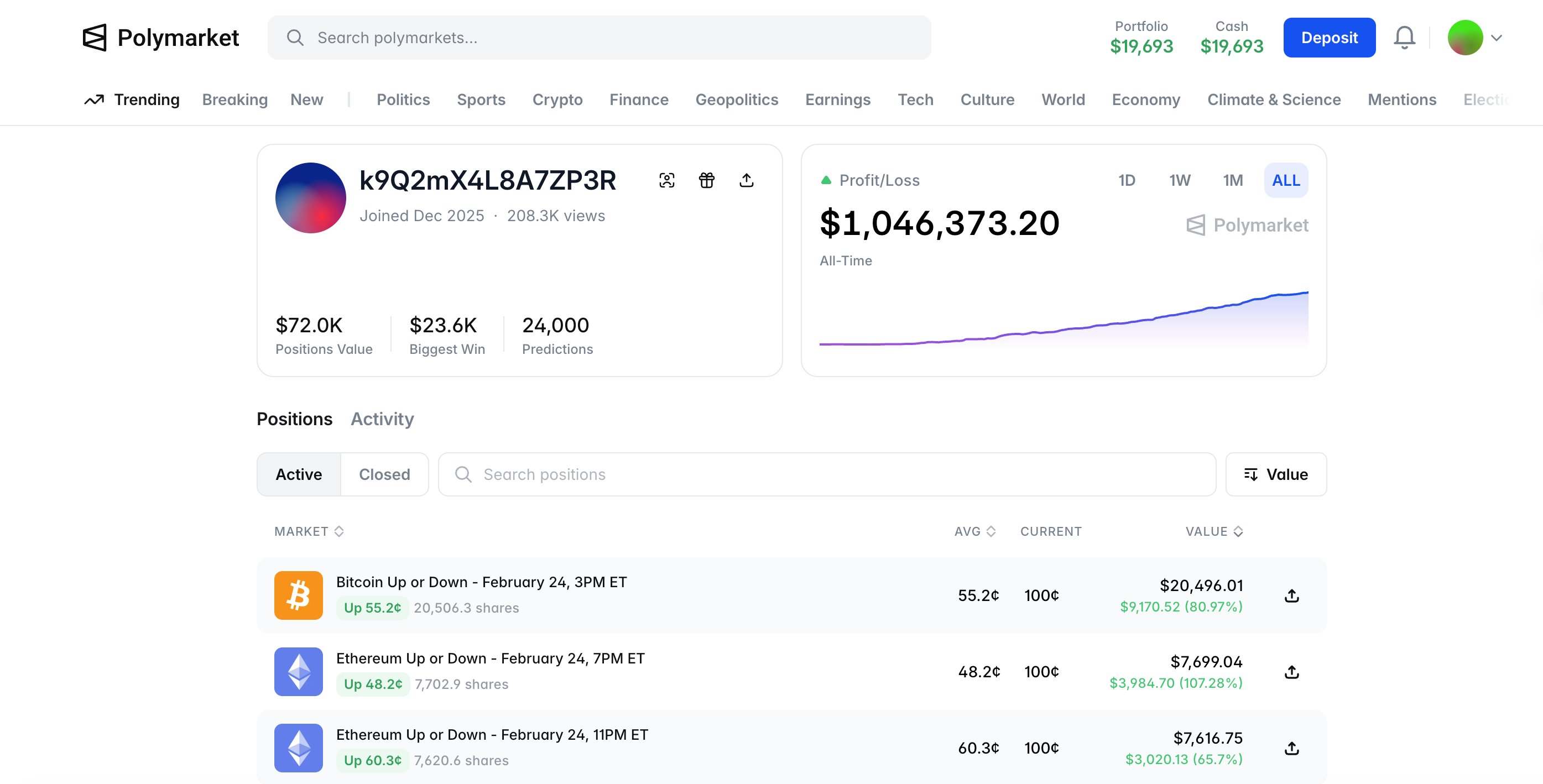
Account 0x8dxd: Profit has reached $1,680,017.40.
https://polymarket.com/@0x8dxd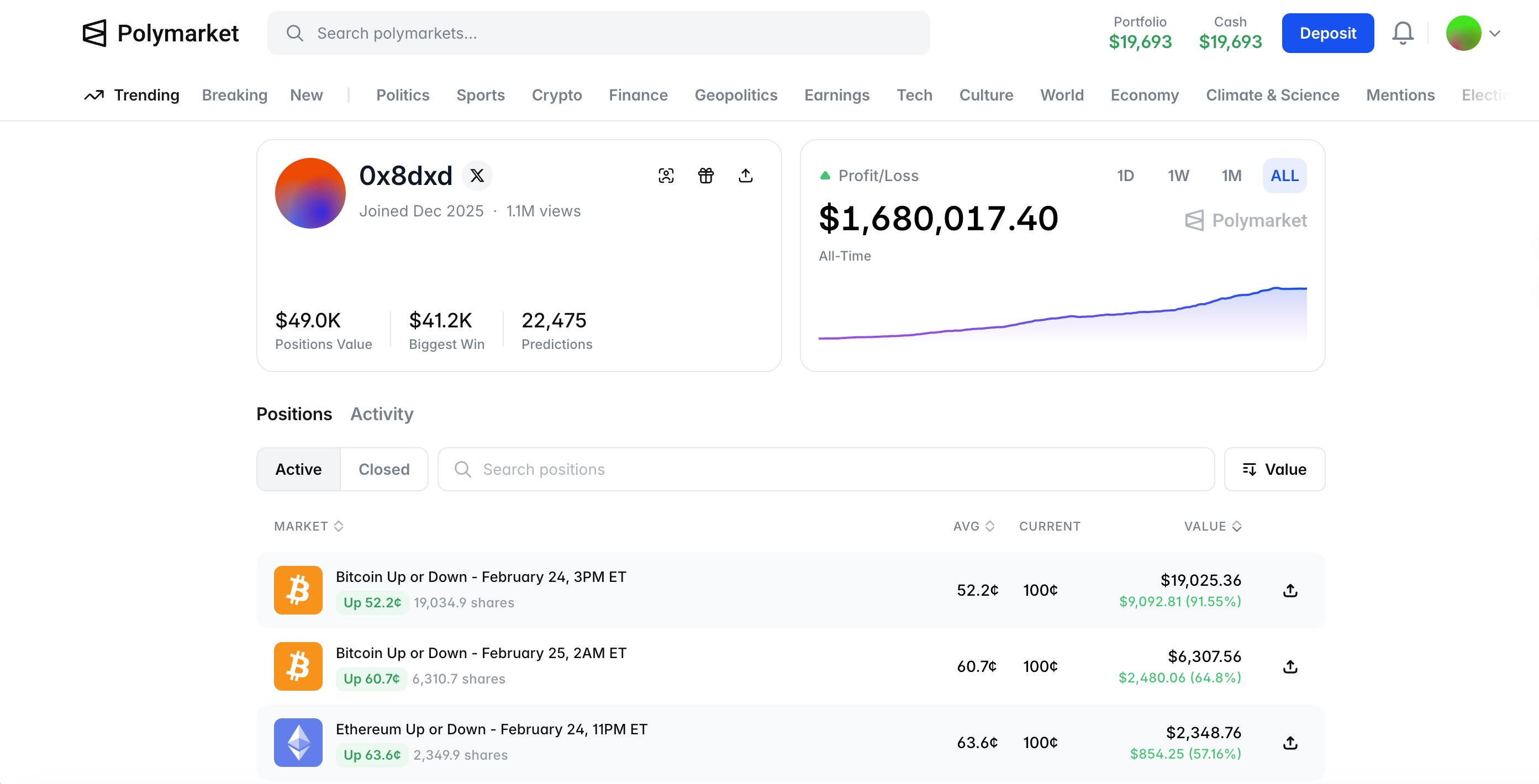
What stands out is their capital curve: almost a perfect upward straight line. This indicates that their profits are not derived from "precise fortune-telling" of a specific event (like an election), but from a mature institutional-level market-making strategy.
Why is there an opportunity to "pick up money" here?
To understand how big accounts profit, one must first grasp the underlying logic of the prediction market. Polymarket's contracts, in a short time frame, are mathematically equivalent to a financial instrument—binary options. In simple terms, if the result occurs, it is worth 1 dollar; if not, it is worth zero.
Data reveal an interesting phenomenon: among 99 price levels, the active buyers (Takers) are suffering negative returns in about 80 of those levels. Wealth is systematically transferred from buyers to sellers (Makers) in the micro order book.
Retail investor's "lottery trap"
Many players like to buy extreme contracts priced at $0.01, believing that if they hit it, they can multiply their money hundreds of times.
However, Polyhub’s backtesting shows that the actual occurrence probability of such contracts is often only 0.43%, with a premium deviation as high as -57%.
Large accounts systematically harvest these premiums generated by psychological biases by occupying the structural advantage of Makers (limit order providers).
In the prediction market's order book, wealth is systematically transferred from the active Takers to the limit order Makers.
The so-called "long tail bias" simply refers to the retail investor's "lottery mentality": **many people like to buy extreme contracts priced at $0.01 (believing they have a 1% chance of occurring), thinking that if they hit it, they can multiply their money hundreds of times.
This means that when you buy these "cheap" contracts, you are actually paying an extremely expensive premium. All these premiums turn into the makers' steady profits.
Pricing logic: How to calculate the "fair value" of an order?
Professional traders never bid based on feelings; they treat prediction contracts as binary options—that is, a "win it all or lose it all" digital contract.
To calculate how much this order is worth, big accounts will reverse-engineer the implied volatility (IV).
In simple terms, IV is the market's "sentiment indicator": the more extreme the price fluctuations, the higher the IV.
If your model can calculate the true probabilities for the next minute more accurately than the market, you can find those mistakenly priced orders on the market.
The "time machine" in the hands of big accounts
Having the theory is not enough; the real challenge lies in engineering implementation.
1. HMM state management: Equipping the system with an "intelligent switch". Since Polymarket has a second-level delay, while Binance has a millisecond-level delay. Big accounts have introduced HMM (Hidden Markov Model).
You can think of it as a "smart switch": when the market is calm, the system is in a steady state and trades normally; once Binance prices surge, the system instantly recognizes and switches to "active mode", freezing data and canceling orders to prevent being targeted by other traders' "fast entry" orders.
2. Brent method: A "super calculator" that never goes down **under extreme conditions, many rudimentary algorithms can crash due to excessive computation. Top systems use the Brent method. This is an extremely robust mathematical tool: no matter how outrageous the price fluctuations are, it can calculate the most accurate pricing in nanoseconds, ensuring that the trading system does not go offline at critical moments.
3. OFI order flow: A "radar" for predicting the future. Big accounts also monitor OFI (Order Flow Imbalance). This acts like a radar: by monitoring who has more strength between buyers and sellers, who is withdrawing orders, and who is adding orders, to predict the price trend in the next few seconds, enabling them to set up or avoid risks in advance.
Capital management: Hard constraints under risk
In the prediction market, the most dangerous thing is not making a wrong judgment, but facing tail risk—that is, extreme events with a very low probability of occurrence but with high destructive power—leading to position liquidation.
The research team at Polyhub found that top-tier accounts never directly apply the traditional Kelly Criterion. Because in the highly volatile environment of the prediction market, the standard formula often provides excessively aggressive betting proportions, leading to sharp fluctuations in capital curves or even to zero.
To solve this issue, the strategy introduces coefficient of variation (CV) as a penalty term.
CV (Coefficient of Variation) here measures the "value for money" of the returns: it calculates the ratio of risk from strategy volatility to expected returns.
This mechanism can be seen as an "automatic decelerator":
When the system detects unclear signals and increased market noise, the CV penalty term rises rapidly, suppressing the betting positions to approach zero. Only during time windows with extremely pure signals and high certainty of returns will the system deploy large amounts of capital according to the models.
This means: the greater the uncertainty, the closer the invested position approaches zero. Only through this strict scaling of capital can one achieve that smooth million-dollar profit curve.
Conclusion: Leveling the asymmetric game
The truth of Polymarket's profits is often that institutional-level algorithms are systematically harvesting the "intuitions" of retail investors. In the face of HMM state switching and microsecond-level order harvesting, ordinary traders can easily become the "exit liquidity" for large accounts.
We do not encourage blind confrontation, nor do we advocate following trends without strategy. Polyhub exists to help you see those "invisible traps." By monitoring the movements of smart money in real-time and identifying order book deviations, we provide you with decision-making precision comparable to top players, allowing this asymmetric game to return to fairness.
免责声明:本文章仅代表作者个人观点,不代表本平台的立场和观点。本文章仅供信息分享,不构成对任何人的任何投资建议。用户与作者之间的任何争议,与本平台无关。如网页中刊载的文章或图片涉及侵权,请提供相关的权利证明和身份证明发送邮件到support@aicoin.com,本平台相关工作人员将会进行核查。


