The Strait of Hormuz is the most important oil transport choke point in the world, connecting the Persian Gulf and the Gulf of Oman, through which about 20% of the world's oil (17 to 21 million barrels daily) and large amounts of natural gas must be transported. The exports of the major oil-producing countries in the Middle East (such as Saudi Arabia, the UAE, Kuwait, Iraq, and Qatar) rely almost entirely on it. Most oil imports from the Middle East to Asian countries like China, Japan, South Korea, and India also depend on this route.
Recent Situation of the U.S.-Iran War (Latest Developments in March 2026)
- Since February 28, 2026, when the U.S. and Israel launched a massive military strike against Iran (including actions targeting nuclear facilities, the Revolutionary Guards, and senior figures like Khamenei), the Islamic Revolutionary Guard Corps (IRGC) of Iran swiftly retaliated.
- From February 28, Iran began broadcasting warnings to passing ships via VHF radio: “No vessel is authorized to pass through the Strait of Hormuz,” declaring passage “unsafe” or “prohibited until further notice.”
- On or around March 2, a senior commander/advisor from the Revolutionary Guard officially announced that “the Strait of Hormuz is closed,” threatening to strike/ destroy/ “turn into fire” any vessels attempting to pass (including tankers).
- Actual Effects: Although Iran's official/navigational naval forces may have been severely damaged (some reports suggest the navy has almost emptied), through land-based missiles, drones, mines, small boat swarms, and other asymmetrical means, combined with propaganda deterrence, led to:
- Shipping giants (such as Maersk, Hapag-Lloyd, etc.) urgently suspended passage, causing tanker traffic to plunge by over 70%.
- Several ships are stranded in surrounding waters, with speeds reduced to zero, and there are reports of tankers being hit/sunk.
- A “de facto closure” formed, rather than a complete physical blockade (no large-scale naval interception of all vessels).
- Global Impact: Oil prices skyrocketed (Brent crude oil jumped by 10-20%+ at one point), energy security in Europe/Asia came under pressure, and nearly half of China's Middle Eastern oil imports were obstructed. Iran has historically threatened to block the Strait of Hormuz multiple times (such as in 2019 and during the Iran-Iraq War); this time it is an extreme escalation of retaliation, with the situation currently highly tense.
How Can Web3 Players Quickly Speculate on This Hot Topic?
What you see on Hyperliquid, both OIL and USOIL, are crude oil-related perpetual contracts (perps) trading pairs, primarily used to bet on crude oil price trends (especially during geopolitical events like the U.S.-Iran conflict, where trading volume and volatility are high). They are both HIP-3 (third-party/community-deployed perpetuals of Hyperliquid) products, created by different deployers, with slight differences in the underlying crude oil benchmarks tracked, but both are crude oil-related products.
Main Differences Summary
- OIL (often shown as flx:OIL or OIL-USDH/OIL-USDC):
- More directly tracks WTI crude oil futures (CL futures, West Texas Intermediate crude oil in the U.S.).
- Prices are usually closer to the true WTI spot/futures level (recently fluctuating between $70-76 during recent events).
- | Higher leverage (max leverage may be 20x+ or higher, depending on deployment parameters).
- Sometimes stronger liquidity, suitable for traders seeking “pure” crude oil exposure.
- Example: Recently rose to ~$76 after events in Iran.
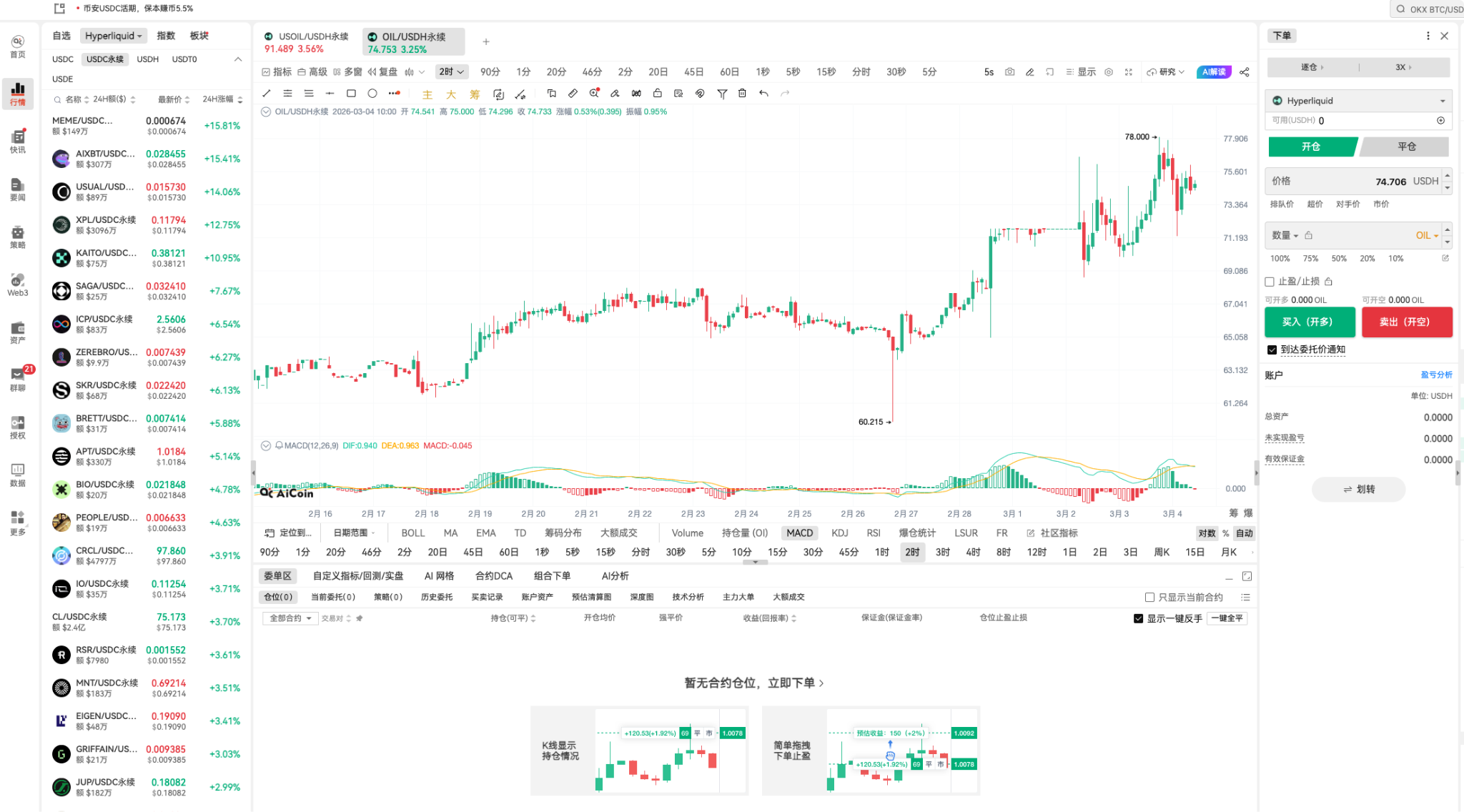
- USOIL (often shown as km:USOIL or USOIL-USDH):
- Tracks the price performance of the United States Oil Fund (USO) ETF (USO is an ETF that tracks WTI crude oil futures, affected by management fees, rolling costs, roll losses).
- Prices are usually higher than OIL (recently spiking to $86-97+ during events), because the USO ETF itself has premiums/structural differences.
- Lower leverage (max leverage is usually 10x or lower), risk control is more conservative.
- Liquidity might be slightly lower, with greater volatility (more likely to experience larger spreads or limit behaviors).
- Example: Recently had higher peaks in the same events.
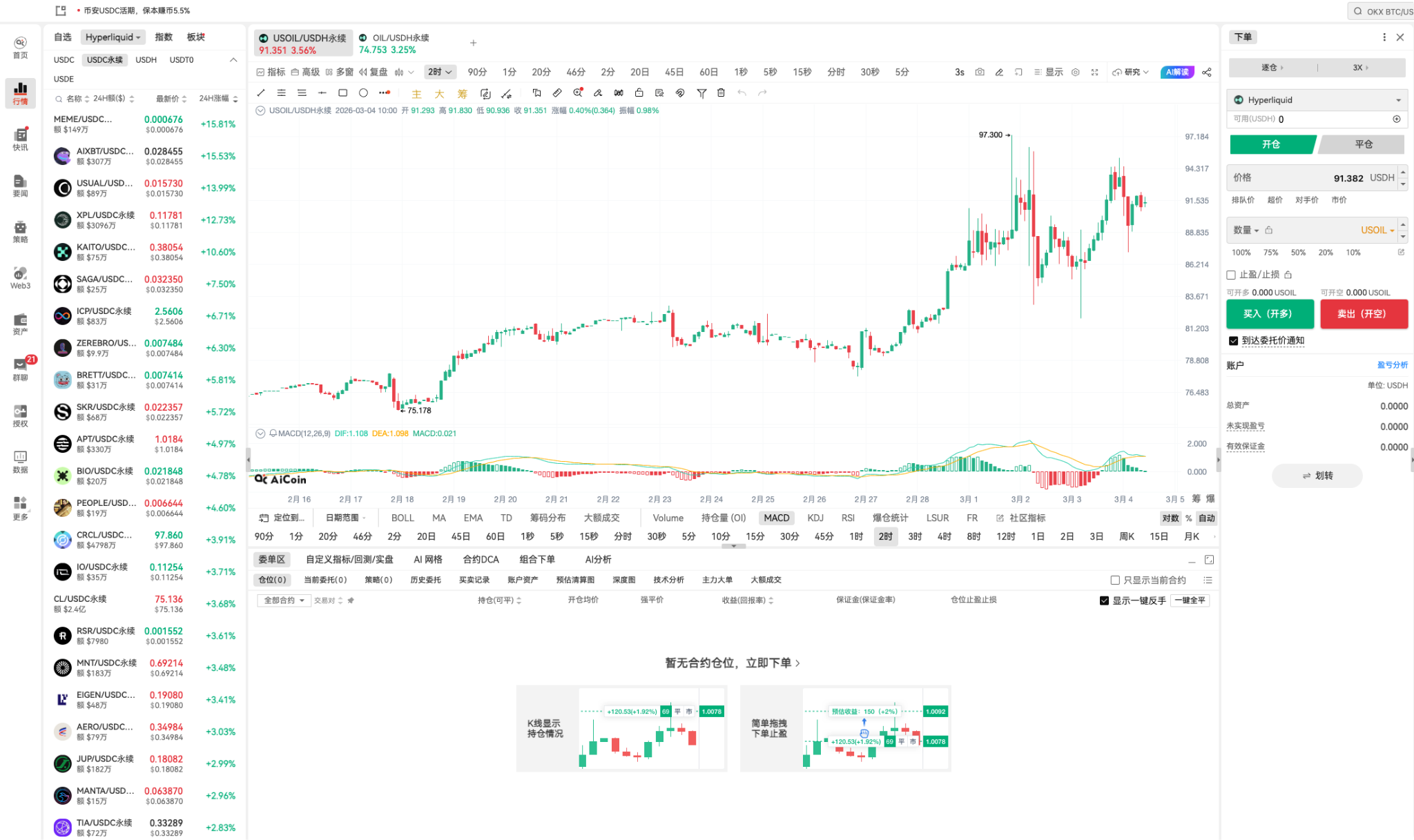
Why Is There Such a Big Price Difference?
- OIL ≈ true WTI crude oil futures price (the benchmark is “cleaner”).
- USOIL ≈ USO ETF price (the ETF has tracking errors, fees, rolling losses, etc., causing it to often be higher than pure futures in bullish markets/geopolitical tensions).
- Similar distinctions between traditional brokers' USOIL (CFD version of WTI) and CL (futures version): one is an ETF derivative, and the other is closer to the futures themselves.
Other Commonalities
- Both are perpetual contracts (no expiry date, maintained close to spot through funding rates).
- Settled using Hyperliquid’s USDH (or USDC).
- Trading volumes surge during macro events (recent oil-related perps total turnover easily exceeds tens of millions of dollars, with high OI).
- Extremely high risk: high volatility, and low liquidity deployer products may have liquidation risks, wide spreads, and other issues. Hyperliquid officials often remind to beware low liquidity/high volatility. In simple terms: if you want to be closer to “real crude oil futures”, choose OIL; if you see higher prices/different leverage, it may be USOIL (ETF version).
How to Track and Execute Trades More Efficiently?
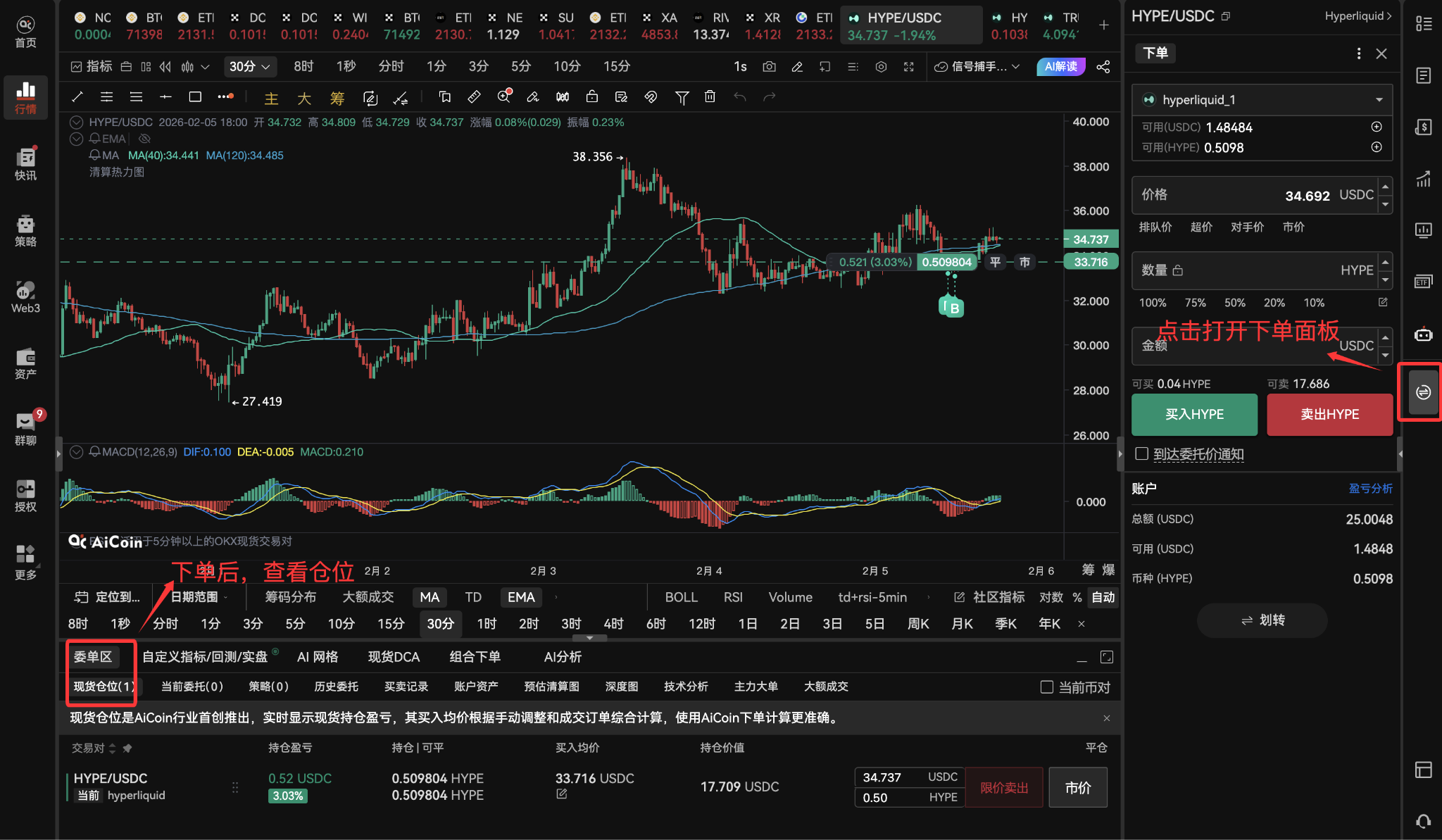
AiCoin has now deeply integrated Hyperliquid, achieving a seamless connection between analysis and trading. You can use powerful charting tools on AiCoin (such as directly drawing these pivot points in the theory of wave analysis, marking pullback confirmation points) for professional analysis. Once you spot a pullback opportunity after observing a similar third buy, you can authorize directly without switching apps, allowing you to place orders for Hyperliquid contracts within AiCoin, making the whole process smooth!
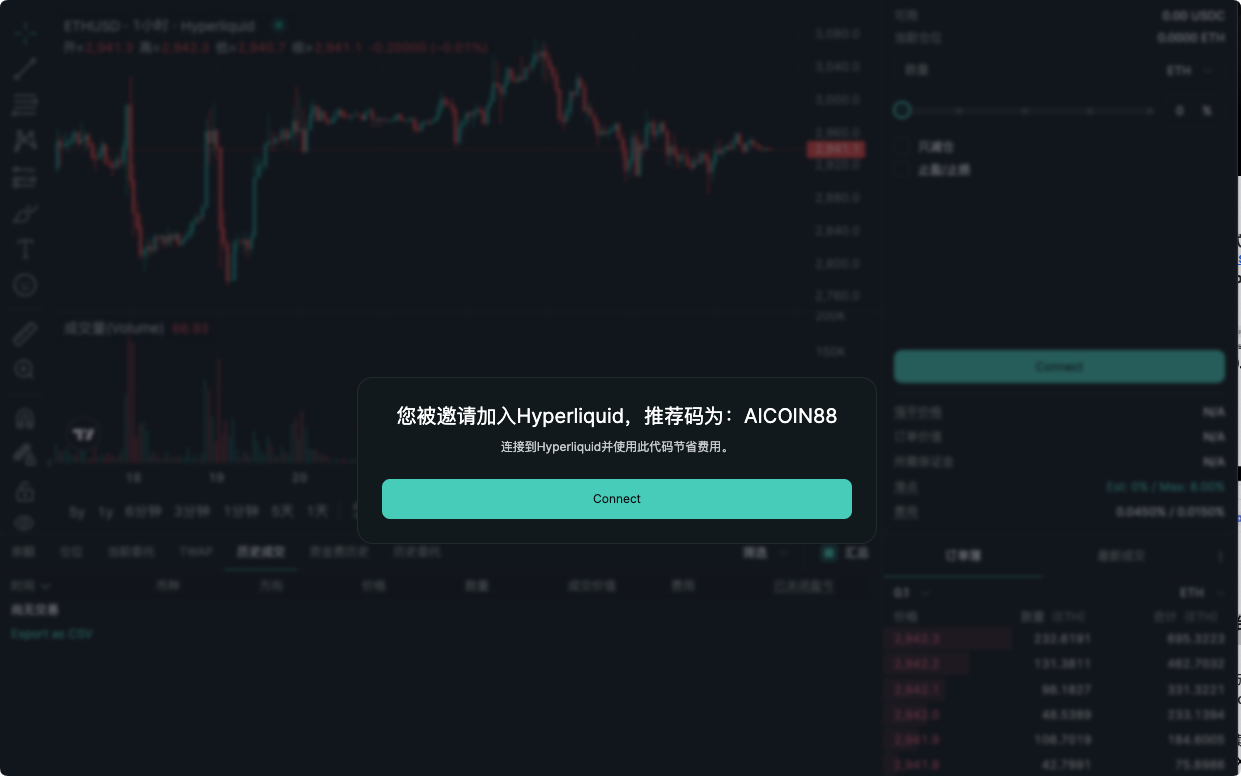
If you don't have a Hyperliquid account yet, now is the best time!
Exclusive benefits: By registering on AiCoin or authorizing Hyperliquid, bind the invitation relationship to enjoy a 4% commission rebate!
Simple operation: Open AiCoin APP → Select trading pairs on the K-line page → Click “Trade” → Choose Hyperliquid and authorize → Start trading.
https://app.hyperliquid.xyz/join/AICOIN88
📖 Special Offer:
1. “AiCoin PC Client Hyperliquid Authorization Trading Tutorial”:
https://www.aicoin.com/zh-Hans/article/514197
2. “Zero-Based Introduction! Hyperliquid First Trading Super Detailed Step-by-Step Tutorial”:
https://www.aicoin.com/zh-Hans/article/510225
免责声明:本文章仅代表作者个人观点,不代表本平台的立场和观点。本文章仅供信息分享,不构成对任何人的任何投资建议。用户与作者之间的任何争议,与本平台无关。如网页中刊载的文章或图片涉及侵权,请提供相关的权利证明和身份证明发送邮件到support@aicoin.com,本平台相关工作人员将会进行核查。